Image source: wikiart.org
Introduction to Peter Paul Rubens’s “The Capitoline Eagle”
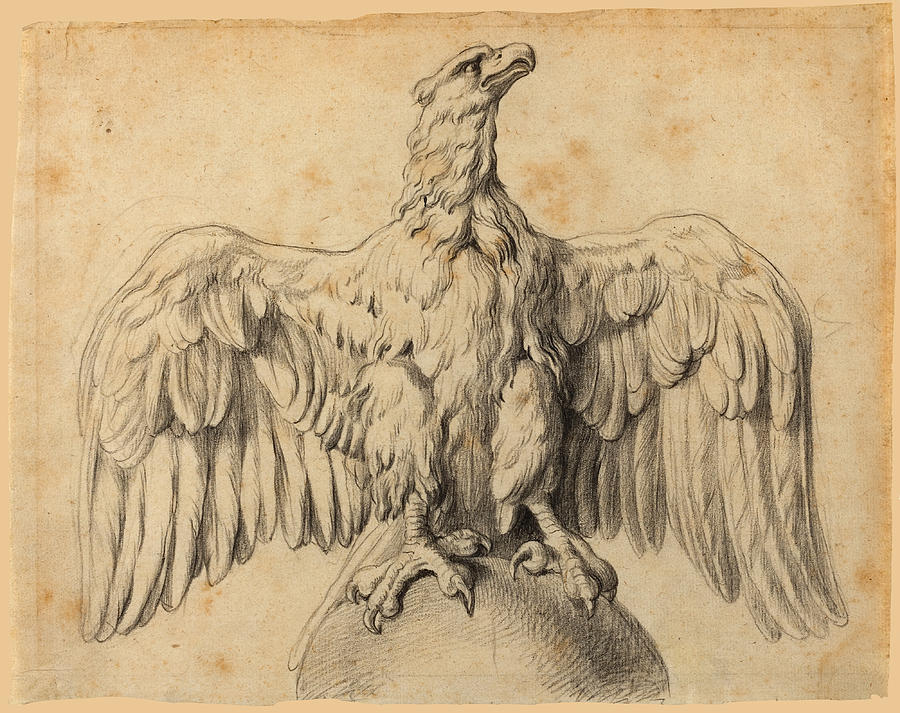
“The Capitoline Eagle” by Peter Paul Rubens is not a painting in the strict sense but a highly finished drawing, executed with a precision and vitality that rival his painted works. The sheet presents a monumental eagle standing on a rounded sphere, wings spread wide in a posture of alert majesty. Carefully modeled feathers, powerful talons, and a sharply hooked beak reveal Rubens’s deep understanding of both natural anatomy and symbolic form.
Although the exact date of the drawing is unknown, its subject and style link it to Rubens’s lifelong fascination with classical antiquity. The eagle on a globe recalls the imperial bird of ancient Rome and the emblematic creatures found on the Capitoline Hill in Rome, one of the symbolic centers of Roman power. Through this single figure, Rubens condenses themes of authority, empire, and divine sanction, while simultaneously demonstrating his extraordinary draughtsmanship.
Classical Sources and the Idea of the Capitoline Eagle
The title “The Capitoline Eagle” immediately connects the drawing to the Capitoline Hill, the political and religious heart of ancient Rome. The hill housed the great Temple of Jupiter Optimus Maximus and later became a repository of Roman sculptures and inscriptions. For humanist artists like Rubens, the Capitoline collections represented the visual memory of the classical world.
The eagle was Jupiter’s sacred bird and a ubiquitous emblem of Roman legions and imperial authority. Depicted on standards, coins, and monumental reliefs, it conveyed power, vigilance, and divine protection. A standing eagle with spread wings atop a globe or a thunderbolt signified Rome’s claim to rule the world under Jupiter’s auspices.
Rubens spent significant time in Italy during his formative years, avidly sketching ancient statues, reliefs, and architectural details. “The Capitoline Eagle” almost certainly stems from this engagement. Whether the drawing recreates a specific Roman sculpture or synthesizes different classical motifs, its roots lie in his study of antiquity. The title suggests a direct association with one of the famous eagles preserved on the Capitoline, perhaps one he saw and copied from life.
By reinterpreting the Roman eagle, Rubens aligns himself with a tradition of artists who saw classical forms as models of ideal design and as carriers of political symbolism. The drawing is both an exercise in archaeological observation and an imaginative reanimation of an ancient emblem for early modern viewers.
Composition and Monumental Presence
At first glance, the composition of “The Capitoline Eagle” is deceptively simple: a solitary bird occupies the centre of the page, wings extended horizontally, talons gripping a spherical base. Yet Rubens organizes these elements with such care that the figure feels monumental, as if carved in stone or poised atop a triumphal column.
The eagle’s body forms a sturdy vertical axis. Its head rises slightly above the midpoint of the sheet, beak angled to the left, giving the impression that the bird surveys the world from a high vantage point. The wings stretch outward nearly to the edges of the paper, filling the horizontal space and creating a powerful silhouette. Their downward curve frames the body, while the outer feathers hang like heavy drapery, suggesting both weight and latent power.
The sphere beneath the talons approximates a globe. Rubens renders its curvature with minimal shading, just enough to indicate three-dimensional form. This globe anchors the eagle, preventing the composition from floating and symbolically placing the bird in command of the world.
The surrounding space is largely empty. There is no landscape, no architectural setting, and no decorative flourish beyond a faint suggestion of the paper’s edge. This deliberate sparseness directs all attention to the eagle itself, allowing its form to dominate the viewer’s field of vision. The sheet becomes a kind of visual shrine to imperial power.
Line, Shading, and Rubens’s Draughtsmanship
The drawing demonstrates Rubens’s exceptional skill with line. Each contour is confident yet responsive, describing not only outlines but the internal structure of the bird’s anatomy. The artist varies the pressure of the medium, moving from firm, dark strokes in the beak, claws, and key shadow areas to lighter, feathery marks across the plumage.
Feathers are indicated through a combination of long, sweeping lines and smaller, nested curves. Rubens avoids mechanical repetition; every group of feathers follows the underlying logic of the wing’s construction. Near the shoulders, the feathers are shorter and denser, forming a protective padding around the joints. Along the wing’s outer edge they become elongated and tapering, suggesting aerodynamics and reach.
Shading is achieved through closely spaced hatching and cross-hatching. Under the wings, between the legs, and along the underside of the body, dense arrays of strokes create deep shadows. These dark zones contrast with the relatively untouched areas on the chest and upper wings, where Rubens leaves the paper almost bare, relying on subtle outlining to suggest volume.
This contrast of light and dark gives the eagle a sculptural presence. It seems to occupy real space, its chest projecting forward, wings casting shadow behind. The use of tonal variation also directs the eye: the brightest, least shaded areas draw attention to the central mass of the bird, while the more heavily worked regions under the wings reinforce the sense of weight and stability.
Anatomical Accuracy and Stylized Power
Rubens’s eagle balances careful observation of nature with stylized grandeur. The beak is sharply curved, with a pronounced hook suitable for a raptor. The nostril is clearly marked, and the eye, though simply drawn, sits in the correct position, lending the bird a keen, alert expression. The legs and talons are particularly convincing: scaled, sinewy, and equipped with strong, curved claws that grip the globe decisively.
At the same time, Rubens magnifies certain features to enhance the sense of majesty. The chest is broad and puffed out, like that of a bird in display, emphasizing the strength of its breast muscles. The neck feathers flare outward, forming a kind of mane that softens the transition between head and body and makes the eagle appear larger and more imposing.
The wings, too, are somewhat idealized. While they respect the basic structure of avian anatomy, their extreme spread and the drapery-like fall of the feathers recall the heroic cloaks and capes of classical sculpture. The eagle thus occupies a space between natural creature and heraldic emblem, embodying both living dynamism and emblematic authority.
This fusion of observation and stylization is typical of Rubens. He often grounded his figures in real anatomy—studied from life, animals, or antiquities—then modified them to achieve a heightened narrative or symbolic impact. In “The Capitoline Eagle,” the result is an image that feels credible as a bird and persuasive as a symbol of empire.
Symbolism of the Eagle and Globe
The imagery of an eagle perched on a globe carries a dense network of symbolic meanings. In Roman antiquity, as in the Habsburg baroque world Rubens inhabited, this motif signified dominion over the world, military might, and divine protection. The globe stands for the earth or for the totality of political territory, while the eagle, as Jupiter’s bird, represents the favor of the highest god.
In a Christianized context, the eagle was often associated with Saint John the Evangelist, whose Gospel begins with a soaring contemplation of the Word. It also symbolized spiritual vision and ascent, thanks to the bird’s ability to fly at great heights and gaze directly at the sun. When combined with the globe, the eagle can thus fuse temporal and spiritual sovereignty, suggesting a power grounded both in worldly authority and in transcendent sanction.
Rubens, who worked extensively for rulers allied with the Habsburg dynasty, would have been well aware of these associations. For the Habsburgs, the double-headed eagle had long been a primary heraldic emblem. Although the drawing shows a single-headed bird, viewers in Rubens’s milieu would undoubtedly have linked it to imperial imagery. The sheet may have functioned as a preparatory study for a coat of arms, a title page, a triumphal decoration, or a ceiling painting celebrating imperial power.
By placing the eagle alone, without additional attributes, Rubens distills the symbol to its essence. The viewer is left to contemplate the raw relationship between bird and globe: talons gripping, wings extended, beak raised. It is an image of vigilance poised above the world, ready to defend or to command.
Possible Function and Context of the Drawing
While the exact commission behind “The Capitoline Eagle” remains unknown, the drawing’s level of finish and emblematic clarity suggest that it served a specific artistic purpose. Rubens was frequently engaged in large-scale decorative schemes for churches, palaces, and triumphal entries, many of which required allegorical or heraldic animals.
This sheet could be a modello—a presentation drawing to show a patron how an eagle motif might appear in a ceiling corner or on a monumental shield. It could also be an academy drawing for his workshop, providing assistants with a canonical form to use when inserting eagles into larger compositions. Rubens ran a busy studio in Antwerp, and standardized studies of lions, horses, and eagles allowed his team to maintain a consistent visual vocabulary.
Another possibility is that the drawing reflects Rubens’s antiquarian interests more directly. He famously compiled sketchbooks of Roman sculptures, using them both as references and as sources of inspiration. “The Capitoline Eagle” might thus represent a direct study of a statue on the Capitoline Hill, drawn for his personal archive of classical motifs. In that case, the sheet would function as a bridge between ancient carving and Baroque painting.
Regardless of its specific context, the drawing reveals how seriously Rubens treated even single motifs. For him, an eagle was not just a decorative filler but a carrier of meaning and an opportunity to demonstrate mastery of line, form, and symbolism.
Emotional Tone and the Eagle’s Expression
Despite being an animal study, “The Capitoline Eagle” conveys a distinct emotional tone. The bird’s head is slightly tilted upward, beak partly open, as if calling or issuing a cry. The eye is focused, not glazed, giving the impression of intense attention. The overall posture—wings outstretched, chest thrust forward, talons firmly planted—suggests a moment of assertion or warning.
This is not a relaxed, resting eagle. It appears to have just landed or to be about to take off, caught in a poised interval between motion and stillness. That sense of readiness heightens the drawing’s symbolic power: the empire it represents is not dormant but vigilant, prepared to act.
Rubens captures this tension with remarkable economy. There is no overt aggression in the eagle’s face, no exaggerated snarl, yet the combination of open beak, upward gaze, and spread wings generates a feeling of controlled energy. It embodies the ideal ruler’s stance: strong, watchful, and imposing without descending into chaotic violence.
The Drawing as a Window into Rubens’s Working Mind
“The Capitoline Eagle” also offers valuable insight into Rubens’s working process and artistic priorities. The sheet is both a finished image and a laboratory of ideas. In the layering of lines and shading, one can see him searching for the best articulation of forms: adjusting the contour of a wing, deepening a shadow under the feathers, sharpening the curve of a talon.
The fact that he lavished such attention on a single emblem underscores the importance he placed on every component of his compositions. In his large altarpieces and allegorical paintings, eagles often appear in supporting roles—on shields, banners, or as attributes of gods and emperors. Yet to portray them convincingly at that scale, he needed a deep reservoir of studies like this one.
Moreover, the drawing reveals Rubens’s fascination with the expressive potential of animals. He frequently used animals to embody virtues, vices, or cosmic forces: lions for strength, horses for martial momentum, dogs for loyalty. The eagle, in this context, becomes a vehicle for exploring ideas of authority and transcendence, not just a piece of ornamentation.
Contemporary Resonance of “The Capitoline Eagle”
Today, viewers may approach “The Capitoline Eagle” from various perspectives. Some are drawn to its technical excellence, admiring the precision of line and the subtle modulation of tone. Others may be intrigued by its symbolic resonance, considering how images of eagles atop globes have persisted in modern national emblems and architectural decoration.
In an age when symbols of power are often contested, the drawing can also prompt reflection on the nature of authority. The eagle here is imposing yet dignified, commanding yet not explicitly violent. It suggests an ideal of rulership that is lofty, watchful, and protective rather than tyrannical. At the same time, the motif’s historical use by empires reminds us that such noble images have frequently been used to justify conquest and domination.
By revisiting Rubens’s “Capitoline Eagle,” contemporary audiences engage not only with a masterpiece of Baroque draftsmanship but also with the long history of visual symbols that continue to shape political imagination. The drawing stands as a reminder that even a single bird, carefully rendered, can carry centuries of meaning on its wings.
Conclusion
“The Capitoline Eagle” by Peter Paul Rubens is a remarkable example of how a seemingly simple subject can become a rich vessel of artistic and symbolic complexity. Through masterful line work, nuanced shading, and a keen understanding of classical iconography, Rubens transforms an eagle perched on a globe into a compelling emblem of imperial power, divine sanction, and vigilant authority.
The drawing reveals his deep engagement with antiquity, his technical brilliance as a draftsman, and his ability to infuse even preparatory studies with monumental presence. Whether viewed as a study after an ancient sculpture, a design for a decorative scheme, or a standalone meditation on power, the sheet invites careful looking and thoughtful interpretation.
Across the centuries, “The Capitoline Eagle” continues to command attention, its wings spread in silent assertion over the world it grips. It testifies to Rubens’s conviction that every element in art—from grand human figures to a single heraldic bird—can embody the drama of history and the aspirations of the human spirit.