Image source: wikiart.org
Introduction
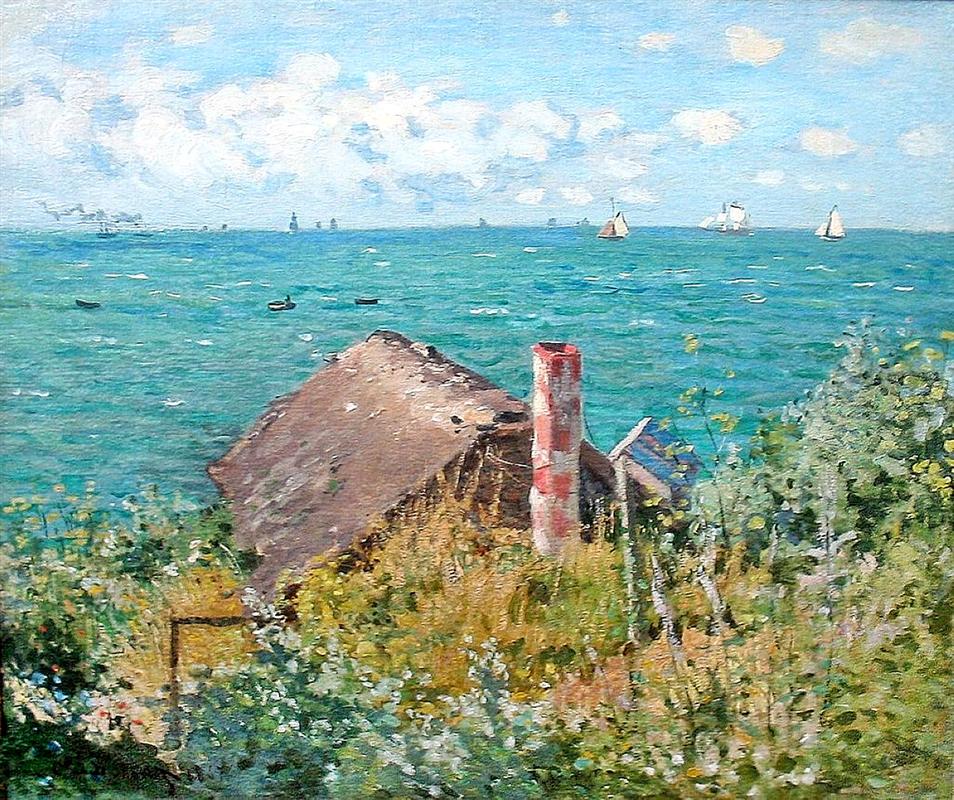
Claude Monet’s The Cabin at Saint-Adresse from 1867 is a quietly radiant coastal painting that reveals how much feeling can be carried through light, color, and atmosphere. At first glance, the scene seems simple. A small cabin sits partly hidden by grasses and wildflowers above a bright expanse of sea. Sailboats drift across the horizon under a pale sky filled with soft clouds. Nothing dramatic is happening, yet the painting feels alive. The eye moves from the textured foreground to the turquoise water and then outward toward the distant sails, sensing both intimacy and openness at the same time.
This balance is one of the most striking features of the work. Monet gives us a close, almost private view of a humble building nestled into nature, while also opening the scene toward the vastness of the sea. The painting therefore exists between shelter and exposure, domestic life and the wider world, the stillness of land and the motion of water. Even in a relatively early work, Monet shows an extraordinary ability to transform an ordinary place into something emotionally resonant.
The painting also stands as an important example of Monet’s growing confidence during the late 1860s. He was already deeply engaged with the challenge that would define so much of his career: how to capture a moment of visual experience before it disappears. In The Cabin at Saint-Adresse, he does not merely record the appearance of a coastal cottage. He paints a lived sensation of place, sunlight, air, wind, and seasonal growth. The work demonstrates how landscape, in Monet’s hands, becomes not just a view but an event.
Historical Context and the World of Saint-Adresse
Saint-Adresse, near Le Havre in Normandy, was a place Monet knew well. Coastal Normandy offered him a rich visual environment of changing skies, maritime traffic, cliffs, beaches, gardens, and holiday villas. In the 1860s, this region was already associated with leisure and modern life, yet it still preserved traces of older fishing and working landscapes. That mixture of modern presence and rustic simplicity is part of what gives the setting its charm.
By 1867, Monet was still a young painter, but he had already begun pushing beyond conventional landscape painting. Academic traditions often favored carefully structured compositions, smooth finishes, and historical or idealized subjects. Monet, by contrast, was increasingly drawn to immediate observation. He wanted to paint what light did to forms in a specific moment. He wanted color to carry atmosphere rather than merely fill in objects. He wanted the ordinary world to be worthy of serious art.
This context matters because The Cabin at Saint-Adresse feels like a work made at the threshold of a new way of seeing. It still retains enough structure to show Monet’s grounding in established composition, yet its real energy comes from fleeting visual impressions. The rough grasses, the shimmer of the sea, the broken touches of paint, and the airy sky all suggest an artist moving toward what would later be recognized as Impressionism.
At the same time, the choice of subject is revealing. Monet does not center a grand monument or an idealized pastoral fantasy. He paints a modest cabin, partly obscured, embedded in the lived environment of the coast. This commitment to the everyday is central to his art. He finds beauty not by inventing it, but by attending closely to what is already there.
Composition and the Structure of the View
The composition of The Cabin at Saint-Adresse is deceptively sophisticated. The cabin occupies the lower middle section of the painting, but it is not presented as a dominant monument. Instead, it is partially hidden by vegetation, as if the landscape itself is slowly reclaiming it. This creates an immediate sense of intimacy. The viewer feels placed on a slope or path just above the structure, looking out beyond it toward the water.
This arrangement is crucial. The foreground is dense and textural, filled with grasses, shrubs, and patches of flowers that seem to flicker in the light. The middle ground contains the cabin and its vertical chimney, which acts as a stabilizing axis. Beyond that lies the open sea, broad and luminous, extending almost endlessly to the horizon. The eye is therefore guided through layers of depth, from tactile nearness to distant openness.
The diagonal forms of the cabin roof and surrounding vegetation keep the composition dynamic. The roof slopes downward, echoing the descent of the hillside toward the water, while the chimney rises as a firm vertical note against the horizontal spread of the sea. The horizon line itself is placed fairly high, allowing the water to dominate the upper half of the image without overwhelming the foreground. This creates a powerful sense of balance between land and sea.
There is also a subtle tension between enclosure and expansion. The foreground feels full, almost crowded, with organic growth. The sea beyond feels liberating and spacious. The painting thus invites the viewer to experience a transition from closeness to distance, from the sheltered world of the cabin to the expansive realm of sky and water. That movement is not only spatial but emotional.
Color and the Brilliance of Coastal Light
Color is one of the most memorable aspects of this painting. Monet uses a palette that is bright yet delicate, vivid yet never harsh. The sea is rendered in shimmering blue green tones that suggest both freshness and movement. It is not a flat field of color. Instead, it is built from many touches and variations, creating a living surface that changes as the eye moves across it.
The sky is pale blue and filled with white clouds that feel light rather than heavy. Their softness contrasts beautifully with the stronger chromatic energy of the sea. Meanwhile, the foreground is alive with muted greens, yellowed grasses, pale blues, and small white blossoms. These land tones are more varied and earthy than the water, but they still participate in the same overall luminosity. Everything seems touched by sunlight.
The cabin introduces warmer browns and reddish notes, especially in the chimney. These colors matter because they anchor the composition. Without them, the painting might drift into a purely atmospheric register. The reddish chimney, in particular, serves as a visual accent that catches the eye and prevents the middle ground from dissolving entirely into surrounding greens and blues.
Monet’s color relationships also create emotional tone. The cool sea and sky produce calm, freshness, and openness. The warmer earth tones of the cabin and grasses suggest human presence, habitation, and seasonal life. Together they create a mood that is serene but not empty, lively but not agitated. It is the kind of color harmony that makes the scene feel breathable, as if one could step into it and feel the salt air.
Brushwork and Surface Energy
Even in reproduction, the brushwork in The Cabin at Saint-Adresse appears active and expressive. Monet does not smooth away the act of painting. Instead, he allows the surface to remain visibly made, with short touches and layered strokes that preserve a sense of immediacy. This is especially noticeable in the vegetation and the sea, where the paint seems to pulse with shifting visual information.
In the grasses and flowers, brushstrokes are varied and broken. Rather than defining each plant with precision, Monet suggests growth through clusters of marks. This method creates a sense of abundance. The foreground does not read as botanical description so much as living texture. One can imagine wind passing through it, light catching some stems while leaving others in shadow.
The water is handled with a similarly broken technique, but its effect is different. Here the brushwork suggests reflection, movement, and the constant instability of the sea’s surface. Small accents of white imply glimmers of light or crests of waves. These touches animate the broad blue green expanse and keep it from becoming static.
This energetic handling is essential to the painting’s emotional power. Monet’s brushwork gives the image its sense of time. The scene does not feel frozen. It feels momentary, as though it is being seen under conditions that are changing by the second. That quality would become central to Impressionism, but here we already see Monet using painterly touch to make vision itself the subject.
The Cabin as Motif and Meaning
The cabin is a modest structure, but it plays a rich symbolic and visual role. It is not grand enough to dominate the landscape, yet it is too central to ignore. Because it is partly hidden, it feels discovered rather than displayed. This gives the painting a sense of privacy, as though the viewer has come upon a secluded coastal dwelling in the midst of summer growth.
Its humble scale also matters. Monet is not interested in making architecture the star of the picture. The cabin exists as part of the environment. It is weathered, integrated into the slope, and visually intertwined with the vegetation around it. This suggests a relationship between human habitation and nature that is intimate rather than oppositional.
The chimney is particularly expressive. As a vertical element, it marks the presence of domestic life. It implies warmth, labor, and routine, even though no person is visible. In a painting otherwise devoted to air and light, this small architectural detail quietly grounds the scene in human reality. It reminds us that landscapes are often lived spaces, not empty stage sets.
There is also something poignant about the cabin’s partial concealment. It seems both protected and vulnerable. Surrounded by grasses and facing the sea, it occupies a threshold between security and exposure. That ambiguity gives the painting emotional depth. The cabin becomes more than a building. It becomes a sign of human smallness within a luminous and expansive natural world.
Sea, Horizon, and the Sense of Distance
The sea in this painting is not merely a background. It is the great field of openness against which everything else is measured. Its horizontal spread creates breadth and calm, but also invites thought about distance, travel, and the world beyond the immediate setting. The small sailboats on the horizon intensify this feeling. They punctuate the wide expanse with points of life and movement, reminding us that the sea is a route as well as a view.
These boats are tiny, yet they are essential. Without them, the sea might feel too abstract or empty. With them, it becomes inhabited space. They also establish scale. The cabin and foreground are local and near, while the boats belong to a farther realm, where forms become simplified and atmosphere softens edges. This contrast deepens the illusion of space.
The horizon line itself is beautifully judged. It separates sea from sky with enough clarity to organize the composition, yet the meeting of the two remains atmospheric rather than rigid. Light seems to pass across both elements, linking them in a common weather condition. The effect is expansive and restful.
Monet’s handling of distance also reveals his sensitivity to vision. Distant forms are reduced, softened, and simplified, not because he lacks skill, but because that is how they are seen under bright outdoor light. This commitment to optical truth helps explain why the painting feels so convincing. It is not built from formula, but from observation.
Nature, Season, and Sensory Experience
One of the most appealing qualities of The Cabin at Saint-Adresse is its sensory richness. The painting does not simply show a place. It evokes the feeling of being there. The grasses look dry and sunlit. The flowers seem to scatter light across the foreground. The sea appears fresh and breezy. The clouds drift lightly overhead. Everything suggests a coastal day shaped by warmth, wind, and brightness.
Season plays an important role in that sensation. The abundant vegetation and luminous atmosphere imply a moment of late spring or summer, when growth is fullest and the coastline feels especially alive. Monet does not state the season explicitly, but he conveys it through color, density, and air. The painting becomes a record of seasonal experience as much as a description of topography.
This sensory immediacy is one reason Monet’s landscapes remain so compelling. He understands that viewers respond not only to form and composition, but to the suggestion of temperature, scent, sound, and movement. In this painting one can almost hear the distant water, feel the dry stalks in the foreground, and sense the salt carried on the breeze.
That immersive quality makes the work more than picturesque. It becomes experiential. The viewer is not placed at a detached analytical distance. Instead, one feels situated within the environment, sharing the artist’s encounter with the place.
Monet’s Artistic Development in 1867
Seen within Monet’s career, The Cabin at Saint-Adresse occupies a fascinating position. It belongs to a period when he was refining the language that would later define him. He had not yet become the mature Monet of serial haystacks, cathedrals, and water lilies, but the essential instincts are already present. He is deeply attentive to light, committed to painting modern nature as directly observed, and increasingly willing to let color and brushwork carry the structure of the image.
This early moment is valuable because it allows us to see Monet balancing solidity and impression. The cabin still has enough weight and definition to anchor the scene, while the surrounding vegetation and sea begin to dissolve into more fluid, light based perception. The result is a painting that stands between traditions. It respects structure, yet pushes toward atmospheric immediacy.
The work also shows Monet’s refusal to separate beauty from ordinary life. A simple coastal cabin becomes the focus of serious artistic attention. This democratic eye would remain a hallmark of his practice. He repeatedly chose subjects that others might have considered too ordinary, then transformed them through patient looking.
In this sense, The Cabin at Saint-Adresse is not just an attractive landscape. It is a declaration of artistic values. It suggests that truth to perception, devotion to place, and sensitivity to light are enough to generate profound art.
Emotional Tone and Lasting Appeal
What makes this painting linger in the mind is its emotional subtlety. It is peaceful, but not empty. Bright, but not theatrical. Humble, but not insignificant. Monet avoids sentimentality by keeping the scene grounded in observation, yet the painting still carries feeling. The cabin’s partial concealment, the sparkling sea, and the airy sky together create a mood of quiet wonder.
There is also an appealing tension between permanence and transience. The cabin suggests stability, dwelling, and continuity. The sea and sky suggest change, motion, and passing time. The grasses in the foreground feel momentary, lit just so in a specific instant. This contrast gives the painting depth. It becomes a meditation on how human life sits within a natural world that is both enduring and constantly shifting.
Modern viewers may also respond to the painting because it offers a vision of retreat. The cabin appears secluded, removed from noise and pressure, yet connected to a larger horizon. It feels like a place where one could withdraw without being cut off from openness. That combination of intimacy and expansiveness is deeply attractive.
Ultimately, the painting endures because Monet finds grandeur in modest means. He does not need heroic action or monumental architecture. A roof, a chimney, a bank of grasses, some boats on the horizon, and a brilliant stretch of water are enough. Through attention and painterly intelligence, he turns them into an image of lasting beauty.
Conclusion
The Cabin at Saint-Adresse is a remarkable early Monet because it gathers so many of his strengths into a single, seemingly simple view. Its composition carefully balances foreground intimacy with maritime openness. Its color harmonies convey freshness, sunlight, and atmosphere. Its brushwork gives the scene life and immediacy. Its subject reveals Monet’s faith in the visual richness of ordinary places.
The painting also captures an important moment in the history of modern art. It shows Monet moving toward a new understanding of landscape, one based not on idealization, but on perception. He paints the coast not as a fixed arrangement of objects, but as a living field of light, color, and sensation. In doing so, he gives the viewer not just a place to look at, but a moment to inhabit.
That is why the work remains so compelling. It is modest in subject, yet expansive in feeling. It offers shelter and horizon, detail and atmosphere, human presence and natural brilliance. In the end, The Cabin at Saint-Adresse by Claude Monet is a painting about the poetry of noticing. It reminds us that a simple cabin by the sea can hold an entire world of light.
