Image source: wikiart.org
Introduction
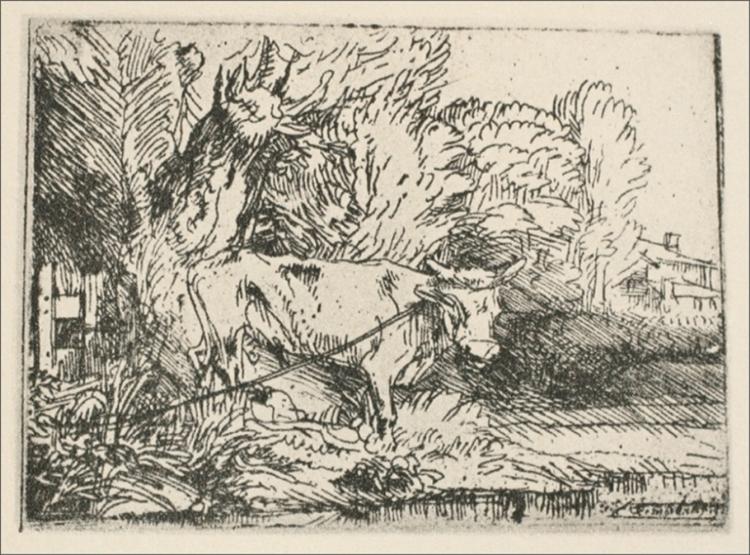
Rembrandt’s art is celebrated for its compassionate attention to ordinary life, and “The Bull” captures that ethos with quiet force. A single animal stands beneath leafy trees, tethered by a rope that cuts diagonally across the foreground. There is no spectacle here—no heroic hunt, no allegorical pageant—only the dense reality of a muscular creature paused within a living landscape. Yet the image feels momentous. The bull’s body becomes a locus where strength, patience, and rural labor converge, while the surrounding foliage and distant farmhouse suggest a larger economy of fields, fences, and caretaking hands. Through economical lines and concentrated tonal accents, Rembrandt creates a scene that feels both observed and contemplated, a portrait of an animal that is also a meditation on human work and the land that sustains it.
Historical Setting And Why A Bull Matters
In mid-seventeenth-century Holland, cattle were not merely pastoral decoration; they were engines of prosperity. Dairy, hides, and meat fed households and markets, and the image of the cow or bull carried associations of abundance, domestic order, and the careful management of land reclaimed from water. Artists seized on these creatures as emblems of a culture that prized practical mastery over nature. Rembrandt’s decision to center a bull within a wooded verge acknowledges this cultural resonance while retaining a personal, unsentimental gaze. He does not idealize the animal. Instead, he presents the bull as a working presence—tethered, alert, and integrated into the rhythms of human agriculture. The choice of subject underscores Rembrandt’s lifelong interest in beings who share the city and countryside with us, their fates intertwined with ours.
Subject And Motif
The composition is anchored by the bull in profile, head lowered slightly, its horn, dewlap, and withers described with economical precision. A rope attaches to a stake or post at the left, marking the animal’s temporary confinement. Behind and around it rises a gust of vegetation: trunks, fronds, and shrubs rendered as quick masses and feathery rhythms. At the far right a house or farm building peeks out, half veiled by trees. Nothing interrupts the primacy of the animal; even the thick bank of shadow that runs horizontally through the midground serves to silhouette the bull’s back and belly. Rembrandt places the viewer close enough to sense texture and weight, yet far enough to read the bull’s stance within a pocket of landscape.
Composition And The Diagonal Of Constraint
Compositionally, the most assertive line in the image is the rope, a taut diagonal that runs from the lower left toward the bull’s chest. It directs the eye, defines space, and articulates theme. The diagonal introduces forward momentum while announcing its check: the animal’s movement is framed by human intention. Countering this, the verticals of trees and the horizontal strip of shadow stabilize the scene. The bull’s body is a long, near-rectangular mass bracketed by triangular negative spaces under the belly and at the neck. These geometric suggestions lend the composition clarity without feeling mechanical. The image reads as a balanced field of forces—animal energy, vegetal growth, human control—held in dynamic truce.
The Language Of Line
Rembrandt’s treatment of line provides the sheet’s pulse. Short, nubby strokes model the bull’s hide, thicker hatchings darken the belly and flank, and freer, leafy arabesques construct the foliage. The drawing does not fuss over anatomical minutiae; it trusts suggestive marks to conjure hair, muscle, and shadow. This confidence is crucial: the fewer the lines, the more each must carry. Around the head, lines become especially tender—lighter at the muzzle, more decisive at the ear and horn—so that expression emerges without overt emphasis. The variety of touch across the sheet mirrors the subject’s internal variety: a living body amid living growth.
Tonal Structure And The Drama Of Restraint
Rather than pouring heavy darkness across the page, Rembrandt limits the densest tones to key accents—the pocket of shade beneath the bull, the core shadows in the foliage, and the rectangular slit of the building at left. These darks function as structural pegs that keep the composition from floating away in whiteness. The bull’s light flank becomes a plane where illumination gathers, set off by the surrounding murk. The effect is a quiet drama: light reveals strength without theatrics, and shadow suggests both shelter and the unknown. The scene feels like late afternoon or early evening, a time when work slows and textures rise to the eye.
Space, Depth, And The Rhythm Of Planes
Depth is achieved through overlapping masses and a clear rhythm of planes. The foreground grasses push toward the viewer with short, brisk marks. The bull occupies the middle distance like a monumental boulder. Behind it, a darker band of foliage sinks back, and farther still the treetops and the faint house lift into air. Because the sky is minimal, depth is built from earth and vegetation rather than atmospheric perspective. This earthbound architecture of space suits the subject: the bull is not an apparition against infinite sky but a creature embedded in a tangible environment.
Portraying The Animal: Strength Tempered By Stillness
What makes Rembrandt’s bull persuasive is not raw size but the sensation of potential energy. The animal is at rest, yet the set of its legs, the angle of the neck, and the very pull of the rope imply readiness. The lowered head suggests searching or grazing, but the slightly turned ear implies awareness. It is a portrait of a mind at work within a body built for labor. Rembrandt avoids heroic posturing; he treats the bull with the same compassion he extends to his human sitters. The result is dignity without sentimentality, a respectful familiarity that recognizes the animal’s role in a shared economy of effort.
Landscape As Character
The landscape is no mere backdrop. The thrust of the trees echoes the animal’s mass, while the dense undergrowth at the left seems to push back against the rope’s pull, as if nature itself participates in restraining the bull. The distant house offers a contrasting geometry—rectangles and right angles—signaling human order amid the organic churn. Even the small patch of open ground near the animal’s hooves reads as a stage on which the daily drama of feeding and tending unfolds. The scene suggests a farm margin: not the center of a field but a shaded verge where animals pause, tethered for grazing or to keep them from straying.
Symbolic And Cultural Resonances
In Dutch imagery, cattle often stand for wealth, good stewardship, and the fertility of properly drained land. A bull, more specifically, can connote power harnessed, virility tempered by labor, and the negotiation between freedom and discipline. Rembrandt harnesses these resonances without turning the image into emblem. The rope that limits movement may be read as the social tether that binds strength to purpose. The house glimpsed through leaves gestures toward the household that benefits from the animal’s work and must also care for it. The image thus becomes an ethics of reciprocity: control paired with responsibility, utility entwined with respect.
Technique And The Intelligence Of Process
The sheet conveys the sensation of being made from life or from close study. The marks feel exploratory—some reinforced, some allowed to remain as first statements. Around the animal’s hindquarters one senses small adjustments, as though the artist tested contours to catch the correct weight and stance. This visible process is not a flaw but a narrative of looking. We witness a mind teaching the hand how to hold flesh and foliage together on paper. The speed of certain passages, especially in the leaves, deliberately contrasts with the measured description of the bull, creating a hierarchy of attention that guides the viewer’s gaze.
Comparisons Within Rembrandt’s Animal Studies
Rembrandt returned often to cattle, horses, and dogs, taking them seriously as subjects worthy of contemplation. Compared to sheets where multiple cows doze in open meadows, “The Bull” is more concentrated and intimate. It compresses the animal into a pocket of shade and offsets its bulk with the oblique line of restraint. Compared to grander scenes that place animals within biblical narratives or market bustle, this image is almost monastic in focus. The difference is instructive: Rembrandt can render an animal as part of collective life or as a singular presence with its own agency. Here he opts for singularity.
The Human Implied
No person is visible, yet the human world saturates the image. The rope, the post, the trimmed edge of grass, the distant dwelling—all mark the scene as managed. Even the path of light across the bull’s back implies grooming or at least familiarity with human touch. The absence of a figure encourages the viewer to inhabit that role. We become the handler who tied the rope, the farmer who will return, the neighbor who pauses to look. In that sense, the image is participatory; it drafts the viewer into the ecology of farm life.
Time Of Day And The Mood Of Work
The tonal economy suggests a low sun filtering through leaves, the kind of light that catches on edges and turns weeds into filigree. It is the light of interim moments—after a task, before another. The mood is neither festive nor somber; it is attentive. The bull’s pause becomes the viewer’s pause, a measured breath in a day of effort. Such moods are central to Rembrandt’s art, which often finds intensity in ordinary thresholds rather than in climactic events.
Reading The Foreground And The Base Line
The foreground matters. The scattered plants, irregular clumps, and angled stalks provide texture and a literal ground for the bull’s weight. The tiny mound where the rope meets the earth acts like a punctuation mark. The bull’s hooves are handled with extreme economy, yet they feel planted; even a minimal crescent of shadow secures contact. This careful attention to grounding keeps the animal from floating within the composition and enforces the theme of weight meeting soil.
The Ethics Of Looking Closely
One of the enduring lessons of this image is that close looking dignifies the world. To draw a bull with this degree of concentration is to say that such creatures deserve our attention beyond their utility. The image carries a quiet ethical charge: it asks us to consider the living bodies that underpin markets and meals, the nonhuman neighbors whose labor is woven into our own. Rembrandt’s art repeatedly insists that attention is a form of care, and “The Bull” extends that insistence to the countryside.
Condition And The Beauty Of Wear
The textures across the sheet—soft scumbles, darker knots of hatch—invite the eye to linger on the materiality of mark making. Slight irregularities read as the honest noise of process rather than blemish, harmonizing with a subject defined by hide, hair, and the roughness of field edges. The beauty here is not glossy; it is the beauty of work surfaces, of things used well and seen truly.
Legacy And Afterlife
Images like “The Bull” influenced later Dutch and European artists who sought truthfulness in rural motifs. The idea that a single animal, carefully observed, could carry the weight of a culture reappears in eighteenth- and nineteenth-century pastoral scenes and in modern studies of animals treated as individuals rather than stock types. For viewers today, the image speaks to ongoing conversations about animals, labor, and landscape management. Its restraint offers a counterpoint to loud, spectacular images, reminding us that intimacy and focus have their own power.
Why The Image Feels Fresh Now
Contemporary life often abstracts agricultural processes into supply chains and statistics. “The Bull” counters that abstraction. It returns us to proximity: the nearness of muscle, breath, rope, leaf, and ground. The image suggests that understanding begins at the scale of encounter. In an age of accelerated images, the drawing’s slowness feels like a gift, training the eye to savor modest things and to recognize interdependence.
Conclusion
“The Bull” is more than a picture of an animal. It is a compact statement about strength guided rather than unleashed, about work shared between humans and the creatures they depend on, about the way a landscape holds and shapes its inhabitants. Through a handful of lines and carefully placed shadows, Rembrandt builds a world dense with implication: a world where the dignity of a single tethered bull radiates outward to touch farms, families, and the broader rhythms of the land. The image’s power lies in its refusal of spectacle and its devotion to what is present. Looking becomes a form of acknowledgment. In that acknowledgment, an ordinary creature turns monumental.