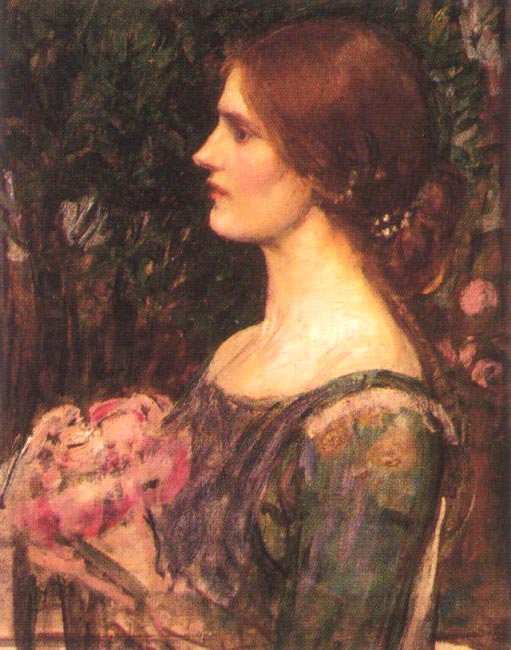
Image source: wikiart.org
First Impressions and the Quiet Drama
John William Waterhouse’s The Bouquet (1908) offers a scene that feels simple at first glance: a young woman in profile holds a cluster of pink flowers. Yet the longer you look, the more the painting reveals itself as a carefully staged moment of emotional suspense. Nothing overtly happens, and that is precisely the point. The work is built around anticipation, the kind that gathers in the body before it becomes a decision, a confession, or a departure. Waterhouse turns that suspended instant into the subject.
The woman’s profile presents her as composed and self-contained, but not sealed off. Her lips are softly set, her gaze fixed beyond the frame, and her posture suggests that she is listening as much as looking. The bouquet becomes more than an accessory. It reads as a message held in the hands, an offering not yet delivered, or a sign of feeling that cannot be spoken directly. In this way, the painting behaves like a lyric: concise in narrative, generous in mood.
Composition and the Power of the Profile
The design of the picture relies on a strong side view, a format that has a long history in portraiture and in romantic imagery. The profile clarifies the silhouette and gives the figure a sculptural presence. It also limits access. We do not meet her eyes. We read her thoughts through outline, angle, and restraint. That distance creates tension, because the painting invites intimacy while withholding full disclosure.
Waterhouse places the woman slightly to the right, letting the dark garden fill the left side with a dense, leafy mass. The bouquet sits low in the frame, close to the foreground, balancing the weight of the head and shoulders above. The result is a stable triangle: face, neckline, and flowers. This stability contrasts with the emotional uncertainty implied by her faraway focus. The composition suggests control, while the narrative suggests vulnerability.
There is also a subtle directional pull. Her face points left, toward space that feels open but unseen. That unseen area becomes a stage for imagination. The viewer supplies what she might be seeing: a gate, a path, a person approaching, or simply the thought of someone absent. By orienting her toward the edge, Waterhouse makes the off-screen world feel active, even though the canvas stays quiet.
Light, Skin, and the Luminous Neckline
The most immediately striking light falls on the woman’s face, neck, and upper chest. Against the deep greens and browns behind her, her skin appears illuminated, as if the air itself is brighter around her. Waterhouse uses this contrast to make the figure feel present and tender, while the background recedes into atmosphere. The transition from light to shadow across her cheek and jaw is gentle, not sharply modeled, which gives her an inner softness rather than a hard, classical finish.
The neckline of her dress opens the space around the throat and collarbone, an area painters often use to communicate vulnerability and grace. Here it works like a visual pause. The long curve from jaw to shoulder is calm and continuous, creating a sense of steadiness. That calmness makes the bouquet’s intimacy more poignant, because the flowers suggest emotion carried quietly rather than performed.
Light also plays a psychological role. The bright skin reads as candid and exposed, while the darker surroundings suggest privacy, secrecy, or the shelter of a garden. It is a portrait of a feeling that is not yet ready for daylight, even though the figure is visibly lit.
Color Harmony and the Dialogue of Green and Pink
The palette is built around a restrained conversation between green and pink. The background foliage is deep and layered, ranging from olive to near-black. It creates a protective enclosure, like a hedge or thicket. Against that, the bouquet blooms with warm pinks and pale highlights, a cluster of softness held in the hands. Pink in Waterhouse often signals tenderness, romantic longing, or the fragile optimism of affection. Here it is not loud. It feels muted, as if the flowers have absorbed the hush of the garden.
Her dress sits between these worlds. The fabric carries greenish tones that echo the foliage, yet it is distinct enough to define the figure. It suggests that she belongs to the garden’s shadowed calm, but she also carries something brighter within it. The painting’s harmony depends on this balance: the background does not overwhelm the flowers, and the flowers do not break the mood. Everything stays lyrical, toned, and slightly veiled.
The limited color range also has a focusing effect. With fewer bright notes, each accent matters more. The pink blossoms become the emotional punctuation of the canvas. They draw the eye, then send it back upward to her face, then outward again to wherever she is looking. The colors choreograph attention like a slow dance.
Gesture, Hands, and the Meaning of Holding
Although the face is the centerpiece, the hands provide the painting’s narrative charge. The bouquet is not displayed outward like a trophy. It is held close, gathered inward. That difference matters. The posture reads as protective, even shy. She is not presenting the flowers to the viewer. She is carrying them for someone else, or perhaps for herself as a private token.
The bouquet’s placement also suggests hesitation. It is ready, but not delivered. The viewer senses the moment just before action, like standing at a doorway with a letter in hand. Because the painting withholds the external story, the gesture becomes the story. Holding becomes a metaphor for containing emotion, delaying speech, or safeguarding hope.
Waterhouse often uses small bodily cues to imply inner life. Here, the stillness of the hands contrasts with the liveliness of the blossoms. The flowers feel like a pulse of color, like feeling itself, while the body tries to remain composed. The painting becomes a study in restraint: the heart in bloom, the posture in control.
The Garden as Atmosphere and Threshold
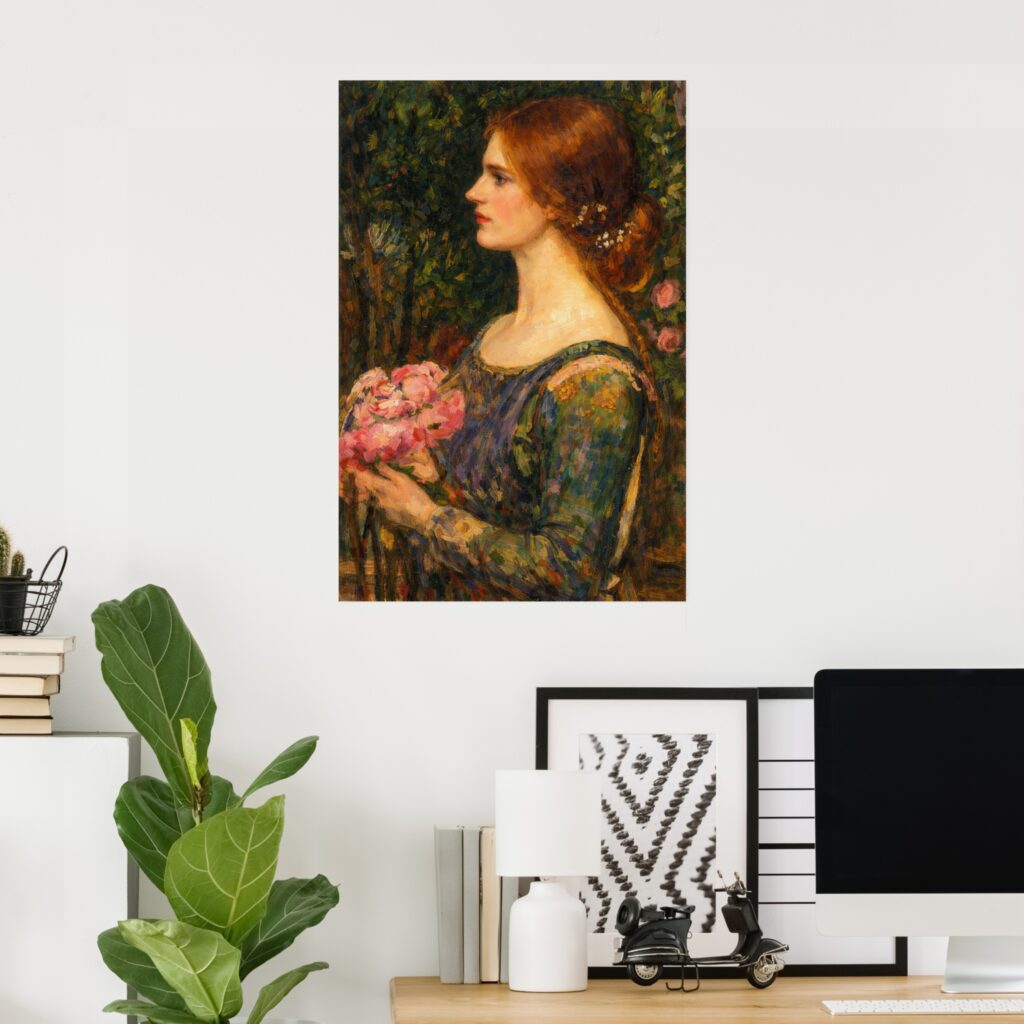
The background is not a detailed botanical record. It functions as atmosphere, a darkened garden that feels both real and symbolic. The foliage is dense and textured, suggesting a private outdoor space rather than an open landscape. Gardens in romantic art frequently act as thresholds between inner and outer worlds, between public life and secret emotion. In The Bouquet, that threshold quality is reinforced by the figure’s orientation toward an unseen space beyond the frame.
The garden’s darkness also creates a sense of enclosure. It feels like an evening corner, or a shaded place under trees. This makes the figure’s illuminated skin and the pale blossoms feel more intimate, like something glimpsed quietly rather than staged. The mood is closer to memory than to report. It is the feeling of being in a garden and hearing your own thoughts more clearly than the world.
At the same time, the background has a softness that avoids harsh realism. Leaves dissolve into one another, and the space reads as layered rather than deep. This shallow, atmospheric setting keeps the focus on the figure’s profile and the bouquet’s color. The garden is a veil, not a destination.
Brushwork, Soft Edges, and Late Waterhouse Sensibility
Painted in 1908, The Bouquet belongs to Waterhouse’s later period, when his approach often leaned toward softer edges and a more atmospheric finish. The handling here feels less concerned with sharp detail and more invested in mood. The transitions in the face, the merging of foliage, and the gently suggested folds of fabric all contribute to a sense of quiet immediacy.
This softness does not mean vagueness. It is purposeful. By reducing crisp outlines, Waterhouse makes the figure feel as though she belongs to the same air as the garden. She is not cut out and pasted onto a background. She is part of a single emotional environment. The bouquet, too, is painted with a balance of definition and blur, enough to read as flowers, but loose enough to stay poetic.
The painting’s surface suggests looking rather than describing. It feels like the artist is trying to catch a sensation before it fades: the way light touches skin in shade, the way pink blossoms glow against green, the way a person’s thought can be visible in posture.
Femininity, Selfhood, and the Controlled Romantic Image
Waterhouse is often associated with images of women drawn from myth, literature, and legend, yet even in a quieter subject like The Bouquet, he returns to the theme of feminine interiority. The woman is presented as dignified, composed, and thoughtful. She is not depicted in a dramatic gesture of pleading or despair. Instead, the drama is internal.
The profile reinforces this inwardness. It offers beauty without direct invitation. The figure seems aware of herself, but not performing herself. Her hair is gathered back, practical and graceful, and her dress sits naturally on the shoulder. These choices create a sense of an individual person rather than an abstract ideal. At the same time, the painting clearly participates in a romantic tradition that associates women with flowers, gardens, and delicate emotion.
What makes the image compelling is how it both uses and complicates that tradition. The bouquet could reduce her to a symbol, but her posture resists simplification. She holds the flowers as if the meaning is hers to decide. The painting’s quietness becomes a form of agency. She is not acted upon in this moment. She is thinking, waiting, and choosing.
Symbolism of the Bouquet and the Language of Flowers
Flowers in art rarely remain only flowers. A bouquet can signify affection, apology, celebration, mourning, or the fragile hope of reconciliation. Here the pink tones steer the meaning toward tenderness, admiration, and emotional warmth. Yet the setting and mood temper any easy reading. The dark garden suggests that the feeling involved is private, perhaps uncertain. The bouquet may be an offering, but it could also be a reminder, something held close because giving it away would change everything.
The bouquet’s softness echoes the softness of her expression, but it also contrasts with her restraint. That contrast is where the symbolism lives. Flowers are fleeting. They bloom, they fade. Holding a bouquet is holding time in a temporary form. This makes the painting feel like a meditation on the short window in which feelings can be expressed, and the human tendency to hesitate until the moment passes.
The bouquet, then, becomes a small emblem of risk. To offer it is to reveal oneself. To keep it is to remain safe but unresolved. Waterhouse paints the pause between those options.
Psychological Space and the Story Outside the Frame
One of the most effective qualities of The Bouquet is how much it implies without stating. The woman’s gaze is directed toward something the viewer cannot see. That unseen object could be a person, but it could also be a thought, a memory, or a future moment she is imagining. Waterhouse turns the edge of the canvas into a narrative device. The story is not painted, but it is activated.
This strategy gives the painting a timeless emotional structure. Viewers do not need to know the specific circumstances to understand the feeling. Many people recognize the experience of preparing to speak and stopping, of holding a gift and wondering whether it will be accepted, of standing in a garden and letting a decision gather in silence.
The painting also invites multiple readings because it avoids definitive cues. There is no obvious ring, no letter, no clear seasonal marker. The atmosphere is generalized enough to be symbolic, yet specific enough to be believable. This balance helps the work remain emotionally open.
Waterhouse and the Afterlife of Pre-Raphaelite Romance
Although Waterhouse is often grouped with the Pre-Raphaelite circle in spirit, his later works show a distinct sensitivity that blends romantic subject matter with a more modern softness. In The Bouquet, the romantic vocabulary remains: the idealized figure, the symbolic flowers, the contemplative mood. Yet the execution feels less like a crisp illustration and more like an impression of feeling.
That shift matters for how the painting communicates. Instead of telling a story through detailed props, it tells a story through atmosphere and psychology. The garden becomes a mood, the bouquet becomes a question, and the profile becomes a boundary between inner life and outer action. The painting suggests that romance is not only a narrative of events. It is also a state of waiting, of sensing, of holding something delicate before it is given a name.
This makes the work feel like a bridge between eras. It carries the poetic seriousness of nineteenth-century romanticism while leaning into a quieter, more introspective visual language.
Why the Painting Stays with You
The Bouquet lingers because it trusts small things. It does not depend on spectacle. It depends on the curve of a cheek, the weight of flowers in hands, the hush of dark leaves behind a bright neck. Waterhouse constructs an emotional scene from minimal ingredients, and the restraint becomes the intensity.
The painting also stays with you because it respects ambiguity. It does not force a conclusion. The woman might be waiting for someone to arrive, or she might be deciding to leave. The bouquet might be a gift, or it might be a consolation. The uncertainty is not a gap. It is the subject. The work shows how feelings often exist most powerfully in the moments when they have not yet become action.
In the end, the painting feels like a held breath. The bouquet is the visible sign of what is at stake, and the profile is the quiet mask of composure. Waterhouse offers a portrait of tenderness that is strong enough to remain unspoken, yet vivid enough to glow against the dark.