Image source: wikiart.org
Introduction
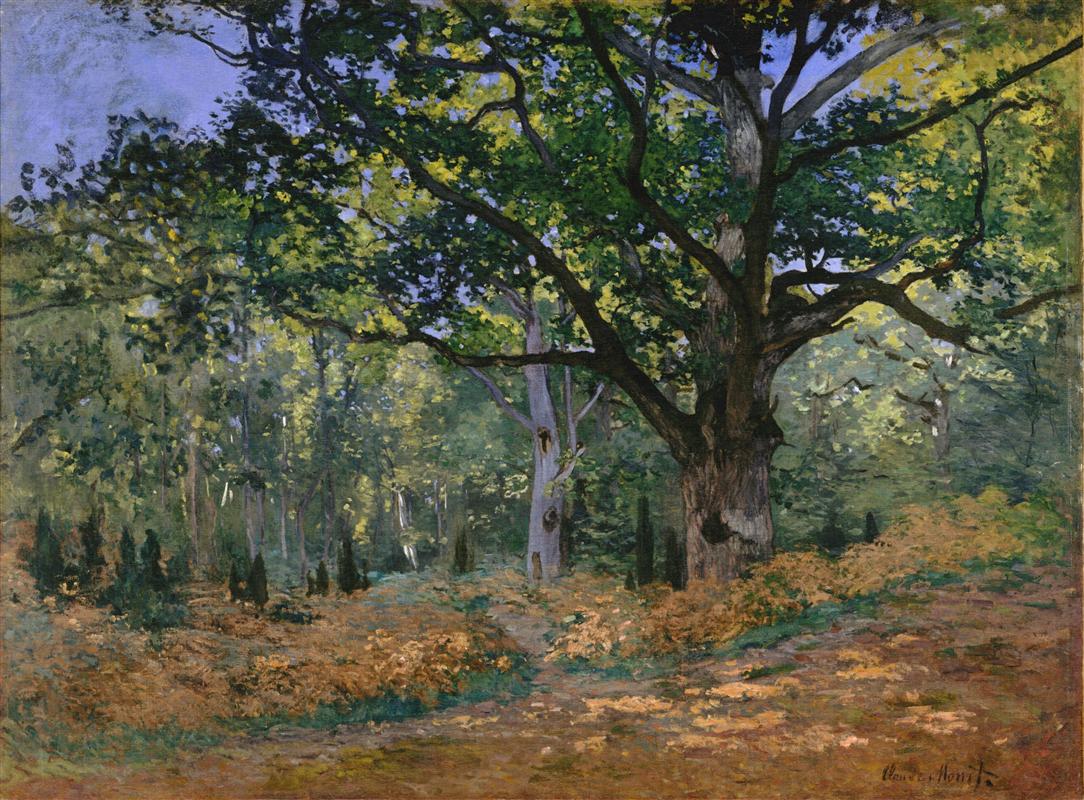
Claude Monet’s The Bodmer Oak, Fontainebleau from 1865 is a remarkable early landscape that reveals a great deal about the painter before the fully developed Impressionist style for which he later became known. At first glance, the painting may appear quiet and straightforward: a large oak dominates a woodland clearing, sunlight filters through dense foliage, and the forest floor glows with warm, earthy color. Yet the longer one looks, the more complex the work becomes. This is not simply a descriptive view of trees in a forest. It is a study of structure, atmosphere, light, and presence. Monet transforms a natural scene into something monumental, almost reverential, while still preserving the freshness of direct observation.
The painting belongs to a formative moment in Monet’s career. In the mid 1860s, he was still defining his artistic identity, absorbing lessons from landscape painting traditions while pushing toward a more personal vision. Fontainebleau was an ideal place for such exploration. The forest had long attracted painters because of its variety of textures, ancient trees, changing light, and balance between intimacy and grandeur. In this painting, Monet takes a specific natural subject, the Bodmer Oak, and gives it both individuality and symbolic weight. The tree is not just part of the landscape. It is the center of the landscape, the element that organizes everything else around it.
What makes this work so compelling is its combination of solidity and shimmer. The oak feels rooted, heavy, and enduring, but the light that moves through the leaves and across the ground gives the whole scene a sense of flux. In that tension between permanence and transience, one can already see the young Monet developing the concerns that would shape the rest of his career.
Monet in 1865
By 1865, Monet was still a young artist, but he was already deeply committed to painting modern, observed nature rather than idealized academic scenery. This was a period of experimentation and ambition. He had not yet reached the iconic serial studies of haystacks, poplars, or water lilies, but the essential sensibility was already present. He was intensely attentive to the effects of light, to the changing character of outdoor space, and to the relationship between color and atmosphere.
At this stage, Monet’s work often shows a stronger attachment to structure and tonal modeling than in his later paintings. In The Bodmer Oak, Fontainebleau, that quality is especially evident. The composition is firmly organized, and the central tree carries real mass. The trunks, branches, and deep areas of shadow are carefully established. This is not the dissolving, vaporous Monet of the 1890s. It is an artist still building the bones of his vision, making sure that nature holds together as form before allowing it to dissolve into sensation.
This early date is important because it helps explain the painting’s balance between realism and freedom. Monet is still close enough to mid nineteenth century naturalism to care deeply about the legibility of space, the identity of species, and the physical character of woodland growth. At the same time, he is already moving beyond a merely descriptive approach. The paint surface is alive with broken color and shifting visual accents. The scene is observed, but it is also felt.
The Forest of Fontainebleau as Artistic Subject
The Forest of Fontainebleau occupied a special place in nineteenth century French art. It was not only a real location but also a site of artistic renewal. Painters associated with the Barbizon school had turned to Fontainebleau as a living alternative to studio formulas and heroic historical landscapes. They found in its rocky paths, tall trees, and changing weather an environment suited to close observation and emotional depth.
Monet’s choice of Fontainebleau places him within that larger tradition, but he does not simply imitate it. The forest gives him a subject rich in precedent, yet he approaches it with a distinctly personal eye. Rather than constructing a sweeping panorama, he selects a focused scene in which a single tree becomes the anchor for a whole world of subtle visual events. The Bodmer Oak is not presented as a picturesque accessory. It commands the composition with the authority of an old natural monument.
The forest itself is rendered as layered and immersive. The background recedes into a mistier network of trunks and foliage, while the foreground is rougher, warmer, and more tactile. This creates the sensation of entering a real woodland interior rather than observing a decorative arrangement. The viewer stands at the threshold of a space that seems both open and enclosed. There is room to move into it, but there is also a strong canopy above, a sense of shelter and density.
Fontainebleau allowed artists to explore the drama of nature without the need for grand mountains or stormy seas. Its drama lies in intimacy, in the complexity of leaves against light, in the age of bark, in the way a path bends through brush. Monet responds to exactly those qualities here.
Composition and the Dominance of the Oak
The most striking feature of the painting is the monumental presence of the oak itself. Positioned slightly right of center, the tree rises with tremendous force, its trunk thick and textured, its branches extending outward in powerful arcs that spread across much of the upper half of the canvas. The composition depends on this structure. The oak acts as both subject and architectural framework, giving the painting stability while also guiding the eye across the surface.
Its placement is masterful. Because the trunk is not dead center, the image avoids stiffness. The asymmetry creates movement, allowing the eye to travel from the open space at left into the heavier mass at right, then upward into the branching canopy. The branches themselves form a kind of web that holds the composition together. Their dark, sinuous lines cut through the luminous foliage and create a visual rhythm that is both organic and deliberate.
The ground plane also plays an important role. The foreground opens gently toward the viewer, with patches of sunlit earth and undergrowth leading inward. A subtle path or clearing seems to draw the eye into the forest interior. This inward pull balances the upward expansion of the oak. The painting therefore moves in two directions at once: into depth and into height. The result is a scene that feels spacious without losing intimacy.
Monet also carefully contrasts the great oak with the more slender trees behind it. Their vertical forms echo the main trunk but do not rival it. Instead, they establish a secondary rhythm that reinforces the oak’s dominance. These lighter trunks create recession and keep the background active, yet they remain subordinate to the central presence. Everything in the composition acknowledges the tree as the defining force of the landscape.
Light Filtering Through the Canopy
One of the most beautiful aspects of this painting is the treatment of light. Monet does not present sunlight as a single strong beam or theatrical effect. Instead, light is dispersed, filtered, and broken apart by leaves and branches. It appears in fragments across the canopy, in touches on distant trunks, and in warm patches on the forest floor. This dispersed illumination gives the scene a breathing quality. The forest is not frozen. It seems to flicker.
The canopy is especially important in this regard. Rather than painting it as a flat green mass, Monet breaks it into countless nuanced notes of yellow green, olive, deep blue green, and soft light. Small openings reveal the sky, which appears in cool blue and violet tones. This interplay between leaf and sky creates a mosaic effect. The eye never settles on one uniform surface. It keeps moving, registering the instability of light as it passes through dense foliage.
On the ground, the effect changes. There the light becomes warmer, touching dry vegetation and exposed earth with gold, ochre, rust, and muted green. These sunlit areas are irregular and soft edged, which suggests the natural scatter of light beneath trees. Nothing feels mechanically patterned. The illumination seems to have arrived naturally through the movement of leaves overhead.
This sensitivity to filtered light is one of the clearest signs of Monet’s emerging originality. He is not simply painting a tree in a forest. He is painting the experience of seeing that forest under a particular set of conditions. The light is never separate from the forms it touches. It exists through color, through contrast, and through the shifting relationship between shadow and brightness.
Color and Tonal Harmony
The palette of The Bodmer Oak, Fontainebleau is rich but restrained. Monet relies on greens, browns, ochres, muted golds, cool blues, and touches of gray violet to create an atmosphere that feels natural and deeply coherent. There are no harsh accents that pull the scene apart. Instead, color is woven across the painting in a way that unifies sky, leaves, bark, and ground.
The greens are especially varied. In the canopy, they range from dark, almost blackened green in the deepest shadows to bright yellow green where sunlight strikes the leaves. In the middle ground, the greens soften and cool, helping to push the space backward. This tonal variation creates depth without requiring hard outlines. Color itself becomes a tool of spatial construction.
The browns and ochres of the forest floor introduce warmth and weight. They prevent the scene from becoming too airy or decorative. These earth tones ground the composition physically and emotionally. They suggest late summer or early autumn, or at least a moment when the undergrowth has dried and taken on a golden cast. Even if the season is not stated explicitly, the color temperature gives the landscape a mature, settled character.
The trunk of the oak is handled with a particularly subtle range of hues. It is not just brown. Monet mixes gray, black, warm umber, muted cream, and hints of cooler tones to suggest bark that catches light in some places and recedes into rough shadow in others. This complexity gives the tree real tactile presence.
What is impressive is how the whole painting remains tonally unified despite its many variations. Monet achieves harmony not by reducing difference but by balancing it. Warm and cool, dark and light, dense and open all coexist in a carefully judged equilibrium.
Brushwork and Surface
Although this is an early Monet, the painting already shows a lively and responsive handling of paint. The brushwork changes according to what is being described. In the trunk and larger branches, the marks are firmer and more directional, emphasizing solidity and texture. In the foliage, the brushwork becomes lighter, more broken, and more varied, conveying the tremor of leaves and the diffusion of light. On the ground, it broadens again, creating a looser carpet of vegetation and earth.
This variation in handling is one of the painting’s strengths. Monet does not apply a single formula across the whole surface. Instead, he adapts his touch to the visual character of each element. The result is a painting that feels responsive to nature rather than imposed upon it.
At the same time, the surface never becomes overly smooth. One senses the movement of the brush and the painter’s active encounter with the motif. This gives the work freshness. Even where the structure is strong, the execution remains alive. The leaves are not individually delineated in a botanical way, but neither are they vague. They are suggested through clusters of touches that capture mass, light, and vibration all at once.
This responsiveness of touch anticipates Monet’s later development. In his mature Impressionist work, brushwork often becomes more visibly autonomous, more openly concerned with optical sensation. Here, it is still tied more closely to descriptive form, yet the seeds of that later freedom are clearly visible. The painting therefore stands at an important point between traditional landscape construction and modern painterly perception.
Nature as Presence Rather Than Scenery
What gives this painting its emotional force is the sense that the oak is not merely a visual object but a presence. Monet treats the tree with a seriousness that borders on portraiture. Its age, scale, and rootedness are all emphasized. The trunk feels scarred and durable. The branches extend with authority. The canopy spreads like a living crown over the clearing. This is a tree with character.
That quality changes the mood of the whole work. The painting does not feel casual or decorative. It feels contemplative. The viewer is invited not just to admire the beauty of the woods but to stand before something enduring within them. The oak becomes a witness to time, holding together the more fleeting effects of sunlight and season.
There is also a subtle tension between human absence and implied human experience. No figures appear in the painting, but the scene is arranged in a way that suggests an observer on foot, someone pausing before this remarkable tree on a forest path. The absence of people allows the natural world to dominate fully, yet the painting remains deeply human in its act of attention. It is about what it means to look carefully and to find significance in a patch of forest.
This is where Monet’s sensitivity is already evident. He does not need dramatic narrative content to make the image meaningful. The simple fact of concentrated seeing is enough. The oak, the clearing, the layered woods, and the broken sunlight become emotionally resonant because they are painted as if they matter profoundly.
The Painting’s Place in Monet’s Development
Seen within the larger arc of Monet’s career, The Bodmer Oak, Fontainebleau is fascinating because it reveals both continuity and change. It belongs to an earlier phase, before the radical openness and color vibration of full Impressionism. Yet many of the concerns that later define Monet are already present. He is attentive to transient light, committed to painting from direct observation, and interested in how atmosphere transforms stable objects.
What differs is the degree of emphasis placed on mass and structure. In this painting, the forms still possess a strong sculptural clarity. The oak is unmistakably a physical body in space. In later works, Monet would often allow such solidity to dissolve more completely into color relations and reflected light. Here, he has not yet relinquished the weight of the world. That makes the work especially satisfying for viewers who appreciate both realism and painterly sensitivity.
The painting also shows Monet engaging with artistic traditions that he would eventually move beyond. The seriousness of the tree motif and the intimate woodland setting recall earlier naturalist and Barbizon interests, yet Monet infuses them with a brighter chromatic life and a more immediate sensation of atmosphere. He is learning from precedent without being confined by it.
Because of that, The Bodmer Oak, Fontainebleau can be seen as a bridge. It links the observed landscape traditions of mid nineteenth century France to the more radical visual language Monet would later help define. It shows an artist on the verge of transformation, already highly skilled, already original, but still carrying traces of the world from which he emerged.
Why the Painting Still Matters
This painting remains compelling because it captures something timeless about the experience of nature. Many landscape paintings offer beauty, but not all offer presence. In The Bodmer Oak, Fontainebleau, Monet gives the viewer both. The scene is visually attractive, with its cool greens and warm earth, its patterned light and graceful recession into depth. But it is also quietly profound. The great oak stands as an emblem of endurance within a world of constant change.
Modern viewers may also find the painting moving because it reflects a mode of attention that feels increasingly rare. It is based on patience, close looking, and sensitivity to subtle difference. Monet asks us to notice how light breaks across leaves, how shadows cool a trunk, how the forest floor shifts from green to brown to gold. The painting rewards slowness. It grows richer the longer one remains with it.
There is also something deeply satisfying in seeing Monet before the full flowering of his later fame. Works like this remind us that great artistic revolutions do not appear from nowhere. They are built through observation, discipline, and gradual deepening of vision. In this early forest scene, one can already sense the future master, but one can also appreciate the painting entirely on its own terms.
It is a powerful woodland image, a study of a singular tree, and a meditation on light filtered through living matter. Above all, it is a work of conviction. Monet paints the oak and its setting as if they deserve full artistic seriousness, and that seriousness is exactly what gives the painting its lasting strength.
Conclusion
The Bodmer Oak, Fontainebleau is one of those paintings that reveals more with every return. Its subject may seem simple, but its achievement is substantial. Monet turns a forest interior into a carefully balanced composition of monumentality and atmosphere. The oak dominates without overwhelming. Light flickers without dissolving form. Color remains natural while achieving extraordinary harmony. Every part of the painting contributes to a larger sense of rooted life and passing light.
As an early work, it is especially revealing. It shows Monet still close to naturalist landscape traditions, yet already pursuing the visual questions that would later define his art. The painting demonstrates his sensitivity to outdoor light, his confidence in structuring space, and his ability to make a specific natural motif feel universally resonant.
What lingers most is the feeling of standing before that great tree in the cool filtered air of the forest. Monet captures not only what the place looked like, but what it felt like to encounter it. That combination of observation and atmosphere is what makes the painting memorable. It is not only a view of Fontainebleau. It is an early declaration of Monet’s gift for turning direct experience into enduring art.
