Image source: wikiart.org
Introduction
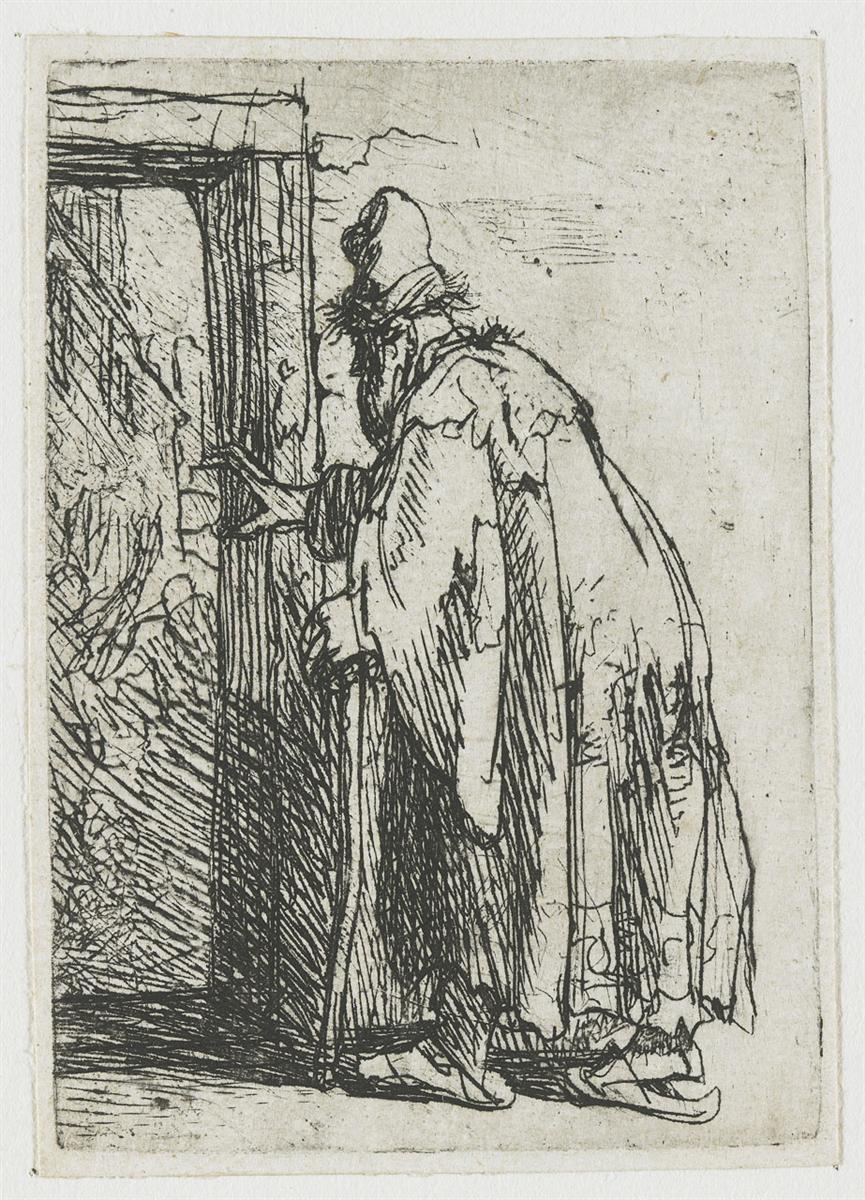
Rembrandt’s “The Blindness of Tobit” (1629) is a small yet arresting etching from his Leiden years that distills a biblical crisis into a compact, everyday gesture. The figure of Tobit, cloaked and stooped, feels for the doorframe with one hand while leaning on a staff with the other. His long coat hangs in tatters, his cap droops, and the lines that contour his shoulders sag under the weight of lived suffering. No entourage of angels, no narrative bustle, no theatrics intrude. Instead, Rembrandt concentrates our attention on the tactile fact of blindness: a body groping into space, memorizing a world it can no longer see. The result is a scene that is both profoundly specific to the apocryphal Book of Tobit and universally legible as a portrait of human vulnerability.
The Story Behind The Image
In the Book of Tobit, a righteous Israelite living in exile is struck blind when sparrow droppings fall into his eyes as he rests. His misfortune tests his household and his faith. Tobit prays for death, his wife Anna labors to support them, and his son Tobias sets out on a journey that leads to healing through the archangel Raphael and the gall of a fish. Artists often choose the more spectacular episodes—Tobias and the angel on the road or the moment of miraculous cure. Rembrandt, instead, selects the interval of affliction, a choice that reveals his commitment to the psychological root of narrative. He paints the silence that suffering imposes before deliverance arrives.
A Composition Built Around Touch
Nearly the entire sheet is given to Tobit’s profile, turned toward a doorway. The left third of the etching is a vertical architecture of jambs, slats, and wall scratches—hard, parallel marks that read as coarse wood. These harsh lines oppose the softer, rounded rhythms of the figure’s cloak, hat, beard, and bent knee. That opposition is the print’s engine: structure against flesh, unyielding surface against seeking hand. Tobit’s extended arm bridges those worlds, the fingers splayed and cautious, as if reading the grooves of the door like Braille. The staff planted near his foot adds a third vertical, stabilizing the diagonal lean of his body and anchoring the composition with an unambiguous axis of support.
Line As Language
Rembrandt exploits the freedom of etching to produce a vocabulary of marks that translates sensation. Short, broken strokes articulate ragged fabric; long, down-swept hatches darken the doorway; rapid crosshatching suggests the roughness of the floor. Across Tobit’s shoulders, single deliberate strokes describe frayed edges and thin places where a garment has worn out over time. The face is succinct—just enough curve for a nose and cheekbone, a few tight strokes for the eye—but the economy is expressive. The minimalism demands that viewers engage their own memory of faces aged by worry, filling the gaps with empathy.
The Physics Of Blindness
What makes the figure believable is Rembrandt’s attention to the physics of not seeing. Tobit’s body leans forward from the ankles as if hoping proximity will yield information. His foot searches cautiously for a boundary the eye would otherwise chart with ease. The arm nearest the viewer folds to cradle the staff, fingers gripping with habitual intimacy. The mouth, small and tight, implies a held breath. Even the hat slumps forward, echoing the forward pitch of the head. Together these details form a movement vocabulary that communicates disorientation without melodrama.
The Doorway As Spiritual Threshold
The door is more than setting; it is metaphor. In the story, blindness isolates Tobit from the world he once served with acts of burial and charity. Standing at a threshold he can no longer cross confidently, he becomes a symbol for all who feel life divided into a before and after. The verticals of wood and stone read like a barred staff on which the music of daily life is written in lines he cannot decipher. When the cure comes later, it will be a re-entry into shared space. Rembrandt has chosen the moment just before that hope is visible, when a threshold is only an obstacle.
Leiden Years And Human Scale
The year 1629 locates the print among Rembrandt’s experiments in concentrated storytelling. In Leiden he practiced staging grand narratives at human scale, often with a single figure holding the scene. The early prints of beggars, scholars, and saints share with this work a fascination with how bodies register states of mind. The restraint of “The Blindness of Tobit” is typical: the drama resides in a gesture, not in architecture or costume. By refusing to crowd the sheet with expository detail, Rembrandt magnifies the eloquence of a hand feeling its way along a wall.
The Theology Of Ordinary Suffering
Rembrandt’s choice to depict a biblical patriarch without glory aligns with a broader theology of the ordinary that recurs throughout his career. Tobit’s righteousness is not manifested here by halos or angelic company but by persistence. He keeps moving. He reaches. He stands at the door because daily life still requires passage—from room to room, from day to day. Faith appears as endurance more than triumph. This subtly devout vision would later inform Rembrandt’s renditions of Christ and the apostles, where the sacred often hides in weariness and the miraculous arrives through touch.
The Economy Of Costume And Status
Tobit wears a long, patched cloak and simple shoes that turn up at the toes. The hat is lopsided and heavy. Nothing signals wealth, power, or grandeur, and yet everything signals dignity. The cloak’s worn hem is etched with broken, deliberate strokes that refuse to aestheticize poverty while also refusing to shame it. The clothing locates him in a continuum of care: someone patched these garments; someone washed them; someone watched them fray. That unseen domestic labor—often Anna’s in the narrative—haunts the picture and thickens its atmosphere of humble fidelity.
Space, Silence, And Plate Tone
Although this impression is executed with spare line, the surrounding paleness of the paper works like silence in music. It keeps the scene hushed, amplifying the small sounds we imagine: the soft tap of the staff, the brush of sleeve against wood, the low exhale of a man measuring his progress. Some impressions of the plate show faint tone or surface scratches that suggest dust or light; even when the background is largely blank, those incidental marks become part of the weather through which Tobit moves. Etching’s capacity to register such accidents folds the actual life of the plate into the fictive life of the figure.
Motion Held At The Point Of Change
The image captures motion as it converts into comprehension. Tobit’s fingertips have just made contact; the staff is about to lift; the foot will soon slide. This suspended instant is Rembrandt’s favorite temporal unit—a hinge between the unknown and the known. In later canvases he would achieve similar suspension with paint; here pure line arrests the drama at the exact point where the body negotiates with the world. It is a lesson in narrative timing: a quiet gesture, if chosen precisely, can contain a story’s entire weight.
Echoes Of Other Works On Blindness
Rembrandt returned to blindness at multiple points, sketching beggars who grope through streets or lean into companions’ guidance. In those studies, as here, he treats blindness not as a spectacle but as a mode of being that adapts posture, map-making, and attention. He finds grace in the adjustments. “The Blindness of Tobit” participates in that broader humanistic project while sharpening it through biblical reference. If the beggar studies remind us that misfortune is near, the Tobit print reminds us that misfortune can visit the righteous as well, complicating easy equations between virtue and prosperity.
The Role Of The Viewer
The print positions us beside Tobit rather than above him. We see what he cannot—the way the wood slats interlock, the open space beyond the doorway—but our knowledge is inert unless it transforms into sympathy. The viewer feels the urge to narrate directions: a step here, a hand higher there. That impulse points to the social dimension of disability: a community’s attention can become prosthetic sight. In sparking that urge, the print makes us responsible witnesses rather than passive consumers of pathos.
The Expressive Power Of Imperfection
The plate carries small irregularities—uneven bites, wavering lines, slips of the needle—that some later academies would have polished away. In Rembrandt’s hands, those imperfections become expressive. A tremor in the line around the hat reads like worn felt; a slightly crooked staff suggests use and age; a jagged edge on the cloak records not only a tear in fabric but a history of snags and catches. The visible making echoes the figure’s visible struggle. Both artist and subject work against resistance, and that kinship between process and theme is one reason the print feels so alive.
Symbolic Readings Without Overstatement
Tobit’s staff and doorway provide obvious symbolic pathways—pilgrimage, threshold, exile, return—but Rembrandt keeps symbolism subordinate to observation. The staff is first a practical aid and only second an emblem of journeying. The door is first a thing to be found and only then a sign of transition. This ordering of priorities allows the image to function both as a devotional meditation and as a documentary fragment of ordinary life in the seventeenth century.
Anticipations Of Later Mastery
Despite its small scale and brevity, the etching foreshadows the mature Rembrandt. The faith in gesture as narrative, the humility with which sacred figures are treated, the attention to aging garments and hardworking hands, and the refusal to supply sentimentality where truth suffices—all are traits that will culminate in the great paintings of his Amsterdam years. The print reads like a note in the composer’s hand that already contains the themes of the symphony to come.
Why The Image Still Speaks Today
Modern viewers recognize in Tobit’s tentative reach the universal experience of negotiating spaces not built with them in mind. The print reads as an early lesson in accessibility and care. It asks what architecture feels like when sight fails, how a community might host such bodies, and how dignity survives when independence is interrupted. Without rhetoric, the image advocates for attention—attention to surfaces, to textures, to the hands of those who move among us more slowly.
Conclusion
“The Blindness of Tobit” is a minor miracle of compression. In a handful of etched lines Rembrandt conjures a life altered by darkness and a faith that persists in reaching. He replaces spectacle with touch and epic with intimacy, making the biblical present and tactile. The slant of a body, the rough music of wood grain, a staff planted on the threshold—these become the instruments of a drama as old as exile and as current as the next room we must enter without certainty. Small in size but immeasurable in sympathy, the print confirms that Rembrandt’s genius lay not only in his command of light and shadow but in his unflinching attention to the fragile dignity of human beings.