Image source: wikiart.org
Introduction
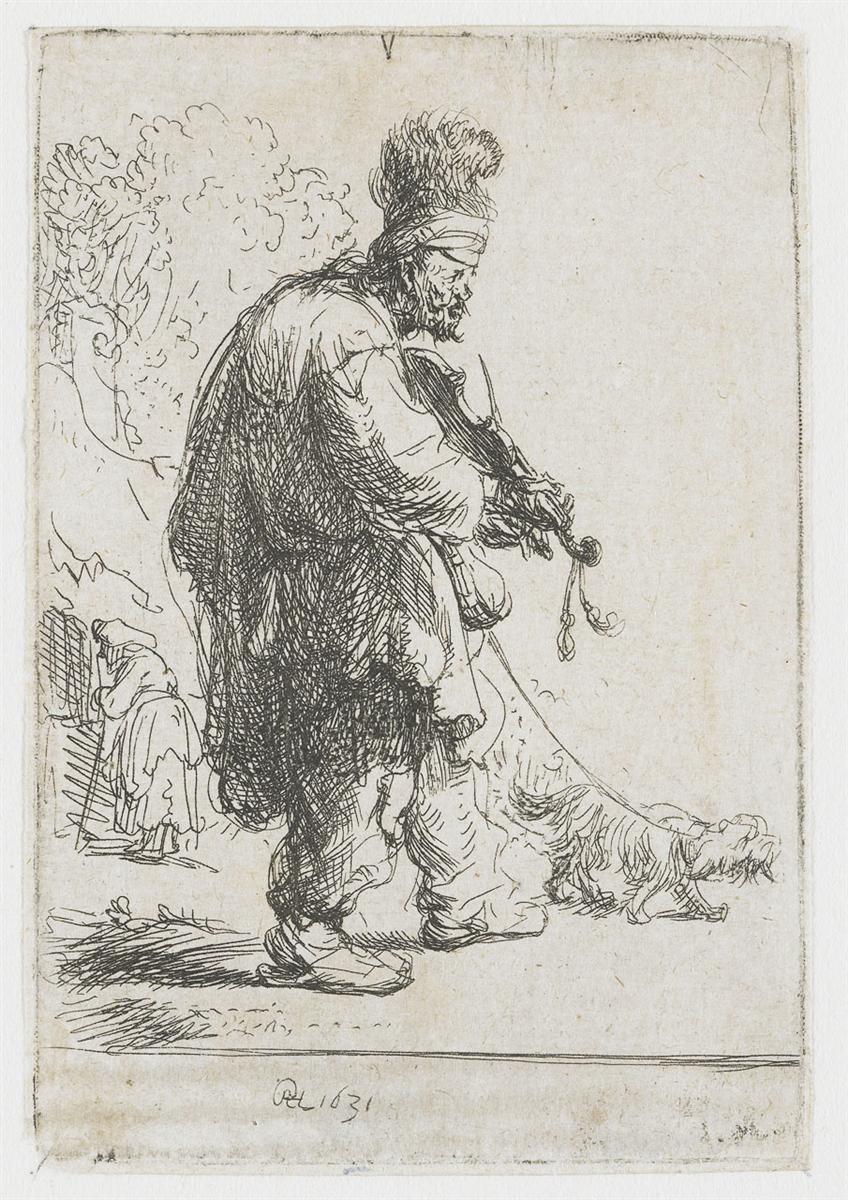
Rembrandt’s “The Blind Fiddler” (1631) is a compact etching that turns an everyday encounter into a scene of astonishing presence. A street musician, bundled in heavy garments and capped with a towering hat, plays his instrument as a small dog noses along the ground beside him. In the middle distance, a figure stoops near a slatted door, and a shag of trees sketches the open air. There is no stagecraft or grand anecdote; yet the sheet feels dramatic because the artist uses line, light, and gesture to make time audible. The drawing seems to hum. Look a little longer and the etching becomes an essay on resilience, attention, and the power of sound to organize a world.
A Moment In Rembrandt’s Development
The year 1631 lies at a hinge in Rembrandt’s life. He was leaving Leiden’s networks for the larger theater of Amsterdam, where he would soon become the most sought-after portraitist in the Republic. The early 1630s also mark a furious period of printmaking, when he stretched etching beyond tidy contour into a medium capable of atmosphere and psychology. “The Blind Fiddler” belongs to this cluster of studies focused on beggars, peasants, and itinerant performers. These were not moralizing cartoons; they were laboratories in which the artist refined his descriptive touch and learned how to translate motion, sound, and interior life into marks of ink.
Etching As A Language Of Speed And Memory
Etching preserves the timing of the hand. A copper plate coated with ground lets the artist draw like a draftsman; acid then bites the exposed lines. Every shift of pressure, hesitation, and acceleration is registered in metal. In this sheet Rembrandt uses that responsiveness to deliver textures that feel both observed and remembered. The dog’s coat is a braid of quick, curling strokes; the fiddler’s thick jacket is knitted from dense crosshatching; the feathered hat erupts in wiry spirals. The medium’s agility lets the sheet carry the immediacy of a street note jotted on the way home and the staying power of a performance etched in mind.
Composition And The Architecture Of Gesture
The composition relies on a strong diagonal that runs from the musician’s lofty hat down through the slanted fiddle and bow to the dog’s upturned muzzle. This diagonal sets the rhythm of the scene: downbeat at the hat, phrase through the arms, cadence at the dog. The fiddler’s stance—one foot forward, one back—builds a counter-diagonal that braces the body against the instrument’s pull. Behind him, a vertical cluster of trees balances the sweeping mass of his clothing, while the small figure at left creates a second point of human scale that keeps the sheet from becoming a single, monolithic silhouette. The result is a stable picture that still feels on the move.
The Blindness That Organizes Space
Rembrandt never sensationalizes the man’s blindness. There is no theatrical tilt of the head or exaggerated gesture begging for pity. Instead, he communicates the condition through the logic of posture and the independence of the senses. The fiddler’s face angles slightly downward in a line continuous with the neck and torso, a calm arc rather than a dramatic droop. The hands operate with assured economy: the left works the strings; the right draws the bow; both know where they are without sight. Space grows around this centered axis of sound. The dog, attentive but unthreatened, seems to navigate by the same auditory map, nose close to the ground as if scent and rhythm together were sufficient to chart a path.
Clothing, Texture, And Social Reality
The musician’s coat is oversized, patched by shadow into a single bulking form. The sleeves swell and fold, their weight evidenced by the creased elbow and the heavy hang at the wrist. Trousers gather at the knee and balloon into stout shoes that anchor the figure to the earth. None of these details is fussy; each is built from confident strokes that privilege overall weight over decorative incident. The garments are not costumes; they are evidence. They tell a story of weather endured and streets trod, of a life supported by small earnings in open air. Rembrandt’s refusal to prettify the clothing helps the image achieve a dignity that does not depend on sentiment.
The Dog As Companion And Meter
Rembrandt habitually includes animals as moral and compositional partners. Here the long-bodied dog functions as a metronome in fur. Its forward stretch, tail low and feet braced, extends the bow’s gesture toward the ground, completing a phrase that would otherwise be invisible. The dog’s curls are rendered with the same energetic flicks used for the feathered hat, tying the top and bottom of the composition into one rhythm. The animal’s presence softens the austerity of the scene. It is neither allegory nor accessory; it is a working companion whose alertness suggests how music binds human and animal attention into a shared tempo.
Line, Pressure, And The Music Of Mark
The etched lines vary in weight and spacing with musical precision. Where Rembrandt wants volume—the full, rounded mass of the coat—he crosshatches densely, letting acid bite a deeper tone that prints dark and resonant. Where he wants surface—feather, fur, foliage—he spreads lighter, springier strokes that scatter light and air. The bow and strings are drawn with taut, economical lines that feel audible; you can almost hear the rasp of horsehair across gut. Even the ground is given a rhythm: a few quick horizontals under the forward foot stabilize the step while avoiding literal shadow. The print becomes a score that you read with your eyes and hear with your imagination.
The Background As Breath
The left third of the plate is remarkably open. A few airy contours suggest trees; a faint framework hints at architecture; then the space clears to paper. This negative area is not emptiness; it is breath. It insulates the fiddler and dog from the press of detail, creating a small stage of quiet in which the sound can resonate. The open zone also keeps the composition from feeling crowded, a risk in small prints. Rembrandt trusts the viewer to complete the world beyond, and that trust makes the image feel larger than its size.
Light Without Theatricality
Unlike many of the artist’s history prints, “The Blind Fiddler” avoids strong chiaroscuro. The tonal range is moderate; highlights are short and strategic. Light behaves like an overcast day that favors attention rather than spectacle. It catches on the edges of the coat, finds the dog’s spine, and nudges the cheek and beard just enough to separate head from hat. Because the value scale is subdued, line does the heavy lifting, and the drawing’s energy remains close to the skin of the copper. The effect is humane and observational, entirely suited to a street performer who makes his living without fanfare.
The Ethics Of Looking At Poverty
Seventeenth-century images of the poor often flirt with mockery or moral lesson. Rembrandt’s etching does neither. The fiddler is not a cautionary emblem; he is a craftsman at work. The bow is steady, the stance practiced, the dog engaged. There is no hint of caricature in the face; the beard and nose are particular without being cruel. By meeting the performer with respect, the artist trains the viewer to do the same. The print becomes a lesson in attention rather than a sermon about vice or virtue.
A Street Narrative Compressed Into A Single Moment
Though static in medium, the sheet holds narrative time. You sense the fiddler approaching from the left, pausing here to play, and then moving on. The dog has already sniffed the ground behind and now investigates the path ahead. The distant figure bends to a task unrelated to the music, a reminder that even the most resonant sound occupies only a slice of other people’s days. The etched line, with its suggestion of motion in nearly every stroke, holds these time-slices together without spelling them out.
Comparisons Within Rembrandt’s Oeuvre
Rembrandt etched several beggars and itinerant figures around 1630–1631: a peasant walking with hands behind his back, a beggar leaning on a staff, small family groups on the road. “The Blind Fiddler” stands apart for its musical subject and its unusually open background. Many companion prints press figures against architectural settings; this one gives the performer air. The difference is meaningful. Music needs space to be imagined, and the blank paper functions like silence around a note. The etching thus foreshadows Rembrandt’s later genius for using emptiness and atmosphere as active components of meaning.
Printing, States, And Mood
As with most of the artist’s etchings, impressions of this plate can vary. A light plate tone leaves the background cool and crisp, heightening the drawing’s graphic energy; a warmer, retained film of ink gently unifies figure and ground, pushing the scene toward dusk. Minor inking variations in the coat’s depths can make the garment feel heavier or lighter. Such differences are not defects; they are performances of the same composition in different keys, reminding us that printmaking is a living art rather than a mechanical copying process.
A Guide For Close Looking
Begin at the musician’s hat and notice how the feathery tuft is carved from a few buoyant strokes, each curving slightly differently to conjure fluff and lift. Slide down to the eye and cheek: a handful of hatchings create the soft turn of flesh without enclosing the forms in hard contour. Read the bow’s path and listen for its implied scrape. Then drop to the dog and follow the line of its bent foreleg; watch how the curls tighten at the neck and loosen along the back. Step back and let the diagonal from hat to nose to bow to muzzle reset the tempo of your gaze. The sheet rewards this dance between nearness and distance.
Sound, Sympathy, And The Viewer’s Role
Because the fiddler cannot see, the print quietly assigns the viewer the task of witness. You complete the audience his blindness cannot register. The dog acts as intermediary, aware of the world’s textures in ways the man cannot be. In this triangulation between musician, animal, and viewer, sympathy emerges without sentimentality. You are not asked to pity; you are asked to attend. The etched line becomes the meeting ground where our looking and his playing coincide.
Why The Image Still Feels Modern
Contemporary audiences, inundated with spectacle, often find Rembrandt’s restraint startlingly fresh. The absence of moral signage, the refusal to stereotype, the confidence that a few lines can conjure air and sound—these choices align with modern sensibilities that value authenticity over display. The print’s empathy is practical rather than theatrical, grounded in the accurate description of posture, texture, and task. It is precisely this accuracy that allows the image to travel centuries without growing stale.
Legacy And Influence
“The Blind Fiddler” contributed to the European appetite for character studies that dignify ordinary labor. Later printmakers learned from its economy and from its way of converting gesture into narrative without recourse to speech or scenery. Within Rembrandt’s practice, the sheet is a waypoint between his early fascination with expressive heads and his mature capacity to orchestrate full scenes with a few decisive masses. It taught him, and teaches us, how attention itself can be a subject.
Conclusion
In “The Blind Fiddler,” Rembrandt captures not simply a man and his dog but a moment in which sound organizes space and dignity resides in practiced movement. The etching’s lines are quick, but their effect is deep: they turn paper into air, air into rhythm, and rhythm into the felt presence of another human being working at his craft. At the threshold of his Amsterdam career, the young artist shows that he can make a world from a handful of strokes—and that the smallest of scenes can carry the largest human truths.
