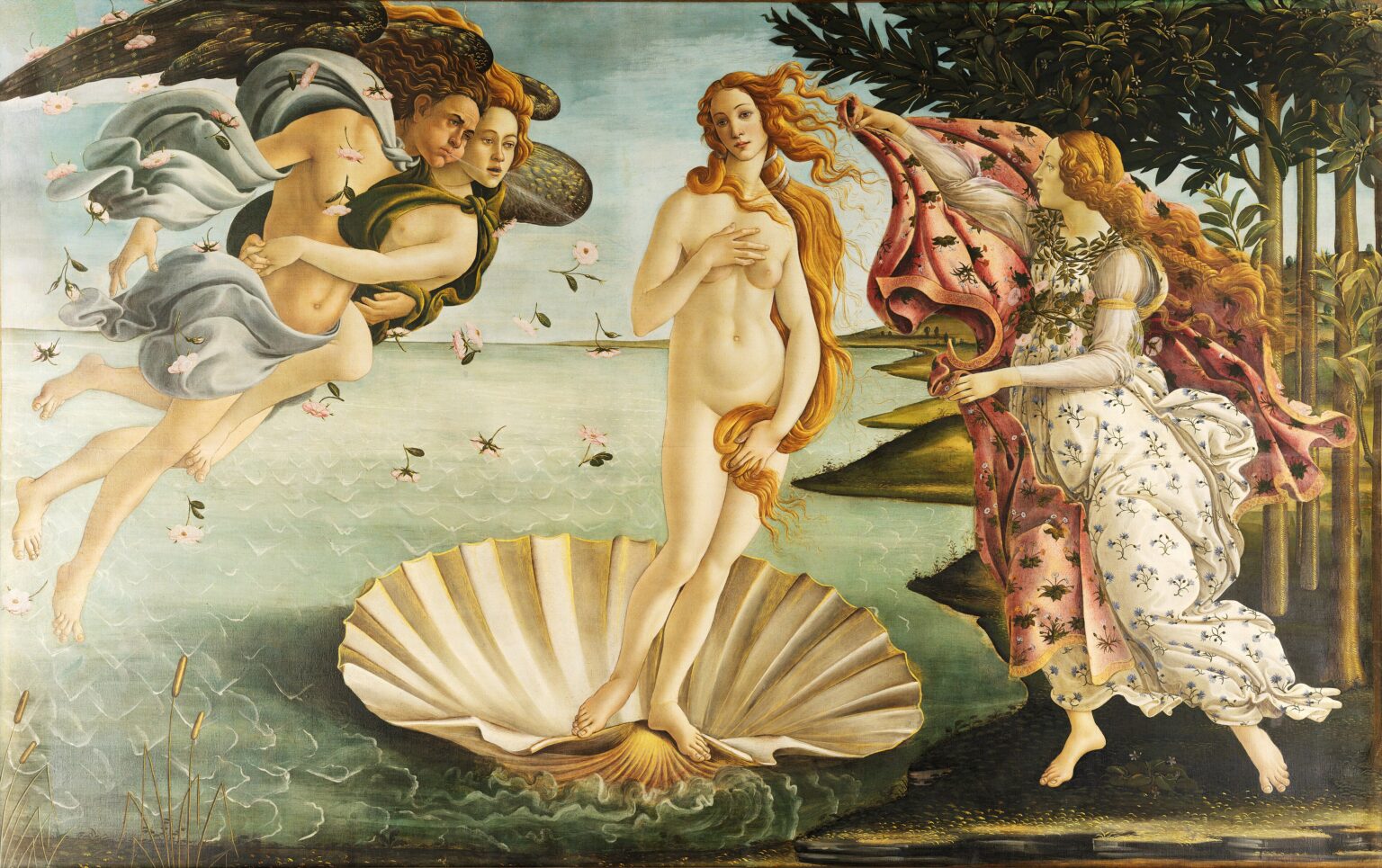
Image source: wikimedia.org
Introduction
Sandro Botticelli’s The Birth of Venus, painted in 1485, remains one of the most recognizable images of the Italian Renaissance. At first glance, the painting seems simple and graceful. Venus stands on a shell, blown toward shore by the wind, while a female figure on the right moves forward to clothe her in a flowered mantle. Yet the longer one looks, the more complex the work becomes. It is not just a scene from classical mythology. It is a meditation on beauty, love, purity, desire, poetry, and the ideal power of art itself.
What makes this painting so enduring is the way Botticelli transforms a mythological subject into a vision that feels both earthly and otherworldly. Venus is present as a body, but she is also presented as an idea. She is sensual, but she is also distant. The sea, the flowers, the shell, the wind, and the flowing hair all contribute to an atmosphere that seems less like a real coastal landscape and more like a dream of perfect arrival. Botticelli is not trying to convince the viewer that this event happened in nature. He is building an image of ideal beauty, one that speaks to the intellectual and artistic culture of Florence during the Renaissance.
The painting is often approached as a masterpiece of mythological art, but it is equally important as a statement about how painting can elevate the visible world. Botticelli uses line, rhythm, and surface elegance to create a composition that feels musical. Bodies curve, drapery swirls, hair streams across the picture, and even the shoreline seems to answer the movement of the figures. Everything is orchestrated. Nothing is accidental. This harmony between form and meaning is one of the reasons The Birth of Venus has remained central to discussions of Renaissance painting for centuries.
The Mythological Subject and Its Meaning
The subject of The Birth of Venus comes from classical mythology, in which Venus, the goddess of love and beauty, emerges from the sea. Botticelli captures the moment of her arrival, not as a violent or dramatic episode, but as a ceremonial appearance. She is carried on a shell toward land, while the wind gods on the left propel her forward and a female attendant on the right prepares to cover her. The scene is less about narrative action than revelation. Venus is being presented to the world.
This mythological setting mattered deeply in Renaissance Florence, where classical literature and philosophy had been revived and reinterpreted by humanist thinkers. In this context, Venus could represent more than physical beauty. She could symbolize spiritual love, harmony, or the uplifting force of ideal beauty on the human soul. Botticelli’s painting draws power from this dual meaning. Venus is naked and visually seductive, yet she is also serene, remote, and almost untouched by ordinary human emotion. She invites admiration, but she does not fully belong to the everyday world.
That tension between sensual beauty and elevated meaning gives the painting much of its richness. Botticelli does not present Venus as a merely decorative figure, nor as a fully naturalistic woman. Instead, he gives her a symbolic role. She stands at the threshold between nature and civilization, between the sea and the shore, between raw creation and refined culture. Her arrival can be read as the arrival of beauty into the world, or even as the birth of a higher form of love that transforms those who behold it.
The attendant at the right, often identified as one of the Horae, strengthens this reading. She comes bearing a cloak patterned with flowers, suggesting spring, renewal, and the ordered cycles of nature. Venus may be born from the sea, but she is welcomed into a world of cultivated form and meaning. The painting therefore stages a transition, not just in space, but in value. It suggests that beauty becomes fully significant when it is recognized, framed, and honored.
Composition and Visual Structure
One of the greatest achievements of The Birth of Venus is its compositional clarity. Botticelli arranges the figures so that the scene is easy to understand, yet visually dynamic. Venus stands at the center, establishing the painting’s main axis. Her upright body stabilizes the composition, while the figures on either side create a gentle sense of motion toward her. The wind gods press inward from the left, and the female attendant advances from the right. All movement converges on Venus, making her both the literal and symbolic center of the painting.
The balance is not rigid. Botticelli creates harmony through asymmetry. The group at the left is compressed and energetic, filled with intertwined limbs, swirling drapery, and blowing breath. The figure at the right is more grounded, though her mantle billows outward in response to the same wind. Venus stands between these forces, still and calm. This contrast between motion and stillness heightens her presence. She appears almost untouched by the turbulence around her, which makes her seem timeless and divine.
The shell beneath Venus is also crucial to the structure of the image. It acts like a stage or pedestal, lifting her above the water and marking her as an object of contemplation. Its broad, fanlike form echoes the curves of her body and hair, reinforcing the painting’s overall rhythm of flowing lines. The shoreline at the right, with its dark edge and trees, provides a visual counterweight to the open sea at the left. This division between open and enclosed space helps guide the eye across the picture while keeping the central focus secure.
Botticelli’s composition depends less on deep perspective than on elegant arrangement across the surface. The background landscape is relatively simple, and the space feels shallow compared to many other Renaissance paintings. This is deliberate. By minimizing deep recession, Botticelli keeps the viewer’s attention on contour, gesture, and symbolic presence. The painting unfolds like a decorative yet meaningful tableau, where beauty is conveyed through arrangement rather than illusionistic depth.
Venus as an Ideal Figure
Venus is one of the most famous female figures in Western art, and much of her power comes from the way Botticelli idealizes the body. She is not anatomically exact in a strict naturalistic sense. Her neck appears elongated, her shoulders slope gently, her torso is delicate, and her pose seems slightly improbable. Yet these departures from physical realism are part of the painting’s expressive language. Botticelli is not trying to record a living model with scientific precision. He is creating an ideal of beauty shaped by grace, modesty, and poetic refinement.
Her pose recalls the classical Venus Pudica type, in which the goddess attempts to cover herself with her hands. This gesture suggests modesty, but it also draws attention to the body. It creates a delicate balance between concealment and revelation. Venus appears aware of being seen, yet she remains inward and composed. Her facial expression is calm, even slightly melancholy, which separates her from more overtly sensual images of beauty. She is available to the eye, but not emotionally accessible. This distance is essential to her divine character.
Her flowing hair is one of Botticelli’s most expressive devices. It moves through the air in long golden strands, at once natural and ornamental. The hair frames her body, protects her modesty, and extends her presence beyond the limits of ordinary anatomy. It behaves almost like drapery, becoming part of the painting’s larger system of line and movement. In this sense, Venus is not only a figure in the image. She is also a source of formal harmony.
What is especially striking is how Botticelli joins fragility and authority in this figure. Venus does not dominate through force or grandeur. She stands lightly, almost delicately, yet everything in the painting revolves around her. Her power is quiet. It comes from beauty understood as an ordering principle, something that calms motion, organizes vision, and invites contemplation. That idea lies at the heart of the painting.
Line, Rhythm, and the Poetry of Form
Botticelli was one of the great masters of line, and The Birth of Venus shows that gift at its highest level. The painting is built from contours that are not merely descriptive but expressive. The curves of limbs, the flowing hair, the folds of drapery, the edge of the shell, and the outlines of leaves and flowers all contribute to a rhythmic visual language. Line in this painting does not simply define shape. It creates movement, elegance, and emotional tone.
This linear beauty gives the work a distinctly lyrical quality. The painting seems to move like a poem or a song. The wind at the left is visible not only because the figures blow air, but because all the forms around them respond in sweeping arcs. Drapery billows, hair streams, petals scatter across space. On the right, the mantle opens and twists in a large decorative curve that answers the movement on the opposite side. These repeated motions unify the image and make it feel alive.
At the same time, Botticelli controls this rhythm carefully. The painting never descends into chaos. The central figure of Venus interrupts the flow with vertical calm. Her stillness gives meaning to the surrounding motion. Without her, the picture would be all breeze and ornament. With her, it becomes an arrival, a revelation, a moment suspended between movement and rest.
This emphasis on line is also part of what distinguishes Botticelli from painters more committed to volume and spatial realism. He is less interested in making bodies seem solidly weighty than in making them beautiful in contour and relation. This is why the painting retains such decorative strength. It works not only as a story or symbol, but as a pattern of living forms arranged with extraordinary sensitivity.
Color, Light, and Surface Beauty
The color palette of The Birth of Venus is gentle, refined, and harmoniously restrained. Botticelli does not overwhelm the viewer with rich darkness or dramatic contrasts. Instead, he uses pale blues, soft greens, warm flesh tones, gold, cream, and delicate pinks to create a world of airy clarity. This palette supports the mythological subject by making the scene feel luminous and removed from ordinary experience.
The sea and sky are especially important in establishing atmosphere. They form a cool, open backdrop that allows the figures to stand out clearly. The tones are light and calm, giving the painting a sense of purity and spaciousness. Against this cool setting, Venus’s warm golden hair and pale body gain greater prominence. Her flesh does not glow with heavy modeling, but with a refined smoothness that suits the idealized nature of the image.
The mantle at the right introduces richer color and pattern into the composition. Its pinkish tones and floral decoration provide visual richness without breaking the overall harmony. It acts almost like a ceremonial fabric, bringing the elegance of textile design into the painting. This detail reminds us that Botticelli’s art belongs to a culture that valued luxury, refinement, and surface beauty as expressions of cultivated taste.
Light in the painting is even and clear rather than dramatic. There is little sense of sharply directional illumination. Instead, forms are revealed in a stable, almost timeless brightness. This contributes to the painting’s dreamlike quality. The scene seems outside ordinary weather and time, held in a perpetual state of gentle revelation. Botticelli’s concern is not with capturing a fleeting effect of light, but with sustaining an ideal vision.
Nature, Symbolism, and the Setting
Although the landscape in The Birth of Venus is relatively spare, it plays a vital symbolic role. The sea from which Venus emerges is calm, stylized, and expansive. It suggests origin, fertility, and the primal source of life. Yet Botticelli avoids any raw or chaotic sense of nature. The water is patterned and controlled, its waves rendered with decorative regularity. Nature here is already shaped by artistic intelligence.
The flowers blown across the scene deepen the symbolic texture. Roses are traditionally associated with Venus and with love. Their movement through the air suggests that beauty and desire accompany the goddess’s arrival. They also help make the invisible wind visible, turning motion into a graceful shower of petals. This is typical of Botticelli’s imagination. He translates abstract forces into elegant visual signs.
The grove at the right introduces another aspect of the setting. Unlike the open sea, the trees create a sheltered space of arrival and reception. They suggest civilization, garden culture, and the fertile order of spring. The female attendant standing there seems to belong to this world of cultivated nature. She is prepared to receive Venus and integrate her into the terrestrial realm. This gives the shoreline a ceremonial significance. It is not just land. It is the place where divine beauty enters human experience.
The shell itself is perhaps the most memorable symbol in the painting. It evokes birth, femininity, and natural form, but also functions visually as a throne-like platform. Venus does not simply rise from the water. She is displayed, elevated, and framed. The shell helps transform myth into image and image into icon.
Renaissance Ideals and Florentine Culture
The Birth of Venus is inseparable from the intellectual culture of Renaissance Florence. It reflects a moment when classical mythology, Christian thought, poetry, and philosophy could intersect in sophisticated ways. Rather than seeing ancient myth as pagan material to be rejected, Renaissance humanists often treated it as a source of moral, philosophical, and aesthetic insight. Botticelli’s painting belongs to that world of reinterpretation.
In this setting, Venus could be understood on more than one level. She was the goddess of love, but love itself could be interpreted as both physical and spiritual. Beauty could lead the soul upward, from admiration of the visible body to contemplation of higher truths. Whether or not every viewer would have articulated that philosophy in formal terms, the painting clearly participates in a culture where beauty was believed to possess intellectual and elevating force.
This helps explain why Botticelli’s nude does not feel merely erotic. The figure is certainly alluring, but she is presented with a seriousness and refinement that encourages contemplation rather than possession. The painting idealizes beauty in a way that turns looking into a form of reflection. It asks the viewer to consider what beauty means, how it acts upon the soul, and why art is capable of giving visible form to invisible ideals.
The work also reflects Florentine taste for elegance, literary allusion, and controlled refinement. It is mythological, but not theatrical. It is decorative, but not superficial. It is learned, but immediately beautiful to the eye. That combination helps explain its lasting appeal. The painting speaks both to viewers who know its philosophical background and to those who simply respond to its grace.
Why The Birth of Venus Still Matters
Few paintings have remained as culturally powerful as The Birth of Venus. Its continued relevance comes partly from its iconic status, but more deeply from its emotional and visual balance. It is at once simple and layered, serene and sensuous, decorative and intellectual. Botticelli created an image that seems to define beauty while also questioning what beauty is. Is it physical perfection, divine harmony, poetic imagination, or spiritual aspiration? The painting never forces a single answer.
Its influence has been immense because it offers an image that can be reinterpreted again and again. Modern viewers may see in it a celebration of femininity, an exploration of idealized beauty, or a brilliant example of myth transformed into art. Art historians may focus on its classical sources, its Florentine context, or its distinctive linear style. Casual viewers may simply be captivated by Venus herself, standing in impossible calm amid wind and sea. All of these responses are valid because the painting is rich enough to support them.
What Botticelli achieved here was not realism in the narrow sense, but something more enduring. He created a vision. Every formal choice, from the pale sea to the streaming hair, serves that vision. The result is a painting that does not age in the way many images do. It continues to feel immediate because it was never tied entirely to physical reality. It belongs to the realm of ideals, and ideals have a long life in art.
The Birth of Venus remains one of the clearest examples of how painting can unite beauty, symbolism, and cultural meaning in a single image. It is not only a masterpiece of the Renaissance. It is a reminder that art can turn myth into meditation and surface beauty into lasting significance.