Image source: wikiart.org
Introduction to “The Birth of the Princess” (1625)
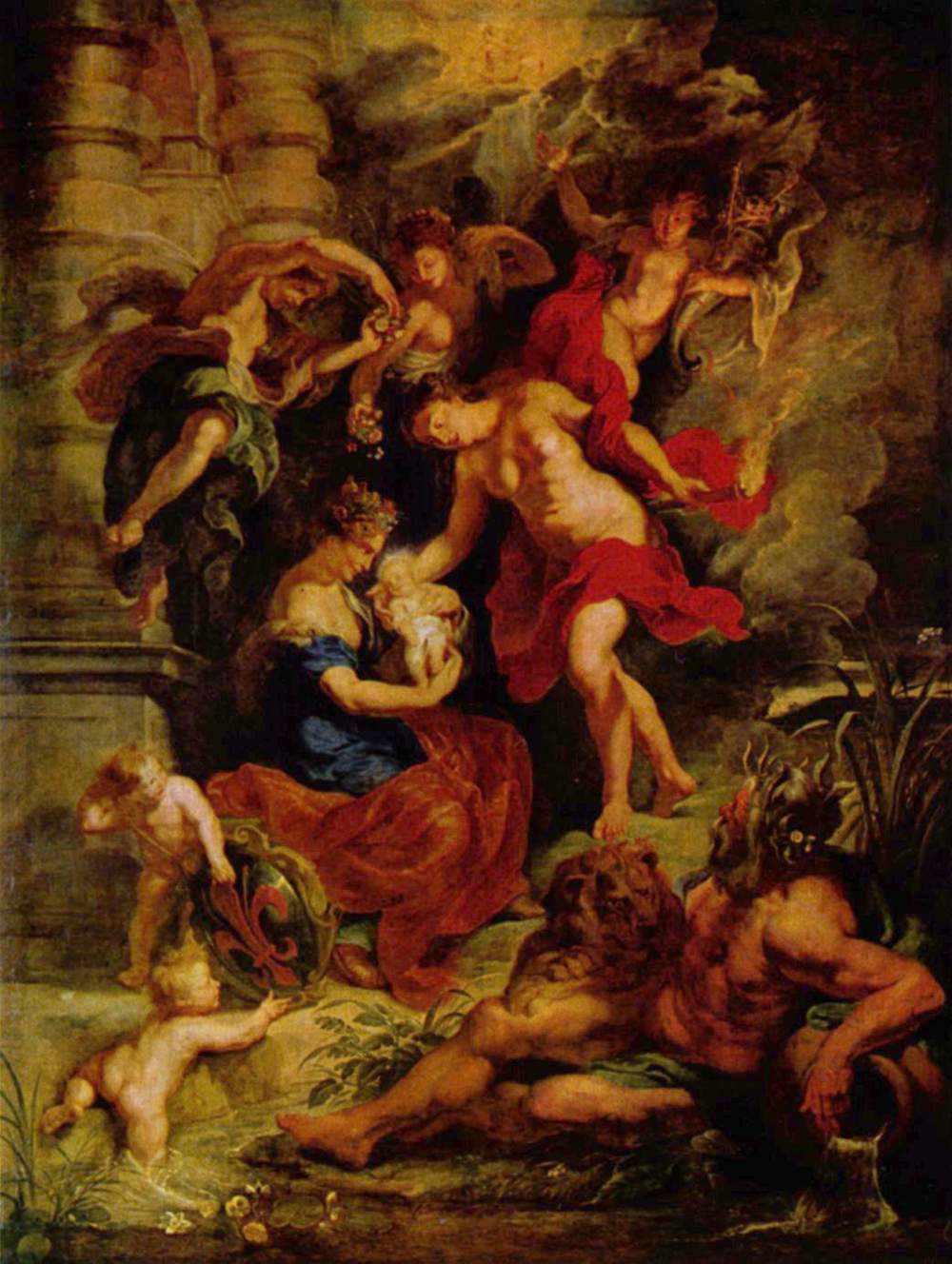
Peter Paul Rubens’s “The Birth of the Princess” is one of the most lyrical panels from the Medici cycle painted for the Luxembourg Palace in Paris. In this scene a royal daughter’s arrival becomes a mythic celebration where nature, the heavens, and the virtues gather around the mother and child. Rubens refuses the documentary chamber of a birth narrative and instead composes a living allegory of dynasty, abundance, and political promise. Putti romp in the foreground, river and sky converse at the edges, and a small forest of draperies, wings, and arms flows toward the luminous triangle formed by the mother, the newborn, and the protective figure of France. The painting stages the way a single infant could reshape a kingdom’s future through the alliances and continuities her life would enable.
Historical Moment and the Purpose of the Image
Marie de’ Medici commissioned Rubens to narrate her life and authority across a monumental series of canvases. A princess’s birth within that program does more than register a date; it verifies the queen’s essential political achievement—she produced heirs and daughters who would knit France to other thrones. In an age when dynastic marriages altered the map of Europe, a princess signified treaties in seed, potential queenship, and diplomatic leverage. Rubens structures the painting as a statement of providence and fertility: the queen is both mother and guarantor of the realm’s future, and the gods themselves come down to welcome the child.
A Composition That Converges on Mother and Child
The composition rises in a diagonal sweep from the reclining river god in the lower right to the hovering spirits and open heavens at the upper left. That diagonal movement is checked and gathered by a counter-flow of figures and draperies that bend toward the mother seated near the center. She cradles the infant while a second female figure—armored with the fleur-de-lis shield—leans in to assist. Together they form a stable nucleus amid the swirling pageant, a human still point around which the rhetoric of the state and the cosmos revolve. Architecture at the left encloses the group like a modest apse, while vegetation and water open the right margin to nature’s abundance.
Allegorical Identities and Their Messages
Rubens peoples the canvas with personifications rather than courtiers. The woman crowned with lilies and associated with the fleur-de-lis stands for France, presenting the child to the polity she will one day serve in marriage or diplomacy. Above, winged figures scatter flowers and carry wreaths, emblems of joy and victory; one descends with the gesture of benediction, bridging heaven and earth. To the right a nude figure in a wind-whipped red mantle offers gifts of fruit and blossoms, the color reading as royal ceremony as much as sensual life. At the lower right a powerful river god pours water from an urn, a classical token for the life-giving rivers of the kingdom—Seine, Loire, or Garonne—whose fertility sustains national plenty. Each actor performs a clear argument: the child’s arrival harmonizes nature and state, and her life will attract prosperity rather than deplete it.
The Fleur-de-lis and the Shield of France
The glistening shield decorated with the fleur-de-lis anchors the foreground with a concrete sign of sovereignty. A putto plays at its edge, as if practicing the duties of guardianship. The shield’s metal selectively catches light, its cool glints cutting through the surrounding warmth; this contrast keeps the political symbol legible within the abundant painterly flow. Rubens places the shield close to the child’s body, visually linking dynastic symbol and newborn flesh. The message is unmistakable: the body of the princess is also the body politic’s future, protected by France and destined to protect France in return.
Drapery, Movement, and the Baroque Breath
Few painters could make cloth think the way Rubens does. Drapery here is both weather and argument. The red mantle that twists around the standing figure at right behaves like a portable standard announcing celebration. The blue and rose folds surrounding the mother turn gently, echoing the rocking motion of nursing and lullaby. Smaller eddies of fabric at the shoulders and wrists articulate gestures so that the eye can read the soft grammar of touch without any harsh outline. This rolling sea of drapery is never chaotic; it is wind given law, a choreography of curves that sets the emotional tempo of the scene: festive yet tender, public yet domestic.
Light, Color, and the Temperature of Joy
Light tumbles from above at the left, diffusing through cloud and catching on shoulders, cheeks, and silk before sinking into the mossy shadows near the stream. Its temperature is warm without glare, like afternoon sun after rain. Rubens organizes color to conduct that light. Reds punctuate the center and right, performing ceremony and heat; blues and violets cool the mother’s lap and France’s mantle, tempering pomp with repose; honeyed golds on flesh and hair keep the crowd of figures harmonious. The river god’s tawny skin and the green-brown vegetation at his elbow anchor the palette in the earth so the scene does not evaporate into sugary myth. Everywhere, color argues for balance: exaltation paired with composure, sensual glow within moral frame.
Bodies as Signs of Virtue
Rubens’s bodies are never neutral decoration. The classical nudity of the angelic attendants signifies the timelessness of their role: joy and victory belong to no single century. The river god’s muscular volume speaks the strength and permanence of nature’s resources at the kingdom’s service. The princess herself receives a single spark of light on the forehead and cheek, the painter’s way of marking a destiny without turning the baby into icon. Even the putti who scramble in the foreground contribute to meaning, their plump limbs and play signaling fecundity and secure peace.
The River and the Promise of Abundance
At the lower right the river god tips an urn so that water spills softly into the stream. This detail, almost pastoral amidst the courtly pageant, tells a crucial part of the story. Royal births promise not only succession but the flourishing of fields, trade, and households. The water is Rubens’s shorthand for growth and circulation; it flows without violence, mirroring the unforced arrival of the princess and the smooth continuity of the royal line. Reeds and blossoms along the bank echo this calm, and coins or petals near the stream’s edge flicker with latent prosperity.
Architecture as Secular Sanctuary
The massive stone at the left—half-column, half-pier—creates a shallow niche that behaves like an improvised chapel. The choice matters. Rather than place the birth in a bedchamber crowded with midwives, Rubens gives the queen a seat at the frontier of palace and natural world. The stone frame sanctifies the event with the dignity of civilization, while the opening sky admits the breath of the divine. The painting thus fuses temple and grove, suggesting that France’s order and nature’s order concur about the child’s significance.
The Queen as Maternal Sovereign
At the center sits the mother, simultaneously private and emblematic. Her gaze bends toward the infant; her hands secure but relaxed. Rubens paints her not as a theatrical queen who dominates the scene but as a maternal sovereign around whom others arrange themselves. This demeanor is instructive: it claims that the greatest royal power is nurture, the ability to generate continuity and peace. The queen’s profile gains authority from restraint; it is the economy of her movement that steadies the exuberant crowd around her.
The Princess as Promise Rather Than Personality
The newborn is too young to possess traits; Rubens therefore paints a promise. The small face glows softly, hands curl into natural fists, and the body nestles secure between two mothers—the literal mother and the emblematic mother, France. By resisting saccharine detail, the painter lets the inscriptions around the child carry the meaning: cornucopia, wreaths, river, lilies, and the semi-crown of light that touches the upper edge of the canvas. The effect is tender without sentimentality, political without coldness.
Painterly Execution and Workshop Harmony
The Medici cycle was a colossal enterprise; workshop assistance was necessary. Yet the high-value areas—head of the mother, the infant, the chief allegorical figures—bear the unifying touch of Rubens’s own brush. Flesh transitions run wet-into-wet, edges breathe, and the highlights on hair and eye are placed with a precision that only the master typically risked. Assistants likely blocked architecture, secondary drapery, and parts of the vegetation, later harmonized by unifying glazes so that, across the surface, all colors participate in the same air.
How to Look Slowly
Enter along the riverbank and let the poured water guide you to the reclining god; from his torso climb through the red mantle’s spiral to the airborne attendants and their falling blossoms; cross the cloud’s bright seam to the architectural niche and descend to the mellow blues and violets of the mother’s garments; pause on the infant’s face and feel the triangle formed by mother, child, and France; then allow a final circuit along the shield’s sheen and the two putti at play before resting again in the middle. Each lap tightens the sense that all motion serves the quiet axis of care.
Place Within the Medici Cycle
“The Birth of the Princess” stands in deliberate conversation with the panels celebrating the birth of the dauphin and other key events. Where the dauphin’s canvas emphasizes state ceremony under a red canopy, this picture allows more pastoral warmth and mythic intimacy. The difference suits the subject. A royal daughter’s future as a dynastic negotiator is articulated through Venusian abundance and river-fed fertility rather than the martial emblems that accompany an heir apparent. Together, the two paintings declare the queen’s double gift to France: a son to inherit and a daughter to ally.
Political Rhetoric Without Stridency
Rubens’s genius is to make the political natural. Nothing in the painting feels coerced. The shield lies where a child might reach it, flowers fall as if carried by a mild wind, and the sky opens without thunder. In this gentleness the painter persuades. Viewers accept that the princess’s birth harmonizes realms because the picture itself harmonizes its parts—stone with cloud, myth with flesh, ritual with play. The painting functions as soft power at its most effective, converting private joy into public assent.
Emotional Truth and the Afterlife of the Image
Beyond the allegory there is a perpetual human scene: a mother tired and radiant, a baby warmed by arms and attention, friends leaning close with gifts. That emotional truth is why the painting remains legible even when the specific princess or treaty has receded into history. Rubens captures a recognizable tenderness and coats it in symbols that amplify rather than smother it. The image continues to move modern viewers because it respects ordinary happiness while claiming its world-shaping consequences.
Conclusion: A Kingdom Welcomes Its Daughter
“The Birth of the Princess” offers a Baroque grammar for the joy of expansion—of family, of polity, of hope. Rubens arrays water, stone, cloud, flower, and flesh into a single sentence that reads: abundance has arrived, and it brings peace. The queen becomes the still center of a benevolent cosmos; France kneels nearby to share the embrace; the streams of the realm promise to nurture the future; the heavens acknowledge the day. In this brilliant fusion of myth and reality, Rubens gives a private cradle the dignity of state and a public monument the warmth of home.