Image source: wikiart.org
Introduction
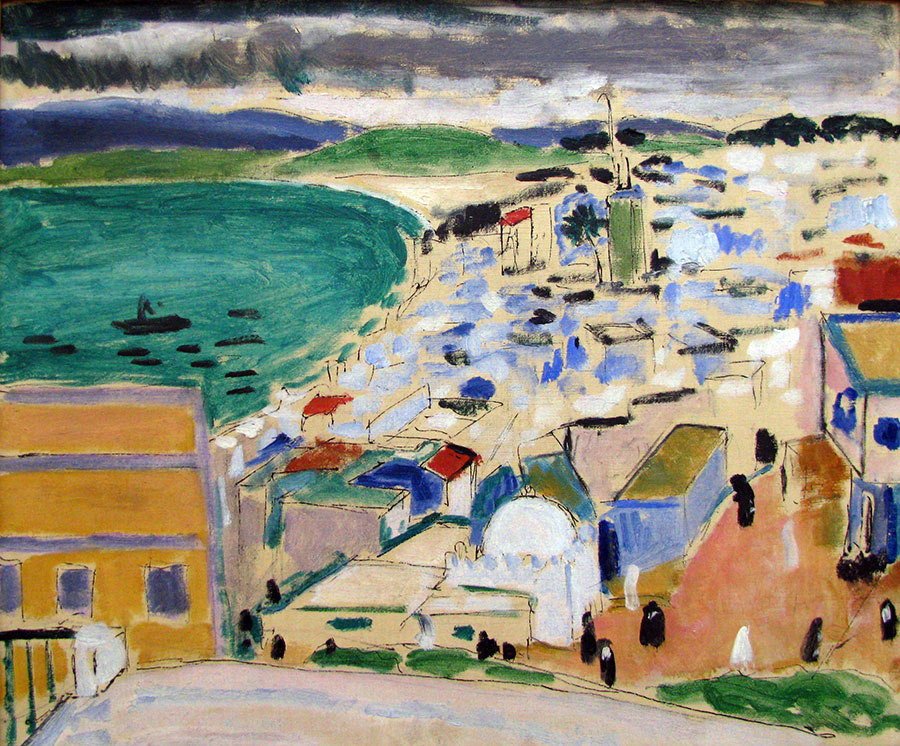
Henri Matisse’s “The Bay of Tangier” (1912) captures the Moroccan port from a high balcony with the directness of a traveler’s first intake of breath and the poise of a mature modernist. The canvas divides into two interdependent theaters: a green basin of water curving in from the left and a pale, sun-flattened city that spreads to the right under a weather front of slate and pearl. Buildings are simplified to blocks of ochre, rose, blue, and white; boats read as dark dashes; the minaret lifts like a slim piston; domes punctuate the roofs like cool stones. Rather than record detail, Matisse organizes sensation. The result is not a topographic map but an orchestration of light, temperature, and rhythm that lets the viewer feel the city’s air and hear the hush between gusts.
A High Balcony and the Cartographer’s Eye
Matisse chooses a vantage point that tilts the scene toward abstraction. From above, the bay becomes a semicircle of paint; the city becomes a scatter of rectangles and angled corridors. The parapet in the lower left confirms our perch and anchors the composition with a block of mustard and mauve. This high position allows Matisse to compress sea, shore, and architecture into a single shallow field. Streets are suggested by seams of sand color; plazas emerge where pigment thins; the promenade along the water slips by as a pale ribbon. The perspective is less optical than conceptual, a way of thinking through the landscape in broad units that can be tuned to one another.
Color Architecture and the Climate of the Scene
Color builds the city’s architecture more than line does. The bay’s green is not simply blue water warmed by sun; it is a saturated field pitched between emerald and bottle glass, glazed in places so that underpaint shows like currents. The city is constructed from pale creams and warm sands that absorb and reflect the sky, with local flashes—vermilion roofs, cobalt doors, blocks of olive—acting as signposts. The sky itself is a layered weather band: charcoal and silver gray press down at the horizon, a lighter veil floats above, and small rents of pale blue appear where the clouds thin. The full palette is restrained yet vivid, a balance that lets the painting feel both calm and alert.
Light, Weather, and the Drama of Edges
Much of the painting’s electricity comes from the meeting of zones. The green bay presses against the sand-colored city with a narrow line of creamy surf; the storm bank crushes the horizon, turning the distant hills into softer shapes; a spare highlight rides the minaret’s edge where sun finds it through cloud. Matisse works without theatrical shadows. Instead he uses adjacency—cool beside warm, light beside dark—to produce a state of illumination that feels true to coastal weather when the sky is heavy but the ground is bright. Edges carry the drama: where water meets land; where a white dome breaks from its blue neighbor; where a black boat stroke cuts the green.
Brushwork and the Honest Surface
The picture’s surface is frank. Scumbles of thin paint let the weave breathe; thicker dabs build the small roofs and the minaret’s shaft. The boats are pure calligraphy, quick horizontals and diagonal flicks that assert presence without volume. Buildings are blocked in with a loaded brush and then sometimes corrected by placing surrounding color against their edges, an additive way of drawing that keeps the forms lively. The sky shows long sweeps of gray dragged across lighter ground, a painterly equivalent to wind advancing over water. Nothing is fussed; nothing is gratuitous. The authority comes from decisions that are visible.
Space Without Anxiety
Matisse avoids deep perspective. The city does not retreat to a vanishing point so much as settle into a carpet plane that rises slightly as it approaches the horizon. The viewer experiences depth through overlap and scale, not through grids. A closer block at the left foreground is larger and more saturated; smaller, paler rectangles indicate distance. Where the minaret rises, it punctures the plane, providing a vertical counterweight and measuring rod for the city’s spread. This gentle geometry gives the painting stability while preserving the freedom of its brushwork.
The City as a Mosaic of Signs
Tangier appears not as an inventory of structures but as a mosaic of signs that stand for types of place: the white dome for a mosque or shrine, the thin tower for the call to prayer, the bright roof for a market stall, the ochre block for a house, the dark strokes for figures in motion. Because each sign is concise, the city remains legible even as it edges toward abstraction. Matisse respects the character of the place without slipping into ethnographic illustration. He paints the way memory assembles a city after a day’s walk: lights, turns, accents, and the handful of marks that make everything click.
Water as a Living Field
The bay is a single, breathing body of color. Matisse keeps it unified but alive by allowing striations and darker runs to drift across the green. A handful of boat marks sit on its surface; they read as craft and also as evidence of scale, reminding us how broad the curve must be to dwarf them so easily. Along the shoreline a thin band of sandy cream toggles between beach and surf, an ambiguous seam that tightens the join between elements. The water does not mirror the city; it converses with it as an equal partner in the composition.
Human Presence in Minimal Strokes
Figures are reduced to small, dark commas that cross plazas and streets. They are enough to give scale and to confirm that this is a lived environment. Because they are signs rather than portraits, they resist anecdote. They take their place in the larger order of the painting the way people take their place in the larger order of a city—important, mobile, transient. This restraint keeps the painting from becoming a narrative picture and allows the viewer to inhabit it freely.
Architectural Motifs and Sacred Geometry
Matisse isolates a few motifs with special care. The dome near the center-right is touched with cooler shadow and sits among buildings like a pearl in a tray. The minaret is given a spare drawing that distinguishes it from chimneys and poles, with a small crown near the top that acts as a rhythmic flourish. These sacred geometries are not oversized, but they orient the eye and temper the sea of rectangles with a round and a vertical. Their presence confirms that the painting is about more than logistics or scenery; it is about the forms through which a city signifies itself.
Dialogue with the Moroccan Series
“The Bay of Tangier” speaks to the intimate street paintings and courtyard scenes Matisse made during the same journey. In those, violet walls and white domes are shaped by intense sun and deep shade; here, the same elements are seen from above under a large sky. The palette overlaps—a family of greens, sandy neutrals, whitened blues—but the spatial idea differs. The balcony view forces Matisse to think like a mapmaker as well as a painter, laying out districts with chromatic blocks. The painting therefore bridges his Moroccan notations and his larger studio interiors from 1911–12, which also rely on large planes of tuned color to define space.
Musical Rhythm and the Pace of Looking
The eye moves across the canvas like a melody. It enters at the heavy block in the lower left, arcs along the bay, steps across the boat strokes, and then syncopates through the rooftops where red, blue, and olive occur in a pattern that feels improvised but intentional. The minaret rises like a held note before the eye descends into the white dome and the figures below. This musicality is not metaphor alone; it arises from placed intervals of hue and value that cue the viewer when to rest and when to quicken.
The Emotional Weather
Though the palette includes bright notes, the painting is not a sun-baked postcard. The sky’s dark band and the green’s thickness imply a shift in weather, perhaps a squall moving in from the Strait. That tension inflects the mood. The city glows not with noon dazzle but with the reflective light that precedes rain. Colors feel measured, perceptive, a little hushed. Matisse expresses not only place but time, a specific hour when the day’s energy bends toward threshold.
Modernism and the Ethics of Looking
The painting’s modernity is not a trick of simplification but a way of treating a foreign city with clarity and respect. Rather than harvest exotic detail, Matisse seeks structures that any viewer could recognize: a bay’s arc, a minaret’s thrust, a marketplace stitched from roofs, weather rolling across a horizon. He reduces only what obscures those relations. This ethic keeps the picture generous. It invites the viewer to complete the city with memory and imagination rather than consuming it as spectacle.
Lessons for Painters and Viewers
The canvas demonstrates that a coherent scene can be built with a handful of values and a disciplined set of shapes. Start with a major field—in this case the bay’s green—and tune every decision to its temperature. Use accents sparingly so they flare, not shout. Construct depth with overlap and scale; let edges do the work of light. Draw with color first and with line only where the silhouette needs to speak. Trust signs for the human and the sacred rather than descriptive cataloging. These lessons ripple beyond painting into photography and design, where limited palettes and strong intervals often yield the clearest results.
Enduring Relevance and Legacy
A century later, “The Bay of Tangier” still feels newly minted. Its green bay could anchor a contemporary poster; its blocky city anticipates aerial photography and modern mapping; its weather band teaches how a sky can be heavy without being opaque. The picture also points forward to Matisse’s cut-outs, where land and sea are sheets of color and boats are pure glyphs. Most importantly, it remains an image of hospitality. The city is open, the water paths are legible, the horizon is wide. The painting does not tell us what to think; it shows us how to look.
Conclusion
“The Bay of Tangier” is a lucid act of translation. From a high balcony, Matisse translates a harbor, a city, and a weather system into a suite of tuned color planes. The bay’s green, the sand’s cream, the sky’s gray, the minaret’s slender lift, the domes’ pearls, the boat strokes and figure commas—together they construct a world that the eye believes and the spirit recognizes. This is the art of seeing pared to essentials, not to make the world smaller, but to make our attention larger. In this painting, the Mediterranean meets the Atlantic, land meets sea, and modern vision meets a very old place with tact and wonder.