Image source: wikiart.org
An Early Epic Of Faith And Encounter
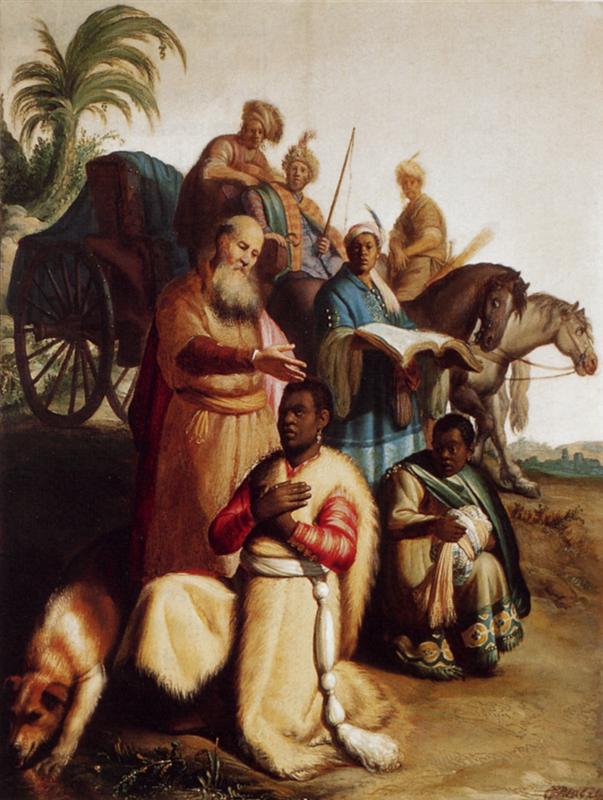
Rembrandt’s “The Baptism of the Eunuch” (1626) is one of the most ambitious narrative pictures from his Leiden years. The canvas stages a charged moment from the Acts of the Apostles: the deacon Philip has explained a passage of Isaiah to an Ethiopian court official traveling home from Jerusalem; moved to belief, the traveler stops his retinue to receive baptism. Instead of distant spectacle, Rembrandt offers a close, humane vision of conversion as dialogue—bodies gathered in a ring of attention, hands speaking alongside faces, light crystallizing conviction.
The Story And Why This Moment Matters
Acts 8 tells how Philip encounters a high-ranking Ethiopian, a guardian of the queen’s treasury, reading scripture in his chariot. After Philip “opened his mouth” and preached Jesus, they come to water and the eunuch asks to be baptized. Rembrandt fixes the moment at the edge of action: the deacon’s blessing hand hovers; the kneeling official crosses his hands at his chest; attendants look on with alert seriousness; the chariot waits. This choice compresses backstory and consequence into a single beat—the threshold where understanding becomes commitment.
Leiden, Lastman, And The Formation Of A Narrator
Painted when Rembrandt was about nineteen or twenty, the work bears the imprint of Pieter Lastman, his Amsterdam teacher famed for crowded history scenes, exotic costume, and rhetorical gesture. Yet it also declares the young painter’s independence. Lastman’s stagecraft remains—the procession, the column of onlookers, the careful props—but Rembrandt deepens the psychology, letting light and touch say what emblems usually would. The picture is a manifesto for his early approach: moral clarity carried by faces, hands, and a lucid beam of illumination.
Composition As A Circle Of Witnesses
The composition spirals around the kneeling convert. At the front left a dog noses the ground, then the curve returns through Philip’s standing figure, rounds the open book held by an attendant, and completes the loop at the kneeling companion to the right. Behind them, the retinue climbs into the distance: grooms, riders, a driver perched at the chariot, and a bannered guard. Spears, reins, and staffs rise like a palisade, holding the vortex of attention in an open-air chapel. Nothing is scattered; every glance bends toward the baptismal act. The result is a civic liturgy performed on a roadside.
Light That Names What Matters
A steady, high light pours from the right, bathing the convert’s face and the deacon’s forearm, brightening the open scripture, and licking the flanks of horses and the chariot’s wheel. The brightest triangle is the one formed by Philip’s blessing hand, the Ethiopian’s upturned cheek, and the white fur sash that drapes his robe. This triangle becomes the theological predicate: grace offered, faith received, new identity clothed. Farther up the composition, illumination thins into a pearly atmospheric wash, letting the retinue remain present without usurping the core drama. Even at this early date, Rembrandt uses light as ethical syntax.
Color And The Temperature Of Belief
The palette marries warm earths with enamel-like accents. Philip’s garment blends rose and tawny ochre; the eunuch’s outfit glows with coral sleeves under cream and white furs; the attendants wear cool blues and greens that steady the scene. A burst of verdure curls behind the chariot, its fresh green answering the new life the sacrament represents. Flesh tones are lively and varied: the deacon’s seasoned complexion, the convert’s deep brown warmed by reflected light, the attendants’ differing hues rendered with respect. The overall temperature is warm but tempered—a narrative heated by conviction rather than spectacle.
Costume, Rank, And The Politics Of Cloth
Clothing is meaning here. The Ethiopian’s rich attire signals status—sash and fur, finely dyed textiles, and a belt with knotted tassels. Philip’s simpler, earth-toned garments mark him as a man of service rather than station. The attendants’ layered blues and greens identify a well-appointed court on the move. Rembrandt’s fascination with global textiles inflects the scene without drowning it; costume supports the narrative by clarifying roles, not by stealing attention. The costly chariot, with its billowing canopy and carved wheel, confirms the official’s high position and the significance of his decision.
Gesture As The Language Of Conversion
Hands do much of the talking. Philip’s right hand extends in an unmistakable blessing, palm soft, fingers calm. The eunuch crosses his hands over his heart, a universal grammar of assent and humility. The attendant holding the book steadies it with both palms, displaying the authority that prepared the moment. A kneeling companion at right gathers his robe with one hand while the other rests on his chest, an echo of the convert’s posture that multiplies the scene’s concentric assent. Even the driver, reins looped loosely in hand, leans back slightly, granting time for the rite. No gesture is theatrical; each is legible and humane.
Reading And Water: The Twin Engines Of The Scene
Acts emphasizes two elements: understanding scripture and encountering water. Rembrandt places both in the viewer’s path. The opened book, heavy and legible, sits between Philip and the eunuch like a witnessed contract. The pool or stream lies just out of frame, implied by the moist channel at their feet and the posture that precedes movement toward it. This near-absence of literal water is eloquent. The baptism is already taking place in desire and consent; the physical immersion will seal what belief has begun. The painting therefore honors both word and sacrament without over-literalizing either.
Faces That Carry The Weight Of Story
Rembrandt’s young eye is already a connoisseur of faces. Philip’s is grave and tender, beard catching the light along its ridges. The convert’s face is a portrait of alert peace—eyes lifted, mouth relaxed, the flicker of earlier questions now quieted. The book-bearer looks on with the quiet pride of someone who has watched meaning dawn in another. The kneeling attendant at right registers watchful solidarity. Even those farther back—the rider glancing over a horse’s ear, the guard behind the canopy—feel particular, not generic. The scene persuades because it could be remembered by each of these witnesses as their event.
Horse, Dog, And The Natural World As Chorus
Animal presence grounds the sacred in the ordinary. The dog at lower left sniffs the earth, oblivious to doctrine but sensitive to the sudden stillness that has descended; it is a tiny barometer of atmosphere. The horses stand patient and monumental, their muscles modeled by the same light that sanctifies the rite. A wind-whipped palm anchors the left edge, its fronds scribing the air like a script of movement that will resume after baptism. The world does not pause so much as accommodate, allowing a pocket of time where eternity leans close.
Space, Distance, And The Traveling Court
Rembrandt opens the scene into depth—chariot behind, riders still farther, a small settlement on the horizon at right. The road curves away, promising continuation. This sense of movement matters. The story is a hinge in the spread of the Gospel beyond Jerusalem; the official will carry news into another land. The painting’s space therefore functions as narrative prophecy: out of this roadside sacrament a path radiates into the distance. The young painter suggests this without banners or inscriptions, only by the logic of a caravan interrupted and soon to move on.
Race, Dignity, And Seventeenth-Century Seeing
The subject gave Rembrandt an opportunity rare in European art of his time: to place a Black protagonist at the luminous center of a biblical drama with full dignity. The Ethiopian is depicted neither as an exotic accessory nor a caricature. He is the moral focus—well dressed, composed, and endowed with agency. The artist’s interest in varied physiognomy, already evident in his studies and tronies, here underwrites a theologically serious representation: grace arrives without respect to rank or ethnicity, and the painting’s structure enacts that claim by giving the convert the picture’s finest light.
Theology Written In Pictorial Terms
Without halo or visionary burst, Rembrandt writes a theology of calling in painterly syntax. Light suggests revelation; hands enact consent and blessing; the open book provides source and warrant; the company of witnesses embodies church and world. The choice to set the act on land rather than dramatic, splashing water keeps the emphasis on inward change that seeks outward sign. Even the diagonal that runs from Philip’s hand to the eunuch’s heart and down to the small stream traces an invisible sacramental logic.
Technique And The Pleasure Of Surfaces
The brush handling is confident and varied. Fur and hair are built with short, lively strokes that catch highlights like frost; the blue garments of attendants are laid in smoother planes that hold light calmly; the horses’ hides are modeled with supple mid-tones and sparing brights at the withers and muzzles. The open book shows parallel lines of music-like script; its edges buckle where pages lift, a splendid observation of use that makes the object convincing. Flesh is thinly glazed so that warmth seems to rise from within. Even the dusty track at their feet bears small, persuasive footprints of the retinue, proof that painting can tell truth with minutiae.
Comparison With Contemporary Works
Side by side with Rembrandt’s other canvases from 1625–1627—“The Stoning of St. Stephen,” “Balaam’s Ass,” “History Painting,” and “David Offering the Head of Goliath to King Saul”—this work shows a shift from crowded violence to intimate conviction. The diagonals and exotic dress learned from Lastman remain, but the climactic energy is gentler and more interior. Where those scenes throttle forward on crisis, this one breathes. The drama here is in a choice made, not a blow struck. The artist’s direction is clear: toward stories where light and attention do the heavy lifting.
The Viewer’s Role And The Ethics Of Looking
The vantage point places us almost at the convert’s shoulder. We are close enough to hear Philip’s voice, close enough to read the book if we leaned in. That intimacy obliges respect. The painting models how to attend a sacred moment without intruding on it. Our gaze is invited to follow the blessing hand, rest upon the upturned face, and then travel outward across the company that will bear witness. The ethics taught by the composition—draw near, see clearly, don’t steal the scene—echo Rembrandt’s larger artistic creed.
Reading The Picture Slowly
Begin with the bright triangle of hand, face, and fur; let your eye step to the open book; rise to the attendant’s steady gaze; then cross to the kneeling companion’s quiet assent. Drift to the horses, the driver, the banner, and the palm; notice how each returns your eye to the center. On another pass, register the small dog, the texture of the earth, the way light crawls along reins and stirrups. The scene becomes a hum of coordinated attention, and the baptism feels not staged but discovered.
Enduring Meanings In A Roadside Sacrament
What lingers is not the paraphernalia of rank or the exotic sight of a traveling court but the humility of people making room for a decision. The painting maps how belief moves through a community: scripture read, sense made, consent given, witnesses gathered, life resumed with new direction. In this sense the picture is both devotional and civic. It honors private conviction and the public forms that welcome it. For an artist barely out of his teens, that is a remarkably mature insight into how change—spiritual, social, personal—actually happens.
A Young Master’s Signature Already Legible
Light as moral argument, hands as language, faces as landscapes of thought, attention as the true subject—these are Rembrandt’s lifelong signatures, already legible here. “The Baptism of the Eunuch” shows the teenage painter doing what he would do better than almost anyone: turning scripture into a human scene where grace looks like people listening to each other in good light.