Image source: wikiart.org
A Threshold Between Earth and Heaven
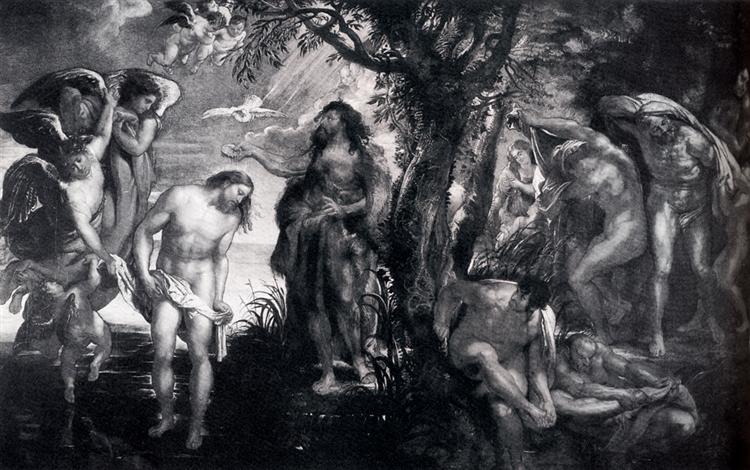
Peter Paul Rubens’s “The Baptism of Christ” (1605) is a young master’s ambitious attempt to compress a cosmic turning point into a single, breathable scene. The Jordan flows at the painting’s left, its water brightened by an opening heaven; at center stands John the Baptist beneath a tree whose leaves catch the same light; at the river’s edge Christ bows his head in obedient acceptance while angels hover with towels and garments. On the right bank, penitents and bystanders crowd forward, stripping, kneeling, and recoiling—humanity in multiple attitudes of awakening. Above, a burst of radiance parts the clouds as the Spirit descends, and the visual world registers that descent: muscles relax or tense, fabric billows, foliage flickers. Rubens’s design makes the sacrament feel less like a liturgical illustration and more like weather—an event that moves through bodies, water, and air.
Context and Ambition in the Early Italian Years
Dated to 1605, the picture belongs to Rubens’s Italian period, when he absorbed Venetian color and atmosphere, Roman monumentality, and the Carracci reform’s insistence on clear, moving narrative. Large multi-figure sacred scenes were the proving ground for any painter with public ambitions. “The Baptism of Christ” lets Rubens experiment with several problems at once: how to stage a miracle without losing human intimacy, how to blend landscape and figure so that nature cooperates with theology, and how to balance the humility of Christ with the authority of revelation.
A Composition That Reads as a Procession
Rubens divides the canvas into two interlocking arcs. On the left, a luminous semicircle of heaven opens, sending down soft diagonals of light. Its earthly echo is the curved shore of the Jordan where angels gather around Christ. On the right, a steeper curve of figures swirls inward from the shadowed bank—nude men preparing to enter the river, a kneeling penitent, and others twisting in the cool gloom. The tree at center is the hinge. It roots the scene in the here-and-now yet points upward, its branches catching the same illumination that blesses the water. The eye reads the whole as a procession: from right to left we move from pre-baptismal struggle into the river’s light; from left to right, divine presence pours into the world. Two currents—human desire and divine grace—meet at the bowed head of Christ.
Christ’s Humility and the New Adam
Christ stands with head inclined, hands relaxed, and body slightly turned toward John—a posture of consent rather than passivity. Rubens resists a theatrically heroic Christ; instead he presents the Second Adam in dignified vulnerability. The softened musculature and the gentle fall of light across chest and shoulder make the body read as incarnate rather than idealized. The theological message is clear: by stepping into the water, the sinless one enters our condition completely, so that the world he came to save can rise with him. Rubens’s decision to modulate the figure’s strength with tenderness foreshadows his later ability to make sacred bodies both monumental and touchable.
John the Baptist as Prophet of Thresholds
At the center under the tree, John wears his rough camel-hair garment, cinched and wind-stirred, a visual counterpoint to the angels’ soft fabric. He neither dominates nor disappears. One hand may be lifted in blessing, the other holding the vessel or indicating the water; his face is turned to Christ as if listening for the Father’s voice that will soon be heard. Rubens gives John the bearing of a hinge between covenants: the last prophet of the old order, the herald of the new. The painter adds a vegetal halo of leaves behind the prophet’s head, transforming the tree into an organic nimbus that binds wilderness to liturgy.
Angels as Ministers of Mercy
At the left, youthful angels lean forward with towels and garments, their wings catching glints of the same light that touches the surface of the river. They are not mere spectators but ministers—diaconal figures who prepare to clothe Christ at the completion of the rite. Their attitudes show affectionate attentiveness: one bends to gather a garment, another steadies it, a third glances upward as if aware of the descending Spirit. The tender interplay of hands and cloth introduces the painting’s domestic intimacy, balancing the grandeur of revelation with the familiarity of care.
Penitents and Onlookers: Humanity in Many Keys
The right bank becomes a study in spiritual psychology. A kneeling figure fumbles with sandals, more preoccupied with practical preparation than with spectacle. Behind him, a man turns away, his torso twisting as he undresses, revealing the labor of conversion—awkward, vulnerable, necessary. Further back, others help a companion down the rocky incline while a figure in near-silhouette braces himself with arm raised, as if shading the eyes from the sudden radiance. Rubens refuses to stage a crowd of identical emotions. Instead he choreographs a spectrum, from tentative interest to ardent desire to bashful hesitation. The baptism is therefore not just Christ’s; it is potentially everyone’s—an invitation to multiple kinds of readiness.
The Dove and the Rays: How to Paint a Voice
Scripture records the Father’s voice and the Spirit descending like a dove. Painting cannot depict a voice directly, but Rubens comes close: angled shafts of light fall from the opening sky like audible lines, and the dove rides their center. The rays strike the water and the angels’ garments, alerting the eye that the miracle is not confined to the air; it touches ground, skin, and cloth. With this device Rubens solves a persistent problem of sacred art—making invisible grace legible—by turning light into event.
Water as Actor, Not Background
The Jordan is more than a reflecting pool. Rubens paints it as living substance responding to contact. Around Christ’s legs, water brightens; under the angels’ feet at the bank, it takes on silvery texture; further left, it widens into a placid reach that reflects the sky’s openness. Theologically, water symbolizes both death and birth. Rubens’s handling respects that double meaning by letting the surface carry a gentle gravity while also flashing with life. The river does not merely stand for grace; it channels it.
The Tree as a Living Cross
The tree that divides the composition is gnarled at the roots and leafy at the crown—a living cross that embodies both struggle and fertility. Its trunk anchors John; its branches shelter Christ; its leaves echo angel wings. Rubens often integrates arboreal forms into sacred narratives as partners of meaning. Here the tree also organizes space: it allows the right bank to remain in a cooler tonality while the left brightens, guiding the viewer’s moral movement through the picture.
Chiaroscuro and the Morality of Light
Rubens’s chiaroscuro is more than a technical flourish; it carries narrative weight. On the right, darker values describe the labor of approach. In the center, mid-tones steady the eye at John’s fur and bark textures. At left, a higher key registers the divine initiative. Because these zones merge rather than collide, the painting avoids didactic harshness. The moral is not that darkness and light are two kingdoms fighting; rather, light seeps into shadow and claims it, the way baptismal grace works on human time.
Color and Venetian Memory
Although often reproduced as a monochrome, the original painting breathes a Venetian palette: warmed flesh, mossy greens, azure distances, and the lambent whites of garments brushed with golden light. Rubens learned from Titian and Veronese how to unify crowds with color harmonies instead of drawing alone. He applies those lessons by curating warm-cool dialogues across the canvas: cool water against sunlit flesh, the Baptist’s tawny garment against leafy greens, the angels’ pale linen against sky. The coloristic discipline keeps the scene cohesive while allowing highlights—like the descending rays—to sing.
Gesture as Theology
Look at the hands. Christ’s hands release tension, the fingers long and ungripped—an enacted “fiat.” John’s hand, by contrast, articulates purpose: either blessing or pointing with a prophet’s economy. The angels’ hands gather and offer; the penitents’ hands tug at straps, shield eyes, or brace bodies against stone. These distinct gestures become a silent catechism of the sacrament: consent, invocation, service, preparation. Rubens knows that in religious painting, hands evangelize as eloquently as faces.
Bodies That Believe
Rubens’s bodies are never mannequins for ideas; they are believing flesh. Christ’s torso inclines with humility that reads through muscle and bone; the kneeler’s back displays the awkward beauty of piety in transition; even the angelic youths wear the fatigue and pleasure of service in the subtle set of their shoulders. This incarnational honesty prevents the painting from turning ethereal. Christianity here is not a vapor; it is a choreography of weight, temperature, and touch.
The Role of Landscape in Salvation History
The small stretch of horizon at left—water meeting distant shore under an airy heaven—expands the event’s scope. The world beyond this bank will be reached by the ministry that begins here. Rubens uses atmospheric perspective to let the future into the picture: tones open, textures relax, and a wider air invites attention past the immediate drama. In the painter’s hands, landscape becomes eschatology, a visual promise that what happens at the Jordan will wash outward to the ends of the earth.
Sources, Influences, and Rubens’s Synthesis
Rubens likely consulted earlier Baptism compositions—Raphael’s clarity of grouping, Veronese’s airy opulence, the Carracci school’s narrative lucidity. From each he borrows and transforms. Raphael supplies equilibrium around the central axis; Veronese contributes luminous fabrics and hospitable sky; the Carracci add muscular credibility and moral readability. Rubens’s particular infusion is warmth—heat in color, generosity in flesh, and a willingness to let divine and human registers mingle without suspicion.
The Narrative of Before, During, After
Rubens compresses temporal sequence into one frame. On the right we see “before”: undressing, fear, preparation. At center we see “during”: blessing, water, the dove’s descent. At left we glimpse “after”: attending angels ready to re-clothe, a clearing sky, the first steps from water to ministry. The painting therefore becomes a sacramental timepiece. Every believer stands somewhere in this arc; every viewer can locate their own narrative within it.
Theology of Clothes and Nakedness
Robes and nudity communicate more than decorum. Christ’s near-nakedness witnesses to Adam restored; the angels’ readiness with garments suggests the church’s maternal care; the penitents’ struggle with clothing dramatizes the exit from old life and the entry into new. Rubens stages these wardrobe moments with sympathetic detail: a strap tugged loose, cloth pooled at ankles, linen weighed by river damp. The scene’s human modesty is maintained, but its theological candor—what must be shed, what will be given—is unmistakable.
Sound, Movement, and the Implied Liturgy
Although the picture is silent, Rubens implies a liturgy of sound: the low current of the river, angels’ soft speech, John’s measured words, a piercing avian cry, and the unheard but felt voice of the Father. Movement supports that soundtrack: wings fold and tilt; water licks and laps; a garment unfurls; muscles release as grace lands. The spectator senses a rite rather than a tableau, a sequence we can almost join. Such participatory design is essential to Rubens’s sacred art: it wants not only to be looked at but to be entered.
Why the Picture Still Speaks
Modern eyes, familiar with baptism as ceremony, can overlook its daring humility: the boundless Word steps into a small river with ordinary sinners. Rubens recovers that astonishment by making the miracle land physically—light on leaves, water around knees, hands busy with towels. The image’s humanity becomes its apologetics. We are moved not by distant abstraction but by a world we recognize, kissed by a light we desire. In an age that often separates spirit from body, Rubens binds them with painterly conviction.
Legacy Within Rubens’s Oeuvre
“The Baptism of Christ” announces motifs that will mature through Rubens’s career: the tree that doubles as cross or column; the river or sea that acts with personalities of its own; crowds shaped into readable currents; and a color world where warmth and clarity collaborate. Later altarpieces will roar with more monumental confidence, but the theological intelligence—and the charity toward bodies—are already present here.
Conclusion: Water, Light, and the Human Yes
Rubens’s early “Baptism of Christ” offers a theology of nearness. Heaven breaks open, but not to terrify; angels descend, but to serve; a prophet commands, but to invite; a Savior bows, but to raise. The painter catches that paradox in the way light behaves, the way flesh relaxes, and the way a river receives a step. We leave the canvas with the sense that grace is not a thunderbolt but a tide—persistent, luminous, and strong enough to carry a world.