Image source: wikiart.org
Introduction
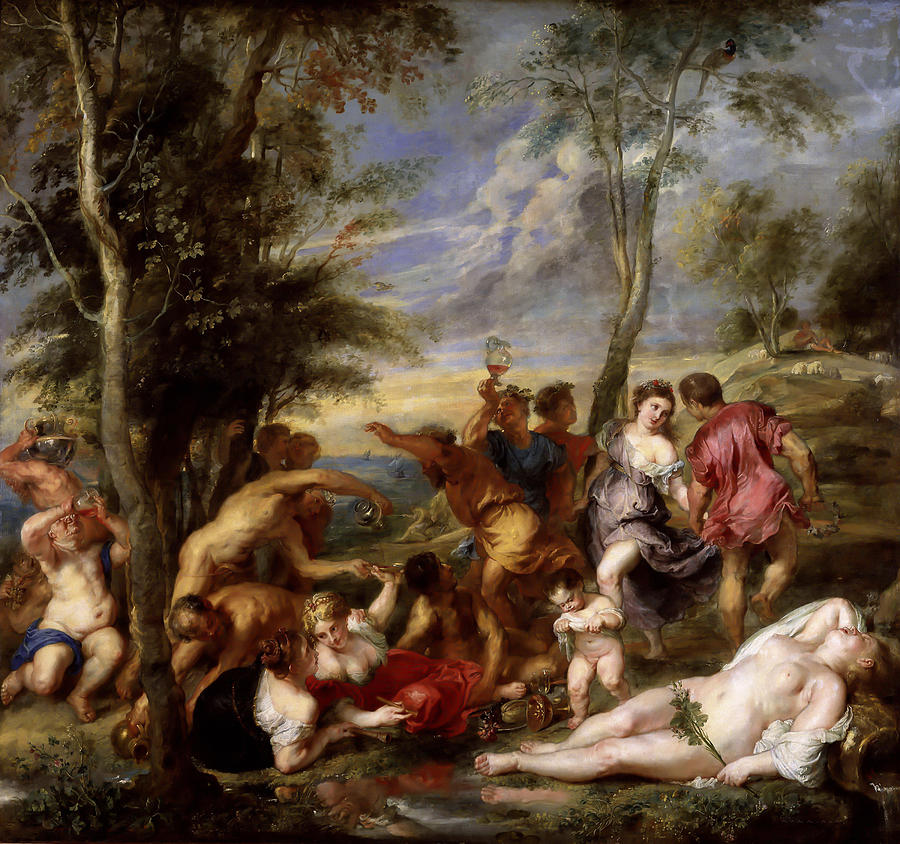
“The Bacchanal of the Andrians” by Peter Paul Rubens is an exuberant celebration of wine, sensuality, and communal abandon. In this sprawling mythological scene, Rubens brings together nymphs, satyrs, children, and revelers who surrender themselves to the ecstatic cult of Bacchus. The painting is usually connected to Titian’s famous “Bacchanal of the Andrians,” and Rubens’ version is both homage and reinvention: he embraces the Venetian love of color and atmosphere, while amplifying the muscular energy and emotional intensity that define his own Baroque style.
The island of Andros, legendary for its spring that flowed with wine, provides the thematic setting. Yet the painting is less a topographical record than a vision of what it means to give in to appetite and joy—wine overflowing, bodies sprawled, music and dancing merging with a glowing landscape. Rubens’ “Bacchanal” becomes a layered meditation on pleasure, fertility, and the thin line between harmony and excess.
Mythological and Cultural Background
In classical mythology, the Andrians were particularly beloved of Bacchus, god of wine. According to ancient authors, a stream on the island ran not with water but with wine during Bacchic festivals. Renaissance and Baroque artists seized on this theme as a way to explore the pleasures and dangers of intoxication. A bacchanal scene allowed them to combine landscape, nude figures, still life, and expressive gesture in one composition.
Rubens, a scholar as well as a painter, knew the antique sources and had studied Titian’s great Bacchanal in Madrid and elsewhere. He admired the Venetian master’s warm color and the natural ease of his nude figures. In his own interpretation, Rubens takes the mythological template and infuses it with his distinctive exuberance. The result is not a moralizing condemnation of drunkenness, but a complex vision where the sensual, the comic, and the slightly ominous coexist.
Overall Composition and Movement
The composition is organized in a broad horizontal sweep, framed by trees on the left and right. The figures crowd the foreground, unleashing a wave of movement that flows diagonally from the bottom left, where reclining women and men share wine, toward the right, where a nude woman lies collapsed beside a reflective pool. In the middle distance, dancers raise jugs of wine and swirl in rhythm, while in the far background the landscape opens toward hills, sea, and small pastoral details such as grazing sheep.
Rubens arranges his figures in clusters that overlap and interlock. Bodies bend, twist, and reach in many directions, creating a dynamic web of diagonals. Yet amid this complexity, the viewer’s eye moves easily through the scene. The path of vision begins with the reclining woman in red and white in the lower center, travels up the arm that extends toward the stream of wine, follows the arc of standing revelers lifting pitchers, and finally arrives at the group of dancers and the receding landscape.
This compositional flow mirrors the very theme of the painting: wine poured out, consumed, and diffused through the bodies and moods of the participants. The scene feels animated by an invisible current that connects all figures in shared intoxication.
Figures of Revelry and Abandon
The left side of the composition is crowded with figures who drink directly from jugs, pour wine into bowls, or lounge in satisfied stupor. Rubens revels in the depiction of flesh: muscular backs, rounded bellies, and glistening limbs. These bodies are not idealized in a cold classical sense; they are warm, heavy, and sensually alive.
One man in a blue drapery sits with his head thrown back and a jug tipped to his mouth, his torso twisting in exaggerated effort to drain the last drop. Nearby, another figure leans forward, arm extended, as he helps refill containers from a stream of wine. The abundance of drink is emphasized by the multiple vessels scattered on the ground—pitchers, goblets, and cups catching the overflowing liquid.
In the center, a cluster of women recline on the grass. One in a rich red dress, crowned with flowers, turns to converse with her companion. Their postures are relaxed but animated, as though caught in the middle of laughter or teasing conversation. Rubens captures small details of intimacy: a hand touching another’s arm, a shared glance, the tilt of a head framed by elaborate hair.
The Dancing Pair and the Child
Toward the right, a young woman crowned with leaves and flowers performs a playful dance with a male partner. Her lilac-grey dress swirls around her knees as she steps forward, one arm lifted in a gesture that is both flirtatious and rhythmic. The man in a reddish tunic mirrors her movement, leaning in with a grin. Their dance is informal yet expressive, embodying the spontaneous joy that wine inspires.
At their feet stands a small child, chubby and unsteady, attempting to participate in the revelry. He holds a cup or small vessel, wiping his mouth with his hand as if tasting the intoxicating drink. The presence of the child underscores the theme of fertility and continuity: this is a community in which joy, wine, and life flow on to the next generation. At the same time, the image of a drunken toddler carries a hint of the unsettling, reminding viewers that excess reaches even the youngest.
The Reclining Nude and the Edge of Excess
The most striking figure on the right is the nude woman stretched out horizontally near the water’s edge. Her body is luminous, with pale flesh that catches the light in broad, smooth passages. One arm shields her eyes, perhaps from the setting sun or from the dizziness of drink; the other rests limply beside her. A garland of leaves lies across her hips, and a piece of drapery slips away, emphasizing her vulnerability.
This reclining figure can be read in several ways. On one level, she embodies the sensual pleasure and physical relaxation that follow prolonged drinking. Her languor anchors the painting’s overall theme of indulgence. On another level, she introduces a note of danger or consequence. Her pose is almost too slack, suggesting unconsciousness rather than peaceful sleep. The proximity to the water hints at the risk that accompanies surrender to intoxication. Rubens allows this ambiguity to stand, inviting viewers to sense both attraction and unease.
Landscape, Sky, and Atmosphere
While the human figures dominate the foreground, the landscape plays a vital supporting role. Trees rise on either side, their trunks twisting and branches swaying in rhythms that echo the movements of the dancers. The foliage is painted in loose, varied strokes, mottled with light and shadow. Through gaps in the trees, the viewer glimpses distant hills, a sliver of sea with tiny ships, and sheep grazing on far-off slopes.
The sky is particularly expressive. Rubens fills it with billowing clouds in blues, greys, and warm creams, touched by the low sun. Streaks of light break through, illuminating patches of land and creating a sense of transitional time—perhaps late afternoon or early evening as the feast continues. The sky’s restless energy reflects the emotional turbulence of the bacchanal below.
This integration of figures and landscape is quintessentially Rubensian. The natural world does not merely frame human activity; it participates in the mood. Trees lean, clouds swirl, and the very air seems infused with the aroma of wine and the sounds of music and laughter.
Color and Sensual Richness
Color is one of the painting’s greatest pleasures. Rubens draws on a warm, saturated palette dominated by fleshy pinks, ruddy browns, deep reds, and shimmering golds. Against these warm tones he sets cooler touches: the blue drapery of the drinking man at left, the grey-lilac dress of the dancing woman, the subtle greens of foliage and grass.
The interplay of warm and cool colors creates visual excitement and depth. Flesh tones glow against the surrounding environment, making the bodies feel present and tangible. Rubens also exploits the translucency of wine itself: in some raised glass vessels, the red liquid catches the light, creating tiny gems of color that punctuate the scene.
The handling of paint is loose and confident. Broad strokes describe fabric and foliage, while softer blending models the bodies. Highlights on shoulders, knees, and cheeks give the impression of sweaty, sun-warmed skin, appropriate to a festival of drinking outdoors. Overall, the chromatic richness reinforces the theme of abundance: nothing is sparse or restrained.
Human Nature, Pleasure, and Moral Ambiguity
Rubens’ “Bacchanal of the Andrians” is not a simple moral lesson, yet it invites reflection on human nature. On one hand, the painting glorifies communal pleasure. The andrians are not solitary drinkers; they revel together, sharing jugs and gestures, music and dance. There is a sense of release from social restraints, a return to a more primal, instinctive mode of being.
On the other hand, signs of overindulgence are present. Some figures already appear drunk to the point of collapse, and the reclining nude suggests a body overwhelmed. The child struggling with wine hints that the culture of excess is pervasive. Yet there is no overt moralizing symbol—no stern satyr or god intrudes to punish them, no explicit narrative of downfall.
This ambiguity reflects a Baroque fascination with the tensions between body and spirit, reason and passion. Rubens seems to recognize the irresistible appeal of sensual pleasure but also the way it can blur boundaries and invite vulnerability. Viewers are left to weigh their response: do they identify with the joy of the bacchanal, or do they feel unease at its extremity? The painting accommodates both reactions.
Rubens and the Legacy of Titian
The connection with Titian’s earlier “Bacchanal of the Andrians” is important. Rubens admired the Venetian master’s ability to integrate figures and landscape in luminous color. In his own version, Rubens preserves the key idea of a hillside gathering of revelers by a wine-filled stream, yet his approach is more muscular and theatrical.
Where Titian’s figures often possess a soft, atmospheric quality, Rubens’ bodies are more robust, nearly sculptural in their presence. Movement is more exaggerated, gestures more emphatic. The landscape, too, becomes more turbulent, with bolder contrasts of light and shade. Rubens effectively translates the Venetian bacchanal into a Baroque key, adapting it to the tastes and expectations of his own patrons while paying homage to the Italian tradition he revered.
This interplay between imitation and innovation exemplifies Rubens’ broader career. He frequently studied and copied older masters, but his versions are never mere replicas. In “The Bacchanal of the Andrians,” he absorbs Titian’s poetic mood and refashions it into an even more exuberant spectacle.
Sensory Experience and Viewer Involvement
One of the painting’s greatest strengths is its capacity to involve the viewer sensorially. Rubens does not just show us people drinking; he makes us almost feel the warmth of the sun, the coolness of the stream, the roughness of bark under a reclining arm, the weight of a wine jug lifted to the lips. The vivid depiction of bodies in contact—people leaning on one another, tugging, embracing—reinforces a sense of shared physical presence.
The viewpoint is close to the ground, as if the spectator sits on the grass among the revelers. This proximity erases any safe distance. The reclining nude nearly spills into the viewer’s space, and the child near the center stands at a level that invites eye contact. The painting thus becomes not an illustration of a distant myth but an invitation to join the feast, at least imaginatively.
At the same time, the viewer occupies a privileged position: able to see the whole composition, we can observe the accumulating signs of excess and reflect on them, even as the participants, lost in the moment, cannot. This duality is central to the painting’s power.
Conclusion
“The Bacchanal of the Andrians” by Peter Paul Rubens is a vibrant, multifaceted exploration of human pleasure, communal festivity, and mythological fantasy. Drawing inspiration from Titian and from classical sources, Rubens stages an island celebration where wine flows freely, bodies move with joyous abandon, and the natural world seems to sway in sympathy. The painting dazzles with its rich color, robust figures, and intricate composition, yet it also leaves room for thoughtful reflection on the edge between joyful freedom and dangerous excess.
Through the reclining nude, the drinking men, the playful dancers, and the child tasting wine, Rubens presents a panorama of responses to intoxication: relaxation, exuberance, seduction, vulnerability. The viewer is both participant and observer, drawn into the sensory appeal while invited to consider its consequences. In this way, “The Bacchanal of the Andrians” remains a compelling masterpiece—an image of overflowing life that captures the complexity of human desire under the patronage of Bacchus.