Image source: wikiart.org
Introduction to The Assumption of the Virgin
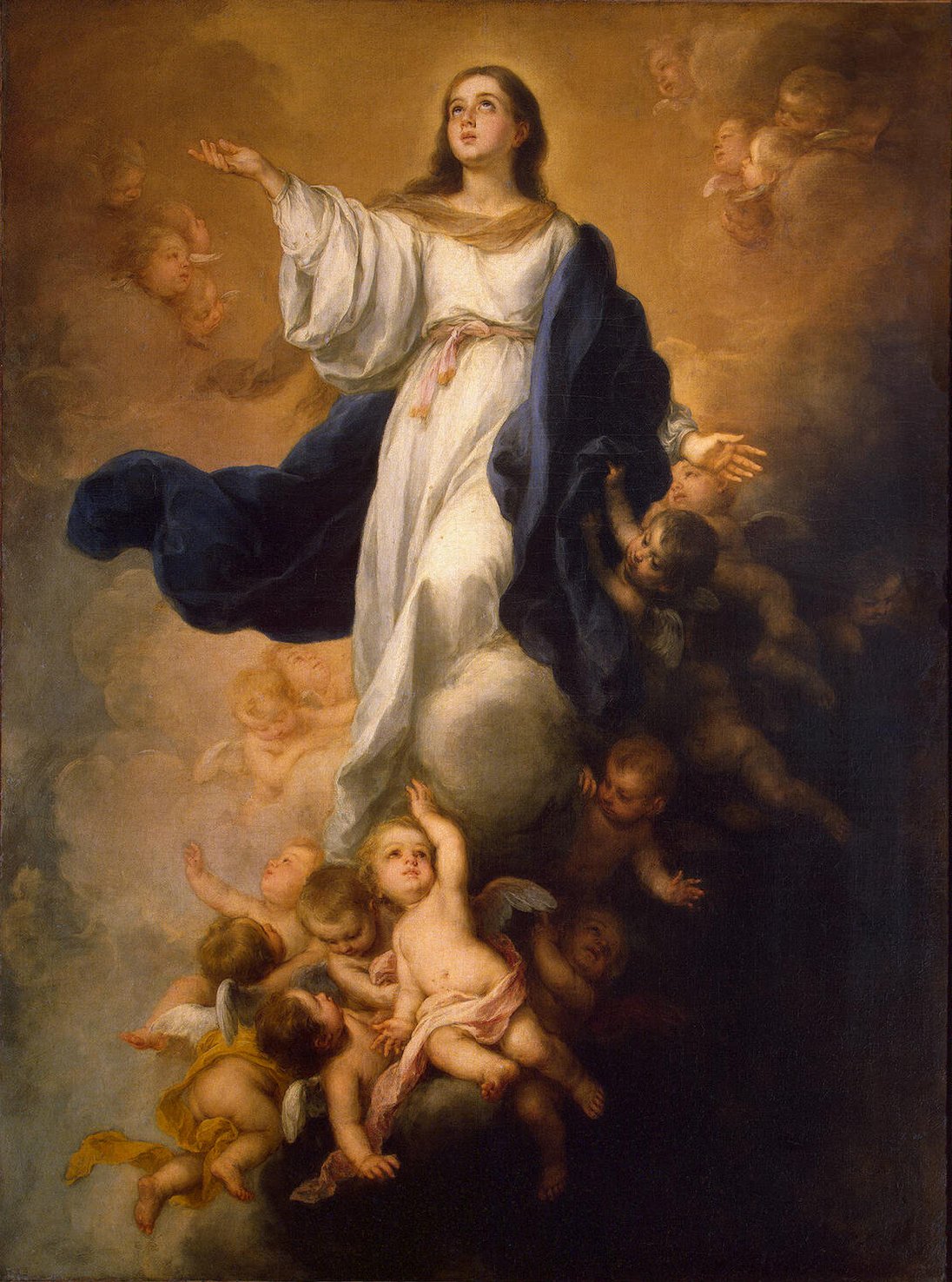
“The Assumption of the Virgin,” painted by Bartolomé Esteban Murillo around 1670, is one of the most lyrical and uplifting images of the Virgin Mary in seventeenth century Spanish art. In this large canvas Murillo imagines the moment when Mary is taken up into heaven, surrounded by clouds and a host of cherubs. Floating in a glowing atmosphere of gold and soft blue, she appears as both a young woman and a spiritual ideal, serene yet emotionally alive.
Murillo produced several versions of Marian themes throughout his career, but this Assumption stands out for its combination of doctrinal clarity and deeply human feeling. The Virgin is shown not as a distant queen but as a gently transfigured woman, carried aloft by the joyful energy of the angelic children at her feet. The viewer is invited to look upwards with her, sharing her sense of awe and trust.
The painting was created in Seville, a city that cherished the cult of the Virgin and commissioned countless images celebrating her purity and intercession. Murillo became the great visual poet of this devotion. In “The Assumption of the Virgin” he distills the city’s fervent faith into a single, radiant vision that still moves viewers centuries later.
Composition and Overall Design
The composition is built around a strong vertical axis that emphasizes ascent. Mary stands at the center of the canvas, slightly off balance as if in mid rise, her body forming a subtle S curve. Her white dress falls in long, fluid folds, while her deep blue mantle billows outward on both sides, creating a wide triangular base that stabilizes the figure and anchors the composition.
Around and beneath her, a swirling cloud of cherubs forms a kind of living pedestal. These small, chubby figures twist and stretch in different directions, some looking up at the Virgin, others reaching out toward the viewer. Their movement creates a spiral that leads the eye upward from the lower edge of the painting to Mary’s face and then further into the glowing heavens above.
Murillo organizes the space so that there is no firm ground. The lower edge of the canvas already belongs to the cloud realm. This choice heightens the sense that we are witnessing an event taking place above the earth, perhaps as if seen from the vantage point of worshippers looking up at an altarpiece. The absence of earthly architecture or landscape keeps the viewer’s attention on the supernatural drama.
The composition is balanced but not static. The blue mantle extends more to the left, while a deeper zone of shadow and clusters of cherubs occupy the right side. This asymmetry keeps the image lively and prevents the figure from feeling rigidly centered. At the same time, Mary’s calm, upright posture acts as a visual anchor amid the swirling movement.
Light, Color, and Atmosphere
Light is the central expressive tool in this painting. Murillo bathes the entire scene in a golden radiance that seems to emanate from above and behind the Virgin. The background shifts from a deeper amber at the edges to a lighter, almost luminous tone around her head and shoulders. This gradual transition creates a soft halo effect without the need for a drawn halo, emphasizing that Mary is immersed in divine light rather than surrounded by a simple emblem.
The color palette is relatively restrained but very carefully chosen. Mary’s robe is a luminous white with subtle touches of pink and pearly gray. This whiteness symbolizes purity and immaculateness, but Murillo paints it with a warm tone that feels human and tangible. The blue mantle, a traditional Marian color, is deep and velvety, contrasting with the bright white and helping to silhouette her figure against the sky. The blue also introduces a cool note that balances the pervasive golden light.
The cherubs are painted in creamy flesh tones that harmonize with the gold of the clouds. Some wear small pieces of drapery in soft yellows, pinks, or muted oranges, which prevent the lower part of the canvas from becoming monotonous and echo the color notes in Mary’s garments. The shadows around some of the infants are surprisingly dark, especially at the lower right, which adds depth and helps push Mary forward into the viewer’s space.
Murillo’s treatment of atmosphere is characteristically soft. Edges are gently blended, particularly in the clouds, where forms dissolve into misty transitions. This softness contributes to the sense of the supernatural. Nothing is sharply outlined; everything seems to participate in a spiritual glow. At the same time, the key elements Mary’s face, hands, and the nearest cherubs are modelled with enough precision to remain psychologically vivid.
The Figure of the Virgin Mary
Mary is the heart of the painting, both visually and emotionally. Murillo presents her as a young woman with delicate features, large eyes, and long brown hair that falls loosely down her back. She looks upward with a mix of wonder and peaceful surrender. Her lips are slightly parted, as if caught in a silent prayer or exclamation.
Her posture conveys both uplift and groundedness. One arm is extended outward with the palm open, a gesture of acceptance and blessing. The other arm hangs slightly behind her, hand relaxed, fingers parted. This asymmetry prevents the figure from appearing overly formal. It suggests that Mary is responding spontaneously to the divine presence above and around her.
Murillo avoids any hint of fear or strain. Mary does not cling to the cherubs or to her garments for support. Instead, she appears almost weightless, as if carried by grace itself. The folds of her robe follow the upward movement but also fall in soft vertical lines, indicating that her body retains natural gravity even while being lifted. This delicate balance between the miraculous and the natural is a hallmark of Murillo’s religious imagery.
Her clothing reinforces her identity as the Immaculate Virgin. The white robe speaks of purity and innocence, while the blue mantle indicates her role as Queen of Heaven and her long established iconographic tradition in Christian art. A narrow pink sash around her waist provides a gentle accent, linking the cool blue and warm white and perhaps hinting at both love and the maternal bloodline through which Christ enters the world.
The Host of Cherubs and Their Role
The multitude of cherubs is not merely decorative. These infant angels are active participants in the scene and play a vital compositional role. The lower group forms a compact mass of tumbling bodies that supports Mary. Some seem to push upward beneath her robe, while others stretch their arms as if to lift or welcome her.
Their expressions vary. A few gaze raptly at the Virgin, others look out toward the viewer, inviting us into the vision. One cherub at the very bottom reaches upward with both arms, his eyes turned toward Mary, embodying the human desire to rise toward the divine. Another looks directly at us, lips slightly parted in joy, drawing the viewer emotionally into the heavenly celebration.
Higher up, clusters of cherubs and angelic heads emerge from the clouds on both sides. They echo the swirling motion of the clouds but also create visual pauses, small islands of form in the golden atmosphere. Their presence reveals that the entire heaven is engaged in this event.
Murillo paints these angels with characteristic tenderness. Their faces are round, their skin luminous, their small wings feathery but not overly detailed. They represent spiritual innocence rather than frightful power. Through them, the painting communicates not only doctrinal content but also warmth and joy.
Theological Meaning and Devotional Function
“The Assumption of the Virgin” illustrates a belief that gained special emphasis in early modern Catholic devotion. According to this tradition, at the end of her earthly life Mary was taken body and soul into heavenly glory. While the formal dogma would only be defined centuries later, the belief already played an important role in liturgy and art in Murillo’s time.
Murillo’s interpretation stresses both the bodily reality and the spiritual exaltation of the event. Mary is clearly present in her human body, with weight and volume, but she is being transformed by light and surrounded by spirits. The viewer is invited to contemplate a destiny in which the human body is not discarded but glorified.
For seventeenth century viewers in Seville, this painting would have carried strong devotional implications. The faithful could see in Mary a model of perfect discipleship and a powerful intercessor. Her upward gaze and open hands suggest that she continues to pray on behalf of humanity even as she enters heaven. The cherubs at her feet, some of whom look outward, imply that grace flows from this event toward the earth and toward the worshipper standing before the painting.
The painting may also be read in close relation to the doctrine of the Immaculate Conception, which held that Mary was preserved from original sin from the first moment of her existence. Murillo painted many Immaculate Conceptions, and this Assumption can be seen as the culmination of that initial grace. The young, unblemished Virgin now receives the fullness of her destiny.
Murillo’s Mature Style in The Assumption of the Virgin
By 1670 Murillo was at the height of his artistic career. His style had evolved from early tenebrist experiments with strong chiaroscuro to a softer, more luminous manner that critics often describe as vaporous. “The Assumption of the Virgin” reflects this mature phase.
The brushwork is fluid and confident. In the clouds and background, Murillo uses broad, blended strokes that merge into one another, creating a hazy atmosphere. In the drapery of Mary’s robe and mantle the brushstrokes are more deliberate, describing the weight and movement of the fabric with sweeping curves. On the faces and hands, the paint is more delicately handled, with subtle transitions that give the skin a gentle glow.
This softness does not result in vagueness. Murillo knows exactly where to sharpen details. The line of Mary’s nose, the curve of her eyelids, and the definition of her fingers are clear enough to give a strong sense of personality and presence. The cherubs nearest to her are also modelled more carefully than those farther away, which helps create depth.
Murillo’s color sense is refined and harmonious. He avoids clashing hues, preferring a limited but rich range of tones. The interplay of cool blue, warm white, and various golds produces a unified impression. This unity of color mirrors the unity of theme, as all elements contribute to a single mood of serene exaltation.
Emotional Tone and Viewer Experience
Perhaps the most striking quality of “The Assumption of the Virgin” is its emotional tone. There is no drama in the sense of conflict or fear. Instead, the painting conveys a quiet yet profound joy. The upward movement feels effortless, and the radiant light seems gentle rather than blinding.
The expression on Mary’s face is key to this mood. She is not overwhelmed by ecstasy or dissolved in tears. Her look combines awe, humility, and a calm confidence in God. This moderation makes her relatable. Viewers can imagine themselves following her example of trust and receptivity.
At the same time, the playful energy of the cherubs below keeps the painting from becoming too solemn. Their intertwined limbs and animated gestures introduce a childlike delight. They seem to celebrate Mary’s glorification as a communal feast. Their joy suggests that heaven is not only a place of solemn worship but also of affectionate companionship.
For a viewer standing before this painting, the experience can be both contemplative and uplifting. The eye follows the diagonal surge of cherubs up to Mary and then beyond, encouraging a mental movement from earthly concerns toward spiritual reflection. The soft light and gentle colors soothe, while the upward gaze of the Virgin invites prayerful imitation.
Relationship to Other Marian Paintings by Murillo
Murillo’s career is filled with Marian imagery, and comparison with his other works helps clarify what is distinctive about this Assumption. In many of his Immaculate Conception paintings, Mary appears standing on a crescent moon, accompanied by symbols such as lilies and mirror. She is usually placed in a more frontal, iconic pose, emphasizing her role as doctrinal emblem.
In “The Assumption of the Virgin,” however, Murillo focuses more on narrative movement. Mary is still clearly the Immaculate, dressed in white and blue and surrounded by clouds and cherubs, but she is now in motion. Her raised arm and angled body convey the action of being lifted into heaven. The emphasis shifts slightly from what she is to what is happening to her and, by extension, to her ongoing relationship with God and with humanity.
Compared with some earlier Spanish Assumptions that include the apostles around an empty tomb in the lower half of the canvas, Murillo omits all earthly witnesses. This choice makes his painting more introspective. The event is shown less as a spectacle observed from the ground and more as an intimate encounter between Mary and the heavenly realm.
Conclusion
“The Assumption of the Virgin” by Bartolomé Esteban Murillo is a masterpiece of Spanish Baroque devotion. Through a clear vertical composition, luminous color, and exquisitely modulated light, Murillo presents the Virgin Mary as she rises into heavenly glory, carried by a cloud of cherubs and bathed in golden radiance.
The painting succeeds on multiple levels. It conveys the theological meaning of the Assumption, affirming Mary’s unique role and ultimate glorification. It offers viewers a model of serene faith and trust, expressed in Mary’s upward gaze and open gestures. It delights the eye with the playful presence of cherubs and the soft shimmer of clouds.
In this work Murillo brings together his mature artistic gifts and his deep sensitivity to human emotion. The result is an image that feels at once doctrinally clear and tenderly personal, inviting each viewer to rise inwardly with the Virgin toward the light that surrounds her.