Image source: wikiart.org
Introduction
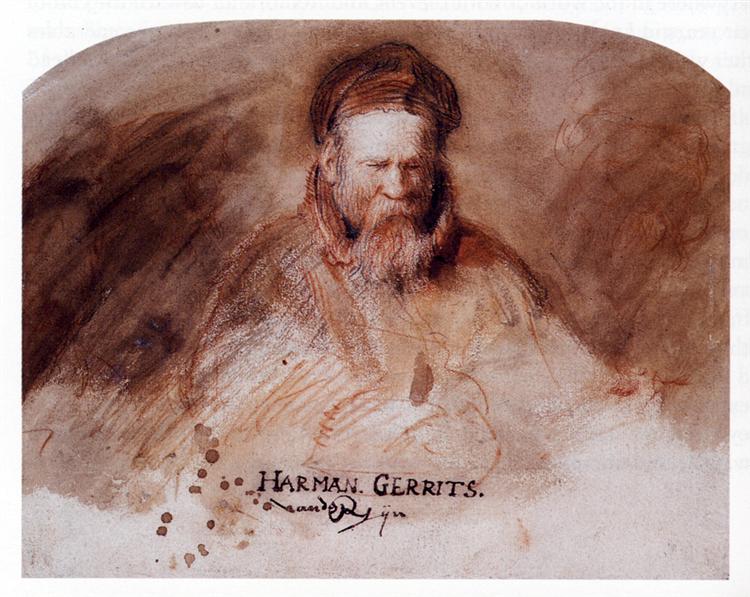
Rembrandt’s “The Artist’s Father” (1630) is a small but profoundly resonant portrait in which paper, ink, and wash become instruments of filial attention. The sheet shows an elderly man with a full beard and a wrapped cap, seated and turned slightly inward as if concentrating on a private thought. A warm brown atmosphere surrounds him; pools of wash gather into shadows at the shoulders; a few searching lines mark the hands and the folds of a simple garment. Near the lower center, a carefully written inscription reads “Harman Gerrits.” and beneath it Rembrandt’s signature, identifying the sitter as the artist’s father, Harmen Gerritsz. van Rijn. No elaborate setting, no emblematic props, and no theatrical gestures distract from the quiet encounter between a son and the face that shaped his earliest world. In this drawing Rembrandt compresses his great themes—light, inwardness, and the dignity of age—into the humblest materials.
Medium, Method, and the Poetry of Restraint
The sheet’s authority begins with its restraint. Rather than the dense hatching of an etching or the thick impasto of an oil, Rembrandt relies on a limited toolkit: brown ink, transparent wash, and touches of body color that pool into highlights. With a handful of tones he creates a complete weather system around the head and shoulders. The pen articulates essentials—the arc of the cap, the edge of the cheek, the contour of the beard—and then steps back, allowing wash to carry volume and mood. The wash veils the paper like breath on glass; pale passages suggest light skimming the forehead and cheekbone, while darker reservoirs of tone build the hollow between nose and mouth, the soft cavern of the eyes, and the weight of drapery against the chest. It is the economy of a master who knows how little is needed when every stroke is alive.
Composition and the Architecture of Looking
The drawing’s top edge is gently arched, an uncommon format that softens the field and concentrates attention on the head. This arch feels almost chapel-like: a small apse of paper in which the elder sits as a living relic of memory. The composition centers the head and beard within an oval of wash, a device that focuses the eye without hard framing. The figure is three-quarter view, shoulders angled, gaze lowered, expression inward. The chest and hands are indicated by a few sketchy strokes, just enough to ground the head in a human body while refusing to drag the viewer away from the face. The empty space to the right balances the dense masses to the left where the wash gathers like shadows from a window out of view. The architecture of the sheet, then, is circular and protective: an orbit of tone that returns the eye to the features again and again.
Light as Affection
Rembrandt’s light behaves here like affection: it favors the brow, touches the nose, and lingers in the beard with that specific warmth sons reserve for their fathers. The highlights are not theatrical; they are domestic—soft, diffused, and familiar, like morning light in a Leiden room. The forehead’s glow feels like a record of thought; the bridge of the nose catches a cool note; the cheek diffuses into air where wash thins to paper. Within this modest value scale, the artist locates a complete portrait of a life. We sense alertness under the heavy lids and patience at the corners of the mouth. Light participates in character rather than merely exposing it.
The Face as a Landscape of Time
Harmen Gerritsz’s face is mapped with the tenderness Rembrandt lavishes on all elders. Lines collect not as caricature but as narrative—gentle furrows at the brow, an inflected crease beside the nose, soft pouches beneath the eyes. The beard falls in open, feathery strokes, then thickens where Rembrandt lets wash pool into little lakes of tone, so that hair feels weighty without becoming a tangle of description. The cap frames the forehead like a soft architecture, defining the boundary between the outer world and the interior weather of thought. Everything is specific and yet nothing is finicky. The portrait’s truth grows from observation that never loses sight of the person behind the details.
Gesture, Posture, and the Theatre of Quiet
Gesture in this drawing is nearly absent, which is precisely why the tiniest motions resonate. The father’s head inclines just enough to suggest contemplation or prayer. The hands—hardly more than a few lines and soft shadows—gather near the center like a small hearth. The shoulders sink fractionally, relaxed rather than broken by age. This theatre of quiet is quintessentially Rembrandt: a drama built from pauses rather than crescendos, a narrative of waiting rather than doing. The son knows how the father sits when the room is calm, and he draws that truth without agenda.
Inscription, Signature, and the Gift of Naming
Many character studies from Rembrandt’s early years adopt the freedom of the tronie, pursuing expression without specific identity. Here he does the opposite. By inscribing “Harman Gerrits.” and signing beneath, he anchors the sheet in the exact coordinates of kinship. Naming his father within the composition converts the drawing from exercise to offering. The calligraphy itself carries affection—firm, slightly embellished, placed like a dedication at the lower center of the sheet. It is as if the artist wanted to ensure that the man would not be swallowed by anonymity after the light left the room. Paper, ink, and a name: a son’s way of giving his father back to time.
The Leiden Year and the Education of Intimacy
The date, 1630, places the work at the end of Rembrandt’s Leiden period, just before he moved to Amsterdam. In those years he honed his ability to orchestrate light in small spaces, to draw character from faces unaccustomed to grand portraiture, and to turn ordinary interiors into stages of conscience. “The Artist’s Father” belongs to this intimate practice. There is no patron to satisfy, no heraldic program to uphold, no urban glamour to invoke. Instead we find the seriousness of a studio where models include parents, students, and friends, and where the truest compliment is attention. The sheet reads like the diploma of that education: an image so modest it must be looked at closely, and so honest it repays the closeness with gratitude.
Material Presence: Paper, Stain, and the Accidents of Work
One pleasure of the drawing lies in its material candor. We see faint drips and stains near the inscription, small constellations where liquid gathered and dried. Rather than flaws, these become evidence of process, like fingerprints on a letter. They remind us that Rembrandt worked swiftly, letting wet medium carry chance into the image. The paper’s tooth catches dry strokes; the edges of wash dry into dark rims that act like drawn lines. The medium cooperates the way an old garment does: it conforms to the body of the image without resistance. In a portrait of a father, such material familiarity feels especially apt.
Compassion Without Sentiment
The artist avoids the sentimental traps that often accompany family portraiture. There is no overt appeal to pity, no theatrical melancholy, no artificially softened features. Instead the drawing achieves compassion through accuracy and restraint. The father’s gaze is lowered not to perform sadness but to remain himself; the mouth is set without bitterness; the beard and cap, practical and warm, belong to a man who has lived in a climate of work. By trusting the small truths of posture and light, Rembrandt achieves a tenderness that never feels forced.
Echoes Across Rembrandt’s Oeuvre
Seen within the broader arc of Rembrandt’s work, this sheet anticipates and converses with several bodies of images. The old men of 1630—etched heads with flowing beards, eyes cast down—share its humility. Later oil portraits of scholars and apostles borrow its vocabulary of inward light and soft edges. In the late self-portraits, where the artist confronts his own aging face, we feel this drawing’s legacy: the acceptance of time’s marks as sources of illumination. The father’s head becomes, in this sense, an original text from which the son will continue to read for decades.
The Psychology of Nearness
The drawing invites the viewer to stand close, both literally and morally. Its scale is intimate; the handling rewards proximity; the subject invites respect. We find ourselves taking on the artist’s perspective, a slightly lowered vantage as if seated nearby. From here we notice details that vanish at distance: the softened bridge of the nose, the nested shadows beneath the lower lip, the way the cap’s edge scumbles across the forehead. Such nearness does not violate the sitter’s privacy because the atmosphere is one of consent. This is not espionage; it is visitation.
The Theology of Ordinary Light
Rembrandt’s art often explores the meeting place of the sacred and the everyday. In “The Artist’s Father,” that meeting happens in light that feels domestic yet reverent. The effect is akin to a candle carried into a dark room: not a blaze that overpowers but a disclosure that respects form. The father is not made holy by symbols; he is dignified by being seen. The theology here, if we may call it that, is that attention is a form of blessing. A son blesses his father by observing him with exact affection and by recording that affection in a medium less fragile than memory.
The Cap and the Cloak: Garments of Use, Not Display
Costume in this portrait is minimal and meaningful. The cap, wrapped and thick, suggests warmth and work rather than social rank. Its curved bands move the eye around the brow like quiet music. The cloak or mantle is indicated by broad sweeps of wash, descending in heavy folds that gather at the lap. These garments shape the body’s bulk, but they also shelter the portrait’s mood. Their weight creates a counterpoint to the fine tracery of facial lines, as if to say that life’s outer burdens and inner subtleties coexist in the same person.
Hands, Tools, and the Implied Task
The father’s hands are only sketched, yet they hold attention. One appears to close around a small object, perhaps a knife, a book clasp, or simply the folds of the garment. The other gathers fabric. These minimal cues hint at work paused rather than absent. We feel a craftsperson interrupted gently by a son who wanted to study the head in a moment of stillness. That implication threads the drawing with respect for labor while keeping the emphasis on mind and presence.
Time, Memory, and the Gift of Pause
The sheet distills a particular kind of time: the pause between tasks in which a person becomes most themselves. No external narrative intrudes. The father is not represented as hero, scholar, or biblical type. He is allowed to exist as a man sitting quietly, remembered by the one who knew that quiet best. In a culture that often equates worth with action, Rembrandt proposes that being looked at lovingly is action enough. Memory begins in such pauses; art extends them.
Why the Image Feels Modern
Modern viewers will find the drawing startlingly contemporary in its frankness. Its minimal means, soft vignetting, and focus on psychological atmosphere over anecdotal detail anticipate later portrait practices in watercolor and photography. But its modernity lies even deeper: in its conviction that the greatest subject is the ordinary person held in light. Across centuries, that proposition keeps returning to us as the truest measure of art’s human value.
Legacy: A Son’s First Monument
Although the sheet is small, it functions as a first monument. The inscription fixes the name; the drawing fixes the likeness; the mood fixes the relationship. Long before Rembrandt painted his grand canvases of elders reading by windows or apostles lost in thought, he learned to honor age by giving it a seat at the center of a sheet of paper. “The Artist’s Father” is the foundational act of that honoring. It shows that the splendor of Rembrandt’s later art was born not of decorative ambition but of practiced gratitude.
Conclusion
“The Artist’s Father” condenses Rembrandt’s gifts into the simplest of forms. With a few strokes of pen and the soft gravity of brown wash, he opens a private room where attention becomes reverence. The arched format wraps the sitter like a small sanctuary; the inscription turns the drawing into a dedication; the face, modeled with breathing light, records a life without sentimentality. In this portrait, the artist’s greatest subjects—time, tenderness, and the way light discloses character—appear in the person who first taught him how to see. The sheet endures because it is more than an image; it is a gesture of thanks translated into lines that will not fade.
