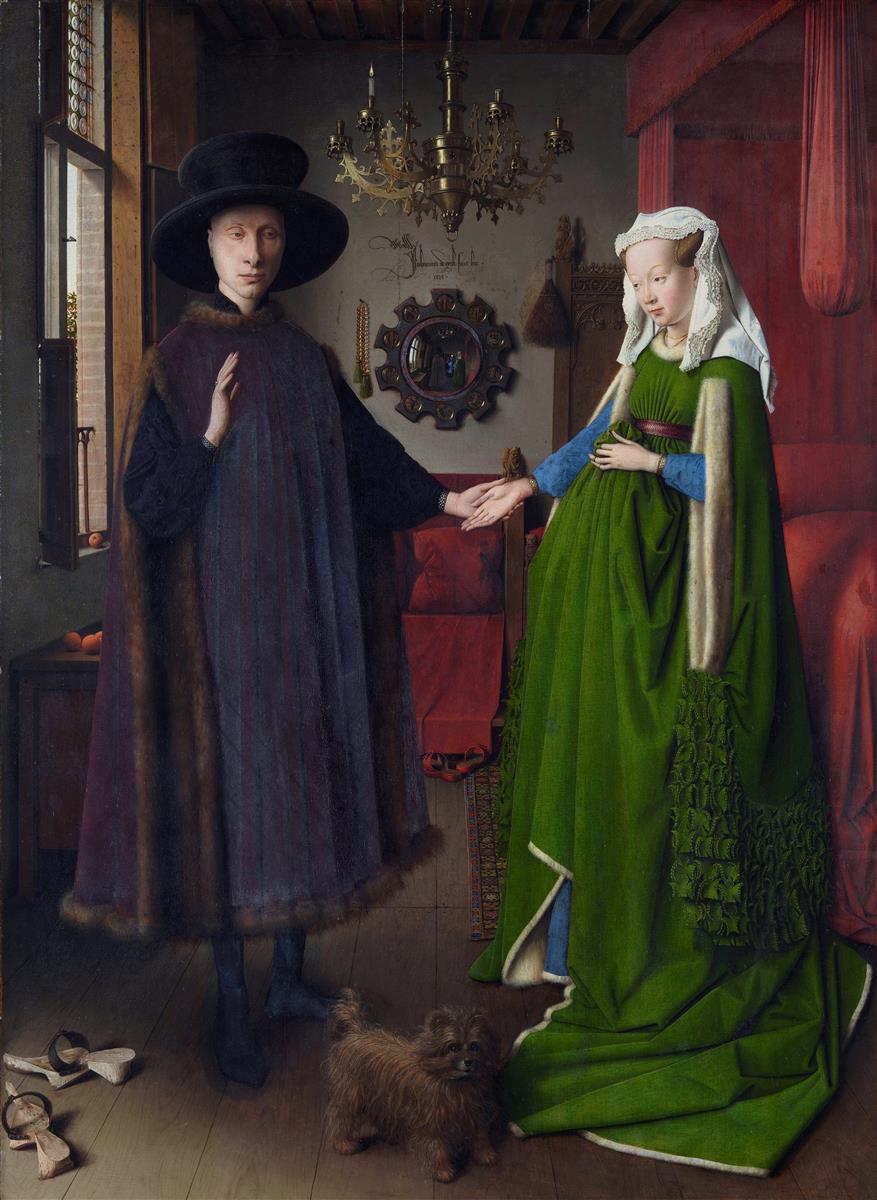
Image source: wikiart.org
Introduction to The Arnolfini Portrait
The Arnolfini Portrait is one of the most studied and admired paintings in European art. Created in 1434 by Jan van Eyck, it stands as a landmark of Northern Renaissance painting and a masterpiece of close observation. At first glance, the work appears simple. A man and a woman stand together in a carefully furnished interior, holding hands and facing the viewer. Yet the longer one looks, the more the painting opens into a world of clues, symbols, technical brilliance, and unanswered questions.
Part of the lasting fascination of The Arnolfini Portrait comes from its unusual balance of intimacy and formality. It feels personal, almost private, but it is also staged with remarkable precision. Every object seems meaningful. The clothing, the bed, the oranges, the mirror, the little dog, the chandelier, and even the discarded shoes all seem to ask for interpretation. Viewers often feel that they are looking at more than a portrait. They are looking at a statement about wealth, identity, marriage, religion, social rank, and the role of images themselves.
Jan van Eyck transforms a domestic room into a space of visual and intellectual richness. He does this not through dramatic action but through control, detail, and atmosphere. The painting invites close reading because it has been built to reward close reading. At the same time, many of its details remain open to debate, which only increases its power. Rather than offering a single fixed meaning, the painting continues to generate discussion across generations.
Jan van Eyck and the Northern Renaissance
Jan van Eyck was one of the defining painters of the fifteenth century. Working in the Burgundian Netherlands, he helped shape a new approach to painting based on realism, light, texture, and extraordinary attention to surfaces. He did not invent oil painting, but he became one of its greatest early masters. His use of translucent layers of oil allowed him to create images of dazzling clarity and depth, making objects appear both solid and luminous.
The Northern Renaissance developed differently from the Italian Renaissance. While Italian painters often focused on classical balance, anatomy, and large public narratives, Northern painters were especially drawn to minute detail, symbolic objects, and the faithful rendering of daily life. Van Eyck brought these qualities together with remarkable intelligence. He could paint fabric, metal, glass, flesh, wood, and fur with such precision that each material seems to possess its own distinct physical presence.
In The Arnolfini Portrait, these qualities are on full display. The room is not merely described. It is experienced through texture and light. The fur trimming of the man’s robe, the shimmering folds of the woman’s green gown, the polished beads of the chandelier, and the reflective surface of the convex mirror all reveal van Eyck’s astonishing control. This is realism, but realism elevated into something almost miraculous. The goal is not only to imitate the world, but to make vision itself seem sacred and exact.
Who Are the Figures in the Painting
One of the most famous questions surrounding The Arnolfini Portrait concerns the identity of the couple. The painting is traditionally associated with Giovanni Arnolfini, a wealthy merchant from Lucca living in Bruges, and a woman believed to be his wife. However, the exact identity of the pair has been debated for a long time, and scholars have proposed several interpretations. This uncertainty is central to the painting’s mystique.
The male figure is generally understood to belong to the Arnolfini family, an Italian merchant clan with ties to the prosperous commercial world of Bruges. His dark clothing and composed stance suggest status and dignity. He raises one hand in a gesture that has often been interpreted as greeting, blessing, or oath taking. The woman stands beside him in an elaborate green dress, her posture calm and reserved. Her body has often been mistaken for that of a pregnant woman, but this appearance is more likely the result of contemporary fashion, which favored voluminous fabric gathered at the front.
Because the painting includes a famous inscription above the mirror, reading “Jan van Eyck was here,” some have argued that the work records a legal or ceremonial event, perhaps a marriage contract or witness scene. Others reject that interpretation and see the painting more broadly as a portrait of a wealthy couple in a domestic setting. The power of the work does not depend on a final answer. In fact, its uncertainty allows it to remain alive. The figures are both specific people and symbols of social and spiritual ideals.
The Interior as a Stage of Meaning
The setting of The Arnolfini Portrait is one of the painting’s greatest achievements. Van Eyck places the couple in a domestic room that feels believable and carefully observed, yet the arrangement is too deliberate to be accidental. This is a private interior transformed into a stage of meaning.
The room is modest in size but rich in implication. A red bed occupies the right side, introducing warmth and visual intensity. A window at the left lets in clear daylight, illuminating the oranges on the sill and chest below. The wooden floorboards recede with quiet logic, helping define the space without relying on the dramatic perspective systems more typical of Italian painting. At the center hangs the small convex mirror, which becomes the visual and symbolic heart of the work.
Each object appears chosen with care. The bed may suggest domestic life, fertility, or household dignity. The chandelier, though holding only one lit candle, adds a ceremonial note. The oranges may refer to wealth, trade, purity, or even the suggestion of paradise. The tiny dog at the couple’s feet has often been read as a sign of loyalty or affection. The shoes on the floor introduce a note of lived reality but also seem to imply respect for sacred ground or a meaningful threshold.
What makes these objects so compelling is that van Eyck never isolates them as symbols in the abstract. He integrates them seamlessly into the life of the room. They remain convincing things even as they invite interpretation. This blend of realism and symbolism is one of the defining strengths of the painting.
Composition, Space, and the Viewer’s Position
The composition of The Arnolfini Portrait is remarkably stable, but it is not static. Van Eyck creates a carefully balanced arrangement in which vertical lines, subtle diagonals, and mirrored forms guide the eye through the painting. The two figures stand slightly apart yet joined by their clasped hands. Their placement leaves space between them, and that space becomes important. It allows the viewer to enter the scene visually and directs attention toward the mirror behind them.
The perspective of the room is convincing, though not mathematically rigid in the later Renaissance sense. Van Eyck is less interested in demonstrating geometry than in creating a believable environment filled with sensory presence. The bed, window, chest, and floor establish depth, but the real center of gravity remains the human relationship and the mirror’s reflected world.
That mirror radically expands the composition. In it, the backs of the couple can be seen, along with two additional figures entering or standing in the doorway. One of them may be the painter himself. This small reflective surface opens the room, complicates the act of viewing, and makes the observer suddenly aware of being part of a chain of looking. The painting shows the couple, but it also shows who sees them, and perhaps who records them.
This device gives the work an almost modern sophistication. The viewer is no longer outside the scene in a simple way. Instead, the painting makes the act of observation part of its subject. It becomes a meditation on presence, testimony, and representation. Who is watching, and what does it mean to preserve a moment in paint? Van Eyck seems to ask these questions long before such issues became common in later art theory.
Symbolism and the Language of Objects
Much of the fame of The Arnolfini Portrait rests on its symbolism. Generations of viewers have tried to decode the objects within the room, and while not every interpretation is certain, the symbolic density of the painting is undeniable. Van Eyck creates an image in which ordinary things carry moral, religious, and social resonance.
The dog is perhaps the most approachable symbol. Small, alert, and positioned at the couple’s feet, it is commonly understood as a sign of fidelity. Whether that meaning was primary or secondary, the animal introduces a note of warmth into the painting, softening the formality of the human figures.
The single lit candle in the chandelier has inspired many readings. It may refer to divine presence, spiritual witness, or the sanctity of the event being depicted. The chandelier itself, with its carefully painted metalwork, also demonstrates van Eyck’s command of reflective surfaces and his delight in material detail.
The convex mirror is both an object and a symbolic center. Around its frame are tiny scenes from the Passion of Christ, reminding the viewer that the domestic world of the painting exists within a larger religious horizon. The mirror reflects what is otherwise unseen, suggesting truth, witness, and the extension of reality beyond the painted surface. It may also imply moral self-awareness, a recurring theme in late medieval and early Renaissance thought.
The oranges are luxurious and somewhat exotic, which would have signaled wealth in fifteenth century Bruges. They may also suggest purity, fertility, or innocence. The bed, deep red and visually commanding, has been linked to marriage, household continuity, and female domestic space. The cast off shoes can be read as signs of everyday life, but they may also hint at reverence or a sacred moment.
None of these symbols should be treated too mechanically. The painting does not operate like a simple codebook. Instead, van Eyck layers possible meanings so that the room feels full of significance without becoming rigidly allegorical.
Light, Texture, and the Miracle of Oil Paint
One of the most extraordinary aspects of The Arnolfini Portrait is its technical execution. Jan van Eyck uses oil paint with such patience and subtlety that the painting still feels fresh and immediate centuries later. The surfaces are not merely detailed. They are alive with light.
The light enters gently from the left, touching the faces, fabrics, wood, fruit, and brass with different intensities. It does not flatten the room. It reveals each object according to its nature. The woman’s gown gathers and folds with heavy elegance, while the fur trim of the man’s robe absorbs light differently. The chandelier glints. The oranges glow softly. The mirror shines with a polished brilliance that seems almost impossible at such a small scale.
Van Eyck’s achievement lies not only in realism but in differentiation. Every substance has its own visual logic. Glass reflects differently from metal, fur differs from cloth, polished wood differs from skin. This makes the room feel inhabited by real matter. Such sensitivity was one reason van Eyck’s art seemed astonishing to later viewers. He did not merely describe objects. He made paint behave like the world.
Yet the technical brilliance never overwhelms the emotional tone. The painting remains quiet and composed. The precision serves atmosphere. There is no theatrical brushwork calling attention to itself. Instead, the technique deepens the seriousness of the image. It suggests that careful looking is itself a form of respect.
Marriage, Status, and Social Identity
Whether or not The Arnolfini Portrait records an actual marriage ceremony, it undeniably engages with themes of union, household identity, and social standing. The couple is presented with solemn dignity, and the room around them reflects their material success. This is not a casual glimpse into private life. It is an image of status made visible through possessions, dress, and controlled behavior.
The clothing alone signals wealth. The fabrics are costly, heavy, and skillfully tailored. Such garments would not have been practical everyday wear in a simple sense. They announce rank and refinement. The presence of imported fruit and finely crafted furnishings further underscores prosperity. These details matter because Bruges in the fifteenth century was a major center of trade, where merchant wealth could rival older aristocratic prestige. A portrait like this could serve to affirm social position as much as personal identity.
The relationship between the figures is also telling. They are close but not overtly affectionate in a modern sense. Their connection is formalized through gesture and placement. The clasped hands are central, yet their faces remain composed. This reserve reflects the cultural values of the time, when portraits often conveyed moral seriousness rather than spontaneous emotion.
At the same time, the painting suggests that domestic life itself could be worthy of monumental representation. A bedchamber, a household interior, and a married pair become subjects of profound artistic attention. That shift is important. It signals a growing interest in the dignity of private life, especially among prosperous urban patrons. Van Eyck gives the household a new kind of grandeur.
The Convex Mirror and the Mystery of Presence
No detail in The Arnolfini Portrait has generated more fascination than the convex mirror. Small in scale but immense in effect, it transforms the painting from an impressive portrait into something conceptually daring. The mirror reflects the entire room from the opposite angle, including the backs of the couple and two additional figures at the doorway. This tiny reflection enlarges the world of the painting and complicates the viewer’s understanding of the scene.
The mirror suggests witness. If this image records a vow, agreement, or meaningful moment, then the reflected figures may be participants in that event. The famous signature above the mirror strengthens that possibility. Rather than signing discreetly at the edge of the painting, van Eyck places his name prominently within the scene, almost as though he is asserting his physical presence.
But the mirror also performs a deeper function. It reminds us that painting can hold more than one viewpoint at once. It can show what is in front of us and what lies behind. It can record presence while also reflecting on the conditions of seeing. The viewer becomes aware that images are not passive windows but constructed acts of attention.
The frame of the mirror adds another layer with its tiny religious scenes. These images connect the domestic event to sacred history, suggesting that human bonds and moral life exist under divine observation. In this sense, the mirror is not just optical. It is spiritual and intellectual. It sees more than the eye alone.
Why The Arnolfini Portrait Still Matters
The Arnolfini Portrait remains powerful because it offers no simple ending. It is technically brilliant, historically rich, and visually unforgettable, but it also resists final explanation. That resistance is one reason it continues to matter. Every generation sees something new in it. Some viewers focus on marriage, some on symbolism, some on mercantile culture, some on gender, and some on the nature of representation itself. The painting supports all of these readings because it has been built with unusual depth.
Its influence extends far beyond its own time. Artists and historians have repeatedly returned to it as an example of what painting can do when realism and meaning work together. The portrait proves that stillness can be dramatic, that ordinary interiors can carry sacred weight, and that small details can open immense questions.
Jan van Eyck created more than an image of two people in a room. He created a model of visual thought. The painting asks us to look slowly, to notice carefully, and to accept that meaning in art is often layered rather than fixed. It rewards patience in the same way it must have required patience to make.
That is why The Arnolfini Portrait continues to fascinate viewers after nearly six centuries. It is a painting of presence, but also of mystery. It is full of life, yet held in silence. It offers certainty in its craftsmanship and uncertainty in its interpretation. In that balance lies its greatness.