Image source: wikiart.org
A Farewell Carved in Light
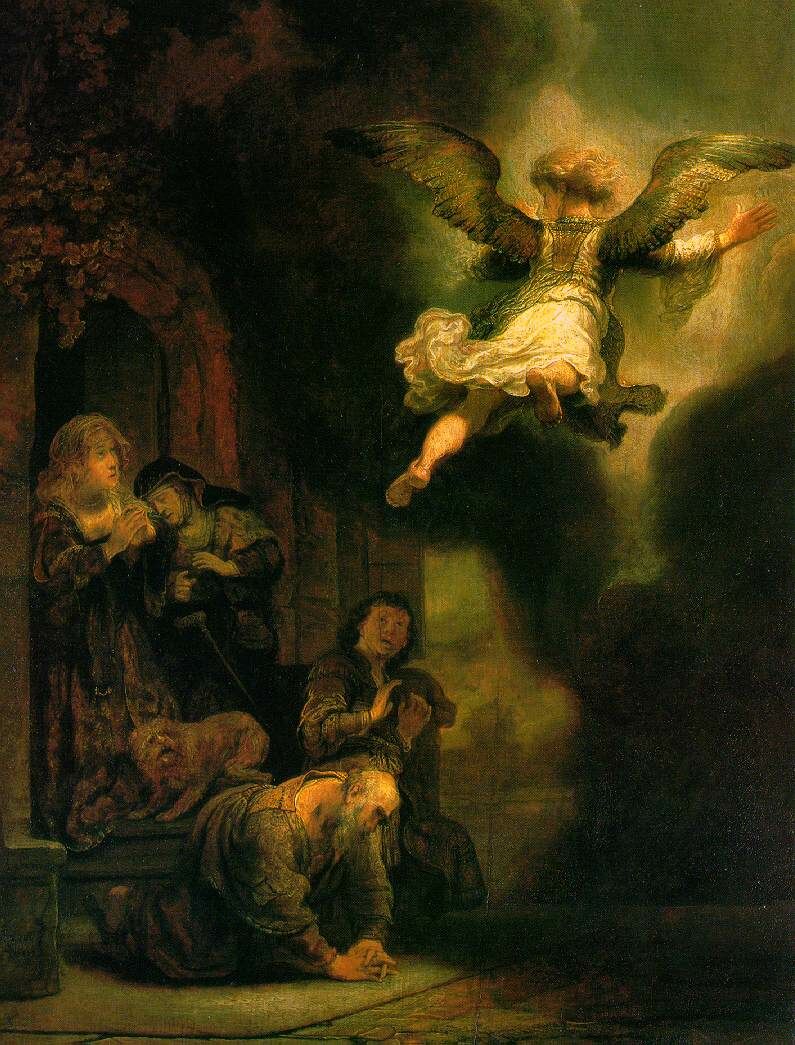
Rembrandt’s “The Archangel Raphael Taking Leave of the Tobit Family,” painted in 1637, stages a climactic moment from the apocryphal Book of Tobit with the immediacy of a scene witnessed at a doorway. The composition blooms from darkness: at the left, a shallow portico frames the family—Tobit, Anna, and their son Tobias with his small dog—while at the right a vast field of shadow opens like a night sky. From that darkness a cone of radiance pushes inward and upward, carrying Raphael, whose body twists as he takes flight. The angel’s departure is not a decorative flourish; it is the central drama. Wings scissor through a gust of light, robes billow, and the figure seems to slice the air as a bird lifts from a pond. On the ground below, Tobit hunches to his knees, hands outstretched toward the limit between shadow and sun, as if to draw the last line of a miracle before it disappears. The painting’s force lies in how it turns a theological revelation into a profoundly human moment of leave-taking.
The Story Behind the Light
The narrative comes from Tobit, a text cherished in early modern Europe for its blend of piety, domestic affection, and travel adventure. Blind Tobit sends his son Tobias on a long journey to recover family funds; the young man is accompanied by a traveler who later reveals himself to be the archangel Raphael. Along the way Tobias gains a wife, Sarah, and learns to cure blindness with gall from a fish he has caught. On their return, Raphael heals Tobit and, having explained the hidden meanings of the trip, makes himself known and departs. Rembrandt chooses that final instant—the hinge where a companion reveals divinity and vanishes. What could be staged as distant legend becomes, in his hands, a scene of everyday furniture, a pet dog, a threshold, and a family browsed by light. Revelation happens not on a mountaintop but at a doorstep.
A Composition That Kites from Earth to Heaven
The entire picture is a lesson in vector and counter-vector. A strong diagonal rises from Tobit’s crouched body at lower left through the seated Anna and the standing Tobias to the departing angel at upper right. This diagonal is answered by a reversed sweep of shadow that surges down the right half of the canvas, as if the void were rushing in to reclaim the departing light. The scene’s geometry makes theology legible. The earthly line—family, house, pet—climbs toward the angel; the heavenly line—radiance, air, movement—recedes from them. At the crossing of these lines the painting breathes, and the eye oscillates between farewell and blessing.
Chiaroscuro as Revelation
Rembrandt’s light is narrative, not merely descriptive. It strikes the angel with the greatest intensity, whitening the linen tunic and setting the golden cuirass aglow, then spills down across Tobias’s lifted hands and Anna’s startled face before dimming into the russet of Tobit’s robe. The left doorway remains pocketed in dusk, vines clinging to stone, a world of habit and shelter. On the right, darkness is not nothingness; it is filled with quiet brushwork, a deep, green-black atmosphere against which the angel’s feathers register in bronze and cream. In this arrangement, light does what words would belabor. It declares who is departing, who is blessed, and how the world feels in the wake of a divine visit.
Raphael as Motion and Mercy
The archangel is all dynamic contrast—weightless yet muscled, armored yet radiant, turning away from the family and yet bound to them by the light that originates in his body. His left leg kicks back in a classic baroque contrapposto; his right arm reaches into the unseen air like a swimmer’s stroke; the head turns up toward the source that both receives and propels him. The wings are painted not as diagram but as living anatomy, their pinions catching and losing light across layered strokes. Rembrandt avoids over-ornamentation. The angel bears no theatrical plume or staff; the only emblems are the truth of his ascent and the gleam of a breastplate whose metal reads as moral steadiness. Raphael’s function in the story is healing and guidance. In paint, that function becomes visible as energy gathered and released.
The Grammar of Hands
The emotion of the scene flows through hands. Tobias lifts both palms in a gesture that mixes awe and farewell; Anna clutches her cloak while the other hand half-rises, a held breath translated into movement; Tobit, closer to earth, reaches with fingers that still know blindness, feeling the shock of light more than he sees it. Rembrandt has long trusted hands to speak in his work—blessing hands, begging hands, hands counting money, hands gripping tools—and here they articulate the degrees of comprehension in a family encountering the end of a miracle. The dog’s paws, draped over the bench, oddly echo the human hands, grounding the drama in animal familiarity and reminding viewers that grace brushes even the small routines of a household.
The Household as Stage
The setting is a modest portal. Stone jambs, a bench, a weaving of vines, plain textiles, a sliver of floor that reflects the angelic glow—these are the materials of late-day life. By refusing to relocate the moment to a palace or temple, Rembrandt affirms a favorite theme: the divine visits the ordinary. It matters that the angel departs not from a tabernacle but from a seat warmed by a pet and an evening of conversation. The painting thus joins a line of Rembrandt’s works in which sacred time enters domestic space—Supper at Emmaus, Joseph telling dreams, Simeon in the Temple imagined as a crowded civic hall—images where the familiar becomes the vessel for the extraordinary.
Color Held in Reserve
The palette is an orchestration of earth and light. Deep browns and olive blacks form the architecture of shadow; warm ochres and russets model the garments; a restrained pink touches Anna’s cheek; and across the angel’s figure a cool, milky radiance erases pigment in favor of near-white. Gold returns in small, decisive accents—the glint on the cuirass, the shimmer along wing edges, a ray touching Tobias’s sleeve—so that the eye can hop from gleam to gleam without losing the scene’s tonal unity. Rembrandt was a master of holding color in reserve, letting the viewer feel saturation even when the paint remains sober. The emotional color is in the value relationships.
A Theology of the Threshold
Doorways in Rembrandt carry ethical charge. They are where decisions are made, where blessings cross. In this painting the threshold is also a border between knowable and unknowable. Inside are the things we can inventory: faces, clothes, the wool of a dog, the rough scrape of a stone step. Beyond is a darkness that is not ours to map. Raphael’s departure both brightens and enlarges that darkness, as if revelation did not reduce mystery but deepened it. The portal then becomes a moral geography: stay within, remember, and act on what you have learned; let what you cannot follow remain in reverent shadow.
Human Psychology in a Sacred Script
Each figure registers a different psychology. Tobit’s humility bends him completely; he who has just regained sight now bows to the force that altered his vision. Anna, long a pillar of the household, is caught between relief and astonishment; her face is both mother and matron. Tobias, youth at the threshold of his adult life, feels awe tinctured with gratitude, his upward hands a secular echo of liturgical thanksgiving. Even the dog, companion from the journey, is an emblem of faithfulness. Rembrandt’s scriptural scenes never flatten their subjects into symbols. He allows mixed feeling to inhabit sacred moments—an ethics of representation that keeps the stories human.
The Painter’s Stagecraft
Rembrandt’s orchestration of the viewer’s eye is precise. He places a bright wedge of floor at lower center, a reflective plane that acts like a mirror for the angel’s light and a landing pad for our attention. From that wedge we travel along Tobit’s spine to the family group, then shoot up the angel’s diagonal into the luminous eddy of cloud at the top right, and finally sink into the pooled darkness from which we began. The cycle repeats without fatigue because textural variety—smooth glazes in shadow, dragged strokes for wings, scumbled highlights along garments—gives the eye fresh tasks each pass.
Material Intelligence
The picture is a demonstration of material intelligence. Rembrandt adjusts medium to meaning: the angel’s radiance appears through thin, opaque touches laid wet-into-wet, softening edges until the figure trembles against the air; the bench is built with thicker, earthier paint dragged with the brush’s belly, making the wood grain tactile; stone is suggested with muted, square strokes; the dog’s fur is a flurry of warm, splayed marks. Nothing is over-finished. The paint always remembers that it is paint, and that honesty deepens the scene’s conviction.
Sound, Breath, and the Moment After
Though silent, the painting is full of implied acoustics. One can imagine the rush of air from wing strokes, the small bark or whine of the dog, the exhalation of surprise from Anna and Tobias, and the rough scrape of Tobit’s robe against the floor. Rembrandt often paints the minute before or after the canonical moment. Here it is both: the revelation has occurred, the explanation has been given, and the departure is under way. We stand in the second in which human bodies adapt to an altered world. The scene’s hush is not emptiness; it is reverent recalibration.
Between Stage and Street
The picture unites theater and documentary. The angel is decidedly baroque—a flying figure spotlighted against unknown space—while the family belongs to the plain world of Amsterdam households, their features and garments rendered with sober sympathy. That hybrid is characteristic of Rembrandt at his height: he invites the viewer to believe in miracle by anchoring it to things they can touch. The balance prevents both camp and coldness. It persuades by proximity.
Comparisons and Continuities
The painting converses with other Rembrandt treatments of the Tobit cycle in drawings and prints, where the artist explores different instants of the narrative—Tobias catching the fish, the healing of Tobit, domestic scenes of prayer. In those works, the angel often appears as a traveler. Here, revealed in full, he departs as a being of air. The step from companion to archangel is dramatized not by added props but by a change of physics. Likewise, the scene relates to Rembrandt’s wider explorations of angelic visitations—the “Flight into Egypt,” where guiding light steadies a nighttime journey, and “Jacob Wrestling with the Angel,” where bodily closeness replaces aerial distance. Across them all, angels are agents of change, their presence measured by how human figures realign.
The Ethics of Representation
There is a moral clarity to the painting’s choices. The family is neither idealized nor caricatured; poverty and age read in their clothes and posture, but dignity is held intact. The angel’s beauty is a matter of light and movement rather than cosmetics. The dog is not sentimentalized; it is a breathing animal that shares the frame because it shares the household. The picture’s ethics mirror its theology: grace visits real people where they live, and the record of that visit should respect their reality.
How to Look, Slowly
Begin at the low triangle where Tobit kneels. Attend to the scrape of highlight along his shoulder, the rough weave of his garment, and the way his hands reach for light. Lift your gaze to Anna and Tobias, tracing the line that connects their faces to the angel. Notice the small dog’s spine arching against the bench, a domestic counterpoint to the airborne figure above. Then let your eyes follow Raphael’s wing, feeling the brushwork change from downy inner feathers to firm outer vanes, until you reach the luminous vortex from which the figure rises. Finally, turn to the painting’s rightmost dark, where the turbulence of scumbled paint suggests a sky that swallows and blesses at once. Repeat the circuit; each pass alters the weight of feeling.
Why the Scene Still Speaks
For a modern viewer, the Book of Tobit may be unfamiliar, but the painting’s emotional grammar is universal: the moment when a helper departs; the gratitude mixed with fear that follows a cure; the domestic space suddenly enlarged by meaning. Rembrandt’s achievement is to image such moments without condescension. The canvas neither lectures nor flatters; it simply offers a way to see leave-taking as part of the architecture of care. The angel’s ascent is less an escape than a handing back of life to those who must now live it.
Closing Reflection
“The Archangel Raphael Taking Leave of the Tobit Family” is a compact epic about guidance, healing, and responsibility. Rembrandt orchestrates gesture, light, and space so that a household becomes a theater of revelation. The angel’s glow is extraordinary, but what lingers is the family’s response—their hands, their faces, their dog, the bench where a body will sit again once the light has thinned. The painting understands that the miracle’s true work begins after the angel leaves, when people return to rooms that now mean more than they did the day before. In that understanding the canvas earns its gravity and its tenderness.