Image source: wikiart.org
Introduction: A Portrait Of Thought And Calling
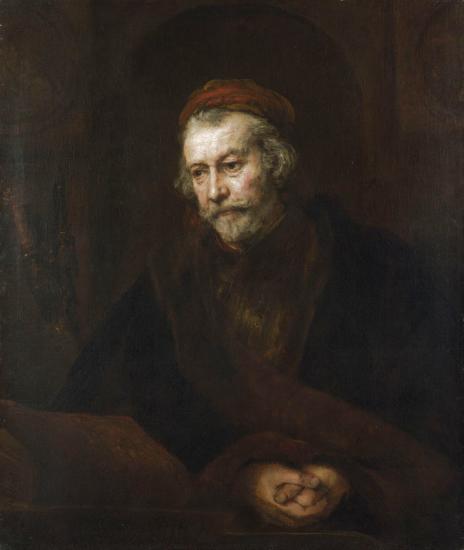
Rembrandt’s “The Apostle Paul” (1659) is a late meditation on vocation, memory, and the burden of words. The painting shows an aging man in a brown habit-like cloak, hands folded, head slightly bowed beneath a simple red cap. A large book, half in shadow, opens on the table before him. Nothing theatrical intrudes. The room is dusk-toned, a quiet chamber where the world falls away so that a mind can work. Paul appears not as a fiery missionary mid-sermon, but as a writer reflecting before he speaks, a presence in whom labor and grace gather without noise. This is quintessential late Rembrandt: restrained palette, tactile paint, luminous darkness, and a face that seems to think as we watch.
Historical Context: Late Rembrandt And The Turn Inward
The year 1659 lies deep within Rembrandt’s late period, after bankruptcy and after the deaths and separations that reshaped his household. Freed from the demands of fashionable patrons, he adopted a radical plainness that let light, texture, and gesture shoulder meaning. Many biblical subjects from these years become intimate portraits rather than public spectacles. Instead of staging Paul at the Areopagus, Rembrandt sets him at a desk; instead of trumpet-blast conversions, he shows the quiet geology of a conscience formed by years of conflict and devotion. The viewer meets not a saintly emblem but a man who has written letters that will outlast empires and who now waits, eyes softened, for the next sentence to arrive.
Subject And Iconography: Paul As Author And Witness
Traditional iconography marks Paul by attributes such as the sword of martyrdom, the letter, or heavy tomes. Rembrandt reduces that vocabulary to essentials: a large open book, the scholarly cap, and the inward posture of a writer. The book functions as both prop and metaphor, a material stand-in for scripture and a visual anchor for thought. Paul’s hands, lightly interlaced, rest below the book’s presence. They suggest pause rather than proclamation, as if the writing hand has stopped at the threshold between memory and utterance. The choice to withhold the sword is deliberate. The painting privileges the apostle’s role as teacher and letter-writer, the man whose words built communities across distances and whose sentences still structure devotion centuries later.
Composition: A Triangle Of Stillness
The composition rests on a stable triangular arrangement. The illuminated head forms the apex; the folded hands and the book establish a broad base. The shoulders slope gently downward toward the hands, guiding the viewer’s eye in a slow, contemplative circuit from face to hands to book and back. The background remains architecturally vague—an arch-like shadow hints at a niche—but its primary role is to cradle the figure in breathable darkness. The table’s edge creates a quiet horizontal barrier between our space and Paul’s, at once inviting and respectful. The lack of hard diagonals or dramatic gestures sustains a mood of stillness. Even the subtle turn of the torso away from us feels like a natural defense of concentration.
Light And Chiaroscuro: Vision Arriving Quietly
Light falls from the upper left, settling softly on Paul’s forehead, cheek, and beard, catching the ridge of his nose and the texture of his cap, and fading into the brown. Rembrandt’s chiaroscuro is not stage lighting; it is the calm of a lamp or high window in late afternoon. Light performs theology here. It arrives as recognition rather than spectacle, declaring that the important action is interior. Darkness performs mercy, allowing privacy around the figure while heightening the visibility of essential forms. The book receives less light than the face, a choice that privileges the writer over the text, the living source over the written record. In Rembrandt’s hands, illumination becomes a way of reading character.
Color And Tonal Harmony: Earth Tones With A Ember Crown
The palette is Rembrandt’s late earth harmony: umbers, warm blacks, burnt siennas, and cool browns, animated by a restrained red in the cap and a honeyed warmth in the skin. The cap’s muted brick red crowns the composition without stealing attention. The fur or heavy wool of the garment absorbs light in broad fields, so small temperature shifts—warmer at the chest, cooler at the sleeve—carry emotional nuance. The book’s pages are not paper white but aged parchment, a creamy low light that never competes with the face. This limited range of color reads like the moral atmosphere of the scene: serious, humane, and resistant to ornament.
Brushwork And Surface: The Texture Of Time
Rembrandt turns paint into a second skin that remembers touch. Flesh is modeled with layered half-tones and soft impasto that catches the light gently on brow and nose. The beard and hair are articulated with broken strokes and scumbles, suggesting wiry texture without enumerating strands. The garment is a field of broader, more absorbent marks that mimic the nap of worn cloth. On the book’s lower corner and along its spine, the brush records small ridges and cracks, the patina of long use. Everywhere, edges shift between crisp and dissolving—hard where attention should focus, soft where air mediates form. The surface reads as lived experience, a material metaphor for a life weathered by travel and writing, disputes and reconciliations.
The Face: A Mind In Session
Paul’s expression carries a complicated calm. The eyelids hang with the weight of focus; the mouth rests in the neutral line of someone who has spoken much and learned the economy of silence. The furrows on the brow and at the corners of the eyes are neither dramatized nor erased. They are evidence of long concentration and care. Rembrandt crafts the eyes as small wells of absorptive light rather than mirrors flashing highlights. They are the eyes of a reader, of a man who studies arguments and prayers until understanding settles. The effect is contemplative intimacy: we do not interrupt him; we share his pause.
Hands And Gesture: The Grammar Of Restraint
Rembrandt often gives hands moral weight. Here they are loosely clasped, fingers interlaced, both relaxed and ready. The right thumb presses gently against the left, a tiny hinge that keeps the pose alive. These hands speak of control learned rather than imposed. They are neither clenched in zeal nor thrown open in rhetoric. They hold a posture that has room for listening. Situated beneath the open book, they suggest that writing is the body’s work as much as the mind’s, and that good words arrive through patience. The hands become a model for the painting’s ethos: strength without noise.
The Book: Material Thought
The open folio anchors the lower left, its pages curving weightily toward us. Rembrandt lavishes just enough attention on the page edges, the darkened margin, and the shadow between leaves to make the book convincingly real. It is less a prop than an object with a life—the daily companion of a writer who knows how words feel in the hand. Symbolically, the book unites inspiration and craft. The text we cannot read becomes a promise of the letters Paul will write or revise, but the paint insists that those letters are made by turning pages, dipping a quill, and gathering thought. Sacred writing here is labor and grace intertwined.
Space And Background: A Cloister Of Air
The background is an enveloping brown that breathes like a cloister. Hints of architectural arches near the top create a visual niche, echoing the tradition of saints in shallow apses, yet Rembrandt avoids explicit sanctifying detail. The apostle does not need an altar; the air around him suffices. This space accomplishes two tasks. It protects the figure’s inwardness, and it keeps historical time at bay. We are not in a specific room with dated furnishings; we are in a spiritual interior where attention can pool. The atmosphere thus elevates an intimate portrait into a timeless meditation.
Psychology And Theology: Conversion Remembered, Grace Practiced
Paul’s story is one of dramatic conversion on the road to Damascus and of tireless labor afterward. Rembrandt’s painting absorbs that narrative into a mood of seasoned humility. The drama is not in a blinding light but in the gentled light that follows, the years in which a man learns to carry a message without losing patience or charity. Theologically, the work presents sanctity as habit rather than event: the habit of study, of listening for a truer word, of revising one’s judgments in the presence of grace. The apostle’s face holds something like repentance ripened into wisdom—no longer a crisis, now a posture.
Comparison Within Rembrandt’s Oeuvre: Kinships With Philosophers And Apostles
This painting belongs to a family of late works in which biblical figures and secular thinkers—Jeremiah, St. Bartholomew, “A Philosopher,” anonymous elders—are treated as portraits of interior life. The staging is similar: a half-length figure in warm brown air, sometimes with a book or tool, always with a face that carries the story. The Apostle Paul fits easily among them, yet it is distinct for its compositional clarity and the serenity of its mood. Where some late portraits carry a storm under the skin, Paul’s temper is steady. The kinship to Rembrandt’s own late self-portraits is unmistakable: the same refusal of flattery, the same drying impasto around the eyes, the same hush. The artist paints Paul as he paints himself—not as a monument, but as a person who is learning.
Technique And Working Method: Revision As Meaning
Rembrandt’s late practice typically involved layered execution and moments of reconsideration. In this painting, one senses adjustments around the contour of the head and cap, softening where an earlier edge might have been sharper. Glazes unify the broader darks, while fatter strokes build the face’s relief. The transitions between garment and background are explored rather than declared, suggesting that the painter returned to these areas to find exactly how the body mingles with air. Those revisions enact the very humility the subject embodies. Understanding—even about edges and folds—arrives through patience, not display.
The Viewer’s Role: Witness To A Pause
The viewer is positioned at a respectful distance, as if standing across a table. The book’s corner approaches our space but does not invite handling; the hands create a small gate, closed but not locked. We watch a pause. In that pause, the painting instructs us in how to look. Instead of scanning for narrative events, we attend to small changes of value, the temperature of halftones, the tremor of a thumb against another finger. We slow down to match the sitter’s slowness, and in doing so we enter the work’s spiritual tempo.
Modern Resonance: Work, Words, And The Quiet Heroism Of Attention
While the subject is ancient, the painting feels uncannily contemporary. Many modern viewers know the pressure of words and the fatigue of information. Rembrandt offers an alternative model of engagement: to sit with a book in honest light, to feel the weight of a sentence before writing or speaking it, to let silence perform its clarifying work. In an age that prizes immediacy, this image dignifies deliberation. It suggests that the deepest meaning flows from focused attention over time—a lesson as urgent now as in the seventeenth century.
The Cap And The Cloak: Dignity Without Pageantry
Costume here does not announce social rank. The cap is modest, practical, a worker’s crown. The cloak, likely fur-lined, offers warmth rather than ostentation. Rembrandt’s brush makes both tactile without fetishizing fabric. Their function is twofold: to frame the face and to establish a humane domesticity. Paul is dignified not by luxury but by the seriousness of his task. This choice aligns with the painting’s overall ethic: the value of a life is measured not by spectacle but by attention and faithfulness.
Time Inside The Picture: The Hour Of Reading
Everything about the painting suggests the hour after labor or before it, when a person reads and considers. The light has the low angle of late day; the book is opened wide; the hands are in the posture of a temporary halt. The minute we inhabit is unremarkable and therefore precious. Rembrandt often turns such ordinary time into a vessel for meaning. In “The Apostle Paul,” the hour of reading becomes a sacrament of vocation, sanctifying the unseen work that precedes any public word.
Reception And Legacy: The Apostle As Companion
Over centuries, viewers have responded less to doctrinal correctness than to companionship. This Paul is someone to sit with. The painting offers neither argument nor miracle; it offers a presence that steadies the room. Its legacy can be traced in later portraits of writers and thinkers who are shown not declaiming but considering—an iconography of the working mind. Museums often hang the work where its hush can be felt from a distance and deepened up close. It rewards return visits because its meaning grows as our own lives accumulate thought and scar tissue.
Why The Painting Endures
The endurance of “The Apostle Paul” lies in its rare combination of honesty and tenderness. The techniques are masterly, but they never overshadow the person they serve. The palette is austere, yet the atmosphere is warm. The composition is simple, yet the psychology is layered. The face belongs unmistakably to a human being rather than to a myth, and the room’s brown air protects the mystery of that being. We come away believing we have seen an apostle and, more importantly, a person.
Conclusion: A Theology Of Quiet
Rembrandt’s 1659 portrait of Paul articulates a theology of quiet. Light recognizes a face, a book waits, hands rest, and the world grows still enough for a word to be found. The canvas proposes that sanctity looks like this: the long work of thinking, forgiving, remembering, and writing in a room that asks for nothing but truth. Standing before it, the viewer joins the pause. In that shared stillness, Rembrandt’s late wisdom becomes clear. The task is not to dazzle; it is to attend. The apostle teaches us with a gaze; the painter teaches us with a brush; the painting becomes a companion in the difficult, beautiful work of finding the next right sentence.