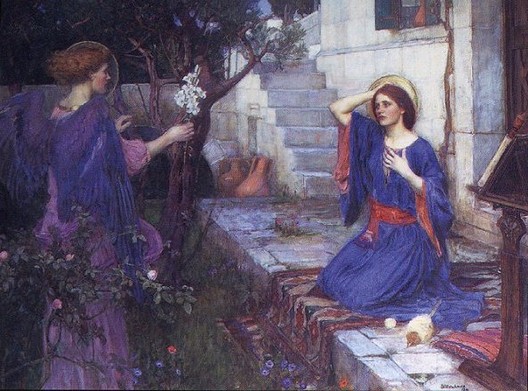
Image source: wikiart.org
Introduction
John William Waterhouse’s “The Annunciation” (1914) revisits one of Western art’s most enduring sacred narratives, but it does so with the quiet intensity and lyrical realism that define his late style. Rather than staging a grand miracle in a blaze of gold and architecture, Waterhouse makes the encounter feel intimate, human, and almost domestic. The scene unfolds in a threshold space that is neither fully inside nor fully outside: a stone terrace and steps bordered by garden growth, shadowed trees, and the pale wall of a building. This in between setting becomes the painting’s emotional key. Annunciation is, after all, a moment of crossing, when an ordinary life is interrupted by a message that changes everything.
Waterhouse focuses less on spectacle and more on the instant of recognition. The drama is contained in posture, gaze, and gesture, and in the way color and light choreograph the viewer’s attention. The painting invites you to read it slowly: first as a story, then as a meditation on surprise, receptivity, and the weight of consent.
The Narrative Moment Waterhouse Chooses
Many Annunciations show the angel arriving mid flight, or Mary reading as the messenger enters with a sudden burst of movement. Waterhouse selects a calmer, more psychologically complex beat. The angel stands at the left, partly embedded in shadow and foliage, offering white blossoms that immediately echo traditional lily symbolism. Mary is already aware that something is happening. She is not depicted as serenely accepting the message from the start, nor as shocked into theatrical recoil. Instead, she appears caught in a suspended second, as if her mind is racing to interpret what her eyes and body already sense.
Mary kneels on the stone steps, her torso angled toward the angel, one hand pressed to her chest and the other lifted toward her head. This combination reads as both protective and receptive: a gesture of self steadiness paired with a gesture of astonishment. It is a believable physical response to life altering news. Waterhouse turns the biblical episode into a recognizably human experience, the kind of moment when the future arrives before the heart has caught up.
Setting as Threshold and Symbol
The architecture is simple but purposeful. A pale stone wall and steps suggest stability, tradition, and an established order, while the garden growth signals natural life, fertility, and the unplanned. The Annunciation sits exactly where stone meets leaf, where constructed space meets living space. This is the perfect stage for the theme: divine interruption within everyday reality.
The terrace feels enclosed yet open, like a private courtyard or a cloister edge. The shadowed trees and deep background darkness on the left create a sense of mystery, while the right side’s stone surfaces catch more light, implying clarity and revelation. The painting’s spatial design becomes a metaphor for the message itself: something emerging from obscurity into understanding, from quiet darkness into articulate meaning.
Composition and the Conversation of Two Figures
Waterhouse arranges the figures as a conversation across space. The angel on the left extends an arm offering blossoms, while Mary on the right responds through her own gestures, making a kind of visual call and response. The distance between them matters. It is not a collision or a forced closeness. The space honors Mary’s autonomy and the gravity of the moment. The message is offered, not imposed.
The figures are also framed by verticals and diagonals that guide the eye. The tree trunk and branches behind the angel create a natural arch, while the building wall behind Mary forms a stable plane. Between them lies the walkway and steps, a route that the viewer’s gaze travels as if crossing from messenger to recipient. This structure makes the scene feel inevitable, like a path that leads to a single pivotal point.
Mary’s Pose and the Psychology of Receiving
Mary’s kneeling posture is devotional, but Waterhouse refuses to let devotion become passive. Her hand on her chest reads as a grounding gesture, as if she is checking her breath or steadying her heartbeat. Her other hand near her head implies a sudden rush of thoughts, the instinct to hold oneself together. Her face is not simplified into pure serenity. There is contemplation, uncertainty, and a dawning awareness that acceptance carries consequences.
This psychological realism is one reason Waterhouse’s sacred subjects can feel unusually modern. The painting is not only about holiness; it is about interior life. Mary’s response suggests that spiritual calling is not merely a reward or a crown. It is a responsibility that arrives with both fear and courage.
The Angel as Presence Rather Than Spectacle
Waterhouse’s angel is understated. There are no large wings dominating the composition, no blinding radiance that overpowers the setting. Instead, the angel’s power is expressed through calm certainty and through the symbolic offering. The angel stands partly within the garden shadow, which is a subtle choice: the messenger belongs to another realm, yet appears within the textures of this one. The angel’s silhouette and drapery feel tangible, and that tangibility is crucial. Waterhouse makes the miraculous feel present in the same air as stone, fabric, and flowers.
The angel’s gesture is gentle, with the arm extended as if inviting rather than commanding. This tone reinforces the theme of annunciation as communication, not coercion. The supernatural enters the scene as a message delivered with dignity and restraint.
Color as Theology and Emotion
The palette is anchored by rich blues and purples, warmed by small accents of red and pink. Mary’s robe is a deep, luminous blue, a traditional color associated with her, but Waterhouse uses it less as a flat symbol and more as a living fabric that carries weight and folds. The blue communicates calm, depth, and spiritual seriousness. Around her waist is a red sash, a vivid note that reads as vitality and embodied life. In a scene about incarnation, this red accent matters. It makes the body and the future tangible.
The angel’s purple drapery, tinged with softer pink, links the messenger to twilight tones, to mystery, and to the liminal. Purple also carries associations of sacredness and royalty, but here it primarily functions as a bridge between shadow and light. The angel seems to emerge from the darker left side and extend into the middle ground, where the blossoms become bright punctuation.
Waterhouse uses white sparingly but decisively. The blossoms offered by the angel glow against surrounding darkness, and small pale objects near Mary’s feet echo that light. This controlled use of white gives the painting a quiet radiance. The miracle is not everywhere; it is concentrated in the message.
Light, Shadow, and the Sense of Revelation
Light in this work does not behave like a spotlight. It feels like natural illumination softened by evening or shade, with the brightest areas reserved for stone planes and symbolic whites. The left side, with trees and garden depth, is darker, while Mary’s side is slightly clearer, more legible. This creates a narrative of revelation: the message comes from mystery, but it aims toward understanding.
The shadows also protect the scene’s privacy. This is not a public sermon. It is a personal encounter. Waterhouse uses darkness to hush the space, as if sound itself has lowered. The effect is that the viewer becomes a respectful witness, drawn close but not invited to intrude.
Symbolic Details and the Language of Flowers
The white blossoms are the painting’s most immediate symbol. Annunciation iconography often includes lilies to signify purity, but Waterhouse’s blossoms feel freshly cut and actively offered, emphasizing exchange and acceptance. The blossoms are not simply placed in a vase as decoration; they function as a communicative object, a visual shorthand for the message’s content and its implications.
The garden itself adds another layer. Floral growth and greenery suggest the generative forces of nature, which align with the painting’s theme of new life. Yet the garden is not lushly triumphant. It is subdued, half shadowed, grounded in reality. Waterhouse avoids making the scene sentimental. The symbolism remains meaningful because it is integrated into a believable place.
Near Mary’s knees and feet, pale objects rest on the stone, alongside the patterned textile. They add still life quiet to the composition, reinforcing the domestic tone. This Annunciation happens amid ordinary textures: cloth, stone, and small everyday items. The divine enters the world that already exists, not a staged theater of heaven.
Drapery, Texture, and Waterhouse’s Late Style
Waterhouse was a master of fabric as emotional language. Here, drapery is not only decorative; it reveals character. Mary’s blue garment pools around her knees in heavy folds, emphasizing humility and steadiness. The weight of the cloth makes her kneel feel intentional and sustained, not momentary. The angel’s fabric, by contrast, hangs with a softer flow, catching dim light and blending into surrounding shadow. The angel appears less bound by gravity, even without obvious wings.
The patterned textile on the steps introduces another register: a human made artifact of comfort and culture. Its warm tones and repeating motifs contrast with the cool stone and the dark garden. This textile becomes a subtle sign of Mary’s everyday life, the life that is about to be transformed. Waterhouse’s attention to these textures deepens the painting’s realism, and that realism, paradoxically, makes the miracle more moving.
Space, Stillness, and the Soundless Moment
One of the painting’s strongest qualities is its silence. Waterhouse creates stillness without freezing the figures into lifeless poses. Instead, the stillness feels like an intake of breath. The space between the figures, the quiet stone surfaces, and the subdued palette all contribute to the sense that time has slowed. This is how momentous events often feel from the inside: not loud, but strangely calm, as if the world has paused to listen.
The viewer’s eye circulates gently rather than darting. You move from the angel’s offering to Mary’s face, down to her hands, across the patterned cloth, and back through the garden shadows. This slow visual rhythm turns the painting into a meditation, encouraging reflection on what it means to receive a calling, and what it costs to say yes.
Waterhouse and the Pre Raphaelite Inheritance
Although Waterhouse is often grouped with the Pre Raphaelite tradition, his late works tend to soften the sharp edges of earlier Pre Raphaelite detail into something more atmospheric and psychological. In this Annunciation, the medievalizing elements and the symbolic clarity remain, but the painting’s primary effect is emotional realism. The figures are idealized, yet they are also credible as people experiencing something difficult to name.
Waterhouse’s interest in women as thoughtful protagonists is central here. Mary is not treated as an ornament to a theological idea. She is treated as the subject of the moment, the one whose interior response matters most. The angel is important, but the painting revolves around Mary’s consciousness.
Themes of Agency, Calling, and the Weight of Consent
At its core, “The Annunciation” is about agency. The angel offers, Mary responds. The distance between them, the tenderness of the gesture, and Mary’s complex expression all insist that acceptance is meaningful because it is chosen. Waterhouse’s depiction emphasizes the human dimension of a sacred narrative: the future depends on a person’s willingness to carry it.
This focus gives the painting a resonance beyond its religious subject. Many viewers recognize the feeling of being addressed by something that changes the trajectory of life, whether that is responsibility, vocation, love, or loss. Waterhouse captures the mixture of fear and courage that accompanies real commitment. The painting does not trivialize that fear, and it does not glamorize it. It simply honors it.
Conclusion
Waterhouse’s “The Annunciation” (1914) is powerful precisely because it is restrained. It does not rely on spectacle to persuade you of the event’s importance. Instead, it builds meaning through composition, color, symbolic flowers, and, above all, through the believable humanity of Mary’s response. The setting, poised between garden shadow and stone clarity, mirrors the painting’s central tension: mystery meeting reality.
The result is an Annunciation that feels intimate and psychologically true. You witness not only a message delivered, but a life shifting in real time. Waterhouse invites you to linger in that suspended second, where surprise becomes understanding, and understanding begins to ask for courage.