Image source: wikiart.org
Introduction
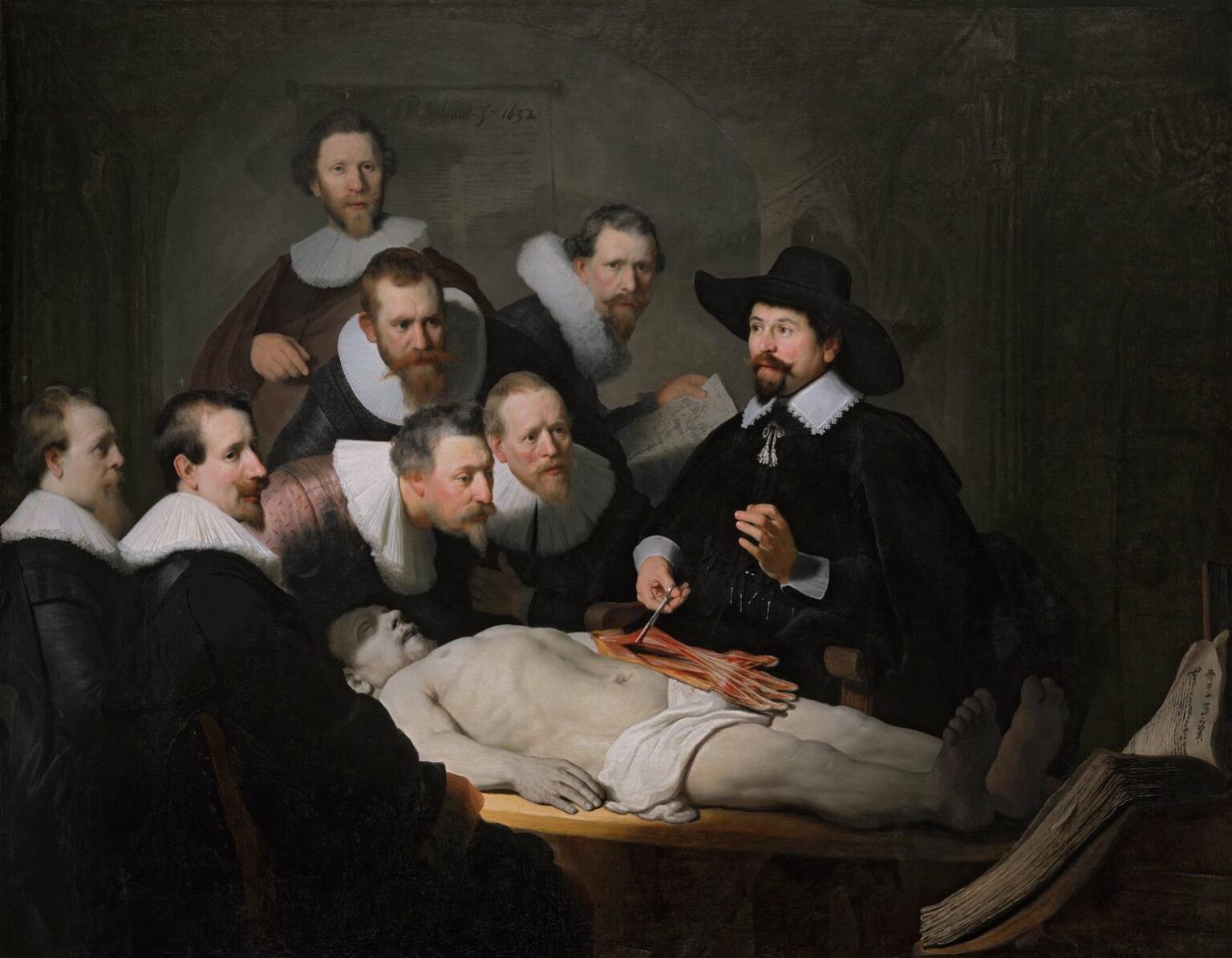
Rembrandt’s “The Anatomy Lesson of Dr. Nicolaes Tulp,” painted in 1632, captures a public dissection transformed into a drama of light, learning, and civic identity. The scene brings together a table of ruffled collars, a surgeon’s poised instruments, and the pale, foreshortened body of a criminal placed in service of knowledge. What might have been a didactic record becomes a meditation on looking and knowing, on the ethics of spectacle, and on the new prestige of empirical science in the Dutch Republic. The painting is one of Rembrandt’s earliest Amsterdam triumphs and a defining group portrait of the century. It announces a young artist fluent in the city’s rhetoric of progress and sophisticated enough to reshape it into enduring art.
Historical Context
In the early seventeenth century, Amsterdam was a prosperous mercantile center where guilds and civic organizations frequently commissioned portraits to affirm their public role. The Surgeons’ Guild held annual anatomy demonstrations in winter, when cold slowed decomposition and crowds could gather in a hall used for lectures. The guild commissioned Rembrandt—newly arrived from Leiden in 1631 and already celebrated for his dramatic handling of light—to commemorate the 1632 lesson delivered by Dr. Nicolaes Tulp, the city’s official anatomist. The event had ceremony and spectacle: tickets were sold, dignitaries attended, and the lecture affirmed the guild’s authority. Rembrandt’s painting elevates the occasion from documentation to emblem, making visible the Republic’s pride in rational inquiry while retaining a probing humanism that complicates easy celebration.
Composition and Staging
Rembrandt orchestrates the figures in a pyramid that rises from the cadaver at lower left to Dr. Tulp’s seated profile at right, and finally to the tall scholar standing behind, whose gaze directs the eye back into the group. The cadaver’s body lies diagonally, foreshortened toward us, turning the table into a shallow stage that meets the viewer’s space. The angle of the corpse and the cascade of faces create a path for the eye: from the exposed forearm and fanned tendons to Tulp’s demonstrative gloved hand, then up through the attentive students to the shadowed architecture beyond. Nothing is accidental. Hands, eyes, and books are arranged to form a chain of attention. Even the open folio in the foreground echoes the splayed tendons, suggesting a new equivalence between flesh as text and text as guide.
The Role of Light
A controlled beam falls from the upper left, igniting the white ruffs and the anatomist’s face before bleaching the cadaver’s torso to a spectral pallor. The darkness around the group is not merely background; it works like a theater’s black to suspend space and time, focusing the moment of demonstration. The light dramatizes two kinds of body: the living, warmly modeled heads orbiting a cool, almost stone-like corpse. The contrast is not lurid. Rembrandt grades tones subtly so the scene feels both concentrated and plausible. The light also carries moral charge. In a culture that prized clarity and truth, the illumination suggests enlightenment made visible: knowledge as a lamp held over nature’s mysteries.
Portraiture and Individuality
Guild portraits often risked stiffness, each member angling forward to claim visibility. Rembrandt solves the problem by embedding likenesses within a narrative. Each face is individualized—beards, noses, receding hairlines, temperaments—but each also plays a role in a communal act of seeing. Some students attend to the dissection; others contemplate a printed anatomical plate; one looks outward, recruiting the viewer into the circle. Dr. Tulp is set apart by his posture and hat, yet he is not isolated. His gaze and gestures bind the group to the act of explanation. The painting thus reconciles the two demands of the commission: faithful likenesses for patrons who paid to be pictured and a coherent, compelling scene worthy of public display.
Gesture, Didactic Tools, and the Language of Hands
Hands are everywhere—Tulp’s left hand flexing his own fingers to mirror the anatomy he reveals, his right hand grasping the forceps, the clustered fingers of students holding paper, the relaxed hands of the cadaver inert on the table’s edge. This choreography of hands turns anatomy into rhetoric. Tulp’s demonstration hand substitutes for speech; it explains musculature through the body of the teacher. The alignment between the anatomist’s living tendons and the dead man’s exposed flexors establishes a bridge from theory to practice, from book knowledge to embodied understanding. The open folio’s curling pages rhyme visually with the fanned tendons, reinforcing the marriage of text and flesh.
The Cadaver as Image and Idea
The body is believed to be that of Aris Kindt, a thief executed on the day of the lesson. Rembrandt renders him with restrained dignity. The foreshortened legs recede into shadow, the loincloth preserves decorum, and the pallor avoids sensationalism. The corpse is both person and object, at once the cost of social order and the catalyst for scientific progress. The face, slightly upturned and lit by reflection, refuses complete erasure; it remains legible enough to kindle sympathy. This duality embodies a larger question the painting poses without answering: how does a society balance the value of human life with the pursuit of knowledge and justice?
Costume, Status, and Civic Identity
The sober black garments and bright ruffs announce the social standing of Amsterdam’s medical professionals. Black, aligned with civic modesty and Protestant virtue, functions here as a velvet foil for light. The collars act as halos of whiteness, concentrating attention on the faces. Dr. Tulp’s broad-brimmed hat, the only one in the group, marks authority. Yet Rembrandt avoids empty pomp. Details are economical: a glint on a button, the modeling of a sleeve, the crisp edge of lace. The clothing situates the scene in a world of professional probity rather than courtly display, aligning science with civic responsibility.
Space, Architecture, and Spectatorship
The hall’s architecture is implied with minimal means: a darkened arch, a pillar fading into shadow, a hanging placard inscribed with date and signature that both locates the event and authenticates it as an official record. These subdued cues create depth without clutter, allowing the figures to project forward. The space feels intimate yet public, an amphitheater suggested by the arc of bodies. The viewer occupies an extraordinary position, both participant and outsider, close enough to see the tendons and yet safely beyond the smell and vulnerability of the operation. The painting thus meditates on spectatorship itself, balancing curiosity, reverence, and unease.
Sources, Innovation, and Artistic Strategy
Group portraits of civic officials were common, but few interwove action and likeness with such coherence. Rembrandt likely knew prints of Italian and Netherlandish anatomy scenes, as well as earlier Dutch militia portraits where action—counting money, signing a document—served as a pretext for assembly. He innovates by making the action inseparable from the identities it knits together. Instead of a simple demonstration of the abdominal cavity, he begins with the forearm, a choice that allows clear visibility of tendons, a living analogue in Tulp’s hand, and a metaphorical parallel to pages and strings. The decision is painterly and conceptual, enabling compositional clarity and a sophisticated play of signs.
Color, Tonal Design, and Paint Handling
The palette is restrained: blacks warmed with umbers, whites modulated by grays, flesh tones built from transparent shadows and opaque lights. The cadaver’s cool grays differ from the warmer, blooded complexions of the living, reinforcing the scene’s life–death polarity. Rembrandt’s brushwork alternates between tight description—especially in faces and anatomical details—and broader, absorbed handling in garments and background. Even in this relatively early work, one senses the beginnings of the textured surfaces that would later define the artist’s mature style. The paint’s materiality animates the fictive flesh, giving weight to shoulders, softness to cheeks, and a chalky matte to the corpse.
Time, Narrative, and Suspended Action
The painting treats time as a hinge between before and after. The execution has happened; the dissection has begun; the lecture is underway. Yet the image is poised in a single, teachable instant: the tendons are exposed but not yet severed further; Tulp’s explanation is mid-gesture; the students are midway between reading and watching. This suspension of action lends the picture an almost theatrical concentration. The viewer senses both the gravity of the event and the fragility of the human body. The moment is not morbid; it is exacting, focused, a ritual of attention.
Morality, Medicine, and the Value of Knowledge
Public dissections were ethically complex. The condemned body served as raw material for instruction, an exchange between punishment and progress. The painting neither condemns nor celebrates. Instead it acknowledges the solemnity of the act by balancing curiosity with respect. Tulp’s composed authority, the students’ earnest faces, and the orderly setting frame medicine as a disciplined path to truth. At the same time, the cadaver’s individuality and foreshortened nearness remind us that knowledge is purchased at the threshold where life becomes object. The work thereby inhabits the tension between compassion and inquiry that still haunts medical practice.
Comparison with Other Group Portraits
Rembrandt would later paint militia companies and syndics that continue this strategy of binding portraits with action. Compared to more static group likenesses by contemporaries, “The Anatomy Lesson” stands out for narrative integration. The students are not passive sitters but characters caught in varied states of attention—leaning forward, reading, pondering, engaging the teacher. This dynamism grants the painting an unusual intimacy, as if we witness both the public ceremony and the private absorption that real learning requires. The image also anticipates later depictions of scientific demonstration in which the act of showing becomes a secular ritual.
Intellectual Culture and Printing
The open book in the foreground and the paper held by a student signal the alliance between medicine and print culture in the Dutch Republic. Anatomical atlases—particularly those derived from Vesalius—standardized knowledge and circulated it widely. Rembrandt places book and body in a charged dialogue, neither eclipsing the other. The cadaver is not a mere illustration of the book, nor is the book a mere caption for the corpse. Instead, both coexist, implying that understanding arises from the mutual correction of text and observation, of tradition and experiment.
Identity, Memory, and Commemoration
Like other guild portraits, the work served as a commemorative document. Viewers would recognize familiar faces and recall the event years later. But Rembrandt resists reducing commemoration to inventory. By choosing a moment of instruction and carefully distributing attention, he transforms memory into allegory: the city remembers itself as a place where knowledge is performed in public, where individuals contribute to a common endeavor. The painting thus becomes a civic mirror, in which Amsterdam’s ideals—industry, clarity, cooperation—are reflected back with heightened dignity.
Reception and Early Impact
The painting quickly established Rembrandt’s standing among Amsterdam’s elites. It announced a painter capable of marrying likeness with feeling and storytelling with restraint. Subsequent commissions followed, including portraits and large scenes that required the same orchestration of many parts. For the Surgeons’ Guild, the picture became a treasured emblem of professional identity, hanging in the Waag’s anatomical theater and later entering museum collections where it remains a touchstone of Dutch Golden Age art.
Conservation, Scale, and Viewing
The painting’s large scale envelops the viewer, encouraging an embodied response to spatial cues—the near edge of the table, the book’s splayed pages, the foreshortened limbs. Conservation records for works of this period often note craquelure in dark passages and the sensitivity of thin glazes to overcleaning. The success of Rembrandt’s tonal design depends on the depth of those shadows and the delicacy of reflected light on faces and flesh. When well preserved and properly lit, the image maintains its stratified space: a bright enclave of reasoning minds ringed by a deep penumbra where the unknown remains.
Legacy and Influence
“The Anatomy Lesson of Dr. Nicolaes Tulp” helped shape the visual language of scientific authority. Later artists depicted lectures, experiments, and clinics with similar triangular compositions and emphatic lighting. The painting also influenced how group portraits could function: not as static lineups but as ensembles with a shared purpose, each member psychologically individuated yet structurally integral. Beyond art history, the image continues to animate discussions about the ethics of using human remains for education, about the theatricality of medical practice, and about the relationship between images and truth in public life.
Human Presence and the Poetics of Seeing
At the heart of the painting lies a paradox Rembrandt knew well: vision is both analytical and empathetic. The anatomist dissects to understand; the artist observes to reveal. The students’ differing gazes model the varieties of attention that seeing requires—scrutiny, comparison, reflection, and wonder. The viewer joins this community of lookers, completing the circuit from body to mind. In this sense the canvas is not only about anatomy but about the act of looking as the foundation of knowledge and art alike.
Conclusion
Rembrandt’s “The Anatomy Lesson of Dr. Nicolaes Tulp” remains compelling because it converts a specific civic ritual into a universal drama of learning. Composition, light, gesture, and character collaborate to stage a moment where flesh becomes lesson and lesson becomes memory. The painting honors the dignity of inquiry without denying the gravity of its means. It stands at the intersection of medicine, morality, and art, and it endures because it understands all three as human enterprises bound by attention, responsibility, and the fragile brilliance of life.