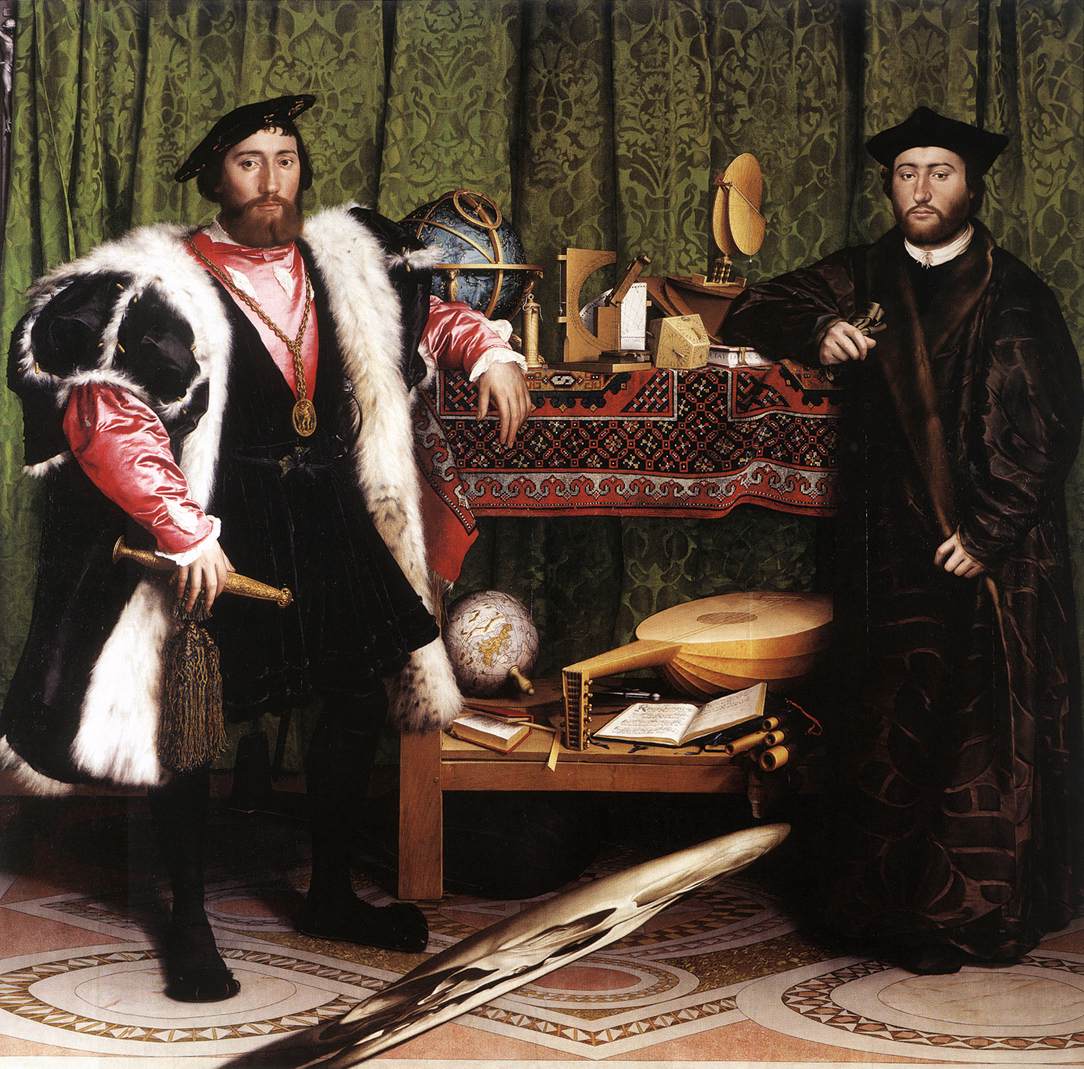
Image source: wikiart.org
Introduction to The Ambassadors by Hans Holbein the Younger
Hans Holbein the Younger’s The Ambassadors, painted in 1533, is one of the most studied and unforgettable portraits of the Northern Renaissance. At first glance, the painting appears to be a grand double portrait of two richly dressed men standing beside a display of luxurious and learned objects. Yet the longer one looks, the more the work opens into something larger than portraiture. It becomes a painting about power, knowledge, religion, mortality, and the unstable nature of human achievement. Holbein turns a formal image of status into a deeply layered meditation on the world of the early sixteenth century.
The painting is famous partly because of its visual confidence. The two men are painted with extraordinary realism, their clothing rendered with such precision that velvet, silk, fur, leather, and metal all seem to possess their own physical presence. The green curtain behind them gives the scene an almost theatrical quality, as though the viewer has entered a carefully staged world. Between the figures stands a table crowded with objects related to astronomy, music, mathematics, navigation, and learning. These objects are not decorative extras. They form a visual language that expands the meaning of the portrait and ties the two men to the larger intellectual ambitions of their age.
At the same time, The Ambassadors is not simply a celebration of wealth and intelligence. Across the lower foreground lies the painting’s most startling feature: an elongated, distorted shape that looks strange and almost abstract when seen head on. When viewed from the side, however, it resolves into a human skull. This anamorphic skull transforms the entire meaning of the picture. What first appears to be a triumph of worldly presence is revealed to contain a warning about death and the vanity of earthly success. Holbein uses illusion not as a trick for its own sake, but as a profound statement about how human beings see and fail to see the truth.
Historical Context of The Ambassadors
To understand the painting fully, it helps to place it in the world of 1533. Europe was in a period of intense political and religious upheaval. Courts competed for influence, diplomacy shaped international relations, and the Christian unity of Western Europe was being shattered by the Reformation. The old certainties of medieval life were giving way to a more complex and divided modern world. At the same time, the Renaissance had brought renewed interest in classical learning, scientific observation, geography, and the dignity of human intellect.
Holbein himself was ideally positioned to capture this changing world. Born in Germany and active in Basel before moving to England, he worked across cultures and political systems. He became one of the greatest portrait painters of the age because he could do more than merely record a likeness. He could turn a face, a gesture, and an arrangement of objects into a complete statement about identity. By the time he painted The Ambassadors, he had already shown remarkable skill in combining Northern precision with Italian ideas about monumentality and design.
The year 1533 was especially charged in England, where Holbein was working. Henry VIII’s break with Rome had created enormous tension, and the question of religious authority was no longer abstract. Diplomatic life was intertwined with doctrinal conflict, royal marriage politics, and shifting alliances among European powers. In this atmosphere, a portrait of two elite men surrounded by instruments of measurement and culture could not be neutral. It reflected a world in which knowledge, status, and belief were all being negotiated under pressure.
Who the Ambassadors Were
The two men in the painting are generally identified as Jean de Dinteville and Georges de Selve. Jean de Dinteville, on the left, was a French nobleman and diplomat. Georges de Selve, on the right, was a bishop and also an intellectual figure who engaged in diplomatic affairs. Their identities matter because the painting is not an anonymous allegory. It is rooted in real political and social relationships. These were educated, cosmopolitan men operating at a high level of European life.
Jean de Dinteville stands in an assertive pose, his left elbow resting on the shelf and his richly decorated clothing proclaiming wealth and rank. He appears as a man of worldly influence. Georges de Selve is more restrained in dress and demeanor, which suits his religious office and scholarly character. Together they create a contrast between secular and spiritual authority, action and reflection, courtly display and intellectual inwardness. Holbein does not make them opposites in a simplistic way, but he clearly encourages the viewer to read them as complementary types within the same elite culture.
Their friendship or alliance gives the picture its human core. This is not just a record of two separate individuals. It is a portrait of association, conversation, and shared presence. The table between them functions almost like a bridge. It binds them together through objects that point to common interests in science, music, exploration, and learning. The men do not touch, yet the carefully balanced composition suggests a relationship built on mutual recognition and social equality.
Composition and Visual Structure
Holbein’s composition is extraordinarily controlled. The two figures stand on either side of the central shelves, creating a stable and symmetrical structure. Yet this symmetry is not rigid. Each figure occupies his space differently, and the objects between them introduce a rich visual rhythm. The eye moves from the men’s faces to the instruments, then down to the musical objects and finally to the strange skull in the foreground. The painting feels both ordered and alive.
The vertical folds of the green curtain provide a rich backdrop that sets off the figures and objects with dramatic clarity. The curtain also creates depth while keeping the scene enclosed. This is not an open landscape portrait. It is an interior world of thought, rank, and symbolic display. The enclosed setting intensifies the viewer’s focus on material detail and intellectual content.
One of Holbein’s greatest achievements here is the management of surfaces. Textures are described with astonishing finesse, but they never feel isolated from the whole. The gleam of metal, the softness of fur, the patterned carpet, the polished wood, and the bound books all contribute to an effect of abundance. Yet the painting never becomes cluttered because the arrangement is so exact. Holbein gives each object its place within a larger geometry of balance and meaning.
The floor also plays a crucial role. Its circular patterns echo the painting’s concern with measurement, harmony, and design. At the same time, the floor anchors the figures firmly in space. The skull, stretched across this elegant surface, disrupts the order just enough to unsettle the viewer. That disruption is central to the painting’s emotional force.
Symbolism of the Objects on the Shelves
The shelves between the ambassadors are filled with instruments and items that carry both literal and symbolic meaning. On the upper shelf are objects connected to astronomy and the measurement of time and space. Globes, quadrants, sundials, and related instruments suggest the Renaissance desire to understand the cosmos through observation and calculation. They speak to a culture increasingly aware of the wider world, of navigation, of celestial order, and of human capacity to measure reality.
These instruments also signal the education and refinement of the sitters. They are not merely rich men. They are men who belong to a learned international elite. In Renaissance portraiture, objects often help define the subject’s identity, and here they do so with unusual sophistication. Holbein presents knowledge as part of social prestige, but he also hints that even the most advanced forms of knowledge remain part of the fragile human condition.
The lower shelf introduces a somewhat different world through books and musical instruments. A lute dominates the space, accompanied by a hymnbook or music book and other objects of learning. Music in Renaissance thought was often associated with harmony, proportion, and the ordering of the soul. But in The Ambassadors, harmony appears incomplete. One of the lute’s strings is broken, a detail that has attracted enormous attention. This broken string is often interpreted as a sign of discord, perhaps referring to religious division, political strain, or the difficulty of achieving unity in a fractured age.
The juxtaposition of scientific instruments above and musical or cultural objects below is especially revealing. Holbein brings together the quadrivium and the broader traditions of humanist education. The painting suggests that the world of the ambassadors is not limited to politics or ceremony. It is informed by mathematics, cosmology, music, theology, and geography. This makes the painting feel like a portrait of an entire intellectual civilization.
Religion, Discord, and the Reformation
Although The Ambassadors is a secular looking image in many respects, religion is deeply woven into it. The early sixteenth century was marked by conflict between Catholic and Protestant positions, and Holbein’s painting reflects a world in which religious disagreement had become impossible to ignore. The broken lute string is often read as a sign of spiritual and political discord. The music book has also been linked to Lutheran hymn traditions, adding another layer to the painting’s engagement with contemporary belief.
The two sitters themselves can be read through this lens. Georges de Selve, as a bishop, represents formal ecclesiastical authority, yet he was also known for his humanist learning and diplomatic activity. Jean de Dinteville belongs more visibly to the worldly sphere of courts and embassies. Their presence together suggests a hope that intellect and diplomacy might help navigate division. But the painting offers no simple confidence that such reconciliation will succeed.
A small but important detail appears in the upper left corner behind the curtain: a crucifix, partly concealed. This hidden Christ is easy to miss, especially when compared to the dazzling display of worldly objects in the rest of the painting. The concealment matters. It implies that the sacred remains present, but not at the center of human attention. Holbein may be suggesting that amid wealth, knowledge, ambition, and conflict, the ultimate spiritual truth is still there, though partially obscured by the spectacle of worldly life.
This tension between visible brilliance and hidden truth is central to the painting. Religion is not announced through dramatic devotional imagery. Instead, it exists as a quiet but essential counterpoint to the ambassadors’ public presence and the brilliant objects around them. Holbein asks the viewer to notice what is easily overlooked.
The Anamorphic Skull and the Theme of Mortality
The skull in the foreground is the painting’s most famous feature and one of the most remarkable devices in Renaissance art. Seen from the front, it appears as an elongated, almost abstract form that interrupts the painting’s harmony. Seen from an oblique angle, it suddenly becomes legible as a skull. This transformation is more than a technical curiosity. It is the key to the painting’s deepest meaning.
The skull belongs to the long tradition of memento mori, reminders of death that encourage reflection on the brevity of life. In a portrait full of luxury, intellect, and worldly accomplishment, the skull introduces a stark truth: all human status, beauty, knowledge, and achievement end in mortality. The ambassadors stand tall and confident, but death stretches across their path. It is literally placed at the viewer’s feet, where it cannot be permanently ignored.
What makes Holbein’s use of the skull so powerful is that it requires the viewer to change position. One must move physically to perceive the truth hidden within distortion. That act of movement turns viewing into a form of meditation. It suggests that reality is not always available from the most obvious standpoint. Human beings are easily dazzled by appearances, by costume, by instruments, by ceremonial display. To see mortality clearly, one must look differently.
This idea aligns perfectly with the broader structure of the painting. Everywhere Holbein contrasts surface and truth, presence and fragility, display and disappearance. The skull is not separate from the ambassadors or the objects. It interprets them. It tells us how to read the entire image.
Holbein’s Technique and Realism
Hans Holbein the Younger was one of the supreme masters of descriptive painting, and The Ambassadors shows his technique at its height. Every surface is observed with care, but Holbein’s realism is never merely mechanical. He does not imitate detail for its own sake. He selects and arranges detail so that it carries psychological and symbolic weight.
The faces are especially impressive. Both men are individualized with great subtlety. Their expressions are calm, intelligent, and self possessed, yet neither face is emotionally blank. Holbein gives them a presence that feels both immediate and reserved. They are accessible as human beings, but they also retain the dignity of their station. This balance is one reason Holbein was such an exceptional portraitist.
His handling of fabric is equally extraordinary. The fur lining of Jean de Dinteville’s coat, the sheen of satin sleeves, the dark folds of Georges de Selve’s garment, and the patterned oriental carpet all display different tactile qualities. These passages demonstrate technical mastery, but they also communicate social meaning. Clothing in the painting is inseparable from identity, rank, and cultural sophistication.
Color is used with restraint and intelligence. The green curtain creates a deep, cool field against which black garments, pink sleeves, gold accessories, and pale flesh tones stand out vividly. The colors are rich but not excessive. Holbein prefers controlled intensity to flamboyant excess, and this discipline helps preserve the seriousness of the image.
Meaning and Interpretation of The Ambassadors
One reason The Ambassadors continues to fascinate viewers is that it supports multiple interpretations without collapsing into vagueness. It can be understood as a double portrait, a celebration of Renaissance learning, a political image, a meditation on religious division, and a moral reflection on death. These meanings do not compete with one another. They interact.
At one level, the painting honors two remarkable men and the world they inhabit. It acknowledges diplomacy, scholarship, and cultivated taste as achievements worthy of representation. At another level, it questions whether worldly achievement can ever be secure. The broken string, the hidden crucifix, and the anamorphic skull all introduce instability into what might otherwise be a straightforward image of success.
The painting also speaks to the Renaissance belief in the dignity of human intelligence. The objects on the shelves testify to curiosity about the heavens, the earth, time, and harmony. Yet Holbein does not allow this confidence to become arrogance. Human knowledge is real, but it exists within a mortal and morally uncertain world. The painting admires human accomplishment while refusing to idolize it.
This complexity gives the work its enduring power. Many portraits show wealth. Many religious images preach mortality. Few works bring together grandeur, intellect, doubt, beauty, and death with such visual intelligence. Holbein creates a painting that feels complete and unsettled at the same time.
The Legacy of The Ambassadors
Over the centuries, The Ambassadors has become one of the defining masterpieces of Renaissance art. It is admired not only for its technical brilliance but also for its unusual conceptual depth. Viewers return to it because it rewards slow looking. What seems at first like a static court portrait gradually reveals itself as a sophisticated reflection on the human condition.
The painting has also become iconic because of the skull’s optical distortion. Modern audiences are often drawn to it through this dramatic feature, but the work endures because the distortion is integrated into a much richer artistic and intellectual design. Holbein anticipated later artistic interests in illusion, viewpoint, and the active role of the observer, yet he remained fully rooted in the moral seriousness of his own age.
In museum settings and art history classrooms, The Ambassadors often serves as an example of how Renaissance art could unite empirical observation with symbolic meaning. It demonstrates that realism and allegory are not opposites. Holbein shows that a painting can be both visually exact and intellectually demanding.
Its influence also lies in how it defines portraiture itself. Rather than reducing identity to facial resemblance, Holbein presents identity as something shaped by objects, beliefs, social roles, and mortality. The result is a portrait that is at once personal and civilizational. It captures not only two men, but an era standing on the threshold of modernity.
Conclusion
The Ambassadors by Hans Holbein the Younger is far more than a portrait of two important men in expensive clothing. It is a carefully structured vision of Renaissance Europe at a moment of brilliance and uncertainty. Through its sumptuous detail, symbolic objects, concealed religious references, and unforgettable anamorphic skull, the painting explores the tension between worldly achievement and human limitation.
Holbein’s genius lies in his ability to make every part of the picture contribute to this larger meaning. The men embody power, learning, and cultivated identity. The instruments speak of discovery, order, and intellectual ambition. The broken string and hidden crucifix hint at division and neglected truth. The skull reminds the viewer that death stands behind all human display.
This richness is why The Ambassadors remains one of the most compelling paintings of the sixteenth century. It asks the viewer not only to admire, but also to reflect. It offers beauty, status, and knowledge, yet it refuses to let these things appear complete in themselves. Instead, Holbein presents a world in which appearance must be questioned, truth must be sought from new angles, and mortality remains the final measure of earthly life. That fusion of realism, symbolism, and philosophical depth is what makes The Ambassadors a masterpiece.