Image source: wikiart.org
Introduction
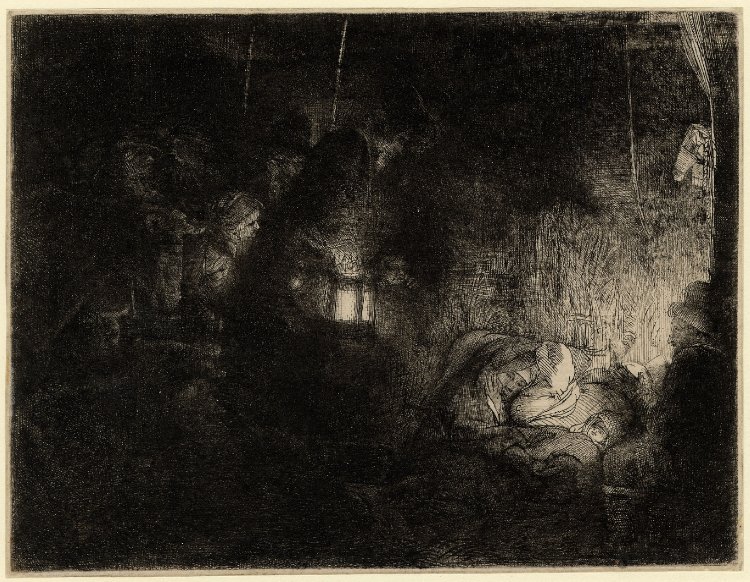
Rembrandt’s “The adoration of the sheperds” (1652) is one of the most profound nocturnes in European printmaking. In a barn-like interior choked with shadow, a newborn lies in a cradle of light. Around him, farm beams, thatch, tools, and bundled figures dissolve into darkness, while a few faces, hands, and boards catch light like small revelations. The print understands night not as a backdrop but as a living medium—a pressure that concentrates attention, hushes movement, and makes a single, modest radiance feel like a world’s center. This is the Nativity translated into the language of ordinary poverty and extraordinary presence.
The Drama Of Light In A World Of Shadow
What first seizes the eye is Rembrandt’s orchestration of light. The sheet is overwhelmingly dark, its blacks built from dense, patient cross-hatching and plate tone. Two key illuminations awaken that darkness: a soft interior glow near the manger and a secondary flare from a lantern deeper in the space. The light around the child is warmer and more tactile, falling across Mary’s bent head and the folds of her blanket, then climbing the straw wall like a sunrise caught in miniature. The lantern’s light is cooler and more directional, striking a few faces as shepherds enter and making their presence feel recent. Between these two sources, shadow becomes a participant—thick where the roof beams descend, wetted by faint glints where tools hang, lustrous where animals breathe. Light is not used to decorate; it is used to mean. Illumination belongs where love, attention, and humility collect.
Composition As Pilgrimage Toward The Child
The composition reads from darkness to light, left to right and foreground to depth, like a pilgrimage through a crowded shelter. Forms on the periphery are smudged into tone; nearer figures step into recognition as attention advances toward the manger. Rembrandt places Mary and the child low and to the right, cradled by a slope of bedding and a vertical wall of straw. Their triangle becomes the print’s anchor point. Above and behind, a slant of roof lines and a hanging curtain form a canopy that echoes traditional altars while remaining resolutely rustic. Shepherds cluster along a diagonal leading from the lantern to the manger, bodies bending as if drawn by gravity. The viewer’s path follows theirs: we enter with them and arrive at the same silent astonishment.
Faces, Hands, And The Psychology Of Wonder
Rembrandt’s figures are not idealized adorers; they are working people whose hands have known weather and labor. The shepherd nearest the light lifts his cap and leans forward, the action carved by a few decisive lines that instantly describe respect. Another kneels, his face half-lost in the radiance that steals detail but leaves posture. Mary’s head dips toward the child in a gesture of practiced tenderness—less display than habit, as if she were shielding a sleeping infant from the draft. Joseph keeps to the dimmer area, a guardian whose presence we feel as steadiness rather than spectacle. In Rembrandt’s world, wonder is not an open-mouthed theatre; it is a deep quiet that gathers in hands and shoulders before it ever reaches the face.
The Barn As Theology
The space is not a stage-dressed temple but a credible shed: rough posts, sagging thatch, ladders, cords, and hay. Rembrandt renders these with selective emphasis. Where the eye needs structure—beam, ladder rung, wall seam—line tightens; elsewhere he lets plate tone carry the weight. The humble setting is not an artistic reduction; it is theology. Divinity arrives where life is actually lived, and the world’s roughness is not an embarrassment but a cradle. The Nativity becomes less an event of décor than an event of closeness: God within reach, light within straw, glory diluted to a warmth a poor family can use.
Printmaking Choices And The Tactility Of Night
Technically, the sheet is a marvel of etching and drypoint used to simulate weather, air, and time. Rembrandt allows plate tone to cling across the surface so that darkness has depth rather than flatness. In passages near the child he wipes more thoroughly, clearing breathing space and letting the paper’s whiteness act as living light. Drypoint burr enriches silhouettes—softening hat brims, beard edges, and animal contours—so that figures seem to glow slightly at their perimeters, as things do when seen by candle. Cross-hatching is varied like music: tight for intensity, open for breath, parallel for gentle shade, and broken where he wants suggestion rather than statement. The print feels wiped, not polished; the hand remains legible in every passage, and that human touch is crucial to the scene’s credibility.
Sound, Smell, And The Sensory Atmosphere
Though we cannot hear it, the print hums with imagined sound: the creamy sputter of tallow, the soft crossing of straw under feet, a lamb’s damp exhale, whispered greetings coming to rest in the rafters. The air is earthy—hay, wood, wool, and breath warmed by bodies. Rembrandt’s marks conjure these senses by convincing surfaces: warm fur where a beast’s flank catches light, brittle bristle where thatch edge meets darkness, the nap of a blanket made from quick, rough strokes. Because each texture persuades, the mind fills the room with weather and smell, and the miracle becomes inhabited rather than abstract.
The Shepherds As Neighbors
One of Rembrandt’s gifts is to make biblical figures feel like neighbors—people we might pass on a road or recognize at a doorway. The shepherds here are dressed in patched coats and simple headgear. Their bodies bend from years of walking fields, and their feet plant with the cautious respect of visitors to a sleeping household. This realism does not diminish sacredness; it grounds it. Adoration becomes an act available to ordinary people in ordinary clothes, and the viewer is invited to join, not as royalty paying homage, but as someone who knows the discipline of quiet in another family’s room.
Mary And The Politics Of Attention
Mary’s portrayal is maternal rather than iconic. She guards warmth, keeps the baby’s face in the lee of her shoulder, and allows the energy of the room to flow around rather than through her. Rembrandt refuses a halo forced upon the head; instead, sanctity arises from the geometry of care. The mother’s focus creates the center of gravity. Theology is not argued; it is modeled in how attention is paid to the smallest life in the room. The composition’s light follows that politics of attention—where she looks, light gathers.
The Infant As A Modest Radiance
The child himself is rendered with gentleness: small arcs for swaddling folds, a pale oval for the face, and a few crucial accents at brow and cheek. He is not a shining emblem but a modest source whose brightness fades naturally into surrounding cloth. That restraint prevents sentimentality and lets the viewer discover the child gradually, as one does in a dim room where pupils adjust. The longer you look, the more the infant resolves; your eye enacts the shepherds’ inward journey from curiosity to reverence.
The Secondary Light And The Narrative Of Arrival
The lantern toward the middle distance carries narrative. Its sharper reflections on wood and the brief glamor on a visitor’s knuckles suggest movement—a door just passed, a lamp just raised, a last whispered instruction to hush. The two-light structure allows Rembrandt to tell time within a single moment: the travelers are still arriving while adoration has already begun. It’s a visual way to hold the simultaneity of a crowded night—some entering, some beholding, some keeping, all gathered by the child’s quiet.
Perspective, Depth, And The Art Of Concealment
Depth in so dark a sheet depends on concealment. Rembrandt layers darkness so that some forms are almost guessed: a beam’s far face, a loft’s hanging rope, a figure half-absorbed by shadow. The eye explores by inference, and discovery becomes part of devotion. We learn the room as we learn a psalm—by tracing shapes, testing unknowns, and accepting that some things remain in prayerful dark. The controlled confusion also serves a compositional purpose: it keeps the center clear while giving the periphery a living murmur.
Comparison With Other Nocturnes
Rembrandt etched several night pieces in these years, and this Nativity speaks with them. Like “The Hundred Guilder Print,” it treats light as moral relationship rather than mere optics: illumination belongs to mercy, listening, and teaching. Like his “Flight into Egypt: A Night Piece,” it understands how a single carried flame can organize space and emotion. What sets this sheet apart is its domestic concentration. There is no open road, no monumental architecture, no orchestration of many discrete episodes—only a crowded room where the sacred hides in plain sight and reveals itself to the patient.
The Viewer’s Place And The Ethics Of Witness
Where, exactly, do we stand? Slightly to the left, a few paces inside the threshold, on the darker side of the lantern’s light. We are participants in the quiet, not judges over it. The print’s ethics are clear: enter softly, keep the light low, let the family be the focus. Rembrandt’s choice of high darkness is an act of protection; it shelters the scene from prying eyes even as it invites reverent ones to draw close.
Time Stilled And Time Lived
In many Nativity images, the birth becomes a kernel of eternity, lifting out of time into icon. Rembrandt does something subtler. He shows time lived: the growth and warmth of bodies, the entering and leaving of visitors, the maintenance of hearth and animals, the fragility of a baby who will need feeding again within the hour. Eternity glows here, yes, but as a warmth within the hour’s tasks. The sacred is not a freeze-frame; it is a heat source for the next motion.
Close Looking At Key Passages
In the thatch above the child, innumerable short strokes gather into a glittering wall where light snags on straw. At the lantern, a few engraved rectangles create the sense of panes, their tiny reflections jumping out of the gloom. On Mary’s sleeve the hatching opens, and the paper’s tone becomes woven cloth catching low light. The shepherd’s lifted cap is handled with two kinds of line—fine for the brim’s worn edge, heavier for the crown’s rumpled felt—tiny decisions that bring real touch into the room. In the far left, a barely legible profile peers in; the smallness of those marks, almost lost, makes the room feel larger than the plate.
Animals, Implements, And The Companionship Of Things
Rembrandt is attentive to the nonhuman companions of the scene. A beast’s flank absorbs and returns light with a warm dullness that suggests breath and hide. A bucket rim glints, a stool leg emerges, a rope sags—a catalog not of props but of the patient company of things that share human rooms. These humble presences humanize the miracle; they insist that adoration can happen among chores.
The Humility Of Scale And The Grandeur Of Feeling
Although the composition is grand in its range of darks, the sheet’s physical scale is intimate, meant for a viewer to hold close. This intimacy is part of its power. The closer you bring it, the more the light blooms and the more your own reflection disappears from the paper’s surface, as if the act of devotion included the disappearance of the spectator’s self-importance. Rembrandt composes grandeur not with size but with density of meaning.
Why The Print Still Speaks
Contemporary viewers recognize in this image a truth about quiet gatherings around small lives—hospitals at night, bedrooms with new children, vigils kept for fragile bodies. The print does not impose sentiment; it grants recognition. Its light is believable, its room navigable, its people neighborly. That credibility allows the mystery—love arriving in a modest place—to pass from story into experience. It is not merely a picture of the shepherds’ adoration; it is an invitation to practice our own.
Conclusion
“The adoration of the sheperds” (1652) is Rembrandt’s proof that darkness can be generous. He builds a room of shadow, installs a few honest lights, and lets working people draw near to a child whose radiance is real because it is small. Every technical choice—plate tone left in place, burr softening edges, sparing highlights, selective detail—serves the larger purpose of making the sacred legible in ordinary terms. What remains after looking is not the apparatus of etching or the cleverness of composition; it is a feeling of companionship with a scene we might enter on tiptoe, warm our hands at, and leave quietly better for having seen.