Image source: wikiart.org
Introduction to Edmund Blair Leighton’s Accolade
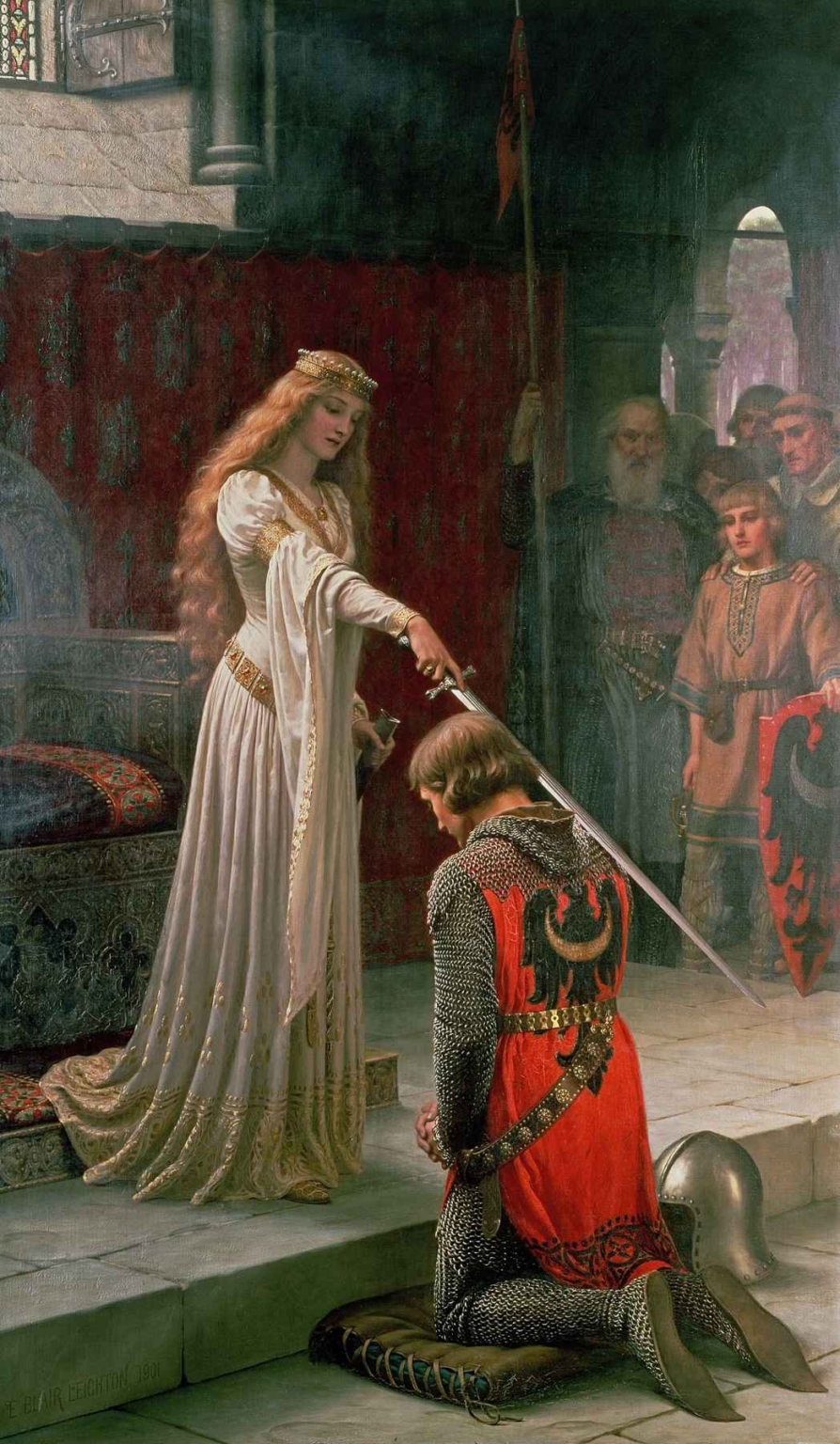
Edmund Blair Leighton’s Accolade from 1901 is one of the most admired images of medieval romance in late Victorian and Edwardian painting. At first glance, the scene appears simple and ceremonial. A young woman in a luminous white gown lowers a sword onto the shoulders of a kneeling knight, while a small group of observers watches from the shadowed interior behind them. Yet the picture has remained so popular because it offers much more than a historical costume scene. It presents an idealized world of honor, beauty, ritual, and emotional restraint, all held together by Leighton’s remarkable control of composition and atmosphere.
The painting invites viewers into a moment of transition. The kneeling figure is not merely pausing for a formal gesture. He is being transformed. Before this instant, he is a warrior awaiting recognition. After it, he becomes something greater in the eyes of society, perhaps even in his own eyes. The woman administering the accolade becomes equally important, because she is not shown as passive decoration. She stands above him, calm and commanding, shaping the meaning of the event through her gesture.
This balance between romance and ceremony explains why the painting continues to captivate modern viewers. It belongs to a long tradition of medieval revival art, but it also speaks to timeless desires for dignity, beauty, and purpose. Leighton does not present the Middle Ages as a brutal era of conflict. Instead, he transforms it into a theater of values, where outward ritual expresses inward worth. In doing so, he created a painting that feels both dreamlike and emotionally direct.
The Narrative Moment at the Heart of the Painting
The power of Accolade begins with its chosen moment. Leighton does not depict a battle, a coronation, or a dramatic rescue. He selects a quieter scene, but one filled with concentrated significance. The knight kneels in submission, not defeat. The woman raises the sword with controlled solemnity. The witnesses remain still. Every figure understands that this is a ritual with consequences. The painting becomes compelling because it freezes the instant when identity is publicly conferred.
In medieval tradition, the accolade referred to the ceremonial dubbing of a knight. Leighton uses that tradition not simply as historical subject matter, but as narrative structure. The act of touching the sword to the shoulders carries symbolic weight. It suggests discipline, service, loyalty, and entrance into a code larger than the individual. The kneeling figure is not celebrated for personal vanity. He is being admitted into an order of meaning.
At the same time, the scene contains a subtle emotional tension. The woman’s face is serene, yet slightly introspective. The knight bows deeply, emphasizing humility and devotion. The distance between them is narrow, but the painting does not turn the moment into overt romance. Instead, it leaves open the possibility of emotional undercurrents without allowing them to disrupt the formal dignity of the event. That ambiguity is part of the painting’s lasting charm. It lets viewers sense feeling without reducing the scene to sentimentality.
Leighton understood that the strongest narrative paintings often depend on restraint. By holding back action and theatrical expression, he allows viewers to supply part of the emotional meaning themselves. The result is an image that feels complete in itself while also inviting imaginative continuation.
Medieval Revival and the Dream of Chivalry
Accolade belongs to the broader medieval revival that flourished in nineteenth century British art and culture. During this period, many artists, writers, and designers turned toward the Middle Ages as a source of moral seriousness, decorative richness, and romantic fantasy. For them, medieval subjects offered an alternative to industrial modernity. Instead of factories, urban anonymity, and social fragmentation, the medieval world could be imagined as one of craftsmanship, hierarchy, devotion, and heroic purpose.
Leighton was especially drawn to this imagined past. His work often returned to themes of courtship, devotion, pageantry, and idealized medieval life. In Accolade, he presents chivalry not as harsh military reality, but as a code refined into beauty. Armor gleams, fabric falls in graceful folds, and architecture frames the action with solemn grandeur. Violence has been replaced by ceremonial order. The sword is present, but it does not wound. It sanctifies.
This vision of chivalry would have appealed strongly to viewers at the turn of the twentieth century. Britain was facing rapid change, and many artists used historical subjects to express nostalgia for a world that seemed more coherent and noble. Whether or not that world ever truly existed in the way they imagined it was almost beside the point. The medieval revival was less about historical reconstruction than about emotional and moral aspiration. It offered a language of ideals.
In Accolade, those ideals are made visible through posture and ritual. The knight kneels willingly. The lady acts with authority and grace. The witnesses affirm communal recognition. Chivalry here is not merely male bravery. It is a system of mutual roles, each defined by dignity and restraint. That is one reason the image feels so balanced. Everyone in the scene belongs to the ceremony, and everyone helps define its meaning.
Composition and the Architecture of Reverence
Leighton’s compositional control is one of the painting’s greatest strengths. The arrangement of the figures immediately establishes hierarchy and movement. The standing woman occupies the left side of the central action, elevated slightly by the step beneath her feet. The kneeling knight fills the lower center and right foreground, his bent posture leading the eye upward toward the sword and the woman’s hand. This creates a visual arc that guides the viewer naturally through the act of dubbing.
The vertical lines of the architecture reinforce the solemn tone. Columns, walls, and hanging banners create a sense of enclosed sacred space. Although the setting is not a church in any strict sense, it has a ceremonial gravity that feels almost devotional. The interior frames the action like a stage, but a stage designed for reverence rather than spectacle. This allows the human gesture to take on symbolic grandeur.
The background figures are also carefully placed. They do not compete with the main scene. Instead, they deepen it by providing witness and social context. Their relative stillness increases the emotional concentration of the central pair. The older bearded man, the younger attendants, and the partial shields establish a world beyond the foreground without distracting from it. They remind us that this transformation is public, acknowledged, and meaningful within a larger order.
Even the empty areas matter. Leighton uses shadow and open floor space to prevent overcrowding. This gives the scene room to breathe and heightens the importance of the central action. The viewer feels drawn into a space of silence, where every gesture carries weight. The painting’s stillness is therefore not static. It is active stillness, a compositional pause that heightens significance.
Color, Light, and the Language of Contrast
One of the most striking aspects of Accolade is Leighton’s use of color contrast. The woman’s white gown dominates the picture with radiant clarity, immediately separating her from the darker interior and from the red and metallic tones surrounding her. White here functions as more than descriptive color. It suggests purity, ceremonial authority, and almost spiritual illumination. She seems to carry light into the dim hall.
Against this whiteness, the rich red backdrop and the knight’s red surcoat create visual drama. Red suggests power, courage, and passion, but in this painting it is carefully controlled. It does not explode into violence. Instead, it provides warmth and depth, giving the composition emotional richness without undermining its calm. The black heraldic forms on the knight’s garment and shield add further intensity, grounding the scene in martial identity.
Leighton also shows great sensitivity in his handling of metallic surfaces and stone. The chain mail, sword blade, and helmet are rendered with convincing luminosity, yet they never overpower the human figures. These objects gleam enough to signify status and realism, but they remain subordinate to the emotional and symbolic center of the work. The stone architecture, meanwhile, provides cool neutrality, allowing the fabrics and flesh tones to stand out.
Light plays a major role in establishing mood. The illumination does not feel broad or naturalistic in a casual sense. It is selective and theatrical, emphasizing the woman, the sword, and the kneeling knight while letting the background recede into shadow. This distribution of light supports the painting’s emotional logic. The ritual itself becomes the source of visual focus. Leighton uses light not merely to reveal form, but to create significance. We see what matters because the painting teaches us what deserves attention.
The Female Figure and the Question of Power
A major reason Accolade remains memorable is the commanding presence of the woman performing the ceremony. In many historical and romantic paintings of the nineteenth century, women are shown as objects of admiration, longing, or rescue. Here, however, the female figure occupies a more complex and powerful role. She is beautiful, certainly, but beauty alone does not define her importance. She stands upright, controls the sword, and presides over the transformation of the kneeling man.
This inversion of expected physical power is crucial to the painting’s fascination. The armored knight, emblem of masculine warfare and endurance, bows before a woman clothed in flowing white fabric. Yet there is no sense of humiliation. Instead, the scene suggests that true knighthood requires submission to a higher code, and that this code can be embodied by feminine grace and judgment. The woman is not shown as fragile in contrast to male force. She is the one who legitimizes force.
Her calm expression strengthens this authority. She does not look triumphant, flirtatious, or emotionally overwhelmed. She appears composed and inwardly assured. This emotional restraint gives her figure unusual dignity. She is not merely participating in ceremony. She is the ceremony’s moral center. The painting suggests that nobility depends not only on martial strength but also on recognition by ideals associated with purity, beauty, and discipline.
At the same time, Leighton does not strip the image of romantic appeal. The woman’s golden hair, elegant dress, and delicate features preserve the enchantment of medieval fantasy. But because she is given agency within the scene, the fantasy becomes more compelling. She is not decoration placed beside heroism. She is one of the forces that defines what heroism means.
Costume, Texture, and Leighton’s Love of Detail
Leighton’s reputation rests in large part on his ability to render costume and material richness with extraordinary care. In Accolade, the surfaces of cloth, metal, stone, and wood are not merely decorative additions. They are essential to the painting’s immersive effect. The viewer feels the weight of chain mail, the softness of embroidered fabric, the polished edge of the sword, and the cold solidity of the architectural interior.
The woman’s gown is especially remarkable. Its flowing white folds create grace and vertical movement, while the gold trim and jeweled headpiece emphasize refinement and ceremonial splendor. The dress does not cling aggressively to the body or seek sensual display. Instead, it enlarges her presence, making her seem both stately and ethereal. The costume supports the painting’s balance between human intimacy and idealized pageantry.
The knight’s armor and surcoat create an opposite but complementary effect. The interlinked texture of the mail suggests endurance, training, and readiness for hardship. Over it lies the striking red garment with black heraldic imagery, transforming the knight from anonymous warrior into a figure of lineage and symbolic identity. His helmet placed on the ground reinforces the transitional nature of the moment. He has set aside part of his martial exterior in order to receive public recognition.
Leighton’s attention to historical detail may not satisfy modern scholarly standards of exact reconstruction in every respect, but that is not really the point. What matters is persuasive richness. Every visible object feels chosen to deepen the atmosphere of medieval romance. The painting convinces because it is detailed in the service of mood. The textures do not merely show technical skill. They help create a world that feels complete, tangible, and emotionally inhabited.
Emotion Through Restraint Rather Than Drama
One of the finest qualities of Accolade is its emotional discipline. Many narrative paintings rely on obvious facial expression or violent action to communicate feeling. Leighton chooses another path. The painting is full of emotion, but it is contained within posture, silence, and ritual. This makes the work feel more refined and, in many ways, more powerful.
The kneeling knight expresses devotion through submission. His bowed head and lowered body communicate humility, readiness, and perhaps reverence. The woman expresses seriousness through composure. The witnesses contribute quiet attention rather than theatrical reaction. This collective restraint creates a tone of solemn dignity. The emotional atmosphere becomes one of concentrated inwardness rather than outward display.
That restraint also allows for multiple interpretations. Is the moment purely ceremonial, or does it contain personal affection? Is the woman acting as noble patron, queenly figure, or beloved ideal? Is the knight motivated by duty alone, or by something closer to adoration? Leighton does not force a single answer. By leaving emotional space around the ritual, he makes the painting richer. Viewers can approach it as a historical image, a romantic fantasy, or a symbolic meditation on honor.
This emotional ambiguity helps explain the work’s broad appeal. It speaks to viewers who enjoy beauty and costume, but it also rewards those drawn to subtler psychological tones. The scene feels poised on the edge of several meanings at once. Because none is overstated, the painting remains fresh even after repeated viewing. It invites reflection rather than exhausting itself in a single glance.
Idealism, Escapism, and Turn of the Century Taste
Painted in 1901, Accolade emerged at a historical moment when many artists and audiences were deeply attracted to idealized visions of the past. The modern world was accelerating. Industrialization, imperial politics, urban expansion, and technological change were transforming everyday life. Against that background, the medieval revival offered not simply nostalgia, but a kind of visual refuge. It presented a world ordered by ceremony, craftsmanship, and visible ideals.
Leighton’s painting should be understood within this climate of longing. It does not document medieval reality. Instead, it creates an ideal Middle Ages shaped by nineteenth century taste. Clean architecture, elegant textiles, moral clarity, and controlled emotion all speak to a desire for beauty organized around order. The painting is escapist in the best sense. It allows viewers to step into an imagined world that feels more ceremonial and meaningful than ordinary life.
Yet the painting is not empty fantasy. Its appeal depends on recognizable human desires. People want to believe that honor can be conferred, that dignity can be seen, and that beauty and duty can coexist. Accolade gives visual form to those wishes. It suggests a society in which ritual matters because it expresses shared values. In an age of uncertainty, that message could feel deeply reassuring.
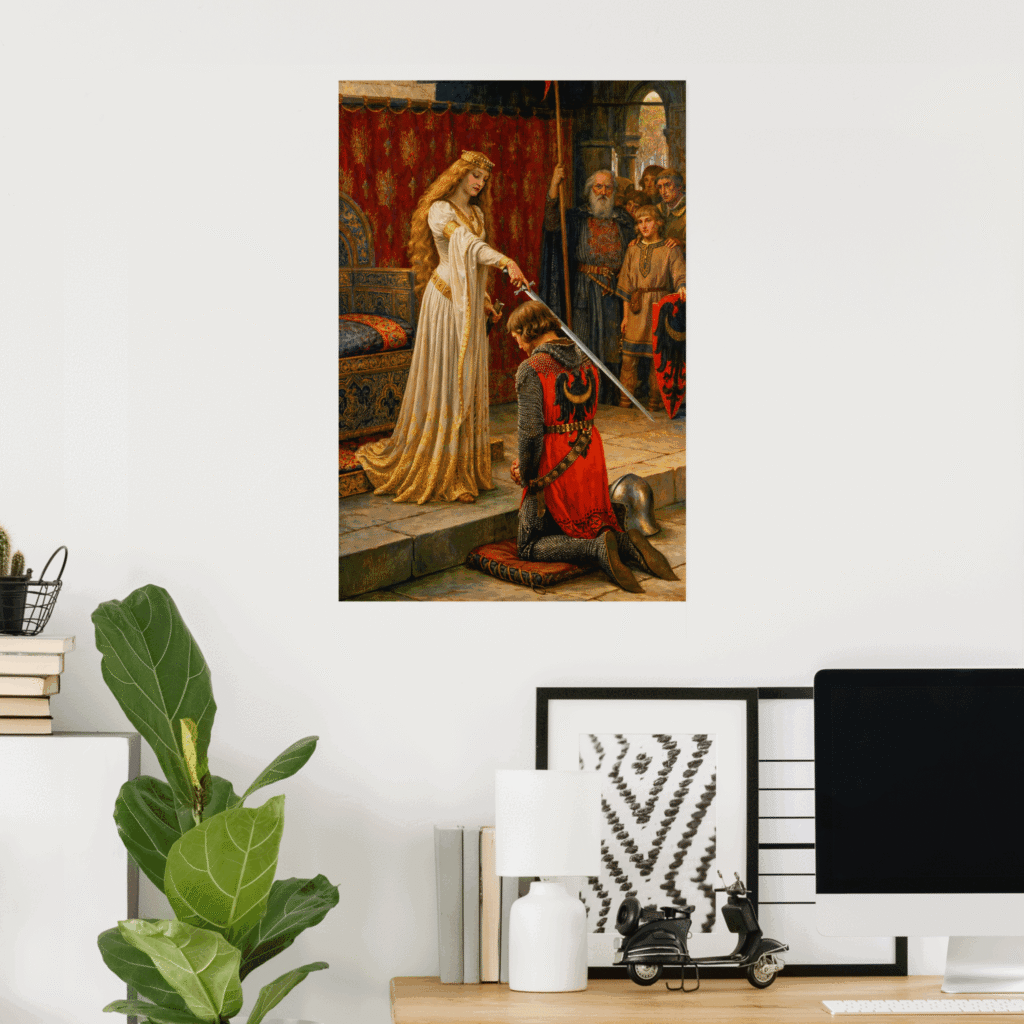
This helps explain why the painting has continued to circulate far beyond its original context. Reproductions, posters, and online sharing have kept it alive because its emotional formula remains potent. Even modern viewers who know little about chivalric history can feel the attraction of the scene. It offers seriousness without harshness, romance without excess, and idealism without chaos.
Why Accolade Still Resonates Today
The enduring popularity of Accolade is not accidental. Many historical paintings fade because they depend too heavily on period taste or obscure reference. Leighton’s work survives because it combines technical beauty with emotional clarity. The subject is easy to grasp, but it is rich enough to reward close attention. Viewers understand immediately that something important is happening, even if they do not know the exact ritual being shown.
The painting also resonates because it offers a rare image of ceremonial grace. Modern visual culture is often dominated by speed, fragmentation, and intensity. Accolade moves in the opposite direction. It slows the eye. It asks the viewer to dwell on posture, fabric, light, and silence. That deceleration itself can feel refreshing. The painting gives permission to contemplate rather than consume.
Its gender dynamics also contribute to its ongoing fascination. The female figure’s authority, the knight’s willing submission, and the mutual dignity of both characters create an image that feels layered rather than simplistic. Viewers can read it through romance, symbolism, power, or historical fantasy. The painting remains open without becoming vague.
Most of all, Accolade endures because it understands the visual power of ideals. It does not argue for them through words. It stages them in a single unforgettable action. Honor, beauty, humility, and recognition all become visible at once. That is a rare achievement. Leighton turned a ceremonial gesture into a timeless image of aspiration.
Conclusion
Edmund Blair Leighton’s Accolade is far more than a decorative medieval scene. It is a carefully structured vision of transformation, ritual, and idealized human relations. Through its poised composition, luminous color contrasts, rich textures, and emotionally restrained storytelling, the painting creates a world in which outward ceremony gives shape to inward values. The kneeling knight and the woman with the sword are not simply historical figures. They become symbols of humility, authority, honor, and grace.
Leighton’s gift lies in making this symbolism feel tangible rather than abstract. The stone hall, the embroidered gown, the chain mail, the witnesses in shadow, and the gleam of the sword all contribute to a believable atmosphere. Yet the painting never loses its dreamlike quality. It remains suspended between history and fantasy, reality and aspiration. That tension is exactly what gives it lasting power.
For many viewers, Accolade embodies the most appealing aspects of medieval revival art. It offers beauty without emptiness, romance without melodrama, and idealism without naivety. Even today, it continues to speak because it presents a scene of dignity that feels complete in itself. We are invited to witness a transformation and to believe, if only for a moment, in a world where ceremony reveals character and grace confers meaning.