Image source: wikiart.org
Introduction to “The Abduction of the Sabine Women”
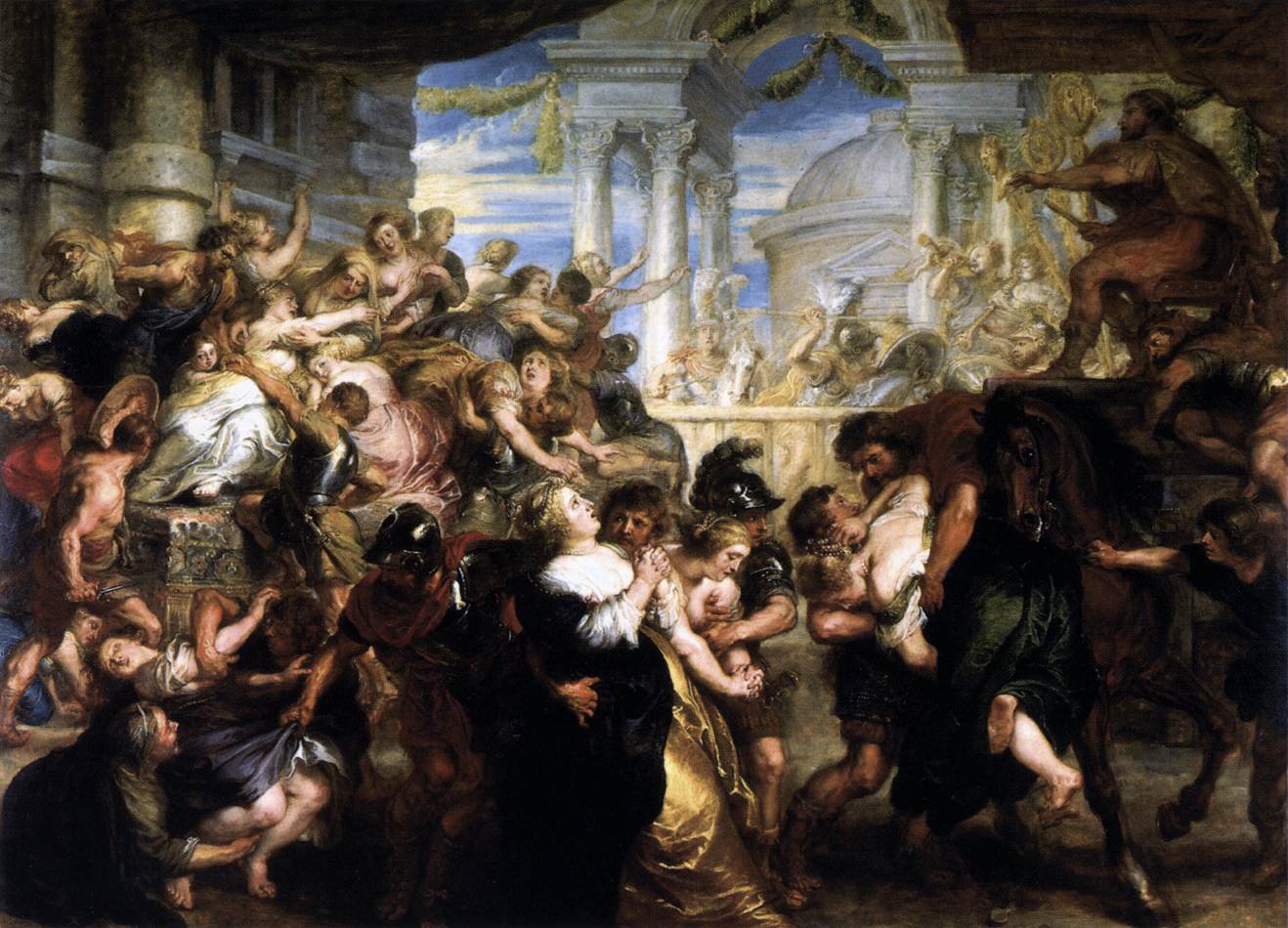
Peter Paul Rubens’s 1637 painting “The Abduction of the Sabine Women” is one of his most tumultuous and emotionally charged history scenes. Spanning the width of the canvas is a violent eruption of bodies as Roman soldiers seize Sabine women in a desperate attempt to provide wives for the new colony of Rome. The painting is crowded, almost overwhelming, yet carefully orchestrated; every gesture, twist of the torso, and expression of terror or rage contributes to a single visual storm.
Rubens does not shy away from the brutality of the subject. Instead, he uses the full power of Baroque movement, color, and drama to force viewers into the heart of the chaos. At the same time, he frames the event within grand architecture and distant processions, reminding us that this episode, however cruel, forms part of the legendary founding narrative of Rome.
Historical and Mythological Background
The subject comes from Roman legendary history, recorded by Livy and other ancient authors. After Romulus founded Rome, the city lacked women, and neighboring peoples refused to intermarry with the rough new settlers. Romulus invited the local Sabines and other tribes to a festival of games in honor of Neptune. At a prearranged signal, the Roman men seized the unmarried Sabine women and drove off their male kin.
In later versions of the story, the abducted women eventually came to accept their Roman husbands and later intervened to stop a war between the Sabines and Romans, placing themselves and their children between the opposing armies. The episode was thus read both as an act of foundational violence and as a prelude to reconciliation and the merging of peoples. For Renaissance and Baroque artists, it offered an opportunity to depict intense action, intertwined male and female nudes, and complicated crowd scenes that demonstrated compositional mastery.
Rubens, deeply familiar with classical texts, approaches the story not as a distant legend but as a vivid human catastrophe. His painting focuses on the moment of seizure, before any reconciliation is imaginable. The scene is a raw display of power, fear, and resistance.
Composition and Overall Structure
The composition is a sweeping frieze of figures that arcs across the foreground from left to right. There is no empty space; the canvas brims with bodies lunging, dragging, pleading, and collapsing. The central and left portions are dominated by a pile-up of women and Roman soldiers, while the right side shows captives being carried away toward a horse and the city beyond.
Despite the apparent chaos, Rubens builds the composition around a series of diagonals and spirals. Arms stretch upward, legs stride diagonally across the ground, and cloaks flutter in curved trajectories. These lines direct the viewer’s eye in zigzagging paths across the canvas, mimicking the confusion of the event yet maintaining visual coherence.
In the background, monumental classical architecture rises: columns, arches, and a domed building glimpsed through an open arcade. Above the balustrade, smaller figures appear, including Romulus himself, who presides over the spectacle. These distant forms provide depth and remind us that the abduction is not a random riot but an orchestrated act sanctioned by political authority.
The Human Drama in the Foreground
Rubens’s great strength lies in conveying emotion through the human body. In the foreground of “The Abduction of the Sabine Women,” the range of feelings is vast: terror, rage, grief, determination, and helplessness.
At the left, a cluster of women in pale garments is being torn apart from one another, their arms outstretched in desperate attempts to cling to sisters and friends. One woman in white is dragged backward, her torso twisted, head thrown back in a cry. Another reaches toward a child who is being pulled away, her face contorted with anguish. Beneath them, a figure falls to the ground, hands raised as if to fend off an unseen attacker, emphasizing the trampling chaos of the melee.
In the middle ground, a woman in dark dress and golden skirt clasps her hands at her chest, caught between a soldier in armor and another woman being seized. Her expression seems to hover between fear and appeal, as if she is begging for mercy or divine intervention. Beside her, a soldier grips a struggling woman whose body arches backward, her bare shoulders and neck exposed, a theatrical embodiment of resistance and vulnerability.
On the right, the drama turns toward departure. A robust Roman soldier carries a young woman in his arms; her body is limp, perhaps fainted from fear, her head lolling as he hoists her onto a horse. Another soldier pulls at a resisting figure, while a youth attempts to control the rearing horse that will carry the captives away. This side of the painting captures the ruthless efficiency of the abduction, the moment when resistance begins to give way to the irreversibility of capture.
Architecture, Setting, and the Role of Romulus
Behind the sea of bodies, a stern architectural backdrop frames the action. The columns and arches recall Roman forums and temples, integrating the legend into a recognizable classical urban setting. The use of architecture serves several functions. It establishes the grandeur of the event, situating it in a space associated with civic ritual and political life. It also provides a rigid, vertical and horizontal framework against which the swirling figures stand out in relief, heightening the sense of movement.
On the elevated platform in the center background sits Romulus, the founder of Rome, identifiable by his elevated position and the commanding gesture of his hand. He appears relatively calm compared to the turmoil below, suggesting his role as architect of the scheme rather than participant in the physical struggle. Around him, attendants and guards form a smaller echo of the chaotic foreground, indicating that the entire city is complicit in the act.
Garlands strung between the columns hint at the original pretext for the gathering—a festival. Their festive connotation contrasts bitterly with the violence unfolding beneath, underscoring the deceit at the heart of Romulus’s plan.
Baroque Movement and the Orchestration of Chaos
“The Abduction of the Sabine Women” showcases the full Baroque vocabulary of movement. Nothing is static; even architectural elements appear to vibrate with the emotional energy of the scene. Rubens uses overlapping figures, twisting poses, and swirling draperies to create a sense of unstoppable motion.
Many bodies are depicted in extreme contrapposto, with torsos twisted against legs, heads turned away from the direction of movement, and arms flung out in arcs. These poses create a feeling of torsion, as if every figure were being pulled in multiple directions, both physically and emotionally. This is particularly evident in the women, whose resistance to capture is expressed through strained muscles and awkward, unbalanced positions.
Draperies and cloaks function like visual currents. Bright reds, whites, and golds sweep across the surface, connecting distant parts of the canvas in rhythmic patterns. A red cloak might trail from one soldier’s shoulder and visually lead the eye to another figure across the scene, helping to unify the composition.
The sheer density of forms could easily result in confusion, but Rubens uses light and color contrasts to clarify the main actions. Highlighted areas of bare skin and pale garments draw attention to key emotional moments—the pleading faces, the clutching hands—while darker armor and shadows recede, providing a backdrop.
Light, Color, and Emotional Atmosphere
The lighting in the painting is dramatic yet nuanced. A strong, diffused light seems to fall from the upper left, illuminating the central and left-hand figures most brightly. Women’s pale skin and light-colored gowns catch this light, making their distress visually prominent. In contrast, the armored soldiers and darker architectural shadows on the left create a heavy, oppressive environment, emphasizing the imbalance of power.
Color plays a central role in conveying mood. Flesh tones are warm and vibrant, giving the figures a sense of life and vulnerability. Whites and creams, used mainly for the women’s clothing, suggest innocence and purity violated. Reds appear in cloaks, tunics, and accents, symbolizing aggression, urgency, and the bloodshed the episode foreshadows. Metallic armor gleams with cold blues and grays, associating the soldiers with implacable force rather than humanity.
In the background, the sky is surprisingly serene, a luminous band of blue and white seen through the architecture. This calm strip of nature contrasts with the turmoil below, perhaps suggesting the indifferent passage of time or the way grand political designs often override the pain of individuals.
Moral Reflection and Political Resonance
While the legend could be exploited as a heroic tale of Rome’s founding, Rubens’s treatment encourages critical reflection on the cost of empire. The painting focuses on the suffering of the women and the desperation of their families rather than on any sense of Roman triumph. The soldiers are powerful but not glamorized; they appear as agents of an impersonal state, carrying out orders amid screams and outstretched hands.
For seventeenth-century viewers, especially those living in war-torn Europe, the scene would have carried contemporary resonance. The Low Countries had endured decades of conflict, sieges, and forced displacements. Rubens himself, though a court painter, was sensitive to the horrors of war, as seen in his later work “The Horrors of War.” “The Abduction of the Sabine Women” can thus be read as a commentary on the violent foundations of states and the suffering inflicted on civilians in the name of political necessity.
At the same time, the classical subject allowed such themes to be approached at a safe historical distance. Patrons could admire the artistic bravura without feeling personally indicted, even as the painting’s emotional impact stirred uneasy recognition of similar events in their own time.
Rubens’s Technique and Workshop Practice
By 1637 Rubens was in the mature phase of his career, commanding a large workshop in Antwerp. For major commissions, he often produced oil sketches and drawings to plan compositions, then worked with assistants to execute large canvases, adding crucial passages himself. “The Abduction of the Sabine Women” bears the hallmarks of this practice: the overall design and most expressive figures display his touch, while some secondary elements may show the hands of collaborators.
His technique in this painting is vigorous and layered. Underpaintings in earth tones establish broad masses, over which he builds figures with increasingly luminous color. In certain areas, especially in the turmoil of the foreground, brushstrokes remain visible, giving the surface a sense of immediacy and energy. Details such as armor, jewelry, and facial features are rendered with swift economy rather than meticulous precision, keeping the focus on movement and emotion rather than on decorative finish.
The scale of the canvas amplifies the effect. Life-sized or near life-sized figures surround the viewer, turning the spectator into an onlooker caught at the edge of the riot. The physical size of the painting thus mirrors the psychological pressure of the subject.
Comparisons and Artistic Tradition
The theme of the Sabine women had been treated by earlier artists, including Giovanni da Bologna in sculpture and Nicolas Poussin in painting. Compared to Poussin’s more classical, orderly version, Rubens’s composition is more chaotic, emotional, and densely packed. Where Poussin might emphasize balanced groups and clear narrative sequences, Rubens immerses the viewer in the very heart of the turmoil, privileging visceral experience over clear storytelling.
Rubens’s version also differs in its treatment of women. While classical art often idealized female victims with composed expressions, Rubens grants his Sabine women a raw, individualized emotional life. Their faces register panic, defiance, and sorrow; their bodies strain and struggle rather than simply collapsing in graceful poses. This emphasis contributes to the painting’s modern resonance, making it less about mythic archetypes and more about human suffering.
Legacy and Contemporary Significance
“The Abduction of the Sabine Women” remains a powerful, disturbing work in Rubens’s oeuvre. It showcases his unparalleled ability to coordinate large numbers of figures within a coherent, emotionally charged composition. At the same time, it raises enduring questions about the foundations of political power, the justification of violence, and the role of art in representing traumatic events.
For contemporary viewers, the painting can be difficult to look at, precisely because it does not sanitize its subject. Yet this difficulty is part of its importance. Rubens compels us to confront, rather than gloss over, the violence embedded in foundational myths and historical narratives. In doing so, he shows how Baroque painting can serve not only as glorification of power but also as a complex witness to its costs.
The work continues to be studied for its compositional brilliance, its handling of the human body in motion, and its psychological depth. Whether approached as a masterpiece of Baroque art, a visual interpretation of Roman legend, or a meditation on state violence, “The Abduction of the Sabine Women” stands as one of Rubens’s most challenging and unforgettable creations.