Image source: wikiart.org
Introduction
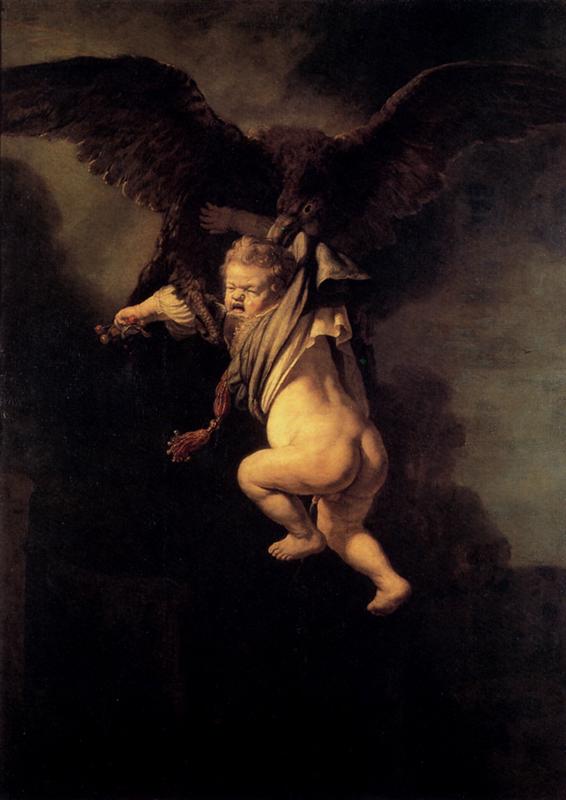
Rembrandt’s “The Abduction of Ganymede” (1635) is one of the most startling reinventions of a classical myth in all of Baroque painting. Where Renaissance and Mannerist artists typically rendered the Trojan boy as a graceful adolescent borne heavenward by Jupiter’s eagle, Rembrandt gives us a squirming, terrified toddler scooped up mid-cry. His little body twists, one fist clenched around a bunch of grapes, while the raptor’s talons bunch the child’s clothing and pierce the moment with predatory force. The background is an abyss of nearly unbroken darkness. What we remember is the weight of the boy, the power of the bird, and the shock that myth can be made newly physical, newly human, and newly strange.
Myth, Sources, and Rembrandt’s Radical Choice
The story of Ganymede comes from Greek and Roman literature. Zeus, smitten with the beauty of the Trojan prince, transforms into an eagle and carries the youth to Olympus to serve as cupbearer to the gods. Painters usually took this as an opportunity for elegant nudity, courtly erotics, and lyrical sky. Rembrandt rejects that convention outright. His Ganymede is not a youth but a very small child, chubby, red-faced, frightened, and entirely unidealized. The gesture is deliberate, not naïve. In 1630s Amsterdam, classical subjects were fashionable among collectors, yet Protestant viewers were often suspicious of erotic mythologies. By recasting the tale with a child, Rembrandt drains it of sensual conventions and restores its elemental violence. The painting thus participates in the market for classicizing themes while satisfying a Dutch taste for moral seriousness and visceral truth.
Composition: A Diagonal of Predation and Gravity
The composition is simple and devastatingly effective. From the upper left shadow bursts the eagle, wings spread into a dark V that fills the frame’s top half. Its beak, eyes, and one claw align along a plunging diagonal that carries our gaze down to the child. Ganymede’s body twists across the opposite diagonal, forming a tense X that locks bird and boy into a single system of motion. There is no landscape, no architecture, no spectators—only two actors suspended in an airless void, the better to articulate mass and motion. The boy’s downward weight, emphasized by the plumpness of thigh and buttock, pulls against the raptor’s upward thrust. Rembrandt stages a physics lesson: the gods may command ascent, but bodies insist on gravity.
Light that Strikes Like a Rescue and a Sentence
Rembrandt’s lighting is a judgment. A wedge of light carves across Ganymede’s body, illuminating soft flesh, flushed face, and the pale fabric bunched around his torso. The eagle remains largely in shadow, its head and talons catching just enough light to register menace. This distribution of illumination makes the child the moral center while assigning mystery to the agent of abduction. The light is not purely narrative; it is empathic, a painterly instinct that says, “Look here, feel this.” Yet the same light that reveals also isolates. The boy glows against the void like an accusation, his human vulnerability set off by a darkness indifferent to his fear.
The Boy’s Expression and the Humanity of Fear
One of the painting’s unforgettable details is the boy’s face. Rembrandt has observed children closely enough to capture the exact look of alarm that precedes a cry: brows knit, mouth half-open, wet eyes losing focus as panic swells. He turns his head back toward the eagle’s grip with the reflex that any child shows when lifted from behind—an instinct to see what holds him. This isn’t the stylized distress of antique sculpture; it is the particular, immediate terror of a child whose world has been rudely inverted. The effect is disarming and, to some viewers, shocking. Rembrandt’s insistence on genuine feeling forces the myth to pass through the crucible of ordinary human experience.
Gesture, Grapes, and the Double Meaning of Play
In the child’s fist Rembrandt places a small bunch of grapes, the one bright, colored accent aside from flesh. The object plays several roles at once. In classical iconography, Ganymede often accompanies Jupiter as cupbearer; grapes therefore anticipate wine, feast, and divine service. In moralizing Christian readings, grapes can also signify temptation or the sweetness of earthly delights. Here, in a toddler’s grip, they read as the most ordinary prop of play—something picked up a moment before, and now useless in crisis. The contrast between toy and talon sums up the painting’s drama: innocence in the clutch of power.
Texture, Paint, and the Touch of Reality
The painting is a demonstration of tactile description. Rembrandt models the child’s body with creamy, modulated paint that captures the stretch of skin across ribs and the puckering of tiny toes. The drapery is treated with quick, crumpled strokes that suggest linen’s stiffness and the twist of a red cord. The eagle’s plumage changes texture as wing meets body: long, slightly dry strokes for flight feathers, small jostling dabs around the neck where down thickens. The beak gleams with a tiny, hard highlight that makes it feel sharp enough to cut. These varied textures perform a double function. They anchor the fiction in a credible world of surfaces, and they heighten the contrast between infant fragility and avian strength.
The Darkness as Stage and Abyss
Rembrandt wraps the action in a deep, ambiguous darkness. It behaves partly like a stage curtain—framing and thrusting forward what we must see—and partly like a metaphysical abyss. Where does the eagle come from? Where is he carrying the child? The myth supplies Olympus as an answer, but the painting resists the picturesque. We feel instead the dread of unknown direction. Dutch contemporaries might have read this darkness morally, as the peril of being carried away from the light of safety; others might see in it a theatrical device that intensifies the sensation of lift and drop. In either case, the void is active, not passive: it is the air the drama breathes.
A Child, Not a Youth: Meanings and Consequences
By making Ganymede a small child, Rembrandt does more than erase eroticism. He shifts the myth’s meaning to themes of power, possession, and sudden fate. The abduction becomes a literal snatching, closer to a fairy tale or to biblical scenes of deliverance and loss. Some scholars have suggested that Dutch parents would have recognized the image’s domestic horror, recalling the frequent warnings about wells, waterways, or animals. The painting thus speaks not only to classicists but to households, translating Olympus into the nursery. It may also contain a sly studio joke: Rembrandt, increasingly successful and “carried off” by fame in the mid-1630s, paints the cost of being taken up by forces larger than oneself.
Baroque Energy Without Ornament
Although the subject is mythic, the painting avoids baroque excess. There are no swirling clouds, no gods peering from the margins, no putti, no architectural balconies. The energy is concentrated in the diagonals of bodies and the muscular spread of wings. This restraint heightens the sense of reality: the event could be happening in the next street of Amsterdam if an eagle large enough existed. Such “realist baroque” is a Rembrandt hallmark—drama intensified through reduction rather than multiplied through decoration.
Echoes of Dutch Daily Life
Rembrandt’s Amsterdam offered him a treasury of models for this scene. Marketplaces teemed with live poultry; hunters’ spoils included hawks and large birds; household chores familiarized parents with the heft of children. The painter synthesizes these memories. The eagle’s legs look like a butcher’s hands; the boy’s weight recalls the feel of lifting a toddler at bath time. Such domestic analogues root the myth in Dutch soil, making its shock intelligible to everyday viewers.
Color, Temperature, and Emotional Weather
The palette is tightly controlled: warm flesh and ochres against browns and blacks, a faint greenish cast to the shadows, a dull red cord flashing in the mid-tones. The warmth concentrates on the child, whose skin seems alive under the light, while the bird is painted in cooler, more neutral browns. This temperature contrast is emotional as well as optical. Warmth belongs to life and vulnerability; coolness to predation and distance. The little flash of red—half decorative tassel, half arterial suggestion—adds urgency without becoming melodrama.
Theological and Moral Resonances
Seventeenth-century Protestant viewers often moralized pagan stories. “Ganymede carried by the eagle” could be read as the soul snatched by passions, or as the dangers of beauty and pride. Rembrandt’s infant version sharpens the allegory: innocence itself is precarious in a world of sudden forces. Yet the painting refuses tidy sermonizing. The eagle is not simply evil; in myth it is the god’s avatar. The boy is not simply a victim; in myth he will become honored. By balancing terror and destiny, the picture leaves room for a complex meditation on providence, vulnerability, and the unfathomable ways lives are changed.
Motion, Weight, and the Physics of Flesh
The success of the painting rests largely on Rembrandt’s ability to persuade us of motion. Ganymede’s legs curl up reflexively; his left foot tenses; his right knee bends inward, suggesting the torque of being lifted by the torso. The folds of drapery twist around his belly as if wind and motion have begun to unwrap him. The eagle’s shoulders hunch; the near wing bends with the push of air. Against these signs of flight, Rembrandt sets the heavy reality of the child’s body. Gravity asserts itself in the way the buttocks sag and the belly pulls downward. We believe the lift because we feel the resistance.
Faces: The Human and the Inhuman Gaze
The eagle’s face is handled with unnerving specificity. The eyes sit frontally, focused downward; the beak hooks with a pale edge; the nostril cavity is small but legible. It is not a symbolic bird but a predator. The human face, by contrast, is modeled with tender attention—small pout, furrowed brow, clamped eyelids. The contrast does not demonize the animal; it dramatizes the difference between appetite and feeling. That difference turns the ancient abduction, often aestheticized, into a scene that engages our empathy first and our mythic knowledge second.
Relation to Rembrandt’s Broader Practice
“The Abduction of Ganymede” belongs to a burst of large, ambitious canvases from 1634–1636 in which Rembrandt translated famous narratives into newly immediate forms. Think of “The Blinding of Samson” or “Belshazzar’s Feast,” works that pull biblical and classical texts into the register of lived experience. In each, Rembrandt favors the decisive instant and the credible body over decorative flourish. Ganymede is perhaps the most radical of these in its reimagining of the protagonist’s age and in its refusal of any beautiful sky. It announces that myth in northern hands can be muscular, unsentimental, and psychologically acute.
Reception, Shock, and the Long Afterlife
Viewers across the centuries have alternated between admiration and discomfort. Some early admirers praised the truth of the child’s body; others accused the painting of vulgarity. Modern audiences often find it thrillingly modern: it shares the candid honesty of later realist art and the psychological charge of twentieth-century myth retellings. Its afterlife has been rich in scholarship and in the visual imagination—once seen, its toddler Ganymede cannot be forgotten, even when looking at the more elegant versions by earlier artists.
Why It Still Feels New
The painting feels new because it restores danger to myth. Instead of a decorative emblem of divine favor, we encounter an event that could bruise, bleed, and terrify. Rembrandt’s courage lies in believing that the ancient story can bear such truth. He trusts our adulthood enough to show a child’s fear, and he trusts painting enough to let form, light, and texture carry meaning without explanatory props. In doing so, he finds a version of Ganymede that belongs not only to Olympus but to the human condition, where fate can arrive from the dark and wrench us into a future we did not choose.
Conclusion
“The Abduction of Ganymede” is one of Rembrandt’s boldest acts of imagination. It compresses myth into the smallest, most vulnerable body and sets that innocence against the dark engine of divine appetite. The picture has the shock of reality because everything in it—weight, motion, texture, light—has been observed as carefully as a scene in the street or a child in a studio. It also has the gravity of allegory, because the void around the figures keeps pointing beyond itself to questions of power, providence, and transformation. Four centuries on, its cry still reaches us, and its terrible lift still pulls at the stomach. Rembrandt’s genius was to make the old story fly again, not on the wings of beauty alone but on the fierce insistence of truth.