Image source: wikiart.org
Introduction
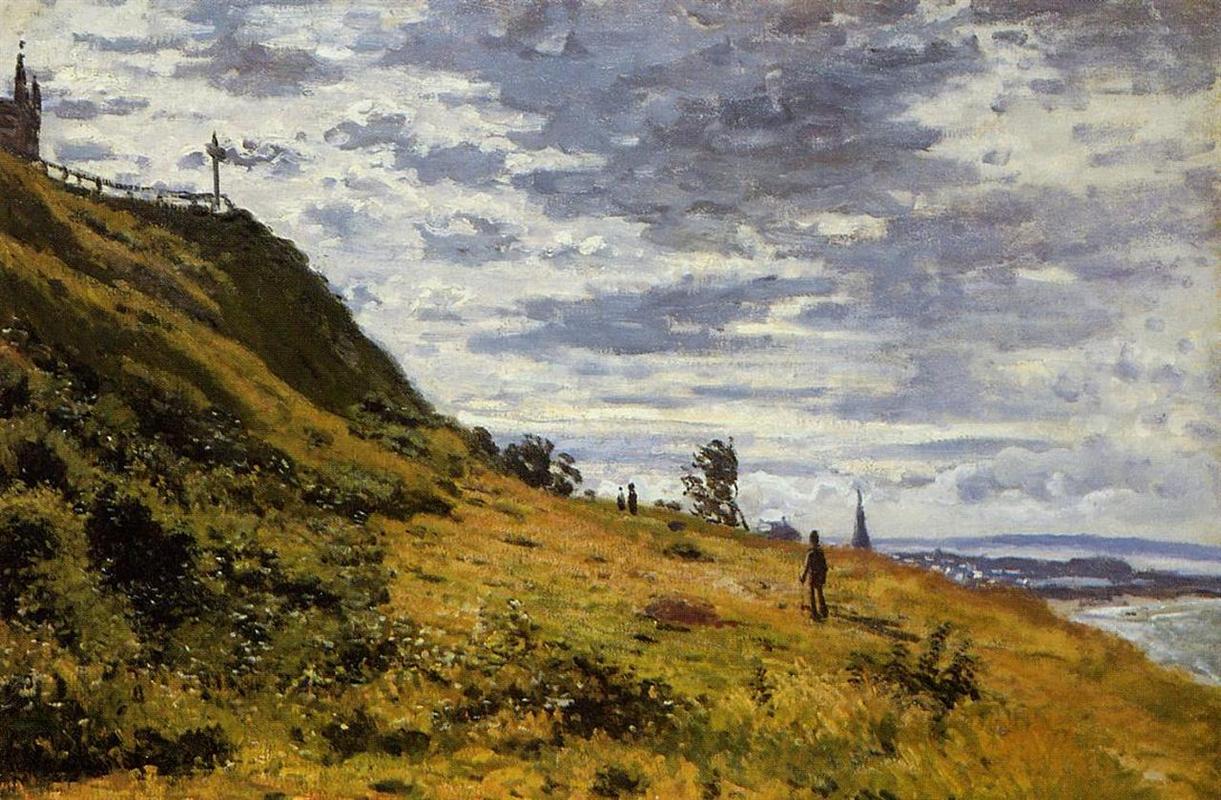
Claude Monet’s Taking a Walk on the Cliffs of Sainte-Adresse from 1867 is a painting that rewards slow looking. At first glance, it seems deceptively simple: a grassy cliff, a broad sky, a few small figures, and a distant suggestion of sea and shoreline. Yet this apparent simplicity is exactly what gives the work its power. Monet transforms an ordinary coastal walk into a deeply atmospheric experience, balancing open space with intimate observation and turning a familiar landscape into something vivid, immediate, and quietly emotional.
This is one of those paintings in which almost everything depends on sensation. The scene is not driven by a dramatic story, a heroic subject, or a symbolic program. Instead, it is built from light, weather, movement, and the relationship between human figures and the natural world. Monet invites the viewer to stand on the slope with the walkers, to feel the incline underfoot, to notice the shifting cloud cover, and to sense the salty air moving across the coast. The painting does not merely represent Sainte-Adresse. It recreates the experience of being there.
Seen in the context of Monet’s development, this work shows how decisively he was moving away from traditional landscape formulas and toward a new kind of painting rooted in direct observation. He is less interested in idealizing the land than in registering what the eye actually perceives in a given moment. That commitment to immediacy is one of the foundations of Impressionism, and in this painting it is already highly visible. The cliffs, sky, grass, and distant water are not rendered as static forms. They are alive with shifting tones and changing conditions.
What makes the painting especially compelling is the way Monet joins grandeur and modesty. The setting is expansive, but the event is small: people walking along a cliff. The sky is immense, but the figures remain quiet and unassuming. The result is a work that feels both observational and poetic. It captures a place, a weather pattern, and a fleeting interval of daily life, while also suggesting something larger about looking, movement, and modern leisure.
Claude Monet in 1867
The year 1867 places this painting at a crucial point in Monet’s career. He was still a young artist, but already deeply committed to painting modern life and the contemporary landscape in fresh ways. The coast at Sainte-Adresse, near Le Havre, was especially meaningful to him. This region was associated with his youth, and it offered a setting where sea, sky, cliffs, and changing atmosphere could all become central subjects. Normandy gave Monet a landscape that was never visually still. Tides shifted, weather changed quickly, and light transformed the same view from hour to hour.
By this stage, Monet was working with unusual independence. Rather than treating landscape as a backdrop for historical or literary content, he was making it the central subject. He was also becoming more confident in painting outdoors, where he could respond directly to what he saw. That practice encouraged quick decisions, broken brushwork, and close attention to transient visual effects. In Taking a Walk on the Cliffs of Sainte-Adresse, these tendencies are already fully active.
The painting belongs to an early but very important phase in Monet’s output, before Impressionism had fully announced itself as a movement but after many of its essential ideas were already forming. The work demonstrates a rejection of polished academic finish in favor of a more living surface. It also reflects an interest in contemporary recreation. Walking along a seaside cliff is not a grand historical act, but it is a distinctly modern one, tied to leisure, tourism, and the new social rhythms of the nineteenth century.
This combination of formal experimentation and modern subject matter is vital. Monet is not simply painting nature. He is painting a modern way of being in nature. The figures do not conquer the landscape or perform within it dramatically. They pass through it. They inhabit it casually. That understated relationship between people and place becomes one of the painting’s most modern qualities.
The Setting of Sainte-Adresse
Sainte-Adresse was an ideal subject for Monet because it joined natural beauty with contemporary life. Located on the Normandy coast, it offered sweeping views, dramatic cliffs, and access to the sea, but it was also a place where people came to stroll, rest, and enjoy the coast. In this painting, Monet uses that setting to full advantage. The cliff rises steeply at the left, while the land descends gradually toward the right, where the sea and distant coast come into view. This slanted arrangement creates both physical movement and visual energy.
The place itself matters because it allows Monet to explore contrast. The grassy slope is textured and earthy, while the sky feels open and unstable. The foreground is dense with vegetation, but the distance dissolves into light and atmosphere. The land is immediate and tactile, while the sea is far away and partially veiled. Sainte-Adresse becomes more than a location. It becomes a structure through which Monet can orchestrate near and far, solid and airy, detail and openness.
The coastal setting also introduces the idea of exposure. Unlike a sheltered inland path, this cliff is fully vulnerable to weather and light. The grass bends, the clouds gather and scatter, and the distant water catches brightness differently from the land. Everything suggests a world in motion. Monet does not exaggerate these changes into theatrical drama, but he allows them to shape the whole mood of the picture.
There is also something quietly social about the site. The presence of walkers indicates that this is a lived landscape, not a remote wilderness. The cliff is both natural terrain and public space. That matters because Monet often found beauty in places where nature and everyday life intersected. He was drawn to environments shaped by modern habits of looking, moving, and spending time. Here, Sainte-Adresse becomes a site of observation not only for the painter, but for the people within the painting itself.
Composition and Spatial Design
One of the most striking features of the painting is its composition. Monet builds the image around a strong diagonal slope that moves from the upper left down toward the right. This diagonal gives the scene momentum from the start. Rather than placing the viewer on level ground, he situates us on uneven terrain, making space itself feel active. The eye follows the incline across the surface, tracing the path of walkers and the gradual opening of the view.
The upper portion of the painting is dominated by sky, while the lower portion is filled by the grassy cliff. This division is simple but highly effective. It creates a tension between heaviness and lightness, between earth and atmosphere. The cliff anchors the scene, but the sky expands it. Neither part overwhelms the other. Instead, they remain in dynamic balance.
The figures are small, but they are carefully placed. One stands or walks in the midground near the center right, drawing attention because of the contrast between the dark silhouette and the luminous surroundings. Two smaller figures appear farther back, helping establish scale and depth. These human elements keep the landscape from becoming impersonal. They provide points of entry for the viewer and subtly reinforce the act of walking as the organizing theme of the work.
The distant shoreline and water on the far right open the composition outward. Without that glimpse of sea, the picture might feel enclosed by the steep landmass on the left. Instead, Monet allows the landscape to breathe. The view widens, and the painting takes on a sense of airy extension. This spatial opening also enhances the emotional effect of the work. The viewer moves from the density of the foreground and hillside toward the spacious calm of the horizon.
Monet’s composition is therefore both structured and natural. It feels spontaneous, as if caught on the spot, but it is carefully organized to guide the eye. The diagonal slope, scattered figures, expansive sky, and distant water all work together to create a scene that feels immediate yet beautifully controlled.
Light, Sky, and Weather
If the cliff provides the painting’s structure, the sky provides its atmosphere. Monet fills the upper half of the composition with layered clouds rendered in soft grays, blues, and whites. This is not a blank backdrop. It is an active, shifting field of light. The clouds appear to move across the canvas, changing density from one area to another and creating a sense of unstable weather.
The sky is crucial because it sets the emotional tone. This is not a brightly sunlit, cloudless coastal scene. Instead, the atmosphere is mixed and changeable, with patches of brightness emerging through a more muted cover of clouds. That complexity gives the painting depth. The weather feels real because it is neither conventionally pleasant nor overtly stormy. It occupies the more interesting middle ground of uncertainty, where light and shadow constantly interact.
Monet was especially gifted at observing how light modifies color, and that sensitivity is visible throughout the work. The grassy slope is not painted in a single green or yellow. It shifts according to exposure, with warmer golden passages catching sunlight and darker areas sinking into shade. The sky’s variable illumination determines much of what we see on the ground. In this way, the painting is less about fixed local color than about the effects of atmosphere on perception.
The weather also contributes to the feeling of movement. Even though the painting captures a still image, it never feels frozen. The clouds suggest passage, the grass seems stirred by wind, and the figures appear to be moving through a changing day. Monet thus transforms weather into a compositional force. It shapes not only the look of the painting, but also its rhythm and emotional resonance.
This responsiveness to fleeting conditions is one of the hallmarks of Monet’s art. He understood that landscape is never static because light is never static. In Taking a Walk on the Cliffs of Sainte-Adresse, the sky becomes the visual record of that truth. It is not just part of the setting. It is part of the subject.
Brushwork and Surface
Monet’s brushwork in this painting is essential to its effect. Rather than smoothing the surface into an invisible finish, he allows the marks of paint to remain evident. The clouds are built from broken, layered touches that give them weight and motion. The grass and vegetation are suggested through varied strokes that feel quick, tactile, and responsive. This visible handling gives the painting its vibrancy.
The surface does not aim for photographic exactness. Instead, it conveys the sensation of seeing. Monet selects what matters visually and lets the rest remain open. In the foreground, bushes and patches of wild growth are described with dark, energetic touches that imply texture without spelling out every detail. The slope itself is animated by changes in direction and density of brushwork, which helps communicate both terrain and plant life.
This manner of painting is particularly effective in a coastal scene because it mirrors the instability of the environment. The brushstrokes are not rigid because the world they describe is not rigid. Air moves, grasses shift, clouds gather and disperse. Monet’s technique captures that flux by refusing overly fixed contours and polished transitions.
At the same time, the painting is not careless. The looseness is disciplined. Monet knows where to sharpen contrasts and where to allow forms to dissolve. The figure in the midground, for example, is relatively simplified, yet it remains distinct enough to anchor the eye. The distant sea and coastline are painted more lightly, which suits their atmospheric recession. This calibration of touch across the surface shows great control.
The brushwork also contributes to the painting’s modernity. It reminds the viewer that this is a painted object, not a disguised illusion. Monet does not hide the act of making. He lets the painting declare itself as paint on canvas while still creating a convincing world. That balance between material presence and visual immediacy is one of the great strengths of his art.
Color and Tonal Harmony
The color palette of Taking a Walk on the Cliffs of Sainte-Adresse is subtle but rich. Monet does not rely on brilliant contrasts or theatrical hues. Instead, he builds the scene from earth tones, muted greens, warm yellows, soft blues, grays, and off whites. The result is harmonious and natural, but never dull. Every color feels adjusted to the atmospheric conditions of the moment.
The cliff is especially notable for its warm golden and ochre tones. These colors suggest sun touched grass, dry patches of earth, and the slightly weathered character of coastal vegetation. They give the land a sense of warmth even under a cloud filled sky. That warmth is balanced by the cooler grays and blues above, producing a quiet but effective contrast between ground and air.
Monet’s handling of tonal value is just as important as his color choices. Dark bushes in the foreground create visual weight and help establish depth. Midtones dominate much of the slope and sky, which keeps the painting from becoming harsh or overly dramatic. Brighter passages are reserved for touches of illuminated cloud, light caught on grass, and the pale band of distant water. Because these highlights are controlled, they feel convincing rather than decorative.
The painting’s tonal harmony helps unify its many parts. Despite the complexity of the sky and the textured variety of the hillside, everything belongs to the same atmospheric world. No single area feels artificially detached from the rest. Monet achieves this unity by allowing color to circulate across the canvas. The coolness of the sky subtly affects the land, and the warmth of the ground prevents the overall image from becoming cold.
This careful balance of color and tone is one reason the painting feels so believable. Monet is not merely recording objects. He is translating a total visual experience, where every part of the scene is influenced by light, weather, and surrounding color.
Human Presence and the Theme of Walking
The title directs attention to the act of walking, and that choice matters. The painting is not simply about cliffs or weather. It is about people moving through a landscape. Yet Monet treats this theme with great restraint. The figures are small and anonymous. They do not dominate the scene. Instead, they emphasize the scale of the environment and the modesty of human presence within it.
This modesty is part of the painting’s charm. The walkers do not interrupt nature. They belong to it. Their presence makes the landscape feel inhabited, but not crowded. They are there to experience the view, the air, and the movement of the day, much as the viewer is invited to do. The painting becomes a meditation on leisurely attention, on the quiet pleasure of traversing a beautiful place without needing to possess or transform it.
Walking also introduces temporality. A person walking is always between one place and another. That sense of transition suits Monet’s broader interest in fleeting moments. The weather is changing, the light is shifting, and the figures are in motion. Everything in the scene is temporary, which gives the work an understated poignancy. It is about being present in a moment that cannot be held for long.
There is also a distinctly modern aspect to this theme. The leisurely coastal walk belongs to nineteenth century patterns of recreation and mobility. People increasingly visited seaside locations for health, pleasure, and visual enjoyment. Monet captures that culture without turning it into social commentary. He simply shows it as part of lived experience. In doing so, he records a modern relationship to landscape, one based on observation, movement, and temporary presence.
The smallness of the figures is therefore not incidental. It is central to the painting’s meaning. They remind us that the landscape is larger than the individual, but they also make the landscape emotionally accessible. Through them, the viewer enters the scene not as a distant observer, but as an imagined participant.
Mood and Emotional Resonance
Although the painting is observational, it is far from emotionally neutral. Its mood is one of quiet expansiveness mixed with slight uncertainty. The clouds prevent the scene from feeling purely cheerful, yet the golden slope and open air keep it from becoming gloomy. Monet captures a subtle emotional register that feels true to real life, where beauty often arrives with complexity rather than simplicity.
The picture has a contemplative quality. The open sky encourages reflection, while the walkers reinforce the idea of unhurried movement. Nothing urgent happens, and that lack of urgency becomes part of the emotional appeal. The painting offers a form of visual rest, but not emptiness. Its stillness is alive with atmosphere and sensation.
There is also a gentle feeling of solitude. Even though there are several figures, they are separated by distance and absorbed in the landscape. This spacing creates a mood of individual encounter with nature rather than social interaction. Each person seems to inhabit the place privately. That quiet separation adds depth to the painting’s emotional world.
At the same time, the work never becomes melancholic in an exaggerated sense. Monet avoids sentimentality. He lets mood emerge from the visual facts of the scene: the slanting hill, the restless sky, the small figures, the far off sea. Because the emotion arises from observation, it feels durable and convincing.
This ability to evoke feeling through atmosphere rather than narrative is one of Monet’s greatest gifts. In Taking a Walk on the Cliffs of Sainte-Adresse, he shows that a landscape can be emotionally resonant without requiring dramatic action. The mood comes from weather, scale, space, and the simple act of moving through the world.
Why This Painting Matters
Taking a Walk on the Cliffs of Sainte-Adresse matters because it shows Monet refining many of the qualities that would make him one of the defining artists of modern painting. It reveals his sensitivity to transient light, his preference for direct observation, his interest in ordinary contemporary subjects, and his willingness to let brushwork remain visible. All of these elements would become central to Impressionism, but here they already appear with remarkable confidence.
The painting also matters because it demonstrates how much can be achieved through restraint. Monet does not rely on spectacle. He takes an unassuming coastal scene and makes it memorable through structure, atmosphere, and perception. That transformation is one of the great achievements of his art. He teaches the viewer that visual richness does not require grand subject matter. It can emerge from careful attention to the world as it is.
There is also enduring appeal in the painting’s humanity. The walkers are small, but they give the work a lived dimension that keeps it grounded. The painting is about place, but also about experience. It is about what it feels like to inhabit a landscape for a moment, to move through air and light while the world changes around you. That sense of lived immediacy is timeless.
In the end, this is a painting about seeing. It asks us to notice the texture of a hillside, the layering of clouds, the shift from warm land to cool sky, and the fragile presence of human life within a larger environment. Monet turns a walk on a cliff into an act of visual discovery. That is why the work remains so compelling. It captures not only a site in Normandy in 1867, but also a way of looking that still feels fresh today.
