Image source: wikiart.org
Introduction
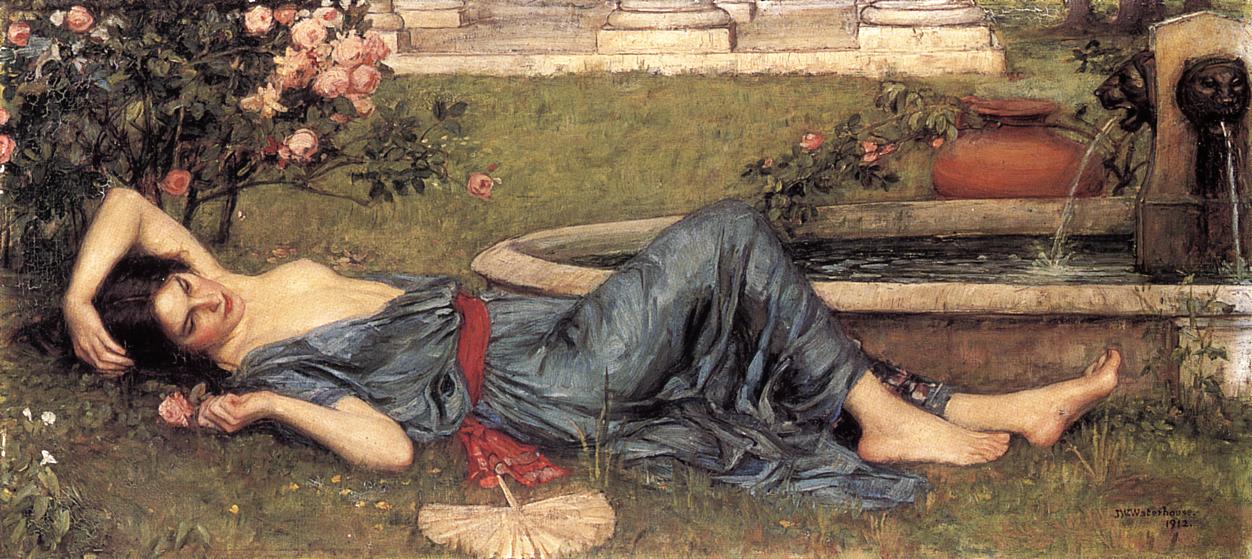
John William Waterhouse’s Sweet Summer (1912) captures a pause that feels both effortless and carefully composed. A young woman reclines on warm grass in a walled garden, her body angled across the foreground like a quiet rhyme to the fountain and stonework behind her. The title suggests an uncomplicated idyll, yet the picture is not simply a celebration of pleasant weather. Waterhouse turns summer into a mood, a psychological season, where time stretches, sound softens, and thought drifts. The painting invites you to linger in that interval between wakefulness and sleep, between sensation and memory, where the world is vivid but slightly distant.
Painted late in Waterhouse’s career, the work carries the maturity of an artist who knows how to say more with less. The setting is pared down to a few symbolic essentials: roses, water, stone, and a figure at rest. There is narrative potential in every object, but nothing forces a story. Instead, the painting acts like a lyrical fragment, offering a single, sustained feeling. What makes Sweet Summer compelling is how it balances presence and dream, realism and reverie, the body’s weight on the earth and the mind’s lightness as it wanders.
Waterhouse in 1912
By 1912, Waterhouse had long been associated with poetic subjects, classical and literary heroines, and a sensibility that looked back to earlier ideals while engaging the modern viewer’s appetite for atmosphere. In his later years, his approach often becomes more distilled. He still cares about costume, texture, and the convincing description of light, but he is less interested in complicated staging. A single figure can carry the whole emotional argument of the painting.
Sweet Summer fits that late clarity. It is not a dramatic tableau, not a moral lesson, not a climactic scene. It is the depiction of an internal weather system: ease, warmth, and a kind of tender languor. Waterhouse’s confidence shows in how he trusts small shifts of color and posture to create meaning. He does not need a cast of characters or an elaborate myth to make the scene memorable. The garden itself becomes a gentle theatre where nature and architecture collaborate, and the figure becomes an emblem of the season without turning into a cliché.
What the viewer sees
The composition presents a figure lying diagonally across the front of the picture plane. Her head rests to the left, framed by a cluster of roses and dark foliage. Her body extends toward the right, legs softly bent, bare feet visible against the grass. Behind her, a low fountain basin and stone steps structure the background, with water spilling from a sculpted spout. A terracotta vessel sits nearby, adding a grounded domestic note among the garden forms.
The woman’s clothing is loose and softly gathered, a muted blue-gray garment cinched by a red sash. The fabric pools and creases, emphasizing gravity and stillness. Her pose suggests rest rather than display. One arm bends above her head, the other relaxes near her face, creating a closed, private circle that draws attention to her inwardness. Her expression is calm, eyes lowered or closed, as if she is listening to the fountain and letting the day pass through her.
Despite the simplicity, the painting is full of gentle contrasts. Soft flesh meets cool stone. The measured geometry of the fountain meets the irregular growth of roses. A controlled trickle of water meets the undirected sprawl of grass. The entire scene becomes an interplay of order and ease, with the figure positioned as the point where these opposites harmonize.
Composition and the art of repose
Waterhouse structures the image so the figure feels both dominant and protected. Placing her along the bottom edge makes her immediately present, almost within the viewer’s space. At the same time, the garden enclosure and fountain architecture create a sheltered backdrop. The diagonal line of her body carries the eye from left to right in a slow glide. That diagonal is echoed in the angle of the fountain basin and the line of the steps, so the whole picture shares a consistent direction, like a current.
The pose is carefully designed to communicate relaxation without slackness. The bent arm above the head creates an arch, a shape associated with ease, but it also frames the face and hair, keeping the focus intimate. The gentle bend of the legs prevents the body from reading as rigid or posed for performance. The feet, often expressive in Waterhouse’s figures, are particularly telling here. They are unshod, resting naturally, a subtle claim that this is a private garden moment, not a formal visit.
Negative space is also important. The open lawn behind the figure gives her room to breathe. The fountain basin provides a calm horizontal counterweight to the diagonal body, preventing the composition from tipping into melodrama. The picture’s stillness is not accidental; it is engineered through balanced shapes that keep the viewer’s gaze moving slowly but continuously, never jolting, never stuck.
Color, light, and seasonal atmosphere
The palette of Sweet Summer is restrained, favoring earthy greens, warm stone tones, and the muted blue-gray of the garment. The red sash becomes a strategic accent, a single flare of heat that reads as the pulse of the season. Rather than saturating the whole image with bright summer intensity, Waterhouse suggests summer through warmth that has settled into everything, like sunlight absorbed by grass and masonry.
Light appears diffused, as if filtered by garden air and perhaps late afternoon softness. Flesh tones are rendered with care but without harsh contrast, keeping the figure integrated into the environment rather than spotlighted. The stone steps and basin carry gentle highlights, showing texture while maintaining calm. This approach makes the garden feel quiet and warm, not glaring. Summer here is not the sharp noon sun; it is the drowsy part of the day when time loosens.
The roses add a second kind of color presence. Their pinks and blush tones are softer than the sash’s red, creating a spectrum of warmth that connects cloth to flower. That link subtly suggests the figure as part of the garden’s life, not separate from it. The coolness of the dress balances those warm notes, like shade against sunlight. The result is a stable harmony that matches the emotional tone: restful, content, unhurried.
Texture and paint handling
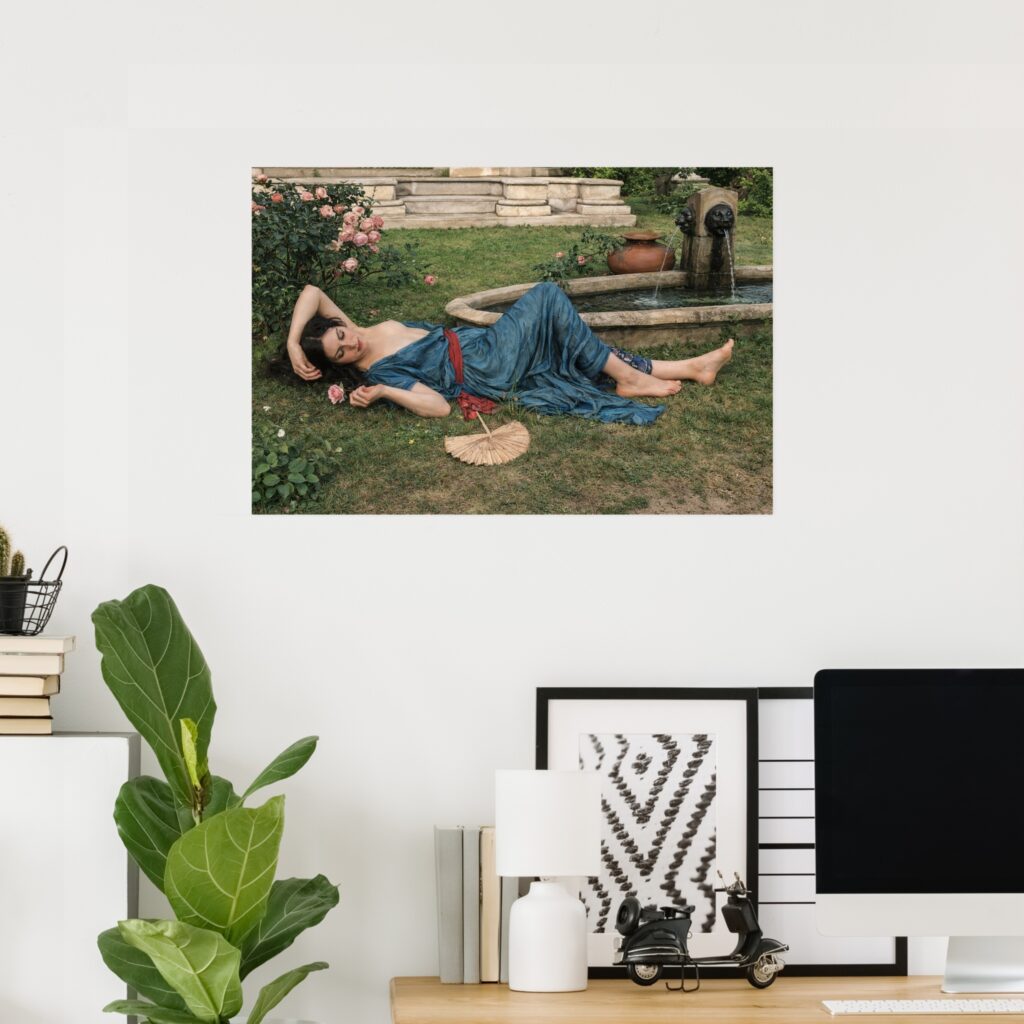
Waterhouse’s technique in this painting emphasizes tactile realism while preserving an overall poetic softness. The grass is described with enough variation to feel alive, yet not so sharply that it becomes distracting. The roses are painted with an eye for clustered complexity, petals emerging from darker leaves, creating depth and a sense of fragrance without literalizing it.
The garment’s folds are especially important. The fabric’s creases and pooled sections communicate weight and gravity, which is essential to the theme of repose. Waterhouse lets the cloth become a map of the body beneath it. The viewer can sense the figure’s form through the way fabric gathers at the waist, relaxes along the legs, and compresses where limbs bend. This is not just virtuosity; it is storytelling through material. The clothes show that the body has settled into the ground, that time has passed in this position, that comfort has replaced alertness.
Stone textures in the fountain and steps provide a contrasting surface language. Their solidity anchors the composition and helps the figure’s softness feel more vulnerable and human. Water, though a small detail, is crucial in paint handling because it introduces motion into the still scene. The water’s thin stream and the suggestion of ripples offer a quiet counterpoint: everything else rests, but time continues to move.
The garden as symbolic space
Gardens in art often operate as more than settings. They can suggest privacy, cultivation, enclosure, and the meeting point of nature and human design. In Sweet Summer, the garden feels like a sanctuary. The presence of stone architecture implies a maintained space, a place made for contemplation. Yet the roses and grass keep the setting from feeling controlled or sterile. It is a lived garden, a sensory one.
The fountain intensifies this sense of sanctuary. Water implies refreshment and continuity, and fountains often carry associations with pleasure, renewal, and even memory. The trickling sound is easy to imagine, and that imagined sound deepens the painting’s silence. The figure’s rest becomes not merely physical but almost ritualistic, as if the garden offers permission to stop striving.
Roses bring another layer. They can suggest romance, beauty, and transience, since blossoms open and fade quickly. In the context of “sweet summer,” roses hint that the season is precious because it passes. The painting does not dramatize loss, but it quietly acknowledges it through the choice of flowers and the languid pose, as if the figure is savoring a day she knows will not last.
The figure and the psychology of summer
The woman in Sweet Summer is not presented as a character with a clear identity, and that openness is part of the work’s power. She becomes a vessel for the viewer’s own memories of warmth, quiet, and the desire to withdraw from busyness. Her closed eyes and relaxed hands signal an inward turn. The painting invites empathy rather than curiosity about plot.
This psychological focus is strengthened by the lack of external action. No one interrupts. Nothing demands her attention. Even the fountain’s movement is gentle. The scene becomes a visual equivalent of daydreaming, where consciousness drifts but remains anchored by sensation: the softness of grass, the weight of fabric, the warmth of air, the faint coolness near water.
There is also a subtle tension between vulnerability and safety. Reclining outdoors can imply exposure, yet the garden’s enclosure and the nearby stone architecture suggest protection. Waterhouse uses this balance to create tenderness. The figure is open to the world’s sensations but not threatened by them. Summer becomes the season when the world feels benign, when the body can be at ease.
Classical echoes and modern intimacy
Waterhouse often drew from classical and literary traditions, and Sweet Summer carries faint echoes of those sources without becoming a direct quotation. The reclining figure recalls pastoral and mythic imagery, where nymphs, muses, or poetic heroines rest in nature. The fountain could belong to an ancient courtyard or a timeless villa garden. These hints place the scene outside strict modern specificity, making it feel universal.
At the same time, the painting is intimate in a way that feels modern. The figure is not acting out a myth; she is simply resting. The emotional center is domestic and personal. The terracotta vessel and the practical stone basin keep the scene grounded in everyday garden life, even as the overall mood feels timeless. That blend of classic atmosphere and personal quiet is a hallmark of Waterhouse’s late appeal. He offers the viewer an idealized world, but one entered through human feeling rather than spectacle.
Stillness, sound, and time
One of the most striking qualities of Sweet Summer is how it suggests sound in a silent medium. The fountain implies a steady trickle. The roses imply a gentle rustle if a breeze passes. The grass implies softness under the body. These sensory suggestions create a fuller reality, and they also shape the painting’s sense of time.
Time here is not measured by events but by duration. The figure’s pose implies minutes turning into hours. The water keeps moving, reminding the viewer that stillness is not emptiness. Instead, stillness becomes a kind of fullness, an attention to small sensations that are usually ignored. Waterhouse builds this idea visually by making motion subtle and continuous rather than dramatic.
The painting also captures a particular kind of summer time: the pause that feels like it could last forever, even though it cannot. That is why the mood is sweet. It is sweet because it is complete in itself, and sweet because it is fleeting. Waterhouse does not need to show the end of the day to make the viewer sense it. The very act of resting suggests a before and after, work and return, heat and cooling. The painting occupies the central, golden interval.
Why the painting endures
Sweet Summer remains compelling because it transforms a simple subject into a carefully balanced experience. It is a painting about pleasure, but not indulgence. It is about beauty, but not display. It is about the body, but treated with calm dignity. Waterhouse’s craft supports a mood that many viewers recognize: the desire to stop, to feel the world as gentle, to let time soften around you.
The work also resonates because it offers a kind of refuge. The garden is a space of cultivation and care, and the figure embodies trust in that space. In a world that often demands productivity, the painting quietly validates rest as something meaningful. It suggests that repose is not wasted time but a state where life is felt more clearly.
Finally, the painting endures because it is both specific and open. It shows a particular garden, a particular figure, a particular arrangement of roses and stone, yet it does not lock the viewer into a single story. It leaves room for projection and memory, which is one of the most powerful tools visual art possesses. Sweet Summer is less a narrative than a season captured in human form, a soft spell of warmth, water, and quiet that continues to hold the gaze.