Image source: wikiart.org
Introduction
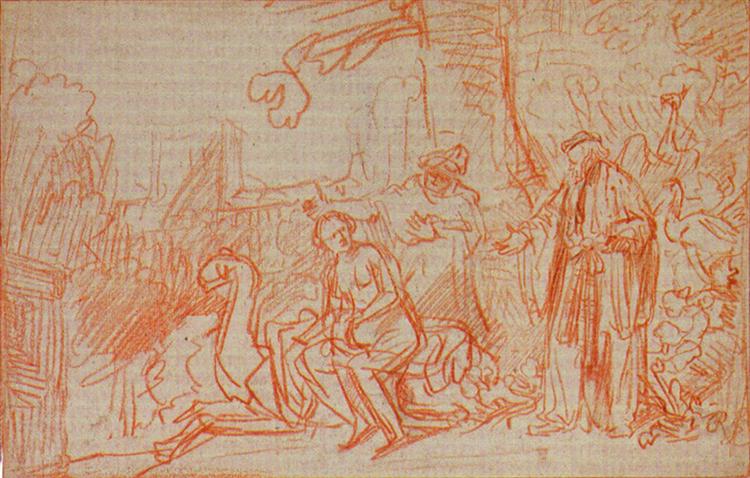
“Susanna and the Elders” (1634) presents Rembrandt’s interpretation of a famous biblical episode through an unexpectedly airy, red-chalk study. Instead of a finished, oil-painted melodrama, we meet a scene constructed from flowing lines and searching contours. The story, from the Book of Daniel, tells of the chaste Susanna, spied upon by two elders while she bathes; when she rebuffs their advances, they accuse her, and only Daniel’s intervention saves her. In this drawing Rembrandt distills the narrative to three essential presences set in a garden: the seated Susanna caught at the instant of alarm, the importunate men closing in, and a surrounding world of foliage, architecture, and attendants that expands the moral theater. The red chalk—warm, humane, and quick—suits a subject about vulnerability and gaze. Rather than staging a lurid confrontation, the artist gives us a choreography of glances and gestures, converting spectacle into a study of perception and power.
Historical Moment
The date 1634 matters. Newly established in Amsterdam and newly married to Saskia van Uylenburgh, Rembrandt was building his reputation with ambitious history paintings and psychologically incisive portraits. At the same time, he drew and etched incessantly, using paper to experiment with narrative structures and to rehearse moments he might later paint. The Susanna story attracted many Northern artists for its mixture of beauty, danger, and courtroom drama; Rembrandt returned to it throughout his career. This version, executed in red chalk, belongs to the exploratory phase around his early Amsterdam years, when he was refining how a handful of lines could carry complex emotional weight. It sits beside related works from 1634—pendant portraits, self-portraits in costume, etchings of theatrical bravura—and shows the same curiosity applied to sacred history: how to make character emerge in a split second.
Composition as Moral Geometry
Rembrandt anchors the composition with a simple but potent geometry. Susanna occupies the center, perched low, her body turning away from the encroaching figures to the right. One elder leans forward with an outstretched hand; another stands behind him, half-shielded by foliage, a conspirator reading his partner’s approach. The artist draws the seated woman with fluid, looping contours that expose knees, torso, and head as a series of echoing arcs; the men, by contrast, are articulated with angular breaks and heavier accents. That contrast does narrative work: softness versus insistence, exposure versus intrusion. A diagonal canopy of branches slants across the upper third, framing the figures and suggesting the bower where privacy should have been secure. At the far left, a palisade or screen and a bank of foliage establish the boundary she believed would protect her. The resulting triangulation presses Susanna between concealment and confrontation, a pictorial equivalent of the story’s moral cornering.
The Economy of Red Chalk
Red chalk offers a spectrum from whisper to shout. Rembrandt exploits it fully. Lightly dragged lines set the atmospheric background and distant buildings; mid-pressure strokes sketch drapery and bark; loaded, concentrated marks deliver faces, hands, and the pivotal contours of Susanna’s body. In a medium that can easily look sweet, he maintains bite by varying speed and pressure. The elders’ hands are not over-modeled; they are indicated with quick, decisive hooks that read as grasping without turning grotesque. Susanna’s head is drawn with a few strong turns around the brow and cheek, while the mouth and eyes remain minimal, allowing the pose rather than facial detail to carry alarm. The chalk’s warmth registers as humane empathy; the story is not illustrated coldly but breathed onto paper as if in one long thought.
Gesture, Gaze, and the Politics of Looking
The Susanna story is, at heart, about looking—who looks, who is seen, and who controls the terms of vision. Rembrandt composes his figures as a chain of gazes. Susanna’s head turns toward the elder at right even as her torso recoils, a visual contradiction that communicates shock. The elder’s extended hand and angled shoulders push the viewer’s eye toward her, while the second elder’s body tilts in from behind, doubling the pressure. In several treatments of the theme by other artists, the woman’s gaze is cast down or away, producing a tableau of serene beauty. Here the gaze is part of the drama: Susanna is fully aware of being seen and reacts in real time. The drawing therefore stages not a passive nude but an ethical encounter—a conflict of intentions embodied in the direction of eyes and hands.
Landscape as Emotional Weather
The scene’s vegetation, loosely indicated, behaves like weather for the soul. Dense scribbles at the right thicken behind the elders, creating a shadowed thicket that reads as moral murk. To the left, the garden opens into lighter hatching and distant architecture, a world of order and daylight that Susanna ought to inhabit. Overhead, the umbrella of leaves and boughs leans like a low sky, enclosing the action and intensifying the sense of trapped privacy. Even the groundline under Susanna’s feet tilts slightly, pitching her forward as if the earth itself were betraying balance. These natural cues are swift and unspecific, yet they materially influence the psychological tone. The garden becomes a participant in the drama, not a neutral backdrop.
The Nude as Vulnerability, Not Display
Rembrandt’s treatment of Susanna’s body departs from courtly convention. She is not elongated or marble-smooth; she is compact, almost compressed by the sudden need to turn away and rise. Lines around the knees and hips are pragmatic, anatomical, locating weight and pivot rather than caressing surface. The insistence on motion over polish avoids the danger of aestheticizing the violence of intrusion. The nude, long a site of ornamental idealization, becomes in his hands a site of vulnerability—the skin of a person suddenly placed in danger. The red chalk’s natural warmth aids this transformation; the body reads as living rather than sculptural, a presence that calls for protection rather than admiration.
Narrative Time and the Chosen Instant
A recurring brilliance in Rembrandt’s narrative art is his choice of moment. Many artists depict either the voyeuristic surprise (elders spying) or the courtroom revelation (Daniel exposing their lie). Here he chooses the hinge—the first approach. The interval is measured by kinetic cues: Susanna leans to gather herself, one elder steps in with persuasive palms, the other hangs back calculating. There is no resolution on the page, only the event of decision. This suspended instant invites the viewer’s ethical participation. We feel the pull toward intervention, not merely observation, precisely because the narrative has not yet congealed into a moralized outcome.
The Role of Secondary Figures
At the far middle ground a servant or attendant appears, hands lifted in alarm. The figure is small and summary, yet vital. She triangulates the field of awareness: Susanna is not alone with her watchers; there is a witness who may help or who may be dismissed, just as the biblical text describes the elders using their social rank to silence opposition. Rembrandt uses this tiny actor to amplify stakes without cluttering the primary exchange. A few strokes suffice—cap, shoulders, gesturing hands—and the composition gains the charged energy of an interrupted routine.
Architecture, Distance, and Civic Space
The faint sketch of columns or garden pavilions beyond the hedge reminds viewers that Susanna belongs to a household embedded in civic order. That order will fail her until Daniel intervenes; nevertheless it frames the narrative as a violation of public trust. Rembrandt’s light architectural accents—verticals and simple arches—stabilize the background and set up a contrast with the organic frenzy of foliage at the right. The juxtaposition can be read as a moral diagram: corrupt desire allies with the wild and hidden; justice belongs with the open and constructed. Such symbolic readings are never shouted; they are made available by the drawing’s structure.
Line as Voice and the Energy of Revision
One senses Rembrandt thinking aloud with the chalk. Multiple passes at certain contours—Susanna’s thigh, the elder’s sleeve—record hesitation and correction, not as doubt but as liveliness. The red lines lay over one another like overlapping phrases, and the viewer hears the voice of decision: “Here; no, here; yes, this.” Far from undermining clarity, these palimpsests of line produce depth. They acknowledge that truth in drawing is arrived at, not merely asserted, and they align with the story’s theme of testimony tested under scrutiny.
Comparison with Rembrandt’s Later Susanna
In later, more finished treatments, Rembrandt would emphasize the pathos of Susanna startled at her bath with tighter modeling and richer chiaroscuro. The essentials present here remain: the turning torso, the intrusive hands, the set of space as a trap. What the red-chalk study adds is breath—lightness, openness, the sense that the scene is being discovered before our eyes. The comparison clarifies his method: drawings like this are not preparatory in a subordinate sense; they are independent meditations that reveal the moral grammar before style and finish speak louder.
Gender, Power, and the Ethics of Depiction
The Susanna narrative is a pressure test for any artist’s ethics. Depicting a woman surprised in her bath risks turning trauma into spectacle. Rembrandt mitigates that risk in several ways. He gives Susanna agency through the turn of the head and readiness of the body; he avoids lingering erotic detail; he frames the elders not as caricatured villains but as men whose gestures and proximity themselves indict them. The moral energy of the drawing thus flows toward the danger of misused authority rather than toward the sensuality of exposure. The red chalk’s warmth contributes again, replacing icy prurience with humane concern.
Rhythm, Balance, and Visual Music
Even as the subject is grave, the page sings. Repeated curves—Susanna’s back, the swan-like sweep of the elder’s sleeve, the bending fronds overhead—create a visual music that carries the eye and keeps the narrative legible. These echoes are deliberate; they keep the composition in motion and prevent the drama from stiffening into diagram. Balance is achieved not by symmetry but by counterweight: the dense right side with its figures set against the lighter left side with its retreating landscape. This asymmetry heightens the sense of encroachment and at the same time protects the drawing from monotony.
Theological Resonances
The Book of Daniel frames Susanna as a parable about true judgment. Rembrandt’s version honors that reading without sermonizing. The elders’ status is implied by their confident approach; Susanna’s innocence is inscribed in the clarity of her figure and the openness of her posture; the witness is present in miniature; the city beyond holds the promise of eventual justice. By letting the chosen instant carry the story’s theological weight, the artist trusts viewers to know or intuit the arc of vindication. That trust keeps the picture from moralizing and allows it to operate at the level of felt experience.
Paper as Stage and the Breath of White
A final pleasure of the drawing is its generous use of untouched paper. White spaces between strokes glow like pockets of air and keep forms buoyant. Susanna’s skin is largely unshaded, a luminous reserve that reads as both fragility and purity. Around the elders and foliage, however, Rembrandt knits a darker net of cross-hatching that thickens the atmosphere. The alternation of white and red, open and dense, becomes the visual equivalent of innocence threatened by pressure. The page is thus more than support; it is a stage lit by the artist’s restraint.
Influence and Afterlife
Rembrandt’s Susanna studies influenced generations of artists who wrestled with how to narrate vulnerability without exploitation. The clarity of gesture, the ethics of gaze, and the disciplined economy of line reappear in later Northern drawings and in nineteenth-century history painting, where moral crisis often hinges on a single glance. Contemporary viewers, sensitive to questions of power and spectatorship, find in this sheet a surprisingly modern solution: show the mechanics of intrusion and the subject’s immediate response; let light and space testify on behalf of the victim; refuse to glamorize the violence by over-modeling the body.
Conclusion
“Susanna and the Elders” (1634) in red chalk is a masterclass in how little one needs to tell a complex, ethically charged story. With warm lines that accelerate and slow like breath, Rembrandt sets a scene in which a woman’s privacy is ruptured and her courage kindles. The elders approach with persuasive hands, the garden folds into complicity, a witness raises alarm, and the distant city waits for justice to be spoken. The drawing’s beauty comes from its honesty: line behaves like thought; space behaves like air; bodies behave like bodies. It is not a finished pageant but a living encounter, precise in its moral geometry and tender in its regard for Susanna’s humanity. Through restraint, rhythm, and the politics of looking, Rembrandt gives the old story a new pulse—one that continues to echo wherever images reckon with power and the dignity of the seen.