Image source: wikiart.org
Rubens’s Drama Of Conscience And Gaze
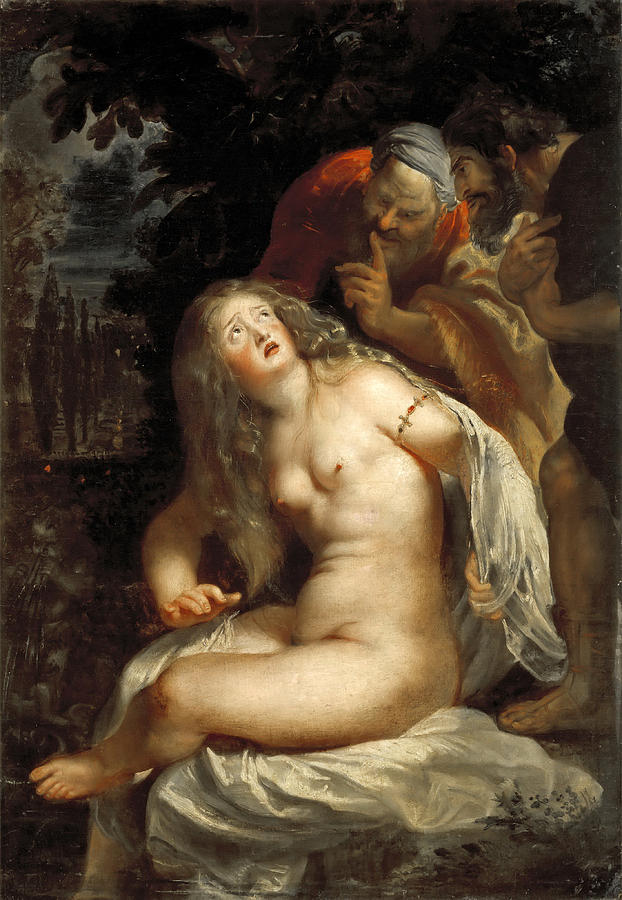
Peter Paul Rubens’s “Susanna and the Elders” (1608) stages the biblical moment when a virtuous woman, surprised at her bath, is coerced by two powerful judges. In a single, breathless instant the painter makes visible both the physical intrusion and the moral stakes. Susanna, seated on a stone ledge and gathered in a slip of white cloth, turns upward in alarm; behind her, the elders lean in from a darkness of foliage, one with a finger to his lips, the other with a hand ready to seize. The scene pulses with Baroque immediacy—flesh and fabric, light and shadow, desire and resistance—yet the center of gravity is ethical rather than erotic. Rubens’s craft pulls the viewer into the vortex of threat and then plants us beside Susanna, making her fear and her refusal the painting’s true subject.
The Biblical Story Condensed To A Single Instant
The Book of Daniel recounts how Susanna, the chaste wife of Joachim, bathed in a private garden where two judges hid and accosted her. They threatened to accuse her of adultery unless she yielded. She refused, was condemned, and would have died if the young prophet Daniel had not exposed the elders’ contradictory testimony. Rubens chooses the narrative point just after Susanna recognizes the ambush—before the false accusation, before the trial, before Daniel’s vindication. By halting the story at the moment of proposal and refusal, he suspends the viewer in the same moral air that the heroine breathes: one heartbeat from violence, one prayer from deliverance.
A Composition Built On Converging Diagonals
Rubens organizes the canvas with intersecting diagonals that intensify the confrontation. Susanna’s body arcs from the lower left toward the upper right as she twists away, an S-curve of torso and thigh. The elders press from the dark upper right toward the exposed center, their bent backs forming a counter-thrust. Where these vectors cross—at Susanna’s lifted face and the elder’s hushing finger—the narrative locks into place. The diagonals are not merely dynamic; they are ethical lines: her recoil is a line of refusal, their lunge a line of coercion. The eye rides these tracks subconsciously, feeling the collision before parsing the details.
Chiaroscuro That Names The Threat
Night and day share the frame, but the light obeys the drama. Susanna is bathed in a silvery glow that glosses her skin with tender heights—across shoulder, collarbone, and thigh—while a pearl-like sheen gathers on the folds of her linen. The men, by contrast, emerge from near-blackness beneath a canopy of leaves. Their faces and hands appear as fragments, illuminated just enough to show intent: the hush of a forefinger, the lean of a jaw, the wedge of a shoulder. This lighting is no neutral illumination; it indicts. Purity glows because it tells the truth; predation skulks because it fears the light.
Flesh That Feels Human, Not Voyeuristic
Rubens’s reputation for voluptuous bodies sometimes tempts viewers to misread his Susanna as an exercise in erotic display. Look carefully: her body is modeled with warmth and weight, but every choice signals vulnerability rather than seduction. Gooseflesh stipples the upper arm; a tremor lines the stomach; the supporting foot presses hard enough to flex tendons; the drapery is clutched, not arranged. The head tilts back in alarm, mouth parting not in invitation but in a half-formed cry. Rubens gives us the flesh that predators see yet denies the predators’ gaze the last word. The painting’s sensual credibility serves empathy, not appetite.
The Elders’ Hands And The Language Of Coercion
Hands are the grammar of this picture. The nearer elder raises a finger to his lips, the universal demand for secrecy that in this context becomes a threat: be quiet, consent, or be ruined. The other elder’s hand pushes forward under his mantle, thumb lifted with a conspirator’s eagerness, as if about to grip the linen. Susanna’s own hands answer: one draws the cloth across her body in a defensive sweep; the other braces on the stone, ready to rise. The conversation among hands transmits the moral content more forcefully than any facial expression could.
Drapery And Stone As Instruments Of Narrative
The swath of white at Susanna’s waist performs multiple roles. Visually, it is the chief reflector of light, throwing radiance back into the scene like a small moon. Narratively, it is the contested threshold between privacy and exposure—gathered tight by one hand, threatened by another, the difference between sanctuary and humiliation. The stone seat beneath her adds a contrary note: cold, immovable, indifferent. Rubens softens its edge with a smear of reflected flesh tones to show how susceptible bodies are when pressed against unyielding circumstances.
A Garden That Behaves Like A Trap
The setting is nominally a garden, the place scripture calls private and enclosed, a symbol of virtue. Rubens paints it as a chiaroscuro labyrinth. At left, a distant file of cypress trees wavers in a dim landscape; above, heavy leaves mass like curtains that close rather than open. The garden has failed in its purpose; it shelters the predators instead of the bather. That betrayal deepens the pathos. Virtue is not rashly flaunting itself; it is attacked in the very space meant to protect it.
Color As Moral Temperature
Though much of the backdrop is subdued, Rubens punctuates the scene with calibrated colors that reveal character. Susanna’s palette is luminous: milk white, shell pink, touches of coral at the elbow and knee. The elders carry hot, darker notes: an ember-red mantle on the nearer figure that flares like appetite; smudged ochres and browns on the other, the tones of dirt and secrecy. The color scheme is not symbolic in a strict sense, but it registers viscerally as heat pressing upon coolness, danger upon innocence.
The Face As A Weather Map Of Fear And Courage
Susanna’s expression is a tour de force of mixed feeling. The eyes lift toward an opening—perhaps toward God, perhaps toward the sky beyond the bower. The brows knit with alarm but also with resolve; the mouth is open in a breath that might swell into protest. Rubens avoids the melodramatic scream common in later versions; he paints the intake of breath before the cry. Her face contains two futures: capitulation and resistance. We recognize courage because we see her choosing the latter in real time.
Italian Lessons Reimagined In Antwerp Flesh
The painting was made as Rubens returned from his Italian sojourn. He had internalized Venetian color and Roman bravura, the soft atmospheric glows of Titian and the dramatic diagonals of Tintoretto. Yet the humanity is distinctly Northern. The elders’ worn faces feel studied from life; Susanna’s body carries the honest gravity of living flesh rather than ideal marble. Rubens synthesizes Italian invention with Flemish tactility, producing a scene that is both operatic and immediate.
The Viewer’s Position And The Ethics Of Looking
Rubens makes a risky but crucial compositional choice: the viewpoint is near the elders’ vantage point, close to Susanna’s exposed side. That perspective could invite complicity, but the painter’s choreography redirects it. Susanna’s gaze flings us upward and away; the elders’ fingers, though pointed toward secrecy, also point accusingly at themselves; the hard edge of the stone between our eye and Susanna functions as a moral curb. We are made to ask how we look and to whom we listen. The painting trains the viewer to move from curiosity to solidarity.
A Study Of Power, Not Only Desire
While the episode involves lust, Rubens emphasizes the elders’ power as the true menace. Their age, their robes, their closeness to one another signal office and alliance. Their whispers promise a rigged narrative—“Agree with us or we will write your downfall.” In that light the painting becomes a meditation on testimony and credibility. Susanna’s body is the site of conflict, but truth itself is the prize. Rubens foreshadows Daniel’s later intervention by making the elders’ faces sly rather than irresistible; their threat is rhetorical as much as physical.
The Body’s Twist As A Baroque Theological Statement
Susanna’s figure executes the Baroque “figura serpentinata,” a spiraling pose that turns volumes through space. Here the twist is more than virtuoso anatomy; it is a theological stance. The body turns away from sin and toward appeal. The spiral contains both recoil and prayer—the muscular refusal and the upward lift that asks for help. In this way the painter lets movement carry meaning. One cannot describe the doctrine of grace more succinctly than this turn of torso and neck.
Surface, Brushwork, And The Presence Of The Artist
Seen closely, the painting glints with Rubens’s hand. Her hair is laid in thick, feathery strokes that catch the light like wet strands; the white cloth is scumbled and then sharpened at the crests to mimic creases; the elders’ garments carry broader, oilier sweeps. Skin is built from warm underpainting glazed with cooler lights—a living translucency rare in any period. These surfaces keep the scene urgent. We feel the painter finishing passages with breath still held, as if he, too, were surprised by what he witnessed.
Echoes And Foils In Rubens’s Oeuvre
Rubens returned to the theme of embattled virtue often—chaste Lucretias, harassed Andromedas, assaulted nymphs—and in each he calibrated the ratio of beauty to peril. Compared to later, more expansive canvases, this work is compact and concentrated. There is no architectural display, no broad landscape, no bystanders. The compression intensifies our moral clarity. It also anticipates the artist’s larger altarpieces, where a central, illuminated figure resists downward or lateral pressures. The vocabulary of refusal practiced here would soon scale up to the drama of martyrdoms and rescues.
The Afterimage Of Justice
Though Daniel does not appear, his logic haunts the scene. The elders’ synchronized lean foreshadows the synchronized lies that will undo them; Susanna’s upward appeal anticipates the divine aid that will answer. Rubens prompts viewers to carry the story forward in imagination. When we leave the painting, we do not leave Susanna alone by the pool; we carry her to court, hear Daniel’s separate interrogations, and watch the crowd turn. The afterimage is relief, and it arrives because the painting has done justice to fear first.
A Counter-Gaze That Dignifies The Subject
Art history is full of Susannas who are looked at; Rubens arranges a Susanna who looks. Her gaze is not toward the viewer in flirtation nor toward the elders in submission; it is above and beyond, a perpendicular look that interrupts the ordinary traffic of desire. That counter-gaze dignifies her as a moral agent. The painting therefore addresses not only the ancient story but every age’s crisis of the gaze: how to look at vulnerability without consuming it, how to render beauty without stealing it, how to answer coercion with witness.
How To Read The Painting Slowly
Begin at the lower left with Susanna’s planted foot, an anchor of refusal. Follow the shin and thigh to the gathered linen; watch the right hand pull fabric across the navel like a shield. Rise along the torso to the lit shoulder, then to the throat where breath gathers. Let the eyes spring to the elder’s hushing finger, and notice how the gesture both silences and admits guilt. Return to Susanna’s face and trace her gaze into the dim gap of foliage where a sliver of sky survives. Lastly, sweep back through the warm red of the elder’s mantle to the cool whites of the cloth. This path retraces the moral motion from threat to appeal to steadfastness.
A Picture For Our Time
“Susanna and the Elders” remains unsettlingly contemporary. It understands how power can corner truth, how shame can be weaponized, and how integrity often appears defenseless until someone speaks. Rubens refuses to trivialize the danger; he also refuses to leave us without hope. In the luminous skin, the clenched cloth, the turned neck, we read a courage that precedes rescue. The painting becomes a small school of conscience: it trains the eye to side with the threatened, the heart to hold its ground, and the imagination to expect justice.
Conclusion: Light That Advocates
Rubens sets an ancient accusation beneath leaves and shadows, then lets light advocate. It reveals the aggressors without granting them glamour; it caresses the victim without reducing her to an object; it collects on linen and skin as if forming a protective veil. The brushwork is sumptuous, the design forceful, the psychology exact. What lingers, however, is the sense that beauty has taken the side of truth. In this canvas, splendor becomes a witness, and the viewer leaves knowing not only what happened to Susanna, but how we must look and act when such moments arrive again.