Image source: wikiart.org
Introduction
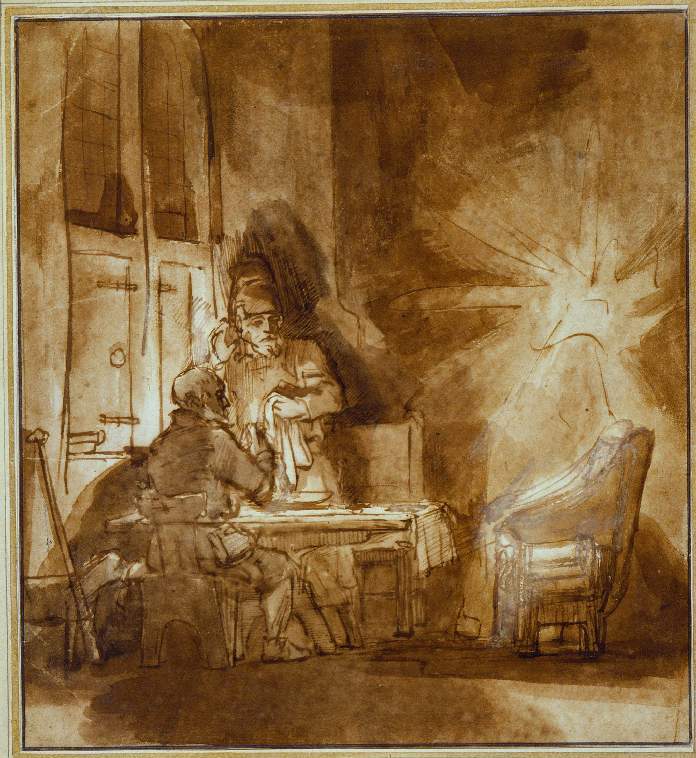
Rembrandt’s “Supper at Emmaus” of 1649 is a brilliant, breath-quick drawing in brown ink and wash that distills revelation to its most economical signs: a kitchen table, two startled men, a servant with a cloth, a low room articulated by shutters and a bench—and, at the right, a blinding eruption of light that marks the presence of the risen Christ. The scene is small in scale yet epic in implication. Where many artists surround the Emmaus story with architectural spectacle and still-life display, Rembrandt pares the story down to domestic essentials and lets light itself carry theology. The drawing reads like a note taken from life the moment a miracle brushed through an otherwise ordinary evening.
The Gospel Moment and Rembrandt’s Choice
The episode, from Luke 24, tells how two disciples meet a stranger on the road to Emmaus on the day of the Resurrection. He explains the scriptures; they invite him to supper; and “in the breaking of bread” they recognize him as Jesus—at which he vanishes from their sight. Rembrandt chooses the shock of recognition and the instant of disappearance at once. Rather than showing an anatomically described Christ, he dissolves the figure into a radiant burst that empties the chair, as if matter could not hold him a second longer. Revelation and absence become the same event. This choice is true to Luke’s phrasing and gives the sheet its electric minimalism.
Composition as a Drama of Edges
Look at how the room is organized. The left half is solid with carpentered forms: vertical shutters, a heavy door latch, a bench, solid chair legs, the rectangular top of the table. The disciples inhabit this geometry of habit. One sits with his back turned, twisting mid-gesture; the other rises half-way from his seat, napkin in hand, body shadowing the wall. Their profiles and the sharp edges around them keep the world intelligible. The right half breaks the logic open. The chair that should hold a third diner is flooded with light; the wall behind dissolves into a corolla of radiance; three or four tracer lines indicate a vanishing head and shoulders, then surrender the rest to blankness. Compositionally, Rembrandt stages recognition as a breach of edges: the straight, settled world yields to a presence that can only be pictured by its light.
The Triangle of Attention
The picture revolves around a triangular choreography of looking. The seated disciple faces right, hands lifted mid-prayer or shock, his gaze pinning the burst of light. The standing disciple turns and leans in the same direction, napkin slack in his hands, his whole posture confirming what the eye perceives. A servant has just entered or stepped from the hearth: he pauses, cloth still raised, head tilted, not yet sure what he sees. Their three heads form a scalene triangle pointing toward the empty chair, and the table’s long edge functions like a visual runway guiding us to the revelation. This is narrative without rhetoric—pure geometry of attention.
Ink, Wash, and the Physics of Revelation
The drawing’s technique embodies its meaning. Rembrandt lays out the room in quick pen lines—brisk, slightly dry strokes for panels and hinges, soft loops for fabric, sturdy hatching under the table. Over these, he floats transparent brown washes, letting the liquid sink into paper and pool in corners like real shadow. Then, for Christ’s apparition, he simply withholds the wash and the line, brushing out a coruscating halo of pale streaks that radiate from the chair’s back. The most powerful “mark” on the sheet is the absence of marks—the untouched paper that becomes pure light. No oil glaze or gold leaf could better express the event: revelation arrives as clarity.
Domestic Space and the Ethics of Place
Rembrandt’s Emmaus is a domestic room, not a painted stage. Every element registers use: the shutter bolts, the low stool, the heavy table with its overhanging cloth, a walking stick propped in the corner. The table stands on sturdy legs; the cloth droops with believable weight; the chair to the right still holds the dent of a body that has just left it. All this attention to workaday furniture is not accidental. It asserts that the divine chooses the ordinary as its medium. The miracle does not undo the room; it perfects it, giving the disciples’ well-worn space a new axis.
Gesture as Language
The sheet’s drama is carried not by faces (which are quickly sketched) but by hands. The seated disciple’s hands rise toward his mouth in a reflex of prayer and astonishment; the standing disciple’s hands loosen their grip on the napkin as if strength had been rerouted to the eyes; the servant’s hand pauses mid-wipe. These differing hand positions create a spectrum of response: startled devotion, dawning recognition, unsuspecting labor caught by a change in the air. Rembrandt was a supreme student of hands; here they speak the Emmaus theology fluently: faith is first a seeing and only then a saying.
Time, Breath, and the Vanishing
Unlike Rembrandt’s 1648 painted “Supper at Emmaus,” which lingers in the quiet after recognition, the 1649 drawing cracks like lightning and is gone. We witness the vanishing itself. Note the chair’s outline: the back splat and seat are solid, but the figure within is already almost pure air. Four or five quick lines describe the rim of a halo and the tilt of a head that is ceasing to be visible. The wash around the apparition is brushed with the speed of a heartbeat, then stops sharply where the paper’s brightness must be preserved. The viewer’s own breathing seems to sync with the scene—that held breath between a name and its echo.
The Discipline of Leaving Out
Rembrandt leaves huge areas untouched: the upper right wall is a geography of pale wash and blank paper; the apparition itself is nearly all omission. This disciplined incompleteness does several jobs. It lets the paper’s natural warmth act as glow; it pushes the figures into silhouette so their gestures read cleanly; and it reserves energy for the crucial passage of light. The mind finishes what the hand suggests, which is precisely how recognition works—knowledge arriving faster than language can describe it.
Drawing as Thought Made Visible
The sheet feels like thinking caught mid-flight. Try to trace the order of operations: layout in light pen, deeper accents at window frames and chair legs, broad wash passages to anchor the left half and under the table, a second set of sharper touches at faces and hands, then the miracle: a burst of saved paper ringed by flicked strokes. The drawing records decision after decision, all aimed toward clarity and speed. That willful speed is not sloppiness; it is fidelity to the scene’s own velocity. The miracle outruns elaboration.
Comparison with Other Emmaus Images
Rembrandt returned to Emmaus often—paintings and prints across two decades. The early treatments revel in theatrical spotlighting and still-life abundance; the 1648 canvas suspends recognition in domestic calm; the 1649 drawing is the most distilled. Compare the softly modeled Christ of 1648, ringed by a gentle nimbus, with the evacuated chair of 1649. Both are true to Luke; both are deeply Rembrandt. Together they map a progression from presence to absence, from seeing a figure to understanding that the figure is known by light and bread rather than by anatomy. The drawing is the later, leaner theology: you cannot hold him, only the radiance he leaves.
Table, Cloth, and Sacramental Axis
The table is the drawing’s altar, and Rembrandt understands that physically. He makes the tabletop a luminous plane—its upper surface left lighter than anything else in the left half—so that it becomes the stage for the gesture that triggered recognition. The cloth hangs almost to the floor, a domestic chasuble whose folds are honored with patient strokes. This is not church ritual; it is household sacrament. Bread and blessing have ignited the room; the table remembers them both.
The Servant as Witness from the Margin
Rembrandt seldom forgets the people who keep rooms running. The servant here—cap on, cloth in hand—embodies unselfconscious labor. He has not been walking the road or rehearsing scripture; he has been cleaning, fetching, tending fire. His inclusion asserts that revelation does not segregate the pious from the practical. It also gives the scene a temporal anchor: life will resume after the moment passes. The plates must still be cleared, the shutters latched, the cloth shaken out. Grace and chores coexist.
The Window and the Two Lights
There are two lights in the drawing: the practical light suggested by the shuttered window, and the miraculous light exploding from the chair. The left-hand light would normally govern such a room at dusk; Rembrandt subordinates it with wash, letting it fall behind mounting shadow. The miracle light needs no window. It originates within the event and carries no cast shadow, only a swelling penumbra. This opposition is quietly polemical: revelation does not borrow illumination; it gives it.
Paper, Medium, and the Poetics of Brown
The warm brown of ink and wash suits the subject. It reads as evening light, as aged wood, as the color of bread crust and hearth smoke. When the paper is left bare, as in the apparition, that brownness makes the white feel all the more piercing. The medium’s limitations become theology: the most precious value on the sheet is not pigment but uninked fiber—the space kept free so light can exist. Few artists exploit paper’s voice as fully as Rembrandt does here.
Speed, Silence, and the Viewer’s Role
Because the sheet gives us so little, it asks a lot of the viewer: to supply detail from memory, to hear the quiet, to feel the warmth of air around hot plates and the sudden coolness of fear and joy. The drawing is participatory. We complete it, just as the disciples’ minds completed the scriptural clues once the bread was blessed and broken. This is why the image continues to live: it makes viewers co-witnesses rather than bystanders.
Theological Depth in Human Scale
The Emmaus story is ultimately about the recognition of meaning in the ordinary. Rembrandt keeps everything human-scaled: no angels, no grand altar, no courtly attendants. The miracle does not remove the men from their room; it gives the room an axis around which their lives can turn. The drawing’s small size intensifies that ethic. This is revelation you hold close, not a spectacle to gape at from a nave.
Echoes of Rembrandt’s Life in the Late 1640s
By 1649 Rembrandt had weathered losses—bereavement, financial strain—and his art turned inward without losing kindness. The drawing’s tenderness toward routine, toward the table and chair and shutters, feels autobiographical. He knows the solace of rooms, the dignity of small things. In that context the Emmaus flash reads not just as doctrine but as the kind of clarity that sometimes visits tired people in familiar places: sudden coherence, sudden trust, sudden courage to return to the road and tell what you have seen.
Why the Sheet Still Startles
Even in reproduction the image startles because it trusts a few bold moves. The empty chair flooded with white, the triangular ring of faces, the wet-on-dry wash that leaves irregular ribs of paper showing through—these are shockingly modern decisions. They anticipate later artists who will paint presence by painting its afterglow. Yet the drawing remains entirely Rembrandt: compassionate, concentrated, rooted in the life of a room.
Conclusion
“Supper at Emmaus” (1649) is revelation reduced to first principles. Two men, a servant, their table; a shuttered room; and light that makes the air itself articulate. Rembrandt does not describe the resurrected body; he shows what it does to a place and to people. The picture is as quick as a heartbeat and as deep as the habit of a lifetime. It reminds us that the ordinary is porous, that the world we can touch is where grace prefers to arrive, and that the strongest image of Christ, sometimes, is not a face but the empty chair brimming with light.