Image source: wikiart.org
Introduction
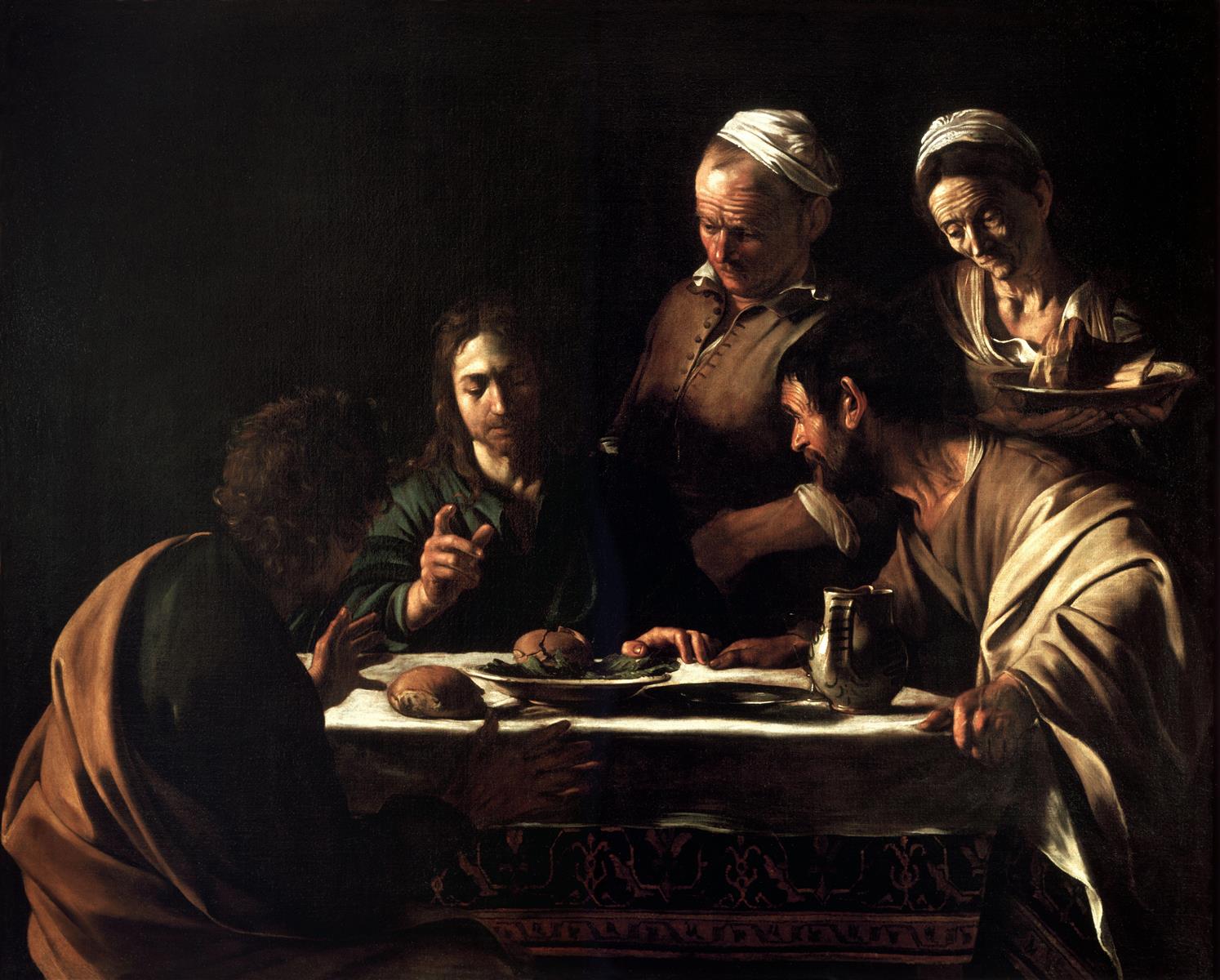
Caravaggio’s 1606 “Supper at Emmaus” is a meditation on recognition that trades spectacle for hush. The scene shows the risen Christ seated at a modest table with two disciples while a host couple attends to the meal. Light pools over faces and hands, leaving the room itself to dissolve into darkness. Instead of the theatrical surprise of Caravaggio’s earlier 1601 treatment, this later Emmaus leans into restraint: the gestures are smaller, the food humbler, the space tighter, and the revelation quieter. It is a painting about how truth arrives in ordinary rooms and is acknowledged with ordinary bodies.
The Gospel Moment and Caravaggio’s Second Thoughts
The story comes from Luke’s Gospel: two disciples, desolate after the crucifixion, meet a stranger on the road to Emmaus who opens the Scriptures to them; they only recognize him when he blesses and breaks bread. Caravaggio had already painted the moment of recognition in Rome five years earlier with expansive arms, a dazzling fruit basket, and daylight clarity. In 1606, newly exiled after a deadly brawl, he revisits the subject with changed eyes. The recognition is real but interior; the gestures contract; the props are pared down. The difference is not merely stylistic but spiritual—this Emmaus believes in revelation that is felt like breath rather than thunder.
Composition Built Around Faces and Hands
The painting is arranged as a shallow stage set around a rectangular table that fills the lower half of the canvas. Christ sits slightly off center, facing us three-quarter view. A disciple leans in from the right, another from the left; behind Christ stand an innkeeper and a woman carrying food. The design funnels attention to two centers: Christ’s calm blessing hand and the disciples’ answering hands. Caravaggio engineers a chain of diagonals—Christ’s forearm pointing to bread, the right-hand disciple’s arm sliding toward the table edge, the old woman’s serving platter tilting in the opposite direction—that meet in the oval of the loaf. The table’s broad front lip anchors the group and makes the viewer feel seated with them.
Chiaroscuro as the Grammar of Revelation
Light enters from the right like a quiet sentence. It touches the old woman’s cheek and headcloth, glides down the innkeeper’s brow, settles on Christ’s face and fingers, and then searches the disciples’ hands before spilling across the tablecloth. Darkness devours the rest. This is not the gaudy contrast of stage lighting; it is tenebrism as moral focus. Everything the story needs—bread, blessing, witness—is given to us in light, while what the story does not need—furnishings, architecture, vistas—is gently revoked. The effect is compassionate: illumination arrives where it will be recognized and rests there.
The Changed Rhetoric from the 1601 Version
In the earlier Emmaus, a disciple throws his arms wide in stunned recognition, the innkeeper looks baffled, and a precarious basket of fruit thrusts toward us with emblematic bravura. By contrast, the 1606 canvas trades shock for reverence. The disciples lean rather than spring; their faces are intent, not amazed. Christ is bearded and calmer, his hand blessing rather than demonstratively breaking. The still life has been edited to loaves, a pewter jug, and a simple dish. The innkeepers are not performers but workers. The change persuades us that recognition often feels like a deep inward assent, the kind that requires less room than a gasp.
The Humanity of Christ
Caravaggio’s Christ is neither distant nor over-idealized. He is a traveler who has earned dust; his hair falls in soft waves, his beard is trimmed, and his robe and mantle catch light in modest planes rather than flowing theatrically. The downcast eyes are tender, and the right hand hovers in a blessing that resembles the familiar motion of one who has blessed bread many times. No aureole or blaze announces him; a thin nimbus of light around the head is nearly absorbed by darkness. The authority is carried not by iconography but by presence.
The Disciples as Witnesses with Work-Hardened Bodies
The disciple at the right leans forward, jaw set, forearm tense, the line of the sleeve catching highlights that reveal the labor of his life. His attention lands on Christ’s hand and the bread; his own hand rises, not in theatrical shock but in a reflexive echo, as if his body knows before his mind has found words. The disciple at the left bends from the shadows, hands half-raised in a restrained acknowledgment that reads like the beginning of a prayer. Caravaggio insists on their ordinariness: the clothes are frayed, the hair unstyled, the postures grounded. The sacred moment does not rescue them from being human; it sanctifies their humanness.
The Two Attendants and the Theology of Hospitality
Behind Christ stand a man and a woman, likely the host and his helper. Their inclusion is not narrative padding; it is part of the painting’s theology. The woman peers at the table with the concerned concentration of someone who wants to serve well; the man’s posture—neither kneeling nor disinterested—suggests practical care. They are not yet participants in the recognition, but they provide the setting where recognition can occur. In the economy of the painting, hospitality becomes a vessel for revelation: the Lord is known in a room made ready by ordinary kindness.
Bread, Wine, and the Everyday Mysteries
Caravaggio’s tabletop is a still life of essentials. Two loaves lie within reach; a small dish of greens or meat sits before Christ; a pewter jug reflects a faint glimmer. The tablecloth, heavy and clean, with a dark border that suggests a textile pattern, provides a small theater where hand, bread, and plate interact. These things are not symbols parachuted in from a catechism; they are the kinds of food that would be served at an inn. Because they are ordinary, they can bear the weight of miracle without breaking. In this quiet way the painting speaks about sacrament: the common made inexhaustible.
Fabric, Flesh, and the Sound of Surfaces
Caravaggio animates the scene with textures you can almost hear. The old woman’s headcloth is crisp and dry; the innkeeper’s jerkin is worn enough to take a warm sheen; Christ’s mantle folds in broad, soft planes; the right-hand disciple’s sleeve shows a fine nap that drinks the light rather than reflecting it. Flesh is modeled with a naturalism that acknowledges age and weather—creases around the eyes, a worker’s tan on the forearm, a disciple’s roughened hands. This scrupulous attention to surface helps the revelation feel present-tense; we are not in a gilded vision but in a room where sound and touch matter.
The Table as Stage and Threshold
The frontal edge of the table creates a threshold between viewer and scene. Caravaggio places the jug near that edge and lets the disciple’s right hand break the boundary so that our space and theirs mingle. The table works like a communion rail: a place where distance is honored and crossed. The heavy cloth muffles the theatrics of the earlier version and gives the action a low acoustics. We are invited to lean in, to be seated, to become third and fourth witnesses at the moment when bread and presence coincide.
Gesture as the Vehicle of Meaning
Caravaggio tells the story with small, exact gestures. Christ’s right hand, index and middle fingers lifted in blessing, is decisive without flourish. The left-hand disciple’s palms answer with a humble mirror, their upward tilt signaling receptivity. The right-hand disciple, already half-risen from his seat, gathers the cloth with one hand and steadies the jug with the other, as if preparing for participation rather than display. The host grips a serving cloth; the woman’s wrist under the plate is tense with weight. A viewer could read the painting with the sound off and still understand it because the grammar of hands is so eloquent.
The Slow Heat of Recognition
Recognition happens here with the tempo of a breath. The disciples’ bodies have not yet completed their turn; the host and the woman are still fixed in their tasks; Christ’s blessing is midair. Caravaggio paints the second before speech—before “It is the Lord” or “Were not our hearts burning within us?” This slow heat matters. By refusing to show an outburst, the painter argues that most conversions are glissandos rather than drumrolls. The sacred often enters at the exact pace of ordinary perception.
The Ethics of Caravaggio’s Realism
The 1606 canvas embodies Caravaggio’s ethic that the divine should never be insulated from the real. Jesus shares a table with men who have the posture of laborers. Servants are not romanticized; they are seen. Food looks like food, hands like hands, light like light. This devotion to the actual is not a rejection of mystery but its very condition. By honoring how bread breaks and how a jug glints, the painting makes theological claims credible: the God who redeems flesh does not despise it.
Color and Emotional Weather
The palette is hushed: earth browns and olive greens, cream whites, the occasional ember of a warm highlight, and the deep blacks that form the room’s negative space. Compared to the earlier Emmaus, the hues are cooler and more grounded. The overall weather feels like late evening when tasks slow and conversation deepens. The color choices support the painting’s psychology; revelation lands best in a climate of calm.
Technique and the Persuasion of Paint
Caravaggio builds the picture from large shadow masses that swallow anything not essential. Over this he lays midtones that sculpt volumes—the slope of a cheek, the swell of a sleeve—and then pricks the eye with sharp, rationed highlights: a glimmer on the jug, a small edge on the bread crust, a bead on the host’s knuckle. Flesh is thinly glazed so warmth can flicker beneath cooler tones; fabrics are dragged with loaded bristles to suggest weight. The brushwork never calls attention to itself because the subject is not virtuosity but recognition.
Space, Silence, and the Viewer’s Place at the Table
The compressed depth and the wide strip of empty dark to the left produce a heavy silence that is almost audible. That silence is a narrative device; it’s the pause between realization and response. Our vantage point is intimate—close enough to feel the table’s rim against our stomach. The painting treats the viewer not as a spectator who peers through a window but as a guest who has arrived slightly late and caught the moment when eyes widen and hands still.
Comparing the Two Emmaus Paintings as a Spiritual Journey
Viewed together, the 1601 and 1606 versions map a journey from astonishment to assurance. The first is a trumpet blast; the second is a psalm. The young Caravaggio delights in the shock of disclosure; the older Caravaggio trusts the steady grammar of blessing and bread. Both are true to the Gospel, but the later painting addresses a different need: how to keep faith when life has made noise suspect. It answers with a room where light speaks softly and still says everything.
How to Look
Begin at Christ’s blessing hand and the small loaf before him. Feel the line of attention from those fingers to the disciples’ answering gestures. Move right to the jug where a pinpoint highlight makes metal breathe, then up the forearm to the intense profile of the disciple who leans in. Climb further to the old woman’s narrow face and the weight she carries, then drop back through Christ’s eyes to the other disciple’s patient hands. Finally let your gaze rest on the empty dark at left; its silence is the frame for the sound you cannot paint—the recognition traveling through the room.
Meaning for Contemporary Viewers
The canvas makes a simple claim: revelation meets us where we eat. It does not require fireworks. It asks for a table, honesty, bread, and the willingness to see again what we think we know. In a world of spectacle, Caravaggio’s second “Supper at Emmaus” feels like counsel. Pay attention to hands. Serve one another. Clear a space for quiet. Light will find what it needs.
Conclusion
Caravaggio’s 1606 “Supper at Emmaus” is a masterpiece of focused tenderness. By contracting gesture, paring the still life to essentials, and letting light bend over bread and faces, the painter makes recognition feel both ordinary and inexhaustible. The miracle happens at the speed of a human breath, and the canvas honors that speed with its own hushed authority. It is a picture to sit with, not to conquer—a table at which every viewer can take a place.