Image source: wikiart.org
Introduction to “Summer” by Peter Paul Rubens
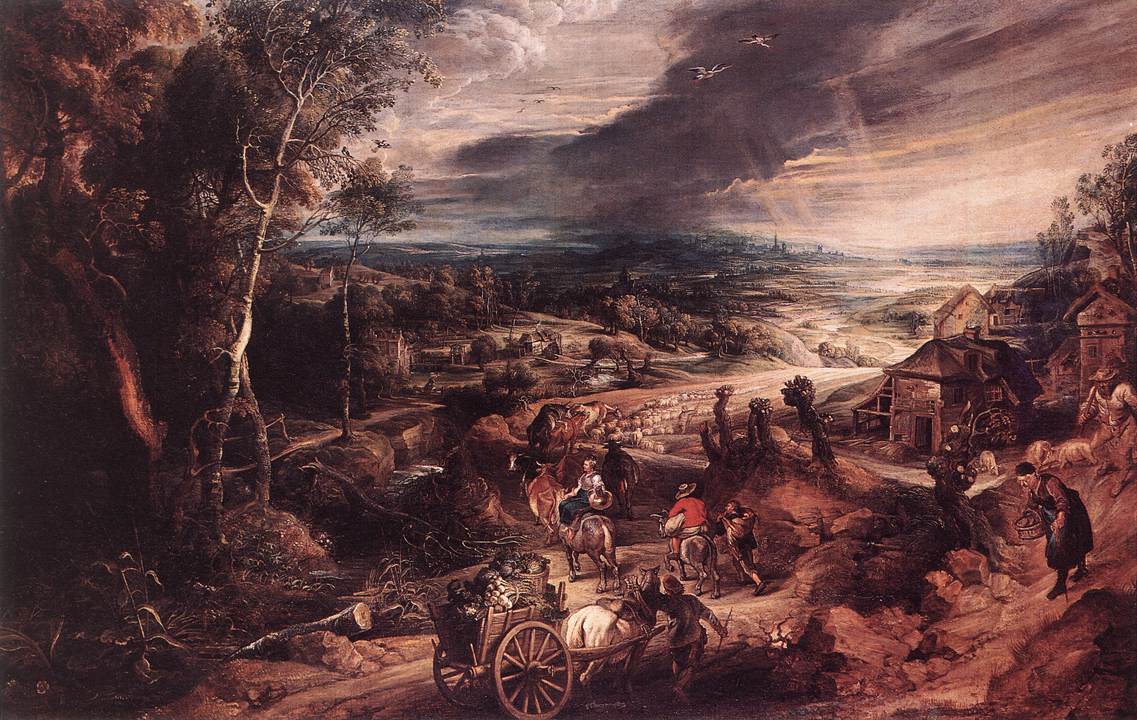
“Summer,” painted around 1630 by Peter Paul Rubens, is an expansive celebration of the warm season translated into the language of Baroque landscape. Instead of presenting a single mythological episode or a static allegorical figure, Rubens constructs a world in motion. The vast panorama stretches from the shadowy foreground to a luminous, far-off city, filled with farmers, travelers, herds, carts, and winding roads. Everything seems to stir: clouds drift, trees bend in the wind, and people move along the rutted path.
The painting belongs to the long European tradition of representing the seasons, but Rubens reinvents that tradition with his characteristic dynamism and emotional richness. Summer becomes not just a time of year but a living experience of warmth, labor, and abundance. The viewer’s gaze travels through the picture just as the characters travel through the countryside, so that looking becomes a kind of journey into Rubens’s imagined world.
Historical Context and Rubens’s Vision of the Seasons
By 1630, Rubens was one of the most celebrated painters in Europe. Based in Antwerp, he moved easily between courts, diplomatic missions, and grand artistic projects. His work on allegories of the seasons and of the elements reflects both courtly taste and his own fascination with nature. He was deeply influenced by Italian art and by the Flemish landscape tradition, especially the work of Pieter Bruegel the Elder, yet he brought to these influences a robust, muscular energy that is unmistakably his own.
“Summer” likely formed part of a series in which each season was embodied through landscape and human activity. Rather than simply personify the season as a goddess surrounded by attributes, Rubens presents an entire environment saturated with the feeling of summer. Harvest, travel, trade, and pastoral life all appear in the same wide view. The painting also reflects the growing prestige of landscape as a genre in the seventeenth century. While earlier landscapes often served as backdrops for religious or mythological scenes, Rubens allows the countryside itself to carry the painting’s meaning.
Composition and Spatial Structure
One of the most striking features of “Summer” is its sweeping composition. Rubens organizes the space along a powerful diagonal that runs from the lower left, where the road and cart enter, up to the middle distance and then toward the right, where the light opens onto the plains and distant town. This diagonal movement gives the painting a sense of progression, almost like a story unfolding as the viewer’s eye follows the road.
The foreground is crowded and rugged. Rocks, tree roots, and uneven earth frame the path. At the left, tall trees rise dramatically, their trunks twisting and leaning, partly silhouetted against the sky. The central band of the image, where the road curves, becomes a stage for human action: a cart laden with goods, peasants working, a rider on a donkey, and figures walking or conversing. The background recedes into a broad valley, with fields, hedgerows, and a flock of sheep forming soft horizontal bands that contrast with the strong diagonals of the road.
This interplay between diagonals and horizontals stabilizes the composition while preserving its sense of energy. The viewer’s gaze is repeatedly drawn forward and then allowed to rest in the calm distance. The effect is a visual echo of a summer day’s rhythm, in which moments of vigorous activity alternate with stretches of hazy stillness.
Light, Weather, and Atmosphere
The sky in “Summer” is as important as the ground. Rubens paints a complex, shifting atmosphere that suggests changing weather. To the right, light bursts through gaps in the clouds, bathing the distant land in a silvery glow that evokes late afternoon or early evening. To the left, darker, more threatening clouds mass together, casting shadow over the trees and foreground. Birds wheel through the sky, reinforcing the idea of air in motion.
This contrast between bright and shadowed zones creates a dramatic mood. It is as if a summer storm has just passed or is about to break. The landscape is not frozen in idealized calm; it is subject to the same restless forces that drive Rubens’s figures. The light raking across the fields emphasizes the undulating topography and the varied textures of foliage, roofs, and water. Highlights on the road and on the backs of the animals guide the eye forward, while the bright patches in the distance promise space and openness.
Rubens’s mastery of atmospheric perspective is evident in the gradual softening of forms and the cooling of colors as they recede into the horizon. Near objects are painted with warm, robust browns and greens; distant fields merge into delicate bluish-gray bands. This not only creates a convincing sense of depth but also strengthens the painting’s emotional structure, pulling the spectator into the scene and out toward the glowing town on the horizon.
Human Activity and Narrative Threads
Although “Summer” is officially a landscape, it teems with human narratives. In the foreground a cart descends a rough path, drawn by horses and laden with produce. A woman sits astride a donkey, balancing a container on her lap, while a man walks beside her. Another figure pushes or steadies the wagon from behind. To the right, near a cluster of buildings, more peasants work: some carry baskets, others attend to animals, and a watermill by the stream suggests constant, unseen movement.
Each small group of figures forms a vignette of rural life, yet together they create a larger story of community and seasonal work. There is no central hero; instead, the painting honors collective labor. The road binds the figures together just as shared economic and social ties bind a community. The presence of the flock of sheep in the middle distance further emphasizes the rhythm of agricultural existence, with people and animals moving in carefully organized patterns across the land.
The travelers’ direction, moving from left to right and downward along the road, opposes the viewer’s instinctive pull toward the illuminated horizon. This tension subtly energizes the composition. It suggests that life continues in cycles, always circulating between farm, market, and town, between work and rest. Rubens thus presents summer not just as a pleasant season but as a crucial phase in the year’s economic and social cycle.
Symbols of Summer and Seasonal Abundance
Although the painting does not rely on obvious allegorical figures, it is filled with symbols of summer. The wagon is piled with goods that hint at harvest and trade. The fields in the distance appear neatly divided and cultivated, showing the land at the height of productivity. Trees, bushes, and roadside plants are full and leafy, their dense foliage signaling growth and fecundity. Even the animals, from the sturdy horses to the grazing sheep, embody the prosperity of the season.
Summer is traditionally associated with midday, maturity, and fullness, and these themes subtly permeate the landscape. The light, though angled, is strong and bright rather than pale. The roads are busy rather than empty. Buildings appear solid and well-maintained, and water flows through the mill, hinting at industry powered by nature’s energy.
The stormy sky may at first seem at odds with the idea of a serene summer, but it actually underscores the richness and volatility of the season. Summer storms bring both threat and nourishment; they can destroy crops but also water them. The mixture of dark clouds and brilliant light captures this duality. In Rubens’s hands, summer becomes a time of intense force rather than mere languor.
Nature as a Baroque Stage
Rubens approaches nature with a distinctly Baroque sensibility, treating the landscape almost like a stage on which dramatic events unfold. The towering trees at the left lean inward like curtains, partially framing the scene. The road functions as a diagonal stage ramp along which figures make their entrance. The contrast between the dramatic foreground and the serene distance operates like the contrast between the front of a theatrical set and its painted backdrop.
However, this theatricality does not make the scene artificial. Instead, it highlights the emotional and spiritual resonance of the natural world. In the early seventeenth century, many artists and thinkers saw nature as a manifestation of divine power. Rubens, who was deeply religious, often used landscape to convey the grandeur of creation. The turbulent sky, the massive trees, and the rolling terrain all reflect a sense of awe and respect for nature’s energy.
At the same time, the painting emphasizes human integration into this environment. The figures do not dominate the landscape, nor are they dwarfed to the point of insignificance. They are woven into it, part of its rhythms and cycles. This balance is central to the work’s impact: human life is shown as both fragile and resilient within a larger natural order.
Color Palette and Painterly Technique
Rubens’s color palette in “Summer” combines earthy richness with subtle atmospheric tones. In the foreground he uses warm browns, deep greens, and reddish accents to suggest soil, rock, foliage, and garments. The figures’ clothing includes touches of red and blue that catch the eye and differentiate them from the surrounding earth tones. These saturated colors contribute to the sense of heat and density that we associate with summer.
As the landscape recedes, Rubens modulates his colors toward cooler greens, grays, and blues. This shift not only creates spatial depth but also evokes the hazy shimmer of distant fields on a warm day. The sky shows a spectrum from bruised purples and grays in the storm clouds to soft whites and pale yellows in the lit areas. These gradations reveal his mastery of blending and glazing techniques, where thin layers of paint build up complex hues and luminous effects.
The brushwork in the foliage and clouds is lively and free, with varied textures that mimic the irregularity of leaves and vapor. In contrast, the figures are more tightly modeled, their forms carefully defined to remain legible even at a distance. Rubens combines broad, expressive handling in the landscape with controlled detail in the human and animal forms, achieving a compelling balance between spontaneity and structure.
“Summer” within Rubens’s Landscapes and Seasonal Cycles
Rubens is often best known for his grand altarpieces and mythological scenes, but his landscapes occupy an important place in his oeuvre. In works like “Summer,” he explores a more personal, almost poetic side of his imagination. These landscapes often blend direct observation of the Flemish countryside with idealized elements, producing a hybrid world that feels both familiar and heightened.
“Summer” can be compared to his other seasonal or pastoral pieces, which often show peasants at work, hunters returning, or travelers on the road. In many cases Rubens collaborated with specialist landscape painters or animal painters, but in works of this kind the unity of vision suggests his strong guiding hand. He transforms the genre of the landscape of the seasons, which had been popular in Northern art since Bruegel’s “Months” series, into something more dynamic and emotionally charged.
Where Bruegel tends toward a cooler, more observational tone, Rubens infuses his landscapes with physical vigor and dramatic light. “Summer” exemplifies this difference: the road churns with movement, the clouds seem to swell and shift, and the figures appear caught mid-gesture. The painting thus bridges the world of traditional Netherlandish landscape and the more theatrical, emotive spirit of the Baroque.
Emotional Impact and Viewer Experience
Standing before “Summer,” a viewer experiences more than a catalog of seasonal motifs. The painting generates a complex emotional response that mingles awe, nostalgia, and perhaps even a sense of restless anticipation. The dark trees and rocky slopes in the foreground create an initial feeling of heaviness and closeness, as if we are ourselves on the road, pushing through uneven ground.
As the eye travels toward the illuminated distance, that heaviness gives way to spaciousness. The distant town, the river, and the soft fields suggest opportunity and continuity. One can imagine markets, festivals, and daily routines waiting there, sustained by the labor we witness in the foreground. The painting invites the viewer to contemplate not just the beauty of nature but the interconnectedness of human effort, environment, and time.
The dramatic contrasts of light and shadow lend the scene a faint tension. The looming clouds hint that all this abundance is precarious, dependent on weather and fortune. Yet the people continue their tasks without visible panic or despair. Their resilience, combined with the land’s fertile appearance, creates a hopeful mood. Summer, in Rubens’s vision, is a season of both challenge and reward, where human beings work with nature and trust that their labor will yield fruit.
Lasting Legacy of “Summer”
“Summer” stands as a powerful example of how a landscape can encapsulate a whole philosophy of life. Rather than isolating nature as a picturesque spectacle, Rubens presents it as an arena of ongoing human activity, tied to economy, community, and spirituality. Later painters, from Dutch realists to Romantic landscape artists, would continue to explore these themes, but Rubens’s synthesis of drama, atmosphere, and everyday life remains distinctive.
The painting also demonstrates the flexibility of allegory in Baroque art. While some allegories rely on clear labels and personifications, “Summer” uses more subtle means. Its meaning emerges from the convergence of many small details: baskets of produce, grazing animals, flowing water, and travelers on the road. These elements do not simply decorate the view; they transform it into a meditation on time, growth, and human dependence on the land.
Today, “Summer” can still speak to contemporary viewers who live far from the rhythms of pre-industrial agriculture. The painting’s sense of movement and change resonates with modern experiences of seasonal shifts and human mobility. At the same time, its celebration of nature’s power and beauty encourages reflection on how closely our lives remain tied to the environment, even when that connection is less visible than in Rubens’s day.
Conclusion
“Summer” by Peter Paul Rubens is much more than a picturesque rural scene. It is a grand, carefully orchestrated vision of the season at its height, rendered through sweeping composition, intricate human narratives, dramatic atmosphere, and a rich handling of color and light. The painting transforms the familiar idea of summer into a living, breathing world full of work, travel, risk, and reward.
By guiding the viewer along the diagonal road from dark foreground to radiant distance, Rubens stages an emotional journey that mirrors the cycles of the year and of human life. The painting captures both the urgency of seasonal labor and the enduring beauty of the natural world. In doing so, it affirms the vital relationship between people and the land, showing summer as a time when that bond is especially visible and intense.