Image source: wikiart.org
Introduction
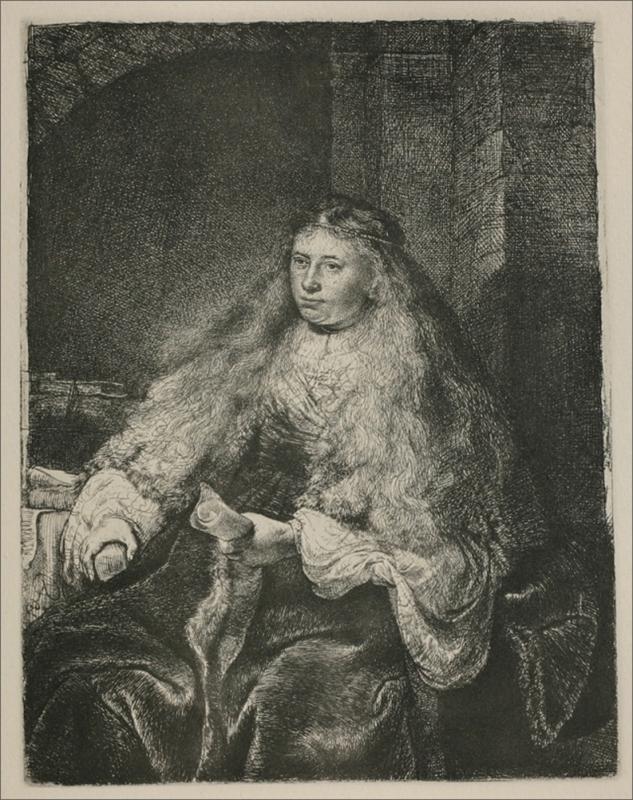
Rembrandt’s “Study of Saskia, called the Great Jewish Bride” (1635) is one of the most sumptuous prints from his early Amsterdam years, a richly worked etching in which a young woman—almost certainly Saskia van Uylenburgh—sits absorbed in her own inward weather while luxury gathers around her like a tide. She is framed by a shadowy interior, her body draped in heavy fabrics that pool and billow; a pale hand rests near a table with patterned cloth; the other hand holds a fold of the garment as if testing its weight. The face, softly lit, is a peninsula of calm in a dark sea of tone. For centuries the print carried the title “The Great Jewish Bride,” a name that gestures toward costume, Old Testament heroines, and the seventeenth-century taste for “portraits historiés.” But whatever the label, the sheet is a love-steeped study of presence, an exploration of texture and light, and an early statement of the psychological quiet that would later define Rembrandt’s greatest portraits.
A Misleading Title and a Revealing Subject
The historic title has launched much speculation. In Rembrandt’s time, affluent Amsterdamers were fascinated by biblical figures and so-called “Oriental” dress. Artists responded by casting living sitters—often their wives and friends—as Esther, Rebecca, or a generic bride. The etching’s grandeur and the broad, fur-trimmed costume encouraged viewers to christen it “the Great Jewish Bride.” Yet the likeness is anchored in Saskia’s features, and the mood is more private than ceremonial. Rather than programmatic allegory, the sheet feels like a studio encounter where costume provided atmosphere while the artist watched the sitter turn inward. The title may misdirect, but it also hints at what the print achieves: an image of dignity and inwardness clothed in the language of luxury and story.
Composition: A Pyramid of Stillness
The composition arranges the figure in a low, stable pyramid. Saskia sits near the center, her head forming the apex, her vast hair and mantle sloping down to the left and right. This triangulation keeps the mass of black and charcoal tones from swallowing the face; our eyes can roam the swirling textures and always return to the calm, lighted oval of thought. Behind, a darkened wall and an arch-like recess supply architectural gravity without stealing attention. A slice of tabletop at the left introduces a horizontal counter-rhythm and a scale reference, so the swell of drapery reads as voluminous rather than formless. The space feels deep yet intimate, like a recess in a large house where air hangs quiet and time moves slower.
Light That Behaves Like Understanding
Rembrandt’s control of value is the print’s secret engine. He allows the white of the paper to bloom only where it matters most: a sheen on the cheek, a glimmer along the forehead, a sift of light on cuff and palm, a glint on the folds that angle toward the viewer. Everywhere else, an orchestration of cross-hatching and plate tone builds velvety darkness. The result is not the theatrical chiaroscuro of a spotlight but the intelligence of light—selective, thoughtful, clarifying. The face reads first because the light understands it first; the rest emerges with a patient delay, like details gathered by memory after the important thing has already been seen.
Etching as Tactile Music
Technically, the sheet is a demonstration of how many textures a needle can sing from copper. The hair is a storm of curving strokes and soft burr, each curl thickening then fading as it rounds toward shadow. The fur trim is abbreviated with short, broken marks that imply a pelt’s nap without pedantic description. The satin or velvet of the gown is rendered with longer, directional strokes that follow the swell of the body and pool into darker reservoirs at the lap. In the background, lean, straight cross-hatching erects the strict geometry of a pier or wall, its rigidity heightening the organic flow of the garments. One feels not only the look of cloth, hair, and stone but their touch: cool weight, soft drag, rough edge.
The Face: A Peninsula of Thought
Amid the extravagance of costume the face remains sober, almost introverted. Saskia’s eyes look slightly past us rather than directly at us; the mouth rests in an unforced line; the cheeks carry the gentle warmth of living blood even in monochrome. The modest headband or fillet that crosses the hair feels less like crown than brace, a quiet line of order that keeps the tides of hair from overtaking the brow. This restraint is key. In many so-called “bride” images the sitter advertises joy; here the sensation is slower—composure, perhaps contemplation. Rembrandt’s affection appears not as flattery but as the steady work of seeing a person who exists beyond the costume.
Hands, Gesture, and the Drama of Stillness
Hands in Rembrandt carry plot. The left hand, near the table, relaxes with a weight that tells us how heavy the sleeve is. The right hand pinches a fold of fabric, as if testing texture or simply giving the fingers a home while the mind wanders. There is no pointed sign language—no theatrical display of rings, no explicit offering of flowers or written vows. The gestures instead make stillness believable. They distribute the body’s quiet across the sheet, so the figure does not freeze but rests.
The Table and the World Beyond the Frame
That small table corner at left, with its patterned cloth and barely indicated objects, is a masterstroke of narrative modesty. It hints at a world of domestic order—papers, comb, cup, perhaps a little box—without itemizing. Like a prologue, the table tells you where you are (a room of comfort, not a throne room) and who lives there (someone with habits, tools, and a day to return to). It anchors the costume’s fantasy in the steady geography of the household, one of Rembrandt’s favorite strategies for keeping allegory humane.
Hair as Landscape
The sheet is famous for its sheer acreage of hair. Rembrandt uses it as both subject and compositional device. The mass frames the face and shoulders like a cove; it carries the light in broken strands and catches tone in nested shadows; it turns the upper half of the print into a landscape of ridges, gullies, and reflected glints. In an etching, such abundance risks heaviness, but Rembrandt breathes air into the mass by varying stroke weight, direction, and spacing. The eye never suffocates; it travels.
The Psychology of Costume
Costume here is not vanity but vocabulary. In the 1630s, Amsterdamers delighted in masquerade—parading as biblical figures or “Orientals” to signal taste and worldliness. Rembrandt takes the glamour but refuses the caricature. The sleeves, fur, and headdress bring dignity and amplitude to the body while remaining believable clothing rather than armor. Their opulence amplifies, rather than replaces, character. You sense a person choosing to wear something that feels good to the skin and generous to the eye, not a prop department swallowing a sitter.
Plate Tone, Printing, and Atmosphere
Impressions of this print often retain a warm film of plate tone that gently veils the background and deepens hollows in the drapery. Rembrandt cultivated that residue per impression, turning inking and wiping into a second stage of drawing. In copies where tone is heavy, the room feels snug, almost nocturnal; where it is lighter, the interior opens like overcast day. This variability gives the “Great Jewish Bride” an atmospheric range unusual for prints—a reminder that each pulling of the plate can change the weather of a scene.
The “Bride” as Portrait Historié
To modern viewers the title may suggest a literal Jewish wedding portrait. More likely, the label came later, reading the attire and aura through the lens of Rembrandt’s famed painting “The Jewish Bride” from three decades later. In 1635, what we see is Saskia cast in an elevated role—a bride or heroine from Scripture—without being shackled to one narrative. The ambiguity is the point. A “portrait historié” invites the sitter to live inside an ideal briefly; the artist’s task is to keep the person alive inside the ideal. Rembrandt does so by letting personality persist through the costume’s delight.
A Dialogue with Rembrandt’s Other Saskias
Placed beside “Saskia in Arcadian Costume” or the exuberant “Self-Portrait with Saskia in the Parable of the Prodigal Son,” this etching sounds a different note. It is calmer than the tavern revel, more inward than the Arcadian parade. The trio forms a psychological chord: public joy, pastoral abundance, and domestic gravity. Through them you witness Rembrandt’s versatile devotion—capable of celebration, play, and quiet regard within a single year. The “Great Jewish Bride” is the quietest voice, and for that reason the one that lingers when the lights dim.
The Architecture as Quiet Counterpart
Behind the sitter, Rembrandt sketches what reads like a pier, arch, or heavy tapestry. Straight, parallel hatchings build planes with architectural severity, a necessary foil to the curvilinear billows of hair and cloth. The verticals act like pillars holding the composition in place and preventing the figure’s softness from dissolving into formlessness. Even in an etching this small, he thinks like a stage designer: give the actor enough world to be credible, but not so much that the stage becomes the star.
Humanity Before Splendor
Perhaps the image’s most modern quality is its patience. Splendor is present everywhere—in the dense blacks, in the fur’s gloss, in the river of hair—but nothing in the print begs admiration. The sitter breathes, the fabrics settle, the room grows quiet. Looking becomes a kind of companionship rather than a tour of virtuoso details. That ethical humility—splendor serving presence—foreshadows the deep humanity of Rembrandt’s late portraits.
Drawing With Silence
One way to describe the print’s mood is to say it is drawn with silence. The darker right side of the sheet, where cross-hatchings deepen to near-black, acts like the hush behind Saskia’s thoughts. The pale hand and face become pieces of speech; the rest of the body listens. Even the edges feel padded with quiet: the margin between plate mark and image is modest, the lines near the corners soften, and the paper seems to hold the scene as carefully as a frame of memory.
The Viewer’s Distance and Invitation
Rembrandt places us at a conversational distance, not across a hall and not in the sitter’s lap. Our viewpoint aligns with the table edge, as if we had just stepped into the room and paused. At that distance, the face is legible and the fabrics are readable as presence rather than mere pattern. We are guests—neither audience for a spectacle nor intruders into privacy. That balance is rare and part of the sheet’s welcome.
Timeliness and Afterlife
Seen from today, the etching feels at once historical and immediate. The costume’s antiquity registers; yet the sensation of a person inhabiting a quiet moment needs no translation. Printmakers still study the sheet for its orchestration of textures; portraitists still learn from its hierarchy of light; viewers still return for its calm. Titles may migrate across centuries, but the human weather of the image remains stable, the way a familiar room does even when fashions change.
Conclusion
“Study of Saskia, called the Great Jewish Bride” is a compact marvel of Rembrandt’s early mastery of etching and of his mature sympathy for human presence. Whatever the costume’s borrowed story, the heart of the sheet is a person sitting in her own thought, lit with just enough daylight to let us read her without violating her inwardness. The needle composes a symphony of textures—hair, fur, satin, stone—yet all that richness bends toward the face. The print shows how Rembrandt could use the theater of luxury to frame, not drown, the quiet of character. It is a love-steeped study, a virtuoso lesson in line and tone, and a gentle prophecy of the humane grandeur that would crown his later work.