Image source: wikiart.org
Introduction
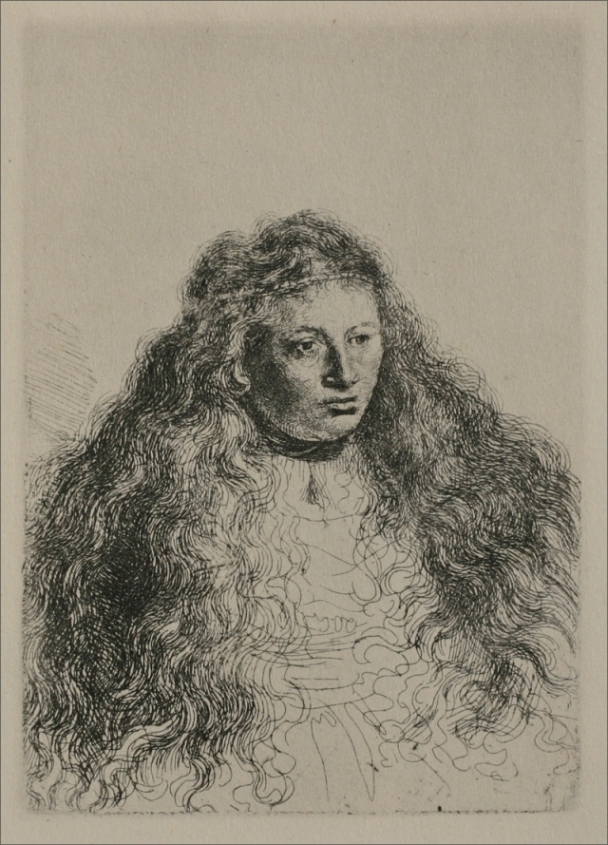
Rembrandt’s “Study of Jewish Bride” is an intimate etching that distills the power of portraiture into a handful of lines. The subject’s face appears calmly intent, set within a cascade of long, unbound curls that sweep outward in rhythmic waves. There is no narrative setting, no elaborate costume, no emblematic attributes—only a living head and the living line that conjures it. The work reads as a preparatory study, yet its economy and psychological acuity make it complete in itself. By harnessing the strengths of the etching medium—speed, delicacy, the capacity for tonal suggestion—Rembrandt turns a study into a revelation of presence.
A Study That Feels Like A Finished Portrait
Although titled a study, the image has the concentration of a finished portrait. The lower torso and garment are abbreviated with searching strokes, but the face and hair receive decisive attention. This purposeful imbalance allows Rembrandt to stage the performance where it matters: in the features and the mass of hair that frames them. The sitter’s gaze, directed slightly to one side, creates a subtle narrative of attention without committing to a specific story. The result is a sheet that bears the freshness of a sketch and the authority of a resolved likeness.
Composition Built From Ovals And Waves
The composition relies on simple geometry refined by touch. The head is an oval centered a little above the midpoint; the hair expands that oval into a larger, irregular shape that overlaps the page edges, giving the subject more-than-life presence. The face’s vertical axis counters the horizontal spread of the hair, establishing a stable cross that keeps the eye from drifting. A few lightly indicated curves suggest the bodice and sleeves, but they do not compete with the upward movement of the curls. This tension between stillness at the core and motion at the periphery energizes the sheet.
Etching As Drawing With Breath
Rembrandt’s handling of the copper plate feels like drawing with breath. Etched lines vary in pressure, density, and length to simulate value and texture. Around the eyes, nose, and lips he uses tight, short strokes to create half-tones that round the forms. Across the hair he switches to long, looping lines that swell and taper, a calligraphy of locks. Sparse hatchings in the background create a faint halo at the left, allowing the head to separate from the paper without enclosing it in a hard silhouette. Everywhere the line relays the sensation of a hand responding to a living sitter.
The Hair As A Landscape Of Line
The hair deserves its own reading, for it is the print’s most exuberant element. Rembrandt maps the mass not as a flat design but as terrain: valleys where lines bunch into dark groves, ridges where they part to reveal the whiteness of the paper, spirals that twist as if catching light. These variations imply natural sheen without requiring filled-in black or heavy tone. The hair’s abundance becomes more than ornament; it is a metaphor for vitality, for uncontained presence, for youth held in thoughtful restraint.
The Face And The Psychology Of Attention
The face is modeled with restraint and humanity. The sitter’s eyes are not ostentatiously large or sparkling; they are watchful, ringed by soft shading that suggests the slow work of looking. The nose bridges the central axis with quiet authority; the lips are closed but supple, poised between neutrality and speech. There is no smile, no frown, no theatrical gesture. Instead, Rembrandt offers the poised ambiguity of real persons—moods in the act of forming. This ambiguity invites viewers to project memory and feeling, thereby making the study a meeting rather than a display.
Light Without Wash
Remarkably, the sense of light is created almost wholly by the sparseness of line. Rembrandt leaves the paper untouched where planes would gleam—the crest of the cheek, the forehead’s center, the top lip—while deepening shadows with denser strokes at the temples, under the nose, and along the jaw. This practice keeps the face luminous and the print aerated; the page breathes. The few background strokes at the left function like a muted reflector, tilting light back toward the profile and preventing the head from dissolving into blankness.
The Title And Cultural Resonance
The traditional title “Study of Jewish Bride” places the sitter within Amsterdam’s vibrant seventeenth-century Jewish community, which Rembrandt knew well and represented often. Whether the model was in fact a bride is less crucial than the respectful, attentive way the artist records her. There is no exoticizing costume, no moralizing subtext—only the recognition of a particular, dignified person. The title thus frames the sheet as part of Rembrandt’s broader engagement with neighbors whose faces and stories enriched his art.
The Poetics Of Incompletion
Lower in the sheet, the garment dissolves into exploratory marks—loops, zigzags, and ghostly curves. This incompletion is not a failure but a strategy. By letting the body remain schematic, Rembrandt heightens the reality of the head. The viewer’s imagination supplies the missing fabric and posture, and in that mental completion the likeness becomes more intimate. The unworked areas also reveal process: the artist’s search, hesitation, and decision-making, which feel as alive as the subject herself.
Paper As Space And Time
The bare paper around the figure is not empty; it is the space she inhabits and the time in which she is seen. Etching’s crisp bite gives the lines a slight burr, which gathers ink and creates a microscopic shadow. These shadows knit the marks together into atmosphere. The sheet’s margins, untouched, behave like silence in which a voice can be heard. The print thus speaks quietly but clearly, relying on the whiteness of the page to carry light and on the viewer’s patience to let the image ripen.
A Study In Touch And Distance
The sitter’s face is rendered with intimate proximity, yet the gaze is not directed at us. This mixture—near but not addressed—produces a humane distance similar to that in many of Rembrandt’s prints of family, friends, and neighbors. We are allowed to be witnesses without becoming intruders. The effect is courtesy made visible: the artist keeps the model’s inwardness intact even as he invites us to behold her.
Kinship With Other Studies And The Jewish Bride Theme
Across Rembrandt’s oeuvre, studies of women—Saskia, Hendrickje, anonymous models—often emphasize hair, headgear, and the subtleties of expression over costume detail. This print aligns with that tendency. It can also be read in dialogue with the famed painting commonly called “The Jewish Bride,” where touch, texture, and inward feeling are paramount. In both, Rembrandt privileges relationship over spectacle, tenderness over display. The etching offers a quieter, earlier station on that road: a single head whose aura is built from line.
The Music Of Repetition And Variation
Look closely and the lines of the hair become musical. A repeated motif—long S-curves punctuated by shorter, kinked strokes—creates rhythm. Occasional reversals, abrupt dark pools, and sudden white reserves act like syncopations and rests. The face, with its shorter strokes, functions as melody. As the eye moves between face and hair, the print becomes a score performed in time, each revisit discovering new harmonics in the simplest means.
Material Honesty And Emotional Truth
One of Rembrandt’s lasting gifts is the alignment of material honesty with emotional truth. He does not disguise the etched line; he lets it show its scratch, its swelling and fading. That candor persuades us of the sitter’s authenticity. We trust her presence because we can trace the means by which she is made. This transparency is part of the artist’s ethics: render the world faithfully and the world will reveal its dignity.
How To Look, Slowly
Begin with the brightest planes of the face—the forehead and the tip of the nose—and let your eye slide to the near eye where tiny hatchings shape the lid. Drift down to the mouth, notice the softness of the upper lip, then step outward into the forest of curls. Follow a strand as it loops and separates, then returns to the mass; feel how the paper’s white opens like light among leaves. Retreat to the center and start again. Each circuit will yield a new inflection of mood: curiosity, calm, reserve, nascent joy.
The Study As A Teacher Of Drawing
For artists, the sheet is a manual in how to use minimal tools to maximum effect. It demonstrates how to model with line alone, how to imply volume through spacing and density, how to set a head into space without heavy backdrops, and how to suggest character with measured asymmetries—the slightly uneven eyes, the faint tilt of the mouth. For viewers, it teaches the possibility of empathy through looking: to attend carefully is to honor.
Enduring Relevance
The endurance of “Study of Jewish Bride” owes to its humility and precision. It asks little of the viewer beyond time and attention, and it repays both with a felt encounter. In a world frequently crowded with images of certainty, this print offers the grace of uncertainty—the awareness that people are more than any single expression can capture. That awareness is what makes Rembrandt’s studies inexhaustible. They return us to the fragile, resilient truth of seeing another person, not as type or symbol, but as a presence.
Conclusion
“Study of Jewish Bride” is a small work with large resonance. In a handful of etched lines Rembrandt composes a portrait that vibrates with life: the face watchful and self-contained, the hair expansive and lyrical, the paper luminous with the air of a shared room. The sheet bears the marks of a session—a living moment between artist and sitter—and it invites us, centuries later, into that same quiet moment. Its power lies not in completeness but in candor. We leave the print with the sense that we have not seen everything, and that is precisely why it stays with us.