Image source: wikiart.org
A Young Rubens Rehearses Majesty on Horseback
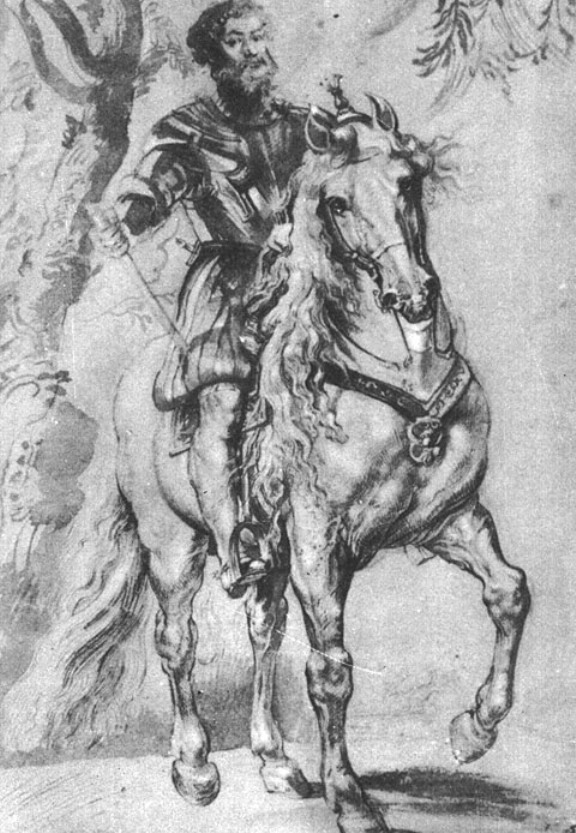
“Study for an Equestrian Portrait of the Duke of Lerma” (1603) places a powerful rider at the center of a controlled storm of motion. The sheet shows a bearded nobleman in armor seated on a high-stepping stallion, the horse’s foreleg lifted in a proud passage while the rider turns his torso and head to acknowledge an unseen audience. Although made as a preparatory work, the study reads like a complete performance. Peter Paul Rubens uses the quicksilver speed of chalk and wash to test how sovereign presence can be forged from anatomy, gesture, and the choreography of horse and man. The image is a laboratory for ideas that would define his court art for decades: the equestrian portrait as a stage where politics, ceremony, and animal prowess fuse into a single emblem of rule.
Political Horizon and Patronage
In 1603 Rubens was working for the Gonzaga court in Mantua and traveling as an emissary-painter across Italy and Spain. Francisco Gómez de Sandoval y Rojas, Duke of Lerma, served as the all-powerful valido—chief minister and favorite—of Philip III of Spain. A grand equestrian portrait suited the duke’s ambitions perfectly. Such images translated administrative authority into knightly charisma, placing the favorite in the visual lineage of emperors and generals. This study probes the formula while keeping the immediacy of a drawing from life. We feel Rubens sounding out how far he can push ceremony toward vitality without losing clarity of rank.
The Concept of the Equestrian Image
Since antiquity, rulers on horseback have signaled command over space, speed, and force. In Renaissance and early Baroque Europe, the equestrian portrait became a diplomatic currency: Titian’s “Charles V at Mühlberg,” the Florentine bronzes of Gattamelata and Colleoni, and countless festival prints put the sovereign’s legitimacy on four legs. Rubens inherits this tradition and makes it more theatrical. The horse does not merely carry; it collaborates. The rider does not merely sit; he conducts. The space around them is not background; it is the idea of a court, a battlefield, or a triumph distilled to air and foliage. The study distills that ethos to essentials, aligning Lerma’s public identity with equine cadence.
Composition as a Moving Pyramid
Rubens organizes horse and rider into a pyramidal mass that leans slightly forward, as though the pair is about to glide into a parade turn. The horse’s lifted foreleg provides the pyramid’s forward point; the rider’s head completes the upper vertex. Diagonals drive everything: the incline of the horse’s neck, the swerve of the reins, the oblique of the rider’s baton or staff. The background is barely indicated—flickers of tree and sky—so that the entire field reads as staged air. This compositional economy keeps the eye where it belongs, on the conversation between face, armor, and horseflesh.
The Horse as Co-Protagonist
Rubens’s equine knowledge is practical as well as poetic. The stallion’s poll flexes, nostrils flare, lips foam, and ears angle forward in keen attention. The lifted knee and rounded cannon bone indicate a collected gait—an elegant controlled passage rather than a frantic gallop. The chest is modeled with swelling planes that catch light as if the horse were carved from living marble. Flowing mane and tail become visual music that softens the armor’s hard geometry. This is not a generic charger. It is a trained court horse whose learned movements mirror the courtier’s cultivated gestures. By giving the animal agency—expressive head, purposeful legs—Rubens elevates the image from transport to partnership.
The Rider’s Physique and Armor
Lerma sits deep and square, the heels down and knees secure, projecting a command that looks effortless. The armor is drawn with beaded rims and swelling pauldrons, then simplified into broad tonal fields so the body reads quickly at a distance. The breastplate turns the torso into a polished instrument that registers light in long, convincing chords. The baton declares command, but Rubens avoids theatrical flourish; the hand relaxes, fingers naturally curved, as if the duke knows the authority of his presence and needs no emphatic punctuation. A beard frames the face, and the head tilts slightly to accept acclamation—neither aloof nor ingratiating. The portrait becomes a psychology lesson in power worn comfortably.
Medium and Touch: Chalk, Pen, and Wash
Executed in black chalk reinforced by ink and wash, the study shows Rubens inventing form at speed. He establishes the horse with confident contour, then breathes volume into the chest and hindquarters using wet, translucent passages. Hatchings harden where structure must be felt—fetlocks, cheekbones, the bead of the armor’s rim—while stumped transitions soften with atmospheric grace. White heightening may once have kissed the highest lights, now mellowed by age, but the overall effect remains electric. Because the sheet is a study, revisions are visible: a shifted hoof, a reconsidered curl of mane, a denser line along the reins. These palimpsests of decision give the drawing kinetic authenticity, a sense that we are witnessing the picture learn to be itself.
Light and Chiaroscuro for Open Air
Even in monochrome, Rubens organizes a believable world of light. It descends from above and ahead, catching the convex armor and the domed skull of the horse, sliding down the neck in broken increments, and pooling in the shadow cast by the lifted foreleg. The tonal map tells us the scene is outdoors without needing a sky. Leaves hinted at the upper margin nod in the same direction as the light, like courtiers bowing when their sovereign passes. By tethering highlights and shadows to the turn of forms, Rubens ensures that motion reads as space rather than blur.
Gesture as Social Language
Every equestrian portrait is a dictionary of gestures. Here the horse’s step means courtly self-possession; the baton’s angle implies authority calmly exercised; the rider’s slight bend toward the viewer signals availability to petition without surrendering distance. Rubens calibrates these social signals with diplomatic tact. Nothing pleads, nothing threatens. The balance between nearness and loft defines the favorite’s political survival. The picture captures that balance in anatomy: hips squared to the saddle, shoulders open to the viewer, chin lifted just enough to keep the air of command.
Heraldry and Emblems Understated
Rubens keeps explicit heraldry to a minimum, perhaps because this is a working sheet. Yet he allows the tack to carry hints of status: medallions at the breast strap, a rosette, the careful finish of bridle leather. The armor’s scalloped edges and the baton’s finial announce luxury without screaming lineage. In the finished oil these signs would multiply—ribbons, plumes, banners—but the study’s restraint clarifies the essential emblem: the noble body in concord with a noble horse.
The Duke of Lerma as Image Strategist
Lerma understood the currency of spectacle. Court festivals, entries, and portraits built the visual scaffolding of his power. An equestrian portrait, in particular, insulated him from charges of mere bureaucratic cunning by anchoring his image in knightly tradition. Rubens’s study readies that transformation. By giving the favorite the public virtues of courage and mastery, the painter equips a controversial statesman with the optics of chivalry. That the horse obeys with exquisite control metaphorically guarantees the realm’s obedience to the duke’s guidance.
Italian Lessons, Spanish Gravity, Flemish Clarity
The study demonstrates how Rubens synthesizes three pictorial dialects. From Italy he takes the classical control of movement and the sculptural rendering of anatomy learned from antique marbles and Renaissance bronzes. From Spain he borrows gravity—an almost religious sobriety in the rider’s face and the horse’s collected energy—that suits Habsburg taste. From Flanders he brings observational exactitude and a love of material textures, evident in the soft muzzle, the bridle hardware, and the spring of curls in the mane. The blend yields an image at once cosmopolitan and precise.
The Horse’s Head as Emotional Pivot
The stallion’s face is the sheet’s most delicate accomplishment. The eye is large and alert, the nostril open, the tender skin of the muzzle indicated with sparing, velvety tones. A small highlight on the eye glints like a thought. The head tilts inward as if checking the rider’s hand, illustrating a dialogue that equestrian portraits often ignore. Where some artists freeze the animal into mere pedestal, Rubens grants it responsive intelligence. The viewer intuits that the rider’s invisible aids—seat, calf, rein—are being answered in kind. Political harmony is thus dramatized as horsemanship.
The Baton and the Idea of Command
In equestrian imagery the raised baton can mean many things: direction of troops, orchestration of a cavalcade, the decisive moment in a hunt. Here the baton is neither vertical nor brandished; it slants with the horse’s motion, amplifying the diagonal thrust of the picture and reading as a conductor’s wand. Command becomes rhythm rather than blow. The duke governs not by dramatic stroke but by steady tempo, and the horse keeps time.
Foliage and the Stage of Power
Rubens allows tree trunks and leaves to enter as counterforms, soft echoes that reassure us this public appearance occurs in a park or along a ceremonial approach. The leaves’ quick wisps rhyme with the horse’s mane, and the trunk’s verticality stabilizes the forward lunge of the composition. The setting is not narrative; it is an acoustic shell that improves the projection of sovereignty. The court will hear and see better because the world itself seems to frame the favorite.
Comparisons and Anticipations
Comparing this study to Rubens’s later oils clarifies its function. In fully realized equestrian portraits—of rulers, commanders, and saints on horseback—Rubens expands the stage, deepens the sky, and saturates color, but he keeps the essential grammar intact: diagonal energy, collaborative horse, psychological presence. The Lerma sheet is a seed crystal. It anticipates the bravura of later equestrian triumphs while preserving the intimacy of experiment. The sheer confidence of the line suggests that a composed oil was more than possible; it was inevitable.
Anatomy, Proportion, and Truthfulness
The horse’s massing is persuasive because Rubens builds it from first principles. Shoulder blade, withers, barrel, and hip lock together as a machine designed for impulsion. The fetlocks carry weight correctly; the raised hoof shows the flexion associated with collected gaits; the far hind leg steps under the center of gravity. Likewise, the rider’s pelvis is oriented correctly in the saddle, not perched on the cantle or thrust forward awkwardly. Such anatomical honesty underwrites the portrait’s authority. Viewers trust what is true in their bodies, even if they do not name it.
The Ethics of Splendor
Equestrian portraits flirt with vanity. Rubens answers that risk by letting dignity arise from discipline. The animal works; the rider sits with composure; the baton directs without vainglory. The study’s monochrome sobriety keeps splendor from becoming self-indulgence. It also models a virtue valuable to powerful men: measure. Nothing is too much. This balance explains why Rubens’s equestrian images still persuade modern eyes that are skeptical of courtly display. The drawing argues that beauty can be a form of self-command.
From Study to Statecraft
Though intimate, the sheet is a political tool. It tests legibility at scale, determines where insignia or banners might sit in a finished canvas, and settles the relation of face to horse to baton so that the message reads instantly at viewing distance. It is statecraft by pencil. In its brisk rehearsals we glimpse the machinery that turns a favorite’s desire for fame into a visual fact capable of traveling across courts and decades.
Why the Drawing Endures
The study remains compelling because it captures a compact truth: power is choreography. Horse and rider align, light and shadow conspire, diagonals agree, and from that agreement rises the persuasive fiction of rightful rule. Rubens shows how that fiction is made, not by mystification but by mastery—of drawing, of anatomy, and of the social theater of gesture. Even without color, the image glows with confidence. Even without a crowd, it resounds with applause.
Conclusion: Authority in Motion
“Study for an Equestrian Portrait of the Duke of Lerma” is a young master’s lucid exercise in turning motion into majesty. Rubens choreographs a trained horse and an armored favorite into a single emblem that moves and reigns at once. The drawing’s lines are quick, but their intelligence is durable. We see a painter testing how sovereign grace sits in a saddle, how a baton conducts a city, and how the rhythm of hooves can translate policy into spectacle. Out of chalk whorls and washes he forges a prototype of Baroque authority—elegant, kinetic, and assured.