Image source: wikiart.org
Introduction
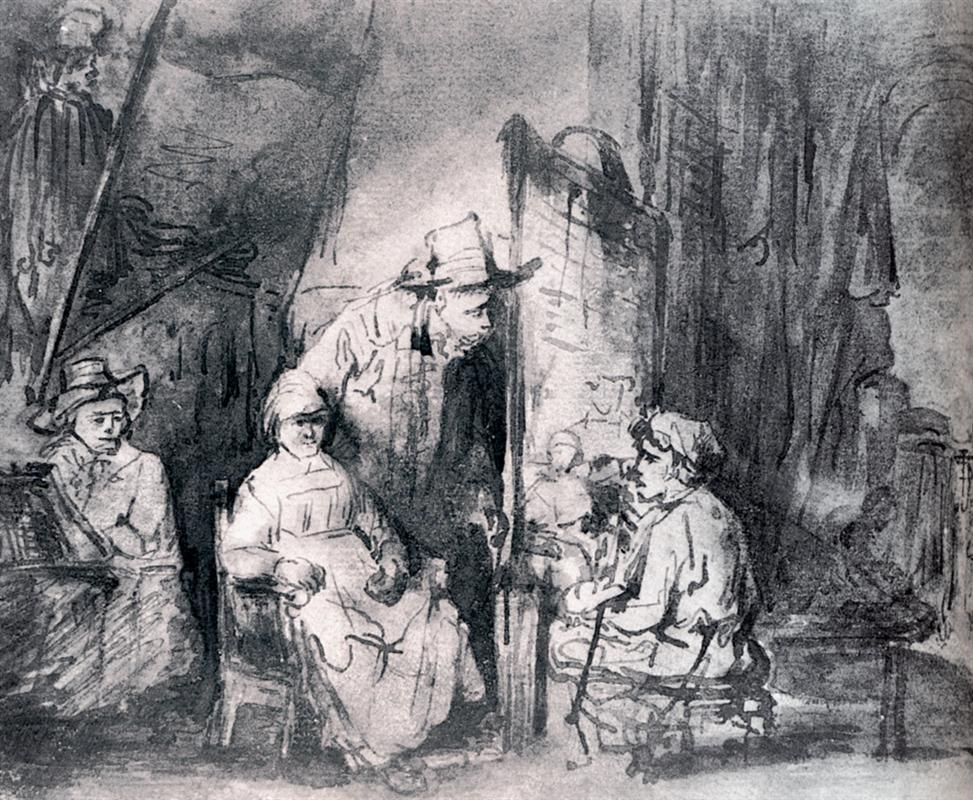
Rembrandt’s “Studio Scene With Sitters” (1650) is one of those rare images where the workshop becomes the subject, the act of depiction turns back on itself, and the people who normally serve a painting—model, master, assistant, visitor—step onto the stage as characters in their own right. Executed in a supple mixture of chalk, ink, and wash, the drawing opens onto a dim, cluttered studio in which multiple figures occupy pockets of light. A seated woman and a boy settle into chairs; a man in a tall hat bends forward to speak; a second sitter turns three-quarters to the left; in the half-glimpsed depths, draperies, canvases, and scaffolds thicken the air. The picture reads like a rehearsal for seeing: poses tried, conversations begun, lights tested, patience measured. It is a portrait of process.
The Workshop as Theater
Rembrandt stages the studio like a small playhouse. At the left, a seated figure beside a table or easel occupies the “musician’s pit,” providing a low hum of activity. Center stage belongs to the near sitter, whose body settles into the broad chair while her hands and bonnet catch a shaft of light. The standing man leans in as if to direct or reassure, his hat brim and shoulders enclosing her in a private proscenium. To the right a second sitter anchors a counter-scene, glancing toward the exchange with a half-smile, cane or mahlstick in hand, as if used to the rhythms of waiting. Behind them all, the curtain of studio drapery and the verticals of stretched canvases create a deep, shadowy backdrop—the wings from which other roles could enter at any moment. The composition acknowledges that every painting session contains several simultaneous dramas: the painter’s search, the model’s endurance, the conversation that keeps time, the play of light that decides everything.
Composition and the Geometry of Attention
The drawing is knit together by three structural diagonals. One runs from the left foreground figure through the leaning man and into the luminous gap between the two principal sitters. A second flows from the bright cap of the seated woman down the forward edge of her dress to a foot that angles toward the right sitter. The third climbs along the right sitter’s profile and cap up into the column of drapery that towers behind. These lines triangulate the center, where Rembrandt leaves a breathing space of paper. The eye moves in a looping circuit—left figure to leaning man to woman to right sitter and back again—gathering meaning from orientation and glance. This is a classic Rembrandt maneuver: create an empty center where interactions take place and let surrounding masses of tone and line declare the weight of bodies and things.
Light, Wash, and the Weather of the Studio
Light in this sheet is not a single beam but a soft system. Washes pool into shadows under chairs, behind the curtain, and along the edges of canvases; then Rembrandt spares paper for the high points of faces, caps, hands, and a sliver of floor. The result is a humid, breathable atmosphere—exactly the feel of a working studio with windows high and north-facing, where daylight fans out rather than knifes in. It is hard to say where the principal source sits; the drawing reads instead as light remembered and re-distributed to serve character. The voice of the wash is gentle but persuasive: it gives bodies weight, binds figures to their seats, and lets the chalk’s quick edges soften into skin and cloth.
People, Postures, and the Psychology of Making
Rembrandt is unsentimental about the emotional mechanics of a sitting. The woman at center shows the look of someone settling into a long task: shoulders gently set, hands quiet, eyes not yet fixed on a single point. The leaning man—perhaps the painter himself or an assistant—bends from the waist with the alert kindness of someone coaching a pose or making a small joke to ease stiffness. The right sitter turns toward the group but not fully into it; he belongs to the session yet remains himself, a person with his own thoughts whose compliance doesn’t erase individuality. Even the shadowy figure at left, absorbed by a book or ledger, contributes to the mood: the workshop is a place where several kinds of attention coexist. Everyone is working, even when still.
The Screen Within the Studio
Behind the leaning man sits a screen or large vertical panel. Its silhouette, hat perched on top, functions like a hinge between the two sitters and like a reflector for light. In studios of the period, such screens were movable walls that shaped light, shielded drafts, and provided a neutral, continuous background for modeling form. Rembrandt seizes on the object’s theatrical potential: it serves as the set line where conversation divides and joins; it allows him to stage the central man half in front, half against; and it gives him a backing for the delicate halo of light that outlines faces. That simple flat plane is the drawing’s quiet engine.
Drapery, Canvases, and the Texture of Work
Studio draperies are not mere decoration. Their deep folds absorb stray highlights, making the faces and hands in the foreground glow. The stacked canvases and frames—suggested by quick verticals and crossbars—push the main action forward and remind us that the drawing is one article in a long chain of production. Rembrandt’s line becomes different in these zones: broad, summary, almost impatient, as if to say “we know what these are; let’s keep our attention on people.” Yet the textures register accurately—the stiff scratch of canvas weave, the dull shine of wood, the slightly greasy drape of a curtain held open by cords. Everything in the studio has a job; everything’s wear explains itself.
The Handwriting of the Drawing
Across the sheet, the mark-making shifts registers according to need. Faces and hands receive tender, open lines; garments get squalls of hatch and zigzag that collect into believable folds; chairs are all right angles and quick arcs; and the floor bears scrubbed passages of tone that gather weight under furniture. Certain contours—like the leaning man’s hat brim, the outline of the woman’s sleeves, and the right sitter’s profile—are stated once, with a kind of calligraphic decisiveness. These set the drawing’s tempo. Elsewhere, Rembrandt nosedrops lines, rephrases a contour, or lets a wash bloom wider than expected. The eye recognizes this as living thinking: the artist is discovering, not transcribing, the scene.
The Studio as Social Space
What makes the drawing unusually compelling is the way it treats the workshop as a social organism. Hierarchies exist—the standing figure directs; the sitters comply—but the atmosphere is companionable rather than authoritarian. The group feels like a team mid-routine, not strangers arranged for display. That social tone is key to Rembrandt’s mature art. In paintings like the “Syndics” or the “Jewish Bride,” he converts ceremony into relationship and replaces spectacle with understanding. This drawing is the rehearsal for that effect: people find their positions relative to light and one another until the picture’s mood clicks.
Time Inside the Image
The sheet captures a moment between actions. The woman is nearly settled; the right sitter is not yet fixed; the leaning man has just entered the frame of the screen and will straighten in a heartbeat. Such “between-ness” is a hallmark of Rembrandt’s storytelling. He loved the instant when anxiety loosens into trust, when a body commits to a pose, when attention moves from chatter to seeing. Lavish paintings can stage such a transition with abundant means; here, a handful of silvery tones and a few strokes suffice.
The Question of Identity
Who are these people? The drawing refuses specific identification, and that refusal is part of its power. Rather than record named patrons or famous models, Rembrandt creates a type: the community of the studio. Any workshop day could supply figures like these—the neighbor pressed into sitting, the apprentice lending a hand, the friend visiting, the master arranging. The anonymity keeps the image general enough to stand for the practice as a whole while remaining specific in gesture and mood.
Light as Ethical Choice
The drawing’s lighting is kind—nowhere harsh, nowhere flattering. It grants visibility but withholds glare. This is not incidental. For Rembrandt, the ethics of portraiture begins in the ethics of light: to see enough to tell the truth, not so much as to make people brittle. The central glow that catches the woman’s cap and the leaning man’s cheek achieves exactly that balance. Even the deepest shadows dissolve at their edges into legible form, as if the studio were a society arranged for empathy.
Lessons in Looking
“Studio Scene With Sitters” teaches you how to look at pictures. You find yourself noticing the little negotiations that make an image: where hands rest to avoid fatigue, how a head is angled to catch an honest plane, how a background is simplified to keep attention on the right thing. You sense how much of painting is logistics—chairs positioned, screens trimmed, light adjusted—and how these logistics become invisible in the final work. By exposing the scaffolding of representation, Rembrandt increases our respect for the finished image without mystifying it.
Kinship with Other Workshop Images
Throughout his career Rembrandt returned to the theme of the artist at work—self-portraits with palette, etchings of draughtsmen before a nude, scenes of collectors and connoisseurs handling prints. This 1650 sheet aligns with those investigations but shifts focus from the solitary maker to the ensemble. If earlier works advertised skill, this one honors the ecology of making. The studio is a commons where multiple kinds of skill—patience, directing, adjusting, waiting—combine to coax the image into being.
The Studio as City in Miniature
Few spaces condense the civic habits of the Dutch Republic as neatly as a seventeenth-century studio. It is a place of contract (commissions), of guild regulation (training and standards), of commerce (sales and materials), and of negotiation (between likeness and ideal, between time and budget). Rembrandt’s drawing compresses that civic complexity into a single room where speech, labor, and beauty share a table. The screen becomes a town gate; the drapery, a public hall; the sitters, citizens; the leaning man, an alderman of light.
Humor, Warmth, and the Human Tone
Look at the tilt of the central hat, the slightly exaggerated lean toward the sitter, the way the right sitter’s posture says “I’ll be here awhile.” There is humor here—the affectionate recognition that posing is both noble and faintly ridiculous. Rembrandt does not mock; he smiles with. That warmth keeps the drawing from becoming an academic document. It is a human record of people making a picture together, and it leaves the viewer with the same feeling one has after stepping out of a good rehearsal: gratitude for shared effort and eagerness to see the performance.
Technique as Metaphor
The mixture of media—firm chalk, wandering ink line, dissolving wash—mirrors the workshop’s variety of roles. Chalk is the sitter’s patience: steady, matte, enduring. Ink is the director’s line: a decisive contour that says “here.” Wash is the social mood: the glue of conversation and time that binds the session into a whole. Rembrandt lets the media overlap, stain, and correct one another until the page behaves like the studio it depicts—disciplined yet porous, structured yet alive.
What the Image Offers Today
For contemporary viewers, the drawing proposes a counter-image to solitary genius. Art emerges here from community, from care, from adjustment after adjustment. In a culture that loves finished products, the sheet defends process; in a market that prizes spectacle, it honors quiet; in a time that often flattens subjects into roles, it shows how roles can be played with grace. If you have ever sat for a portrait, taught a class, or worked on a team, you recognize yourself in this small republic of making.
Conclusion
“Studio Scene With Sitters” is a meditation on how images come to be. Within a modest room, Rembrandt gathers a handful of people and lets light discover their roles. There is no velvet rhetoric, no grand gesture—only a poised screen, a leaning figure, two patient sitters, and the deep fabric of a working space. Out of these, the artist composes a lesson in attention and fellowship. We leave the drawing with sharpened eyes and a clarified sense that the best art is not only seen; it is shared—among those who pose, those who guide, and those who look.
