Image source: wikiart.org
Introduction to “Studies of the Head of a Negro”
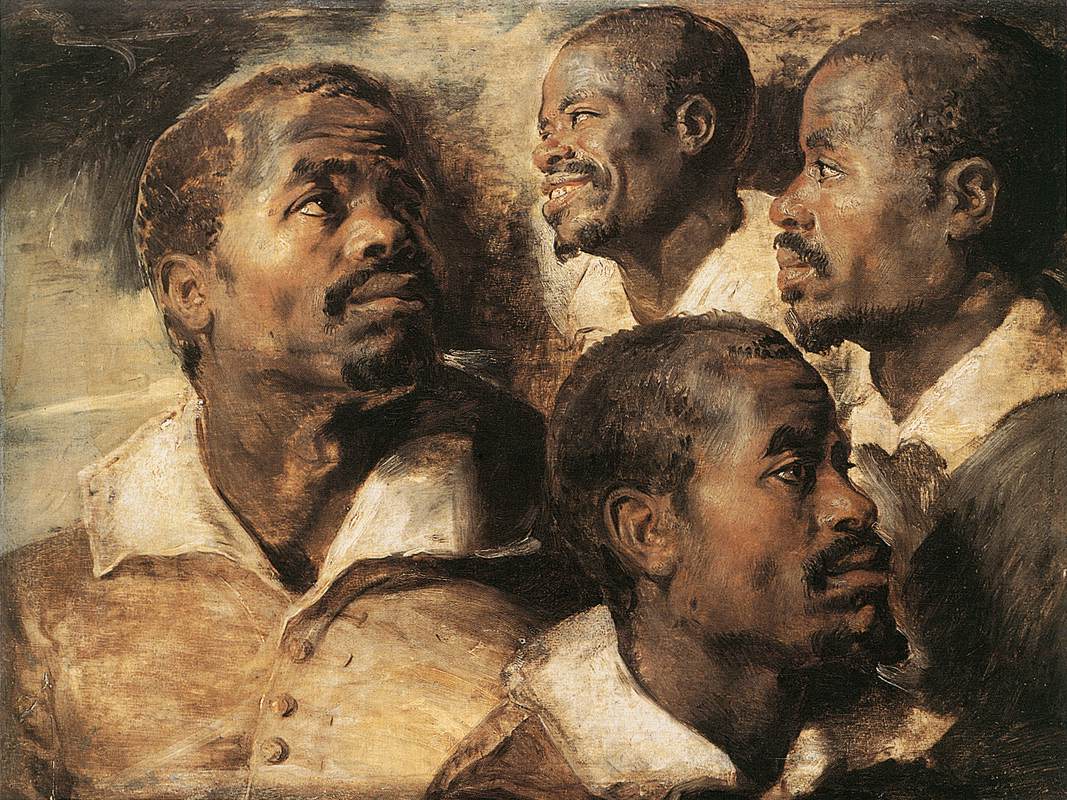
“Studies of the Head of a Negro,” a work historically attributed to Peter Paul Rubens, is one of the most compelling and complex images in his surviving oil sketches. Rather than presenting a polished narrative scene, Rubens fills the panel with multiple views of the same sitter, a Black man in a simple shirt with an open collar. His head appears from different angles and in different expressions: pensive, smiling, attentive, and thoughtful. The painting feels intimate and immediate, as if we are watching Rubens work through visual ideas in real time.
Although small in scale, the sketch carries enormous artistic and historical weight. It reveals how Rubens studied the nuances of human expression, how he handled paint in a rapid and exploratory way, and how a Black sitter could occupy a central role in the creative process of a major Baroque master. At the same time, the historical title reflects language and attitudes very different from those of today, reminding us that this image comes from a world deeply entangled with colonialism and the slave trade.
Historical Context and the Problem of the Title
The work is generally dated to the early seventeenth century, when Rubens was at the height of his career in Antwerp. At that time the port city was a crossroads of global trade, and people of African descent were present in European ports, courts, and households in a variety of roles, including servants, sailors, soldiers, and sometimes enslaved people. Artists encountered Black sitters in daily life as well as in religious and allegorical commissions.
The traditional title, “Studies of the Head of a Negro,” uses terminology that is outdated and can be painful today. It reflects the language of early modern Europe rather than contemporary respect for racial identity and personhood. When discussing the painting now, many scholars refer to it as studies of a Black man or a Black sitter, while acknowledging the historical wording as part of its provenance.
This tension between past and present is important to keep in mind when viewing the painting. Rubens’s artistic attention to the sitter’s individuality and expressive range seems, at first glance, to affirm his humanity in a way unusual for the period. Yet the fact that the man’s name and life story are unknown, while his image is cataloged under a generic racial label, also reveals the limits of that recognition. The painting thus offers both a powerful portrait and a reminder of the unequal structures that shaped its creation.
Composition and the Multiplicity of Views
The first thing viewers notice is the unusual composition. Instead of a single, centered portrait, Rubens scatters five studies of the sitter’s head across the panel. One large head dominates the left side, looking upward with a serious, almost searching expression. On the right, three overlapping profiles and three quarter views create a rhythmic cluster that suggests movement and conversation. In the lower center, another head in profile faces right, forming a subtle diagonal with the principal head at left.
The spacing is informal, as if Rubens added each study wherever there was room. Yet there is an underlying structure. The large head on the left anchors the composition, while the smaller ones to the right balance its weight. The sitter’s gaze moves in various directions: up toward the unseen light source, sideways toward an implied interlocutor, and forward into the shallow space of the painting. This multiplicity of viewpoints gives the sketch an almost cinematic quality, presenting different “frames” of the same person.
By repeating the head from several angles, Rubens explores how features change with position and emotion. The tilt of the chin, the stretch of the mouth in a smile, and the shift of light across the brow are all carefully observed. These variations would have been invaluable for later use in larger compositions, where a single Black figure might need to appear in different poses. The sheet thus functions both as a portrait and as a reference tool in the artist’s studio.
Light, Shadow, and the Handling of Paint
Rubens’s mastery of light and shadow is evident even in this rough study. A strong light source, likely coming from above and to the left, falls across the sitter’s face, catching the bridge of his nose, his cheekbones, and the top edge of his forehead. Areas not reached by light, such as the jawline and eye sockets, sink into deep, warm shadow. This interplay of illumination and darkness sculpts the head and gives it a powerful three dimensional presence.
The paint itself is handled with brisk, energetic strokes. In some areas, especially the background and parts of the clothing, the ground of the panel show through, giving the image a sketchlike quality. Rubens uses a limited palette of browns, ochres, blacks, and whites, relying on tonal contrast rather than bright color. The sitter’s shirt is rendered with quick touches of white that suggest folds and buttons without fully describing them.
On the faces, however, Rubens’s brushwork becomes more deliberate. The texture of the skin is conveyed through subtle modulation rather than meticulous detail. Highlights on the lips, the glint of moisture in the eyes, and the sheen on the forehead are all suggested with economical strokes. Even in this experimental format, Rubens manages to capture the specific quality of the sitter’s hair, the softness around his mouth, and the tautness of muscles when he smiles or looks up.
Expression, Personality, and Psychological Depth
One of the most striking features of the painting is the range of expression Rubens records. The large head at left seems thoughtful and a little wary, eyes lifted as if listening or searching for something beyond the frame. The head at the top right looks to the side with a broad, open smile, revealing teeth and creases around the eyes. Another nearby profile appears calmer and more introspective, lips closed, gaze directed toward some invisible point.
In the lower studies, the sitter’s expression becomes more neutral, but not blank. The tilt of the head, the set of the jaw, and the faint lift of the eyebrows give each view a distinct emotional tone. Rubens avoids caricature. He does not exaggerate features to create a stereotype. Instead he reveals how subtle shifts in posture and line can suggest very different inner states.
This psychological nuance is one reason the sketch feels so contemporary. Where many early modern images of Black figures treated them merely as exotic accessories or generic types, Rubens here explores the complexity of an individual. The man comes across as intelligent, alert, and self possessed. The variety of expressions, from seriousness to joy, hints at a full interior life that cannot be reduced to a single trait.
A Working Study and Rubens’s Studio Practice
“Studies of the Head of a Negro” belongs to a broader category of Rubens’s oil sketches and head studies, which he used as visual archives for future compositions. Working in oil rather than chalk or ink allowed him to test color, light, and surface effects under conditions closer to those of finished paintings. Because the sketch was intended for studio use, he could work more freely, leaving visible traces of the creative process.
In large narrative works, Rubens often included one or more Black figures: as soldiers, attendants, kings, or allegorical personifications. Rather than relying on generic formulas, he drew on specific studies like this one to give those figures convincing individuality. Some scholars have suggested links between this head and Black figures in his Adoration of the Magi or other multi figure scenes, although exact correspondences are difficult to prove.
The painting also offers insight into how sitters might have interacted with artists in informal contexts. The man appears relaxed, even playful in the smiling view, suggesting that the session was not purely hierarchical. While the power dynamics of seventeenth century Europe cannot be ignored, the sketch hints at a moment of collaboration in which the sitter could experiment with different expressions and poses, shaping the image alongside the painter.
Representation of Black Figures in Baroque Europe
To fully appreciate the significance of this work, it is important to place it within the wider history of Black representation in European art. In many images from the period, Black individuals appear in subordinate roles or serve to emphasize the status of white sitters. They are frequently exoticized, their presence signaling wealth, global connections, or biblical themes such as the Adoration of the Magi.
Rubens certainly participated in this visual tradition, but his studies show a desire to render Black sitters with the same attention to realism and character that he gave to any other model. The different angles and moods in this painting resist the idea of a single, fixed “type.” Instead, they suggest that Black faces are as varied and nuanced as any others.
This does not erase the historical context of colonial expansion and racial hierarchy, yet it complicates it. “Studies of the Head of a Negro” occupies a space where artistic curiosity, individual presence, and systemic inequality intersect. For modern viewers, acknowledging this complexity can deepen rather than diminish the work’s impact. It becomes a document not only of Rubens’s skill but also of the lives and bodies that contributed to European art while often remaining unnamed in its records.
The Viewer’s Position and Ethical Looking
Contemporary viewers approaching this painting may experience mixed emotions: admiration for Rubens’s artistry, interest in the sitter’s vivid personality, and discomfort with the historic title and the anonymous status of the man portrayed. This mixture can be a productive starting point for reflection.
The painting encourages close looking. The multiple heads invite the viewer to compare, to trace lines of light and shadow, to notice tiny differences in expression. As we do so, we become aware of how the sitter’s humanity emerges through the very act of attentive observation. At the same time, we must recognize that our gaze is shaped by histories of racial representation and inequality.
Ethical looking in this context means honoring the sitter as more than a subject of artistic experimentation. It involves imagining his possible experiences, acknowledging that his likeness has been preserved while his name has been forgotten, and considering how contemporary language and perspectives might differ from those of his time. By holding all of this in mind, viewers can engage with the painting in a way that respects both its artistic brilliance and its historical complexities.
Legacy and Contemporary Relevance
In recent decades, “Studies of the Head of a Negro” has attracted renewed attention from art historians, curators, and audiences interested in the presence of Black people in early modern Europe. The painting challenges the assumption that Black figures in old master works are always marginal or stereotyped. Here a Black man is central, his shifting expressions the sole focus of the artist’s exploration.
The work also speaks to broader discussions about representation and visibility. Museums and scholars are increasingly working to identify and tell the stories of people of African descent who appear in European art. Although the sitter’s identity remains unknown, his image provides a powerful starting point for research into the networks, professions, and communities of Black individuals in Rubens’s Antwerp.
For contemporary artists, the painting offers an example of how close study of a face can open up questions about personhood, power, and memory. Some have responded by creating works that reimagine or reinterpret Rubens’s study, inserting modern subjects or reclaiming the sitter’s agency. In this way, a seventeenth century sketch continues to generate new visual and intellectual conversations.
Conclusion
“Studies of the Head of a Negro” is far more than a technical exercise. It is a concentrated encounter between painter and sitter, captured in multiple views that reveal both the physical structure and emotional nuance of a Black man in Baroque Europe. Through dynamic composition, subtle handling of light and shadow, and expressive brushwork, Rubens presents a figure who is observant, thoughtful, joyful, and complex.
At the same time, the painting’s historical title and the anonymity of the sitter remind us of the inequalities that shaped its creation. Engaging with the work today means paying attention to both its artistic achievements and its place within a history of racial representation. When we look closely, we see not only Rubens’s virtuosity but also the traces of a real person whose presence continues to challenge and enrich our understanding of the past.