Image source: wikiart.org
Introduction
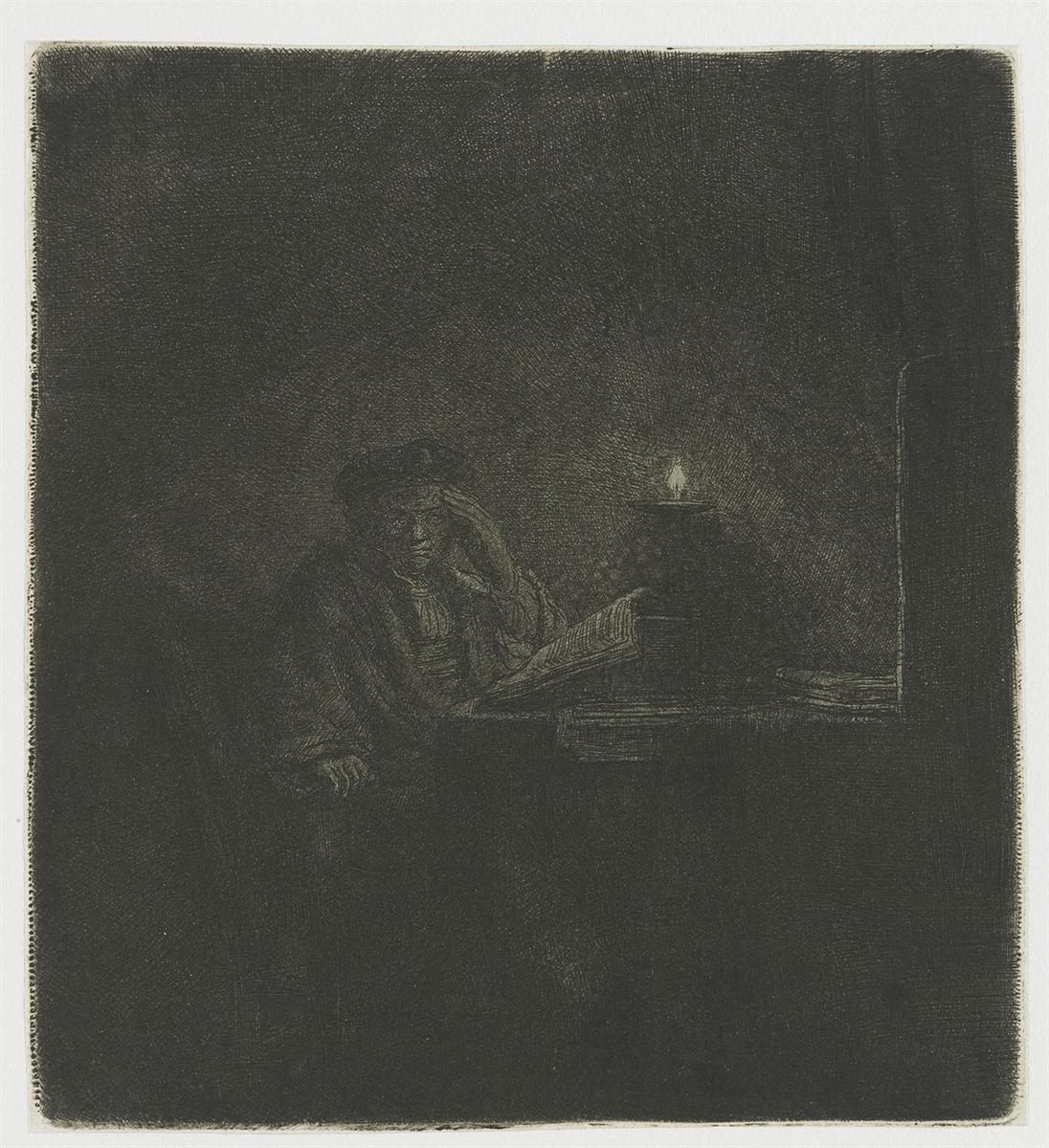
Rembrandt’s “Student at a Table by Candlelight” (1642) is a nocturne of thought. In a rectangle nearly swallowed by darkness, a single candle opens a small island of visibility around a young scholar who sits with one hand to his temple and a folio spread across the table. The print is an etching strengthened with drypoint and rich plate tone, and Rembrandt uses those resources to turn ink into weather. Everywhere else the paper is night; where the candle breathes, lines quiver into legible forms—face, sleeve, open page, the squat candlestick itself. The scene is quiet but not still. It vibrates with the rhythms of reading, with the breath of someone who has stayed up too long and cannot stop.
The Choreography of Darkness
Much of the composition is taken up by a dense field of tone that reads as room and air rather than a simple black. Rembrandt achieves this by leaving a thin, velvety film of ink on the plate when printing. That plate tone lends the darkness a physical presence, so the viewer experiences night not as a flat backdrop but as atmosphere through which light must push. The candle’s globe of illumination does not erase the dark; it negotiates with it. The student’s body sits right at the edge of legibility, his shoulder dissolving into the background even as his hand, cheek, and page catch pale glints. The image thus teaches us a visual grammar: knowledge appears in halos; beyond them the unknown persists.
Composition and the Physics of Attention
Rembrandt compresses the narrative into the lower right quadrant of the plate. The candle stands slightly off-center on a small stand; just below, the open folio jogs diagonally toward the viewer; to its left, the student’s head leans into his hand. This compact triangle—flame, page, face—maps the intellectual circuit of the scene. Light leaves the candle, strikes the page, and returns to the face as understanding. The rest of the sheet is negative space that performs positive work: it mutes distractions, increases the distance between viewer and subject, and makes the small pool of light feel precious. The composition is therefore both dramatic and ethical, staging concentration and asking the viewer to respect it.
Etched Line, Drypoint Burr, and Plate Tone
The print is a demonstration of how different intaglio techniques can collaborate. Etched lines describe the forms within the light: the wavy border of the page, the planes of the scholar’s forehead, the rucked folds of sleeve. Drypoint—scratched directly into the copper—adds velvety, burr-rich accents in the deepest shadows near the figure, thickening the night around him. Plate tone, left intentionally on the surface during printing, unifies everything with a soft haze. Rembrandt does not overdraw. He lets a few lines, strategically placed, do the heavy lifting and allows the inky atmosphere to supply the rest. The result is not illustration but apparition.
The Candle as Actor and Emblem
The candle is both prop and protagonist. Its flame is a tiny, pointed almond of white surrounded by a fuzzy halo of dotted bites; its stubby body sits in a low stand textured with dotted marks that suggest hammered metal. More than a source of illumination, the flame is a metaphor for the mind’s spark—fragile, provisional, yet stubbornly present. It also measures time. Wax implies duration; the drip marks and height of the stub suggest hours already burned. The student’s exhaustion has a correlate in the candle’s fatigue. Together they enact the evening’s economy: light is spent to purchase understanding.
The Student and the Gesture of Thought
Rembrandt’s young scholar is not a generic silhouette. His hand props his head at the temple, a classic gesture of thinking but also of weariness; the elbow anchors on the table; the other hand drifts toward the page, ready to turn it or simply steady it against the air. The hat, cape, and collar identify him as a learned person in the broad seventeenth-century sense—someone trained in letters rather than manual labor. There is no theatrical drama in his face; the features are soberly recorded in a few touches that catch the brow, nose, and slightly parted lips. The scholar’s posture creates a humane, believable narrative: a person who has chosen to wrestle with words long past the hour when most of the city sleeps.
Light as Moral Weather
Chiaroscuro here is not spectacle; it is a worldview. Rembrandt uses the physics of candlelight to imply the ethics of study. At the center, light makes meaning; at the margins, unknowing reigns. The implication is not cynical: the halo of comprehension is real, but it is also limited and must be renewed page by page, night by night. Notice how the brightest zone is not the flame but the open book. The candle gives; the page reflects; the reader receives. This cascading relationship is the moral architecture of the scene and the reason it feels devout even without overt religious symbols.
Silence and the Sound of the Room
Although the image is hushed, Rembrandt’s marks suggest sound by implication. One can hear the soft rasp of paper as a page is adjusted, the tiny hiss of the candle, a log settling somewhere in the dark, the student’s steady breath. The almost palpable depth of the surrounding blackness implies the mute presence of walls, shelves, perhaps a window beyond the reach of light. This sonic imagination enlarges the print’s world: the scholar is not on a stage but in a room that continues beyond the frame, a whole dwelling organized around an island of thought.
Comparisons with Rembrandt’s Other Nocturnes
Rembrandt returned to candlelit interiors throughout his career—saints reading at night, philosophers in studies, the famous “Rest on the Flight into Egypt” etched with a similar sphere of glowing dark. In each, he refines the same insight: darkness is not merely the backdrop for light but its partner. Compared with those more openly narrative scenes, “Student at a Table by Candlelight” is ascetic. There is no angel, no holy book named, no explicit episode. The austerity sharpens the focus on study itself as a meaningful, almost sacred act.
The Open Book and the Weight of Pages
Rembrandt lavishes attention on the folio’s edge. A few staggered marks conjure the layered pages; a slight ripple suggests a book well used; the contrast between the bright sheet and the darker stacked books under it hints at a library cultivated over years. The open spread serves as a stage for light, but it is also an instrument of time. A page turned now will be a memory in a minute. The student’s hand hovers near this hinge of action, and the whole composition hangs on the knowledge that a single turn of paper will change what the mind sees.
Theology of Study Without Inscription
Seventeenth-century Dutch viewers would have recognized the devotional undertone of solitary study. Reading scripture, pondering law, or preparing sermons were part of a culture that prized literacy as a spiritual and civic good. Yet Rembrandt avoids inscriptions or clear attributes that would lock the meaning into a single profession. The absence of a halo, cross, or scroll allows many readings: a university student, a jurist, a pastor, a poet. What binds them is the same practice—discipline at the edge of night. By leaving theology in the structure of light, Rembrandt lets the image speak across vocations.
The Viewer’s Station and the Ethics of Looking
We view the student from a respectful distance, outside the charmed circle of light. Rembrandt keeps us there deliberately. The heavy plate tone functions like a threshold we do not cross; our eyes adjust to darkness the way feet would pause at a doorway. This distance exerts a moral pressure: we are witnesses, not interrupters. The etiquette of the image is clear—look, learn, but let the reader read. That etiquette also explains why the print feels fresh centuries later; it models a way of observing other people’s concentration without claiming it.
Materiality: Ink, Paper, and the Alchemy of Printing
The print’s tactile power depends on material choices. Slightly textured paper grips the delicate veil of ink left across the plate, creating an atmospheric grain that reads as darkness alive with air. Where Rembrandt wiped more completely—around the flame, on the student’s forehead, along the page—the paper shines through as clean light. And in the blackest corners one can sense a heavier, ink-rich wipe that anchors the composition’s tonal scale. Each impression can vary in warmth and clarity depending on how much plate tone the printer allowed to remain. This variability is part of the work’s vitality; it means that “night” has many shades.
Time of Night and the Rhythm of Work
Everything in the image implies late hours. The candle is low; the scholar’s posture has the softness of fatigue; no second light competes from a window. Yet the scene avoids melodrama. This is not desperate cramming; it is steady labor carried past the day’s limit. Rembrandt captures the psychology of that time—an hour when thoughts thicken, associations grow strange, and insight arrives with a weight that morning cannot replicate. The print thus becomes not only a description of study but a phenomenology of it.
Human Scale and the Modesty of the Room
The student’s table is not grand; the candlestick is plain; the stack of books is orderly rather than ostentatious. Such choices root the scene in modest domesticity rather than elite scholarship. Even the hat and robe look more like warmth than ornament. The humanities here are human-sized: a body, a table, a book, a candle. Rembrandt’s democracy of attention dignifies this scale. Greatness in the print is not displayed through architecture or costume; it is revealed through the discipline of a single mind.
The Page as Mirror
There is a subtle self-portrait logic in the composition. The student leans into a light that he partly creates by opening the book; the light returns to illuminate his face. Artworks like this double that loop: Rembrandt, too, worked late, bent over copper or canvas by candle; he, too, opened pages to learn and to draw. While the figure is not the artist literally, the print suggests an affinity between reader and maker. Both are people who trade darkness for comprehension, willing to spend wax, time, and energy to light a square of the world.
Psychological Portrait Without Profile
Because so little of the student’s face is explicitly drawn, the print depends on posture and context to communicate psychology. The hand propped at the temple implies a headache or an intensely focused mind. The slight tilt of the head and the hunch of the shoulder hint at a person deep inside a problem. Rembrandt’s restraint keeps sentimentality at bay. We are moved not by a theatrical expression but by the fidelity with which a common human scene is observed.
Influence and Afterlife
The image has resonated with generations of artists who explore nocturnes, from Caravaggisti who loved a single lamp in a room to nineteenth-century printmakers and photographers who experiment with small sources of light. Writers and educators also borrow the scene as a symbol for patient learning. Its endurance owes much to its accuracy: anyone who has read or written through the night recognizes the exact radius of the candle’s claim and the precise way fatigue leans a head into a palm.
Lessons for Looking Today
In an age of electric glare, Rembrandt’s candlelit room feels instructive. The print models concentration protected by darkness rather than assaulted by brightness. It suggests that understanding takes place best in spaces where a limited field is chosen and defended. The student’s small world—table, books, flame—does not impoverish him; it enables him. Viewers encountering the etching can translate that lesson to their own work: define a circle of light, sit inside it, and stay.
Conclusion
“Student at a Table by Candlelight” transforms copper and ink into the experience of thinking after dark. Through masterful control of plate tone, laconic line, and the dramaturgy of a single candle, Rembrandt stages a world where knowledge flickers and holds. The print’s modesty—no crowds, no overt allegory, no spectacle—becomes its grandeur. It is a portrait of attention that honors the intimacy of learning and the courage it takes to keep a flame alive in a room otherwise given to night.