Image source: wikiart.org
Introduction
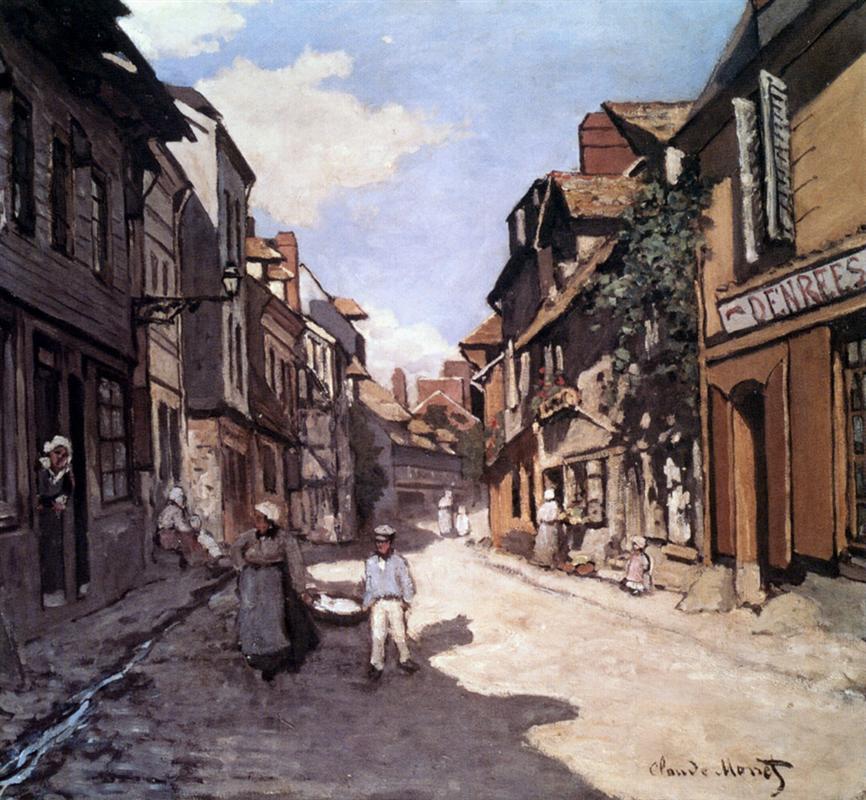
Claude Monet’s Street of the Bavolle Honfleur from 1864 offers a fascinating view into the artist’s early development, before Impressionism had fully taken shape as a movement and before Monet became most closely associated with shimmering gardens, water lilies, and atmospheric river scenes. In this painting, he turns toward an ordinary street in Honfleur and transforms it into something deeply engaging through light, structure, contrast, and observation. What makes the work so memorable is that it does not depend on grand subject matter. Instead, Monet finds meaning in a quiet urban lane, weathered architecture, scattered figures, and the meeting of bright daylight with cool shadow.
The painting immediately conveys a sense of place. The narrow street is lined with old buildings that seem to press inward from both sides, creating a corridor that guides the viewer into the depth of the composition. The road itself becomes the main visual path, stretching from the foreground toward the distance and pulling the eye past the foreground figures into the hazier center of the town. There is no theatrical event here, no historical narrative, and no obvious symbolic drama. Yet the image feels alive because Monet sees poetry in the everyday.
This is one of the qualities that makes the painting so important within Monet’s early body of work. Even before his mature Impressionist style emerged, he already showed an exceptional sensitivity to the effects of natural light and an instinct for choosing subjects from contemporary life. In Street of the Bavolle Honfleur, the artist studies how sunlight falls across walls and ground, how buildings cast irregular shadows, and how human presence animates a street without overwhelming it. The painting stands at an interesting moment between traditional realism and the freer, more atmospheric approach that would soon define his career.
Claude Monet in 1864
To understand this painting more fully, it helps to place it within Monet’s career in the mid 1860s. At this time, he was still a young artist exploring different methods and influences. He had not yet reached the iconic phase most people associate with his name. Instead, he was testing how to represent modern life while also engaging with the conventions of landscape and genre painting. The result is a work that still retains solidity and structure while already hinting at the visual freshness that would later make him revolutionary.
Honfleur was a significant place for Monet. The Normandy coast and its surrounding towns were central to his early development. This region offered him not only changing skies and coastal light, but also a mix of rustic, urban, and maritime subjects. In Honfleur, he could observe working people, old streets, and local architecture alongside the ever shifting effects of daylight. These experiences sharpened his eye for immediate visual reality.
In 1864, Monet was absorbing lessons from realism, from open air observation, and from artists who encouraged direct contact with nature and contemporary life. That tension between tradition and innovation gives this painting much of its interest. It is more controlled and more carefully built than many of his later canvases, but it is also driven by the artist’s urge to capture a lived visual moment rather than a polished academic fiction.
The Subject and Setting
The subject of Street of the Bavolle Honfleur is deceptively simple. Monet presents a street scene in a provincial town, with old buildings, a few pedestrians, and bright weather. Yet the simplicity is precisely what gives the work its power. He is not trying to impress through spectacle. Instead, he relies on the visual richness of ordinary life. The street becomes a stage where architecture, sunlight, dust, shadow, and human movement all play equally important roles.
The buildings are especially important in shaping the mood. They appear irregular, slightly leaning, and full of age. Their facades do not present smooth elegance. Instead, they suggest a lived environment marked by time, commerce, and daily routine. Shopfronts, windows, wooden supports, and textured walls all contribute to the feeling that this is a real place rather than an idealized setting. Monet does not remove the roughness of the street. He embraces it.
The sign on the right side of the painting adds to this atmosphere of ordinary local life. It suggests trade and business, reminding the viewer that this is not simply a picturesque lane but part of a functioning town. That detail helps anchor the painting in the world of everyday experience. The figures, too, are handled with restraint. They are not individualized portraits. They serve instead as markers of scale, rhythm, and life. Their presence confirms that this street is inhabited and used, but the painting remains more about the visual environment than about any particular story.
Composition and Spatial Design
One of the most impressive aspects of this work is its composition. Monet organizes the painting around the receding street, which acts as a strong central axis. The viewer stands near the front of the road and looks inward, moving gradually into the middle distance. This creates a strong sense of depth while keeping the composition easy to read. The architecture on either side frames the scene and narrows the field of vision, making the distant part of the street seem even farther away.
The asymmetry of the composition is crucial. The shadows on the left are heavier and cooler, while the right side catches more sunlight. This imbalance prevents the image from feeling static. Instead, it creates dynamic movement between darkness and brightness. The left side feels enclosed and heavy, while the right side opens up in patches of warmth and reflected light. The street itself becomes a broad ribbon of brightness that bends and narrows as it recedes, functioning almost like a river of light.
The foreground figures are positioned in a way that strengthens the composition without interrupting it. The woman and child near the center left offer a human focal point, but they do not dominate. Their placement helps bridge the foreground and the deeper space beyond. Additional figures placed farther back extend the scene and reinforce the depth. Monet seems deeply aware of how small human forms can help define space within an urban view.
The rooftops and upper walls also play a major role in the composition. Their angled lines guide the eye upward and inward, drawing attention toward the sky while maintaining the street’s corridor effect. The result is a carefully balanced image that feels natural and unforced, even though its structure is highly deliberate.
Light and Shadow
Light is the true subject of the painting. Even though the street, buildings, and figures define the scene, what gives the work its emotional and visual energy is the dramatic contrast between sunlit ground and deep architectural shadow. Monet is already showing the quality that would later make him one of the greatest painters of light in Western art.
The road is flooded with strong brightness, particularly in the middle and right foreground. This open stretch of sunlit earth creates a striking contrast with the darker areas to the left and the cool shadows cast by the buildings. Rather than evenly illuminating the entire scene, Monet allows light to move unevenly across it. This unevenness makes the painting feel more immediate and believable. Real daylight does not behave in perfect balance. It breaks across surfaces, catches one wall while leaving another in darkness, and shifts with the shape of buildings and the angle of the sun.
The shadowed areas are not merely empty dark zones. Monet gives them density and variation. They contain subtle shifts in tone and color, allowing the viewer to sense the texture of walls, the depth of doorways, and the coolness of shaded surfaces. This is one reason the painting feels so convincing. Light is not just laid on top of objects. It defines them. Shadow, likewise, is not just absence. It becomes an active visual force.
The bright sky also plays an important supporting role. Its pale blue and white tones help establish the weather conditions and give the whole composition a breathable openness above the compressed street. The clouds soften the upper part of the scene and prevent the architecture from becoming too heavy. Light descends from this sky into the town, shaping every form below.
Color and Tonal Harmony
The palette of Street of the Bavolle Honfleur is relatively restrained, especially when compared with the brighter and more broken color of Monet’s later Impressionist paintings. Yet the restraint is part of the work’s appeal. The colors are earthy, muted, and closely tied to the materials of the town itself. Browns, creams, grays, dusty whites, soft blues, and touches of reddish roof tones all combine to create an atmosphere of realism and coherence.
This controlled palette gives the painting a strong tonal unity. Nothing feels excessively bright or artificially highlighted. Even the sunlit areas are moderated by the dusty character of the street and the aged surfaces of the buildings. That gives the image a sense of honesty. Monet is not chasing decorative color for its own sake. He is looking carefully at how a real street appears under daylight.
At the same time, the painting is far from dull. Within the muted range, Monet creates subtle but effective contrasts. The cool blue of the sky offsets the warmer buildings below. The white clothing of some figures catches the light and punctuates the darker surroundings. Small warm accents in the roofs and signs create variety and help animate the architecture. The result is a painting whose color operates through harmony rather than intensity.
This tonal control also contributes to the mood. The scene feels calm, grounded, and observant. There is no feverish movement in the brushwork and no explosive use of pigment. Instead, Monet gives the viewer a carefully measured atmosphere, one that suggests the stillness of a bright day in a working town. That tonal moderation helps explain why the painting feels both immediate and reflective.
Architecture, Texture, and Material Presence
One of the painting’s most rewarding features is the attention Monet gives to architecture. These buildings are not rendered with exacting academic detail, but they are full of character. Their irregular facades, sloping roofs, narrow windows, and varied surfaces suggest age, use, and local identity. Monet seems interested not only in how the buildings look, but in how they occupy space and receive light.
The architecture does not appear monumental. It feels intimate and slightly worn. That quality is important, because it helps establish the town as a lived environment. The buildings lean inward, almost as if shaped by centuries of weather and human habitation. Their closeness creates a sense of enclosure, but not of oppression. Instead, the street feels sheltered, textured, and human in scale.
Monet’s handling of texture is especially effective. The surfaces of walls are not smooth or uniform. They appear varied and broken, catching light in different ways. Roofs look rough and layered. The road itself feels dusty and uneven. These tactile suggestions contribute to the realism of the scene, but they also show Monet’s sensitivity to the visual life of materials. He is interested in how wood, stone, plaster, and earth respond to sunlight and shadow.
This attention to material presence gives the painting depth beyond simple topographical recording. The street becomes more than a location. It becomes an environment that can be felt as well as seen. The viewer senses not only the appearance of the place, but also its age, dryness, warmth, and everyday wear.
The Human Presence in the Scene
Although the architecture and light dominate the painting, the figures remain essential. Without them, the street might feel empty or purely documentary. Their presence introduces rhythm, scale, and social life. Monet includes just enough human activity to suggest that the street is part of daily experience, but not enough to turn the work into a narrative painting.
The central figures in the foreground are particularly important. They anchor the viewer’s attention and create an entry point into the scene. Their clothing, modest posture, and small scale all reinforce the ordinary nature of the moment. These are not heroic figures. They are people going about their day. Because Monet does not over define their faces or identities, they remain universal rather than specific. They belong to the life of the town.
Figures deeper in the composition help extend the street and maintain visual movement. They prevent the middle distance from feeling empty and subtly suggest the continuation of life beyond the foreground. This is typical of a painter attentive to both observation and composition. Every person included in the scene has a structural as well as descriptive purpose.
What is striking is the absence of drama. No one gestures theatrically. No confrontation or incident unfolds. The figures simply exist within the environment. That quietness gives the painting dignity. Monet does not need a dramatic event to make the scene worth painting. The fact of life unfolding in light is enough.
Early Signs of Monet’s Future Style
Even though this painting belongs to Monet’s early career, it already contains qualities that would later become central to his art. The most obvious is his commitment to light as the organizing principle of the image. He is less interested in precise linear description than in how a scene appears under specific atmospheric conditions. That concern would grow more radical in later years, but it is already present here.
Another important feature is his choice of modern, everyday subject matter. Rather than turning to mythology, allegory, or grand historical themes, Monet paints a real street in a real town. This focus on contemporary visual experience was crucial to the emergence of modern painting. It signaled a shift away from inherited hierarchies of subject matter and toward a more democratic understanding of what could be artistically significant.
The brushwork, while still more controlled than in many later works, also hints at greater freedom. Monet is already willing to let painterly handling suggest forms rather than fully define them. The buildings, figures, and ground are recognizable, but they are not smoothed into rigid finish. This gives the surface of the painting life and immediacy.
At the same time, the work remains rooted in careful construction. That balance between observation and structure is what makes the painting so compelling. It shows Monet on the threshold of transformation, still connected to established modes of representation but already moving toward a more fluid and atmospheric way of seeing.
Mood and Meaning
The emotional tone of Street of the Bavolle Honfleur is quiet, grounded, and contemplative. It does not attempt grandeur, but it achieves something equally lasting through attentiveness. The painting invites the viewer to slow down and notice the beauty of an ordinary place. Its meaning lies not in overt symbolism, but in the act of perception itself.
There is something deeply humane about this approach. Monet treats the town street with seriousness and care, suggesting that daily life deserves artistic attention. The worn buildings, scattered pedestrians, and strong daylight are all given equal respect. The painting does not sentimentalize poverty or idealize rustic simplicity. Instead, it presents the street honestly, finding beauty in its textures, its light, and its lived reality.
The mood is also shaped by the contrast between enclosure and openness. The buildings create a narrow passage, but the sky above and the bright road below keep the scene from feeling confined. This tension gives the painting subtle complexity. It is both intimate and airy, both structured and alive with shifting light.
For modern viewers, the painting also carries a sense of historical atmosphere. It preserves a way of life and an urban fabric that feel distant from the present. Yet its appeal remains immediate because the core experience it records is universal: standing in a street on a bright day, noticing how light transforms everything.
Why This Painting Matters
Street of the Bavolle Honfleur matters because it reveals Monet at a crucial stage in his artistic growth. It is not yet the Monet of full Impressionist brilliance, but it already demonstrates the eye, intelligence, and sensitivity that would soon reshape painting. The work shows that his greatness did not appear suddenly. It developed through close study of ordinary places, through experiments with light and atmosphere, and through a growing confidence in the value of direct visual experience.
The painting also matters as an example of how modern art can emerge from humble subject matter. Monet does not need a spectacular view to create a memorable image. He needs only a street, a few figures, old houses, and sunlight. That choice reflects a profound shift in artistic values. It suggests that beauty is not limited to grand themes or idealized settings. It can be discovered in local streets, in weathered walls, and in the fleeting relationships between shadow and light.
In the end, this painting remains compelling because it is both specific and universal. It belongs to Honfleur in 1864, yet it speaks more broadly about observation, place, and the poetry of everyday life. It allows us to see how an ordinary town street can become extraordinary when looked at by an artist of exceptional vision. Through careful composition, subtle color, and luminous contrast, Monet turns a passing moment into something enduring.