Image source: wikiart.org
Introduction
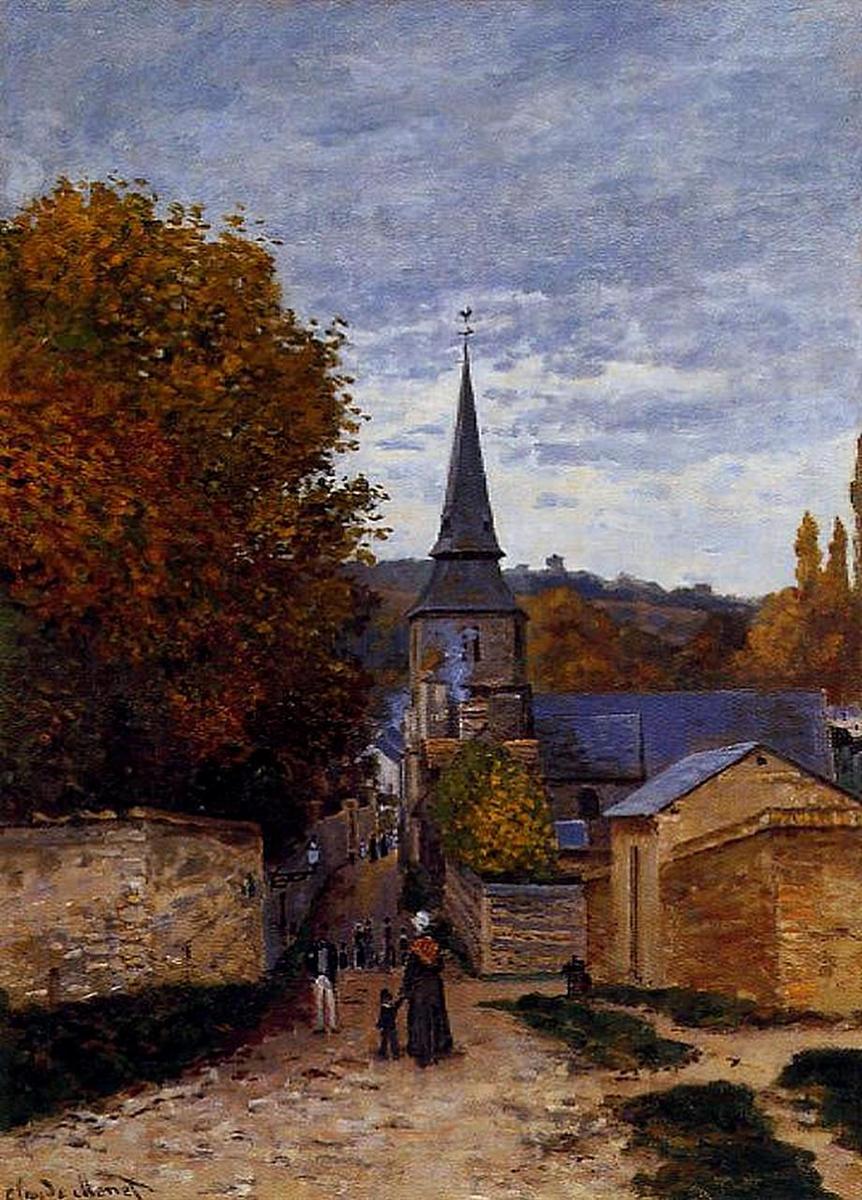
Claude Monet’s Street in Saint-Adresse from 1867 is a painting that rewards slow looking. At first glance, it can seem modest compared with some of his more celebrated coastal scenes, gardens, or water lily paintings. There is no dazzling expanse of sea in the center, no dramatic sunset, no crowd, and no theatrical event. Instead, Monet gives the viewer a quiet street, a church tower, a broad sky, a cluster of autumn trees, and a handful of figures moving through a small settlement. Yet this apparent simplicity is exactly what makes the work so compelling. It reveals an artist deeply interested in how ordinary places can become visually alive through light, atmosphere, color, and structure.
This painting belongs to a formative moment in Monet’s career, when he was refining the way he saw the world and translating that vision into paint with increasing confidence. Even before Impressionism became a named movement, Monet was already pushing away from academic finish and toward something more immediate, more responsive to lived visual experience. In Street in Saint-Adresse, that impulse is already visible. The scene is rooted in observation, but it is not dry or merely descriptive. Monet transforms a local street into an arrangement of shifting tones, rhythmic shapes, and subtle emotional suggestions.
What makes the painting especially interesting is the balance it strikes between intimacy and openness. The road draws us inward, down into the village space, toward the church and beyond, while the sky opens upward and outward, giving the composition air and spaciousness. The result is a scene that feels both grounded and expansive. It is a place people inhabit, walk through, and likely know well, but it is also a place filtered through the sensibility of a painter who is already discovering how much mood can be carried by ordinary weather, architecture, and seasonal color.
Composition and the Eye’s Journey
One of the strongest qualities of Street in Saint-Adresse is its carefully controlled composition. Monet builds the picture around a descending road that leads the viewer into the depth of the scene. This road acts almost like an invitation. We do not stand apart from the village as distant observers. We are placed at the top of the slope, looking downward as though we have just arrived and are about to walk into the street ourselves. That sense of entry is important. It makes the painting feel experiential rather than merely scenic.
The church tower serves as the central vertical anchor of the composition. Rising sharply against the sky, it stabilizes the entire image. Without it, the painting might feel more dispersed, since the landscape includes open sky above, wide ground below, and irregular masses of buildings and trees on either side. The steeple gives the eye a point of concentration. It also introduces a strong contrast between vertical and diagonal movement. The road slopes inward, the walls and rooftops recede at angles, but the spire cuts upward with clarity and firmness.
Monet also frames the church with masses of foliage and architecture. On the left, a huge autumnal tree dominates the upper portion of the composition. Its dense, warm, rust-colored leaves create a visual weight that counterbalances the open sky. On the right, the lower buildings and vertical trees provide a quieter but still essential response. This asymmetrical balance is one of Monet’s great strengths. The painting is not symmetrical in a rigid sense, but it feels stable because every visual weight has a counterpart somewhere else in the scene.
The figures near the center foreground are tiny, yet they are crucial. They establish scale and give the road human purpose. Without them, the image would feel more architectural and perhaps slightly empty. Their presence tells us this is not a deserted place but a lived environment. They also help guide the eye. We move from the foreground figures into the road, then to the church, then up into the sky and outward to the surrounding hills and trees.
This composition reflects Monet’s gift for organizing natural perception without making it feel artificial. The scene appears casual, as if caught in passing, but it is in fact highly ordered. Every mass and opening contributes to a movement of vision that feels natural, fluid, and persuasive.
Autumn Color and Tonal Harmony
The color palette of Street in Saint-Adresse is one of its most distinctive features. Instead of relying on the bright, sparkling chromatic intensity often associated with Monet’s later work, this painting uses a more restrained but deeply satisfying range of earthy and atmospheric tones. Browns, ochres, muted greens, blue grays, soft creams, and touches of warm orange all work together to create a sense of seasonal richness.
The large tree on the left is especially important in establishing the painting’s chromatic identity. Its foliage glows with a dense autumn warmth, but Monet avoids turning it into a decorative patch of exaggerated color. The oranges and browns are broken, varied, and moderated. They feel observed rather than invented. This keeps the tree integrated with the rest of the painting rather than allowing it to overpower the scene.
That tree’s warmth is set against the cool blue gray of the sky, producing one of the painting’s most pleasing contrasts. Monet was always sensitive to the way warm and cool tones activate one another, and here that sensitivity is already highly developed. The sky does not function simply as background. Its cool surface sharpens the warmth of the foliage, while the foliage in turn makes the sky feel more luminous and expansive.
The buildings are rendered in subdued creams, grays, and browns, which reinforces the painting’s sense of modesty and realism. These are not idealized houses. They appear worn, practical, and rooted in everyday use. Monet finds beauty in their tonal relationships rather than in decorative detail. The pale walls catch light differently from the darker roofs, and the variety of surfaces helps prevent the architecture from feeling flat.
The ground, too, is significant. The road is painted in pale earthen tones that suggest dust, dryness, and use. Darker patches of shadow and vegetation interrupt its surface, adding complexity and helping to tie the lower half of the image together. Monet does not treat the earth as neutral filler. He makes it an active participant in the painting’s tonal orchestration.
What is especially striking is the overall harmony of the palette. Nothing feels disconnected. Even when Monet introduces contrast, he does so in a way that preserves unity. The colors seem to belong to the same weather, the same hour, the same season. That unity gives the painting a settled mood, one that is calm without being static and rich without becoming heavy.
Light, Sky, and Atmosphere
Monet’s reputation rests to a large degree on his sensitivity to light, and Street in Saint-Adresse already shows how central that concern was to his art. The light in this painting is not dramatic in a theatrical sense. It does not create blazing highlights or deep, mysterious darkness. Instead, it moves quietly across the scene, shaping surfaces and revealing subtle differences in tone.
The sky occupies a large part of the composition, and Monet uses it to establish the painting’s atmosphere. It is filled with broken cloud forms and layered blue gray tones that suggest a living, shifting weather pattern rather than a fixed backdrop. The brushwork in the sky creates vibration without chaos. It feels airy and mobile, as if the light could change further at any moment.
This atmospheric sky plays an essential role in how the whole village is perceived. The light seems diffused rather than direct, which softens edges and prevents the buildings from appearing hard or overdefined. The church tower stands out clearly, but even it is enveloped in the same atmosphere as the rest of the scene. Monet is not isolating forms from their environment. He is showing how air and light bind everything together.
There is also an interesting tension between illumination and restraint. Certain surfaces catch more light than others, especially portions of the pale walls and road, but Monet never overstates these accents. The effect is naturalistic and believable. We feel the presence of daylight, yet we also feel that the day is gentle, perhaps slightly cool, and touched by the subdued beauty of autumn.
This treatment of light is one reason the painting feels so emotionally convincing. The atmosphere is not just visual information. It carries mood. The broken sky, the softened architecture, the glowing tree, and the muted ground all suggest a moment of stillness within change. Weather is present, season is present, time of day is present, but none of these are fixed into a rigid narrative. The painting remains open enough for the viewer to enter imaginatively.
The Human Scale of the Scene
Although the figures in Street in Saint-Adresse are small, they matter enormously. Monet includes them not as portraits or narrative protagonists, but as measures of life and scale. They animate the street and remind us that this is a community space, not a purely formal arrangement of trees, walls, and rooftops.
The group in the foreground appears to be walking together, and further down the road there are more tiny presences. These figures help create depth by marking intervals along the descending street. They also soften the transition between foreground and middle ground. Instead of experiencing the road as empty space, we experience it as inhabited distance.
Monet’s treatment of the figures is loose, but not careless. They are simplified into dark shapes with just enough variation to suggest clothing and movement. Their relative anonymity is important. They are not individualized in a way that would distract from the larger unity of the painting. Rather, they become part of the everyday rhythm of the place.
This use of figures aligns with Monet’s broader interest in modern life, understood not only as urban spectacle but also as contemporary lived experience. In this painting, modernity does not announce itself through industry or grand boulevards. It is present in the simple fact of ordinary people moving through a familiar environment. The painting suggests that a local street in a small town can be just as worthy of artistic attention as any historic subject or idealized landscape.
The human scale also makes the church tower more meaningful. Because the figures are so small, the steeple appears taller and more commanding, yet not oppressive. It becomes a landmark around which everyday life unfolds. The relationship between small people and stable architecture gives the scene a quiet social dimension. This is a place structured by habit, community, and memory.
Brushwork and the Surface of Seeing
One of the most rewarding aspects of Street in Saint-Adresse is the way Monet’s brushwork negotiates between description and freedom. He is not painting with the slick, polished finish expected in strict academic practice, but neither is he abandoning structure. Instead, he allows visible touches of paint to build the scene in a way that preserves immediacy.
This is especially clear in the foliage and sky. The leaves are not individually drawn. They are suggested through clusters of strokes and tonal variations that create the impression of dense autumn growth. Similarly, the sky is made of broken applications that allow the surface to breathe. These marks give the painting life because they record the painter’s response rather than hiding it.
The architecture is handled somewhat more firmly, but even there Monet avoids overdefining detail. Rooflines, walls, and windows emerge through planes of color and carefully placed accents rather than through precise linear description. This approach helps integrate the built environment with the surrounding air and light. The buildings feel observed in the moment, not reconstructed later from rigid outline.
Monet’s brushwork on the road is particularly effective. The ground is uneven, mottled, and alive with subtle shifts. Rather than treating the path as a flat beige strip, he breaks it up with variations in tone and texture that suggest real terrain. The road carries movement both spatially and physically. It feels walked on.
What we see here is an artist increasingly committed to painting perception itself. Monet is less interested in polishing away the evidence of making than in preserving the sensation of looking. That does not mean the painting is unfinished. On the contrary, it is complete on its own terms. Its finish lies in the success of its visual unity, not in the erasure of the brush.
This is one of the reasons the painting feels modern. It acknowledges that vision is active, shifting, and responsive. Instead of pretending that the world presents itself in crisp, fixed outlines, Monet gives us a world seen through atmosphere, light, and moving attention.
Street in Saint-Adresse in Monet’s Early Career
Painted in 1867, Street in Saint-Adresse comes from an important period in Monet’s development. He was still a young artist, but already moving decisively toward the visual language that would later define Impressionism. In works from this phase, one can often sense both inheritance and departure. Monet remains attentive to structure, place, and recognizable form, yet he is increasingly liberated in his handling of paint and increasingly preoccupied with fleeting conditions of light and weather.
Saint-Adresse was a significant location for Monet, associated with the Normandy coast and with some of his most memorable early observations of outdoor life and atmosphere. In paintings from this broader period, he explored gardens, coastal settings, promenades, and local views. What unites these works is not simply geography, but a desire to paint modern vision directly from the world around him.
Street in Saint-Adresse is especially valuable because it shows that Monet’s interest in modern outdoor painting was not limited to spectacular subjects. He could find pictorial richness in a village street just as readily as in the sea or a flower garden. That breadth of attention is part of what made him such a transformative artist. He expanded the range of what could be considered worthy of sustained painterly attention.
The painting also reveals his movement away from historical or literary subject matter. Rather than illustrating a story, he lets the visual experience itself become the subject. The street, the church, the weather, the season, and the figures are enough. Their arrangement in light becomes the meaning. This was a radical shift in artistic values, even if it now feels natural because artists like Monet helped make it so.
At the same time, the painting still retains a certain solidity that distinguishes it from some of his later, more dissolved surfaces. That makes it especially interesting for viewers who want to see Monet in transition. The composition remains strongly built, the forms remain legible, and the tonal structure remains firm, yet the seeds of Impressionism are unmistakably present in the treatment of sky, foliage, light, and brushstroke.
The Poetry of the Ordinary
What gives Street in Saint-Adresse lasting power is not just its technical quality, but its emotional intelligence. Monet finds poetry in an ordinary place without falsifying its ordinariness. He does not transform the village street into something grandiose. He allows it to remain modest, slightly rough, and entirely believable. Yet through composition, light, and color, he reveals its quiet beauty.
The painting suggests a world of routine, passage, and local familiarity. People walk the road. Buildings serve practical needs. The church marks communal life. Trees change with the season. The sky shifts overhead. Nothing here is exceptional in the dramatic sense, and that is precisely the point. Monet’s vision teaches us that visual meaning does not depend on spectacle. It can emerge from patient attention to the everyday.
There is also a gentle emotional ambiguity in the scene. The warmth of the foliage creates a sense of richness, even comfort, while the muted sky and subdued tones introduce a slight pensiveness. The result is neither cheerful in a simple way nor melancholy in a heavy way. It occupies a more complex emotional register, one that feels truthful to lived experience. Many real moments are like this: calm, beautiful, slightly cool, quietly passing.
That emotional subtlety is one reason the painting continues to resonate. It does not dictate a single response. Instead, it creates a space in which viewers can bring their own sense of memory, place, and season. Some may see tranquility, others nostalgia, others the quiet dignity of village life. Monet leaves room for these responses because he never reduces the scene to a message.
Why This Painting Still Matters
Even in the context of Monet’s vast and influential career, Street in Saint-Adresse remains an important work. It reminds us that his achievement was not only about famous motifs or late masterpieces, but about a fundamental transformation in how painting could engage with the visible world. He understood that perception is shaped by atmosphere, movement, and feeling, and he built a new pictorial language around that insight.
This painting matters because it shows Monet discovering the extraordinary within the ordinary. It also matters because it preserves a particular kind of attentiveness that still feels fresh. In a world that often prizes speed and spectacle, Street in Saint-Adresse asks for slower looking. It invites the viewer to notice the relation between warm leaves and cool sky, between tiny figures and tall steeple, between a sloping road and the depth of space beyond it.
The painting also stands as an early example of Monet’s lifelong devotion to place as lived experience. He is not simply recording topography. He is translating an encounter with a real environment into a visual rhythm of tone, shape, and sensation. That translation is what makes the painting art rather than document.
Ultimately, Street in Saint-Adresse endures because it is both specific and universal. It is clearly a particular street in a particular town, seen in a particular season, yet it speaks more broadly about how humans inhabit places, how light transforms the familiar, and how memory often clings not to grand events but to ordinary views encountered under meaningful skies. Monet gives us a village street, but he also gives us a meditation on seeing, on passing time, and on the quiet beauty of daily life.
