Image source: wikiart.org
First Impressions: A Nocturne Lit from Within
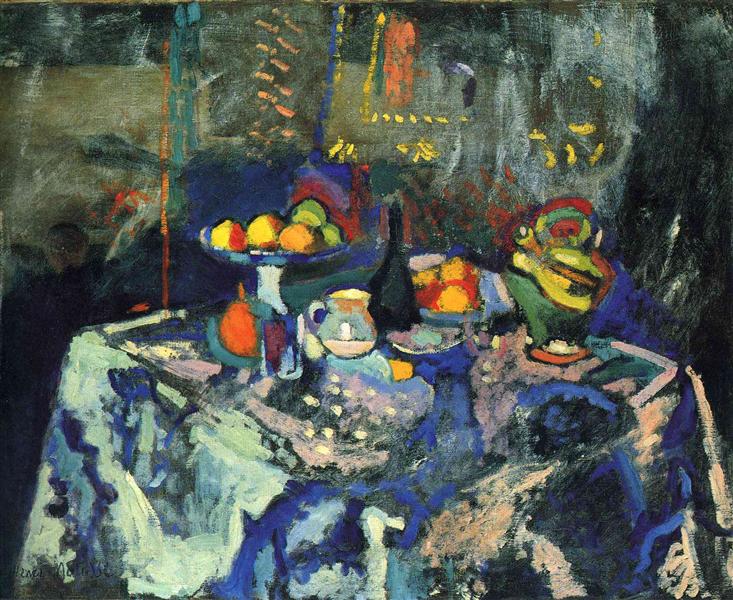
At first glance, “Still Life with Vase, Bottle and Fruit” feels like an evening interior in which light emanates from color rather than from a lamp. A cascade of saturated blues and violets floods the tablecloth; citrus yellows, vermilions, and apple greens flash across bowls and fruit; deep teals, bottle greens, and inks form a soft darkness that swallows the room around the tabletop. The scene lives in a high-contrast key: a luminous island of objects sits in front of a mysterious, shadowed wall animated by signs, dashes, and glimmers. Matisse is less concerned with describing specific fabrics, woods, or metals than with staging an encounter between chromatic forces—cool blues expanding into space, hot yellows and oranges pulsing forward, and a handful of emphatic blacks stitching the image together.
The 1906 Moment: Refining Fauvism into Poise
Painted in 1906, the year following the Fauvist eruption of 1905, this still life shows Matisse deliberately tempering shock with clarity. Where the Collioure landscapes explode with daylight, this interior thinks in half-light, proving that Fauvist color does not require blazing sun; it can find intensity in a dark register. The painting belongs to a cluster of table scenes where Matisse tested how saturated cools—a domain of blues, violets, and greens—could supply atmosphere, while small, high-chroma warms punctuated and organized form. The lesson here is control: color is freed from imitation yet harnessed to build structure and mood.
Composition: A Theater Around a Table
The composition is built like a small stage. The table, a truncated trapezoid, occupies the foreground and edges toward the lower right, its angled sides and frontal edge establishing depth without perspective lines. The objects are arranged in a broad arc: at left a compote of fruit, then a pear-shaped vase with red shoulder, a white jug, a dark bottle, a low plate with fruit, and finally a green lidded jar elevated on a little foot. This arc reads as a company of actors delivering their lines to the audience. Behind them, the wall is not a neutral backdrop but a dark scrim full of marks—strings, tassels, rectangles, constellations of yellow—that imply tapestries, shadows, and hanging ornaments. The eye begins at the brilliant compote, passes along the tabletop’s cold flames, and resolves at the green jar whose rosy crown answers the compote’s hot notes. The composition’s symmetry is not literal but musical; the hot accents at each end bracket the cool expanse between.
Color Architecture: Blues as Air, Oranges as Flame
Matisse orchestrates three interlocking color systems. The first is the cool architecture: deep ultramarine, Prussian blue, violet, and slate define the room and tablecloth. These tones provide both space and calm. The second is the warm constellation: cadmium orange and yellow, vermilion, and soft apricot energize fruit and ceramic highlights, delivering the painting’s heartbeat. The third is the stabilizing dark: inks, bottle greens, and charcoal blacks appear sparingly—in the bottle, in the shadows under fruit, along the table edge—to anchor forms so the high-key warms do not float away. Crucially, Matisse never “mixes down” the color to create mud; he sets hues edge to edge, allowing temperature shifts to do the work of modeling. Blue next to orange is brightness; green beside red-violet is vibration; violet brushed over black turns into a deep, breathable night.
Light and Atmosphere: Illumination as Relation
There is no single lamp in this scene; light is distributed like a weather pattern. Fruit gleams because Matisse builds halos of cooler color around warm disks; the white jug glows because it is trimmed with a hint of blue-violet on one side and yellow reflection on the other; the tablecloth appears to ripple because patches of near-white are nested in pools of cobalt. The background wall, largely dark, is nonetheless active—thin scrapes of paint, translucent veils, and staccato yellow dots suggest reflections and hanging objects without ever locking into descriptive detail. Illumination here is relational: every bright note depends on a surrounding cool; every shadow breathes because its hue is chosen, not merely darkened.
Brushwork and Materiality: Drawing With Paint
The drawing is carried by brushwork rather than linear outline. Short, directional strokes curve around the fruit, giving them volume without resorting to precise contour; long dragged passages spread the tablecloth’s folds like waves; quick, calligraphic marks dot the wall and imply beadwork or embroidery. The paint surface feels layered—thin scumbles let earlier colors whisper through, while thicker accents on the compote’s rim and the jar’s lid catch real light in the gallery. Even the “whites” are impure, typically a warm light crossed with cool lavender; this impurity keeps the surface alive and prevents chalkiness. You sense decisions being made in real time: a violet shadow strengthened, a highlight cleaned and set, a dark stroke laid to lock shape.
Space and Perspective: Shallow Depth With Conviction
Matisse creates depth by overlap and pressure rather than calculation. The compote overlaps the table’s rear edge, the jug slightly overlaps the bottle, the bowl cuts into the jar’s personal space. These small invasions make the stage feel packed and intimate. The tabletop tips toward us more than natural perspective would allow, a familiar Matisse device that turns the surface into a decorative field while still supporting believable objects. It is shallow space, but it breathes; the background’s darkness recedes not by gradient but by transparency, as if we peer through veils of pigment into a dim room.
The Tablecloth: A Sea of Blues
The tablecloth is the painting’s protagonist. It is not a description of a particular textile but an ocean of interlaced blues, violets, and icy lights. Its folds are suggested by direction changes and by sudden shifts from cool to very cool; its highlights are blunt, unblended patches that feel like moonlight on water. The cloth’s edge is thickened with dark strokes that form a visual barrier at the front, preventing the objects from sliding off the stage. In places, green invades the blue to echo the jar and bottle, binding background to foreground. Everything else—the fruit, the ceramics—plays across this sea like bright boats.
Objects as Characters: How Each Form Speaks
The compote at left has a crisp, elegant stem and an open bowl that announces itself with confident, bright fruit. It opens the sentence. The squat jug beside it is painted in softer whites and creams with a blue hem; it speaks quietly, its roundness read by temperature changes more than contour. The bottle, a dark vertical, operates like a pause, a punctuation mark holding the phrase before we continue to the right. The low plate with orange slices is a short, hot interjection. Finally, the green jar with red-rimmed lid is the emphatic ending—its color resonance with the compote’s fruit and its massiveness confirm closure. This narrative quality is not rhetorical flourish; it describes how a viewer’s eye moves and how balance is achieved.
Ornament Versus Structure: Keeping the Image From Drifting
The wall’s glitter—saffron dashes, small rectangles of light, diagonal strings—nudges the painting toward the decorative. But Matisse prevents drift by inserting structural anchors. The bottle’s near-black, the table’s frontal edge, and the repeated circular forms of bowl, jug belly, and jar shoulder act like armature. Ornament here is not added lace; it is a field of small disruptions that keeps the large masses from feeling static. The dance between pattern and structure is the painting’s central tension and central pleasure.
The Discipline of Darks
A high-key palette risks weightlessness unless darks are deployed judiciously. In this still life, darks are few but crucial. They undercut the fruit so the warm disks sit with weight; they carve out the negative space between objects so each reads clearly; they pool along the table’s lower edge to anchor the foreground. By concentrating darkness into decisive shapes instead of spreading it thin, Matisse guarantees clarity and keeps the painting from becoming merely pretty.
Echoes of Cézanne, Departures Toward Matisse
The stacked tabletop, the emphatic fruit, and the color-structured space acknowledge Cézanne’s still lifes. But where Cézanne uses patches to build a stone-like permanence, Matisse prefers liquidity and theatrical light. The planes here are less about constructing solidity than about distributing sensation. Moreover, the background’s decorative allusions—tapestry, curtain, beadwork—gesture toward the ornamental ambitions that will soon culminate in the great patterned interiors. The homage becomes a springboard to difference.
The Background as a Memory of Things
Look long at the wall and it resolves into recollections: the rectangle of a framed picture, a diagonal cord, a hanging tassel, a spray of flowers half-absorbed by shadow. Nothing is spelled out; everything is suggested. This is Matisse’s way of acknowledging the room without sacrificing the self-sufficiency of the color field. The wall becomes a memory surface, where objects leave chromatic traces rather than descriptive portraits.
Temperature Modeling: Flesh for Fruit and Glaze
Matisse models the oranges and lemons with temperature, not value. Warm yellows lean cooler at their edges where they approach the table’s blue; thin notes of green or violet sneak into the shadowed sides, making the spheres turn without academic shading. Ceramics are built similarly: the jug’s belly swells because creamy lights slide into lilac penumbrae; the green jar’s lid lifts because a red-orange ring heats up against a cooler green body. These decisions sustain intensity while preserving legibility.
Rhythm and Repetition: The Music of Rounds and Edges
Round forms repeat—fruit, bowl, jug belly, jar shoulder—creating a pulse that carries across the table. Flat edges intervene—the rim of the table, the bottle’s straight sides—to syncopate the rounds. On the wall, short repeated strokes—yellow dashes, pink scratches—add treble. The painting is orchestrated like chamber music: a few instruments, each timbre distinct, trading motifs while a deep blue drone holds the harmony.
Emotion Without Narrative
There is no story here of who ate which fruit or who set the table. Yet the painting carries an unmistakable mood: intimate, slightly nocturnal, reflective rather than celebratory. The deep blues quiet the eye; the oranges and lemons keep the heart awake. It is a room at the day’s end, where color continues to glow after conversation has stopped. Matisse achieves feeling not by anecdote but by the pressure of hue against hue.
Why the Dark Key Works
Dark-key paintings can become heavy; this one does not. The reason is chromatic buoyancy. The darks are colored—greens, violets, blues—rarely dead black, so they retain internal light. Meanwhile, warm accents are placed where they will travel farthest: lifted on tall stems, positioned near edges, set against their complementary cools. The result is a nocturne that glows rather than broods.
From Fauvism to Decorative Modernism
“Still Life with Vase, Bottle and Fruit” points toward Matisse’s next decade, when rooms would become lush tapestries of pattern, and color would structure not just objects but entire worlds. Already he treats the wall as an active surface and the table as a flat plane capable of bearing ornament. Yet he maintains the integrity of each object and the clarity of the scene. The painting is a bridge: passionate color disciplined into a balanced whole.
Legacy and Lessons for Looking
What persists in memory after leaving this canvas is the way a limited set of elements sustain rich experience. A table, a handful of vessels, some fruit, and a breathing wall—arranged with sensitivity to color intervals and to the way edges change character—are sufficient to build a world. The painting teaches that perception is relational: a lemon glows because of the blue it meets, a jug rounds because of the lavender that cools its flank, a room deepens because of the transparency of its darks. It is a masterclass in doing more with less, and in letting color be both eye and hand.
Conclusion: A Luminous Island of Things
Matisse turns a still life into a small cosmos. The blues give us air; the oranges give us fire; the greens and blacks give us gravity. Objects converse across the tabletop, their voices distinct yet harmonious, while the room behind them hums with half-seen ornaments—memories of pattern that refuse to be mere backdrop. The painting remains one of the clearest demonstrations that modern color can be rigorous and tender at once: a nocturne that sings quietly but does not fade.