Image source: wikiart.org
Introduction
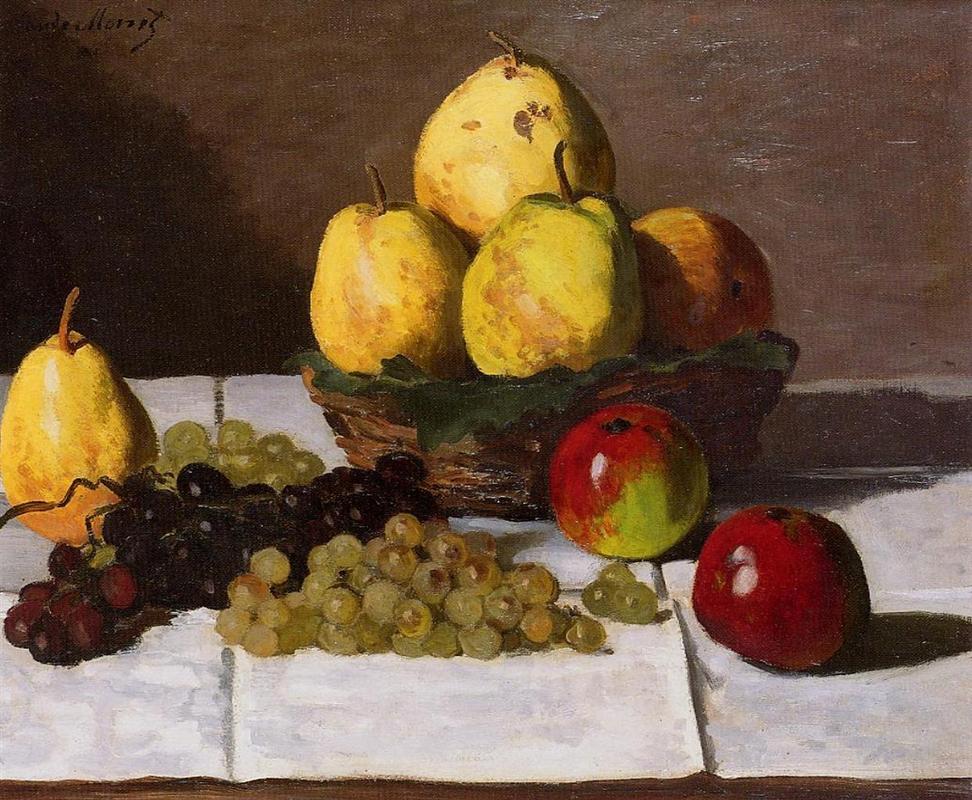
Claude Monet’s Still Life with Pears and Grapes from 1867 offers a compelling look at an artist who is often associated almost entirely with landscape, atmosphere, and the shimmering effects of outdoor light. Yet this painting reminds us that Monet’s artistic intelligence was never limited to gardens, rivers, coastlines, or cathedrals. In this early still life, he turns his attention to familiar objects placed on a table, transforming pears, grapes, and apples into a study of color, texture, structure, and illumination. The result is quiet but deeply sophisticated. It is a work that may appear modest at first glance, but the longer one studies it, the more it reveals about Monet’s sensibility and the foundations of his later greatness.
The painting belongs to an important moment in Monet’s development. In the 1860s, he was still defining his artistic identity, absorbing lessons from Realism and contemporary painting while also moving toward the more radical handling of light and color that would later define Impressionism. This still life reflects that transitional moment beautifully. It is grounded in observation, yet alive with painterly freedom. It respects the traditions of still life, yet it also loosens them, letting light, surface, and visual rhythm take on greater importance than strict finish or symbolic complexity.
What makes Still Life with Pears and Grapes especially rewarding is its balance between intimacy and ambition. The subject is simple, but the painting is not simple at all. Monet uses the arrangement of fruit, the contrast between dark and light passages, and the subtle vibration of color to create an image that feels both immediate and carefully composed. It is a painting about seeing, about the act of transforming ordinary objects into something resonant and memorable through careful attention. In that sense, it expresses one of the central truths of Monet’s art: beauty is not reserved for grand subjects. It can be discovered in the everyday, if the artist knows how to look.
The Subject Matter and Its Quiet Richness
The subject of the painting is a tabletop arrangement of fruit. Pears dominate the composition, gathered in and around a basket, while clusters of grapes spill across the white cloth in the foreground. Two red apples add strong accents of color on the right, and a single pear sits apart on the left, helping extend the composition laterally. The background remains subdued and dark, allowing the fruit to emerge clearly and with weight. Everything about the setup suggests restraint. Monet does not overwhelm the viewer with abundance or exotic objects. Instead, he focuses on familiar produce and the relationships between shape, color, and light.
Still life painting has a long history in European art, and fruit has always been one of its most enduring motifs. Fruit offers painters endless opportunities. Its surfaces vary from matte to glossy, its colors range from subtle to brilliant, and its forms can be rounded, tapered, clustered, or irregular. In Monet’s hands, these qualities become the basis for a rich visual meditation. The pears are especially important because they are not smooth, idealized forms. They have bumps, bruises, mottled skin, and irregular contours. They feel real, touched by nature and time rather than polished into perfection.
That sense of reality gives the painting much of its appeal. Monet does not present fruit as decorative symbols detached from life. He presents them as objects one might actually encounter in a home or market. The basket is simple, the arrangement slightly informal, and the cloth is spread with visible folds and angles. This naturalism keeps the work grounded. At the same time, the arrangement is far from accidental. Each object has been positioned to create visual movement and balance. The isolated pear on the left prevents the basket from becoming too dominant, while the apples on the right echo the warmth of the pears but introduce deeper, more saturated notes.
The grapes are especially effective because they spread low across the front of the painting, drawing the viewer into the scene. Their clustered forms contrast with the more solid masses of the pears and apples. This creates a pleasing play between compact volume and scattered texture. The painting is quiet, but it is never static. The fruit seems to settle into the surface of the table while also creating a gentle flow from left to right and back again.
Composition and Spatial Design
One of the great strengths of Still Life with Pears and Grapes is its compositional clarity. Monet organizes the scene through a strong triangular structure centered on the basket of pears. The highest pear rises near the top middle of the composition, while the surrounding fruit forms a stable base beneath it. This pyramidal arrangement gives the central group a sense of order and permanence. It recalls traditional compositional strategies used by earlier still life painters, yet Monet applies them with fresh informality.
The central basket functions as the visual anchor of the painting. Around it, the supporting fruit extends outward, softening the structure and making it feel more natural. The isolated pear on the left is especially important because it prevents the eye from remaining fixed only on the center. It acts almost like a visual counterweight. The grapes then connect that left side back toward the middle, while the apples on the right complete the movement. This creates an elegant rhythm across the table.
The tablecloth itself plays a surprisingly major role in the composition. Its broad white surface is not just a neutral support. Monet uses it to carve out planes of space and to enhance the visibility of shadows. The folds and seams of the cloth create a geometric framework beneath the organic forms of the fruit. This tension between angular cloth and rounded fruit adds energy to the image. The cloth also pushes the fruit forward toward the viewer, especially in the foreground where the grapes seem almost within reach.
Depth is handled with subtle efficiency. The background is shallow and dark, which reduces distraction and concentrates attention on the still life. Yet the painting does not feel flat. Monet creates space through overlaps, shadows, and tonal transitions. The basket sits convincingly behind the foreground grapes, while the apples occupy their own distinct positions in front of and beside the basket. The viewer senses a tabletop environment without needing elaborate perspective.
The composition also reveals Monet’s interest in asymmetry. Although the painting is balanced, it is not perfectly mirrored or rigid. The central mass leans slightly through the placement of the fruit, and the side elements are unequal in both size and color. This asymmetry makes the work feel more alive. It avoids the stiffness that can burden highly controlled still lifes. Monet wants order, but he also wants naturalness, and that balance is one of the painting’s quiet triumphs.
Color and Tonal Harmony
Color is central to the success of this painting. Even within a relatively restrained palette, Monet demonstrates remarkable sensitivity to warm and cool relationships, muted passages, and accents of brightness. The dominant tones are yellows, greens, reds, browns, whites, and deep shadowy neutrals. From this limited range, he builds an image that feels rich and varied rather than narrow.
The pears are the main carriers of warm light. Their yellow skins are broken by green undertones, brown speckles, and touches of creamy highlight. Monet avoids monotony by varying each pear slightly. Some lean more toward golden yellow, others toward pale green, and still others toward warmer orange or brown. This variety keeps the central group lively and believable. The pears feel individual, not copied from a formula.
The grapes introduce another kind of color experience. The pale green grapes in the foreground catch light softly and almost glow against the white cloth. By contrast, the darker grapes on the left create a denser, more shadowed passage. This opposition between light grapes and dark grapes enriches the painting’s tonal range and creates a layered effect. The grapes are not simply decorative additions. They help Monet explore translucency, depth, and reflected light.
The red apples are perhaps the most striking chromatic accents in the composition. Their vivid redness stands out against the more subdued yellows and greens, immediately catching the eye. Yet Monet handles them carefully. He does not let the red overpower the painting. Instead, the apples function like punctuation marks, small but powerful. They intensify the overall harmony by providing contrast and by echoing subtle warm notes elsewhere in the composition.
The background is painted in deep brown and grayish tones, creating a sober field against which the fruit shines more clearly. This dark backdrop is essential. Without it, the light values of the pears and cloth would lose much of their force. Monet understands that brightness depends on surrounding shadow. The white cloth, for instance, is not uniformly white. It contains cool gray notes, warm creams, and areas darkened by shadow. These tonal modulations make it feel substantial and luminous at the same time.
What is especially impressive is how Monet creates harmony without relying on flashy color. The painting is not about spectacle. It is about subtle orchestration. Every color has a role, and every note is adjusted in relation to the others. The result is a visual field that feels balanced, warm, and deeply satisfying.
Light, Shadow, and the Sense of Presence
Although Monet would later become celebrated for his open air studies of changing daylight, this early still life already shows his fascination with light. In Still Life with Pears and Grapes, light does much more than describe form. It creates mood, shapes the composition, and gives the objects a compelling sense of presence.
The light appears to enter from the left, illuminating the fruit unevenly and creating a pattern of highlights and shadows across the arrangement. This directional light gives the painting structure. The left side of the still life receives more immediate brightness, while the right side falls more deeply into shadow. Yet Monet does not treat shadow as empty darkness. He fills it with color and nuance. The shadows on the cloth, beneath the apples, and around the basket are full of tonal life.
The highlights on the pears are especially important. They are not hard or metallic. Instead, they seem softly absorbed by the fruit’s skin, suggesting the varied texture of pears and the diffused quality of indoor light. The grapes, by contrast, respond differently. Some catch tiny points of brightness that hint at their translucency. The apples reflect light more distinctly, their smoother surfaces allowing stronger highlights that emphasize their roundness and gloss.
This handling of light gives the painting immediacy. The fruit does not feel like a static arrangement assembled only for symbolic meaning. It feels as though Monet observed it in a specific moment, under specific lighting conditions, and translated that experience into paint. That sense of a real moment matters. Even in the controlled world of still life, Monet is already attentive to fleeting visual effects.
The cast shadows also help anchor the fruit in space. The apple on the far right, for example, throws a clear shadow across the cloth, reinforcing its solid presence. The basket and grapes are similarly grounded by surrounding darkness and reflected tones. Nothing floats. Everything belongs convincingly to the tabletop environment.
At the same time, the lighting contributes to the painting’s mood. The contrast between bright fruit and dark background creates a sense of intimacy and concentration. The scene feels enclosed, quiet, almost contemplative. It is not theatrical, but it is deeply atmospheric. Monet shows that even simple studio lighting can produce emotional richness when handled with sensitivity.
Brushwork and Surface Treatment
One of the most revealing aspects of this painting is Monet’s brushwork. Even at this early date, he is clearly not interested in polishing the surface into complete invisibility. He allows the act of painting to remain visible. This is crucial because it places the work between traditional still life finish and the freer handling that would later become central to Impressionism.
The fruit is modeled with strokes that are responsive rather than rigid. Monet does not outline every contour sharply or smooth every transition. Instead, he builds form through patches of color, directional strokes, and tonal contrasts. On the pears, this approach is especially effective. Their mottled skins are suggested through varied touches of yellow, green, brown, and white. The surface feels alive, slightly rough, and organic.
The grapes are handled with equal intelligence. Rather than rendering every grape with identical precision, Monet varies his treatment according to light and position. Some grapes are more clearly defined, while others dissolve into the cluster. This creates a natural sense of density and prevents the arrangement from becoming mechanical. The viewer’s eye completes what the brush merely suggests.
The basket, too, benefits from painterly freedom. Its woven structure is indicated with lively strokes rather than painstaking description. This keeps it subordinate to the fruit while still making it convincing as an object. The cloth is similarly animated. Its folds and planar shifts are conveyed through broad passages of paint that preserve spontaneity. Monet understands that too much finish would deaden the painting.
This visible brushwork matters because it tells us something about Monet’s artistic priorities. He is not simply copying objects. He is translating visual sensation into paint. The strokes themselves become part of the image’s vitality. They create a subtle vibration across the surface, making the still life feel less like an inert inventory of fruit and more like a living act of perception.
The painting therefore occupies an interesting threshold. It still respects solidity, weight, and structure, but it is already loosening the conventions of academic finish. In that sense, it points forward. It suggests the young Monet discovering how brushwork can both describe and energize the world.
Monet’s Early Career and the Importance of This Work
In 1867, Monet was still a young artist navigating the pressures of the Paris art world, financial instability, and the challenge of forging a new artistic path. He had already shown remarkable talent, but he had not yet become the towering figure associated with Impressionism in later decades. Works like Still Life with Pears and Grapes are therefore important because they reveal his development in real time.
This painting shows that Monet’s later achievements did not emerge suddenly. They were built on serious observation, technical discipline, and a deep engagement with traditional genres. Still life offered him an ideal field for experimentation. Unlike landscapes, which involve shifting weather and light, still life allowed for sustained study of form, color, and arrangement. In such works, Monet could test how objects respond to illumination, how color relationships can unify a composition, and how painterly handling can remain expressive without sacrificing coherence.
The painting also reminds us that early Impressionism did not reject the past as completely as it is sometimes imagined. Monet learned from older still life traditions, including the careful arrangement of objects, the use of dark backgrounds, and the emphasis on tactile material presence. Yet he adapted these traditions to his own way of seeing. He made them fresher, less formal, and more attentive to immediate visual experience.
In this sense, Still Life with Pears and Grapes occupies a meaningful place in Monet’s career. It may not be among his most famous works, but it contributes to our understanding of how he became Monet. It reveals the seriousness of his craft and the breadth of his interests. It also complicates any simplistic view of him as only a painter of water lilies and haystacks. Before those later masterpieces, there was an artist carefully studying fruit on a table and learning how to make paint convey both substance and light.
Mood, Meaning, and the Poetry of Ordinary Things
Unlike some still lifes from earlier centuries, Monet’s painting does not seem heavily burdened with symbolic intent. There is no obvious moralizing message, no elaborate vanitas program emphasizing mortality through dramatic signs of decay or luxury. Yet the absence of overt symbolism does not mean the painting lacks meaning. Its significance lies in its poetic attention to ordinary things.
The fruit is ripe, varied, and imperfect. The pears show marks and blemishes, the grapes are unevenly scattered, and the arrangement feels lived rather than ceremonial. These qualities give the work a human warmth. It is a painting that values the ordinary world not because it hides a secret allegory, but because it is already worthy of attention. Monet finds dignity and beauty in what might otherwise be overlooked.
There is also a sense of calm abundance. The table is not overflowing extravagantly, yet there is enough fruit to suggest comfort and domestic ease. The painting feels intimate, perhaps even private, as though it belonged to a quiet interior where simple pleasures mattered. That emotional register is one of its enduring strengths. The still life invites slow looking. It rewards patience.
At a deeper level, the painting can be understood as a meditation on transience. Fruit ripens and spoils. Light changes. Arrangements are temporary. Still life as a genre always carries some awareness of time, even when symbolism is understated. Monet captures a brief state of freshness and illumination, preserving it through painting. That act itself is meaningful. It reflects the artist’s wish to hold onto visual experience before it vanishes.
This concern with the fleeting moment would later become one of Monet’s defining themes. In this still life, it appears in embryonic form. The painting is still, but it is not timeless in a frozen or abstract sense. It is rooted in a moment of seeing, and that moment gives it emotional truth.
Conclusion
Still Life with Pears and Grapes is a beautiful and revealing early work by Claude Monet. It demonstrates how much can be achieved through restraint, attentiveness, and sensitivity to the visual world. With a simple arrangement of fruit, Monet creates a painting rich in structure, color harmony, light, and atmosphere. The composition feels balanced yet natural, the brushwork lively yet controlled, and the overall effect both intimate and assured.
What makes the painting especially compelling is the way it bridges traditions. It belongs to the long history of still life painting, with its careful arrangement and concentration on material presence, yet it also anticipates Monet’s later commitment to immediacy and visual sensation. The fruit is not merely described. It is experienced through light, color, and touch. Every pear, grape, and apple contributes to a larger harmony that feels both observed and deeply felt.
This work also broadens our understanding of Monet himself. It reminds us that his artistry was rooted in close looking and disciplined experimentation. Before the expansive landscapes and serial studies that made him world famous, he was already exploring how paint could transform ordinary objects into something luminous and memorable. That exploration is fully alive in this painting.
In the end, Still Life with Pears and Grapes proves that Monet did not need a dramatic landscape or a famous garden to create beauty. A basket of pears, clusters of grapes, two red apples, a white cloth, and a dark background were enough. Through these simple elements, he made a painting of remarkable quiet power, one that continues to reward careful attention and to reveal the depth of his vision.
