Image source: wikiart.org
Introduction
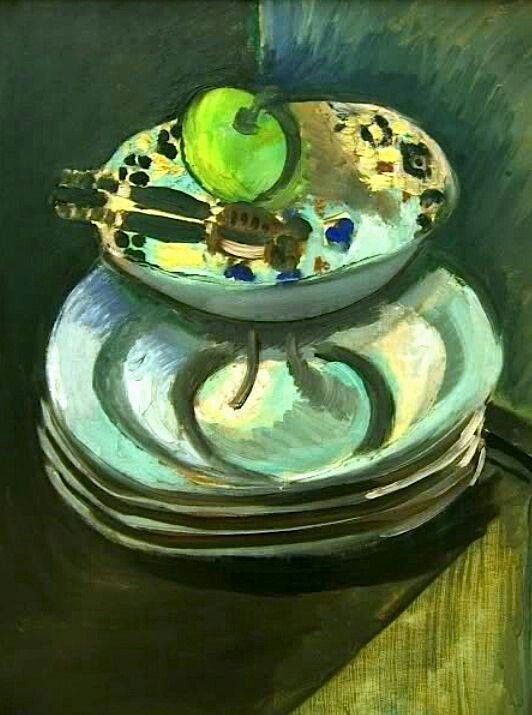
Henri Matisse’s “Still Life with Nutcracker” (1916) is a compact masterclass in how a handful of everyday objects can be orchestrated into a complete visual world. On a dark tabletop, a stack of cool, luminous plates supports a shallow pedestal bowl. In that bowl a green apple, a small patterned utensil, and the namesake nutcracker sit among reflections that look almost like stained glass. Nothing extraneous intrudes. Matisse pares the scene to essentials—ellipses, arcs, and a few tuned color notes—and lets relationships of shape, value, and temperature do the expressive work. The result is at once intimate and monumental, a domestic arrangement transformed into architecture.
Historical Context
The painting belongs to Matisse’s wartime phase of 1914–1917, a period marked by reduction and structural clarity. After a decade of high-chroma Fauvism and the luminous experiments of his Moroccan journeys, Matisse tightened his palette and concentrated on the foundations of pictorial design. Interiors became fields of large, measured planes; portraits turned masklike and essential; still lifes were rebuilt from decisive forms. “Still Life with Nutcracker” shares the discipline of these years while preserving the sensual promise of color and surface that had always been central to Matisse’s art. It is a table-sized demonstration of his broader project: discover how little is needed for the image to feel inevitable.
First Impressions
From a few steps back the picture reads as a strong vertical stack. Four or five plates overlap in a glowing column that rises from the lower edge like a pale totem. Perched on top, a shallow dish or tazza presents a single apple and the dark, compact nutcracker. The setting is almost nocturnal—deep greens and near-blacks absorb light at the corners—so that the ceramic forms appear to generate their own radiance. The apple’s clean green and the bowl’s patterned highlights draw the eye first; then the spiraling ellipses of the stacked plates pull the gaze down and back up again. In spite of the stillness, the painting feels active, as if the tabletop were breathing.
Composition and Geometry
Matisse builds the composition from concentric ellipses set on a quiet axis. The plates describe a set of nested ovals, each slightly offset, whose rhythms create depth and forward thrust without linear perspective. The pedestal bowl sits exactly where the stack’s energy culminates, its thin stem drawing a graceful S that connects the plates’ shadows to the bowl’s underside. The apple and nutcracker form a compact diagonal inside the bowl, a small-scale counterpoint that keeps the top from reading as a static crown. Negative spaces matter: the dark triangular wedge at lower right and the shadowed corner behind the bowl are shaped with as much care as any object, bracing the stack like wedges in a sculpture.
Color Architecture
The palette is disciplined and striking. Almost everything is made from cool families—sea-greens, bottle greens, blue-grays—set against a ground of near-black. Into this climate Matisse introduces sparing warmth: a few buff and ochre notes in the bowl’s patterned interior, small champagne highlights where glaze catches light, and the apple’s juicy green leaning subtly toward yellow at the crown. These decisions keep the picture from chilling. The cool contentment of porcelain is animated by the apple’s freshness and the nutcracker’s burnished brown. Color works less as description than as temperature control; each zone is tuned so that the whole feels luminous but not brittle.
Light and Value
No spotlight is mapped across the scene; instead, Matisse assigns values to surfaces so the picture glows from within. The plates do most of the lighting. Thick, high whites ride along their rims, while blue-gray half-tones curve into the wells, creating a clear sense of volume with very few steps. The bowl’s interior features a constellation of reflective patches—light blue, white, straw yellow—that read as mirrored fragments of the room. The apple is modeled economically, a soft transition from a lighter cap to a darker flank, with a single crisp accent along the edge where it meets the bowl. The nutcracker is a compact middle-dark, its solidity emphasized by the bright field around it. Value contrasts are placed not to simulate a single light source but to create a stable, legible architecture.
Brushwork and Surface
The painting’s surface is legible as paint and that legibility carries meaning. In the ground, long diagonal strokes sweep color like a velvet nap, ensuring the darks remain active rather than dead. On the ceramics, Matisse shifts to shorter, stacked strokes that travel along the ellipses, allowing the glaze to feel both hard and luminous. The apple’s skin is rubbed in a round touch that suggests tautness without describing texture. Look closely at the bowl’s highlights and you’ll see quick knife-like slivers and thicker ridges of impasto; these small differences make the interior sparkle. Throughout, the brush is economical. It states only what is needed for the eye to complete the rest.
Drawing and Edge
Edges in this picture are alive. The plate rims are reinforced by brisk, dark lines that thicken and thin as they move, a calligraphy that gives the stack weight. The bowl’s stem is drawn with a flexible contour whose slight wobble acknowledges the speed of a painter’s hand. The apple’s edge sharpens where it meets bright glaze and softens where it recedes into shadow. The nutcracker’s outline is the tightest in the painting, a deliberate choice that ensures its small mass holds its ground atop the shimmering bowl. These varied edges act as the score the color follows, setting rhythm across the surface.
The Nutcracker as Motif
The title singles out the nutcracker, and for good reason. Amid luminous ceramic and fruit, it is the only frankly mechanical form, a compact tool whose jaws and hinge are compressed into a small, dark glyph. Its presence folds function into the still life’s lyricism. The nutcracker is not lovingly detailed, yet its silhouette and little notches are sufficient to make it legible at once. As a motif it adds a note of potential action—a thing made to exert pressure and split a shell—contrasting the cool repose of porcelain and the soft life of the apple. It also anchors the bowl’s interior pattern, preventing the reflections from drifting into pure abstraction.
The Stacked Plates and the Pedestal Bowl
Ceramics are the painting’s protagonists. The stacked plates are not identical; each ellipse tilts a little differently, and each rim carries a unique cadence of highlight and shadow. Those differences keep the tower from stiffness and let your eye step down and up as if on stairs. The pedestal bowl is a delicately balanced form, its shallow dish floating on a narrow stem that meets the plates with a small, curved foot. Matisse knows that the psychological “weight” of a bowl depends on these curves. He exaggerates the bowl’s inner reflections so the dish seems thin and glazed, then grounds it with that sturdy little stem. The effect is poised rather than precarious.
Space and Depth
Depth is shallow and designed. The right-hand corner of the tabletop offers just enough plane to situate the stack; beyond that, darkness swallows detail. Overlaps do the rest: plate over plate, stem through shadow, bowl over stack. The corner behind the bowl creates a faint, almost architectural niche, helping the topmost forms to stand forward. This compression keeps the painting close to the decorative ideal—an active surface in which figure and ground belong to the same order—while preserving enough spatial cues for the objects to feel graspable.
Pattern and Reflection
The interior of the bowl contains a small world. Broken patches of straw, cream, black, and cobalt punctuate the pale ground like pieces of inlaid tile. These may be reflections from a patterned cloth, a real decoration on the bowl, or a deliberately ambiguous hybrid of both. Matisse uses them to test the threshold where representation blurs into pure design. They echo the apple’s green in the form of cool mint flecks and return the dark of the nutcracker in tiny ovals. This micro-patterning concentrates activity at the very top of the stack, crowning the composition with a field of lively color.
Evidence of Process and Revision
Pentimenti—traces of change—animate the painting. Along the lower rims slight halos reveal earlier placements of the plate edges. The stem’s left contour carries a faint ghost where it was shifted, and the apple’s highlight sits over a slightly darker underpaint, proof of adjustment. These marks don’t disturb the final clarity; they give it credibility. We sense that the painting’s ease is achieved through decisions, not formula.
Dialogue with Matisse’s Other Still Lifes
“Still Life with Nutcracker” speaks to several neighbors in Matisse’s oeuvre. The cool porcelain and carefully tuned whites recall “Still Life, Peaches and Glass,” where a tumbler carried the interior light. The compressed tabletop and purposeful darks relate to the 1914–1916 window interiors, in which black planes steadied bright accents. Compared with the elaborate homage to Dutch Baroque in “Still Life after de Heem’s ‘La Desserte,’” this canvas is concise and modern, exchanging abundance for essentials. Yet all share a common conviction: that order and delight can arise from everyday things when color and contour are exact.
Modernity and Tradition
At first glance the painting seems unassuming; with attention, it reveals its modernity. Classical still life favored textures, reflections, and anecdotal detail; Matisse favors structure. He does not count the facets of porcelain or the ridges of fruit; he sets a few values and edges so that porcelain and fruit declare themselves without boasting. At the same time, he honors the old still-life virtues: a balanced arrangement, a sensitive accounting of light, and objects presented with dignity. The conversation between past and present happens quietly in the way the plates’ ellipses echo the bowl’s, in the way a single apple can balance a stack.
Symbolic Readings Without Allegory
The painting resists overt symbolism but invites subtle readings. The nutcracker—instrument of force—shares a stage with a single unbroken apple. The stacked plates suggest readiness for company yet sit unused. Inside a wartime year, these objects could carry hints of restraint and potential. Matisse leaves such meanings unforced. If there is a theme, it is the sufficiency of attention: when you look intensely and arrange patiently, ordinary things become more than enough.
How to Look
Begin by letting the entire stack resolve as a single vertical mass against the near-black ground. Notice how the top bowl punctuates that mass like a crest. Then dwell on the plates’ rims, tracing their changing widths and highlights until the rhythm becomes musical. Shift to the bowl’s interior and allow the mosaic of small patches to clarify as reflection and decoration. Rest on the nutcracker and feel how its compact darkness steadies the swirl of light around it. Finally, return to the apple’s green and register how it carries warmth through a cool climate. Moving between near and far makes the painting deepen; it thrives on that oscillation.
Lessons in Economy
This canvas offers practical lessons for painters and designers. Reduce the palette and gain control over temperature. Let whites be many rather than one. Build cylinders and dishes with tuned ellipses, not fussy shading. Use negative space to steady bright forms. Crop decisively so small formats feel immediate. Above all, make relations, not inventories. When the ellipse of the top bowl answers the ellipses of the plates and when the apple’s green balances the surrounding sea of cools, the image breathes on its own.
Conclusion
“Still Life with Nutcracker” is small in subject and large in consequence. A stack of plates, a shallow bowl, a tool, and a single apple are arranged with such structural tact that they become more than objects; they become a grammar of painting—ellipse, edge, value, and temperature—spoken with clarity. The work demonstrates Matisse’s wartime ideal: calm, exact relations that carry light without spectacle. More than a century later, the painting still reads as fresh because it trusts essentials. It teaches that when forms are tuned and whites are alive, everyday things can hold the weight of art.