Image source: wikiart.org
Introduction
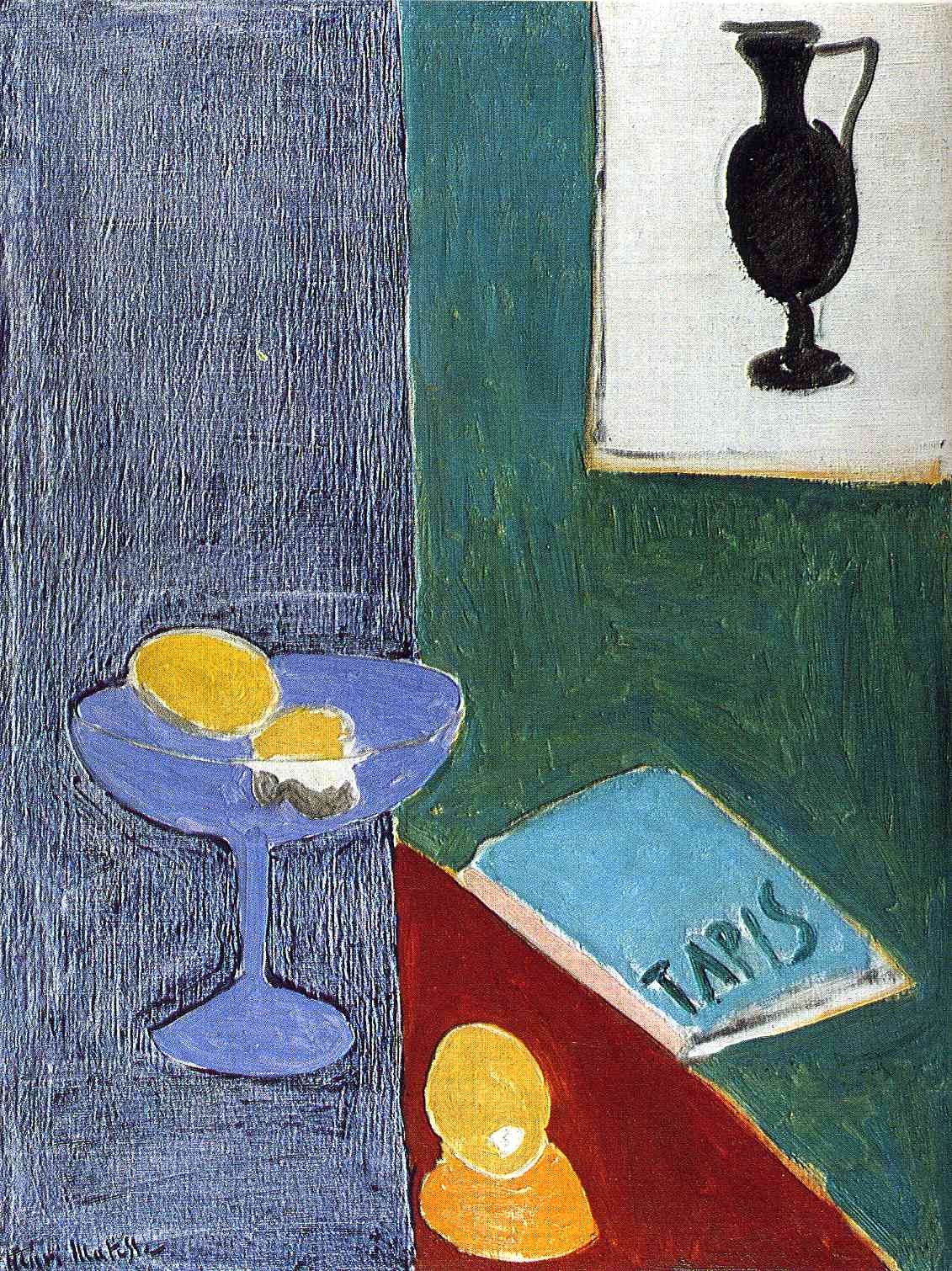
Henri Matisse’s “Still Life with Lemons” (1914) compresses an entire room’s atmosphere into a handful of tuned planes and a few decisive objects. A violet-blue field on the left hosts a tall glass coupe with lemons. A red diagonal wedge of tabletop cuts in from the bottom center like a stage ramp. To the right, a green wall carries a framed silhouette of a jug and a pale blue book whose cover reads “TAPIS.” A single lemon segment, set on a small orange base near the bottom edge, glows like a lamp. With scarcely any modeling, Matisse turns color into architecture, contour into structure, and omission into active light. The painting is at once austere and playful, an object lesson in how modern still life can speak through relations rather than description.
Historical Moment
Painted in the charged months of 1914, this canvas belongs to Matisse’s prewar suite in which he pared the language of painting to essentials. The exuberant Fauvist palette of the previous decade had given way to a stricter grammar: large color planes, bold contours, shallow space, and unblended strokes that leave the weave of the canvas visible. In portraits such as “Woman on a High Stool,” interiors like “View of Notre Dame,” and studio scenes featuring bowls of fish, Matisse tested how few marks could sustain a whole. “Still Life with Lemons” shares that rigor but keeps the domestic warmth of the studio—fruit, a glass, a favorite book, a small picture on the wall—pressed into a disciplined design.
First Look and Layout
The composition divides into three dominant fields: the textured violet-blue expanse on the left, the saturated red isosceles wedge that climbs diagonally through the center, and the deep green wall on the right. Each plane is cut cleanly by a dark linear seam that reads as a corner or table edge, so the image announces its flatness while describing a real interior. Objects sit at the seams where planes meet. The coupe straddles the boundary of blue and red; the lemon on an orange stand punctuates the lower edge of the red; the book lies on the green plane, tilted to catch the light and to echo the table’s diagonal. The framed silhouette above balances the glass below, a “picture within the picture” that turns the wall into a second still-life shelf.
Color Architecture and Temperature
Matisse organizes the painting with a triad of dominant hues—blue, red, and green—supported by small accents of yellow and orange. The violet-blue field is cool and textural; it pushes back and acts as a stage for the coupe. The red triangle is warm and forward, a device that locks the bottom of the canvas and energizes the arrangement. The green wall mediates the two while carrying the highest density of things: the book’s pale cyan cover and the black silhouette both ride the green like clear notes in a deeper chord. Against this climate, the lemons blaze in yellow, their warmth intensified by proximity to blue and red. Color does not describe surfaces in the academic sense; it creates a climate in which the few objects can read unequivocally.
The Lemons and the Coupe
The coupe is drawn with a single, confident ellipse and a stem that thickens as it nears the foot, an elegant translation of glass into contour. Inside, Matisse sets two lemon forms and a pearly white highlight to suggest reflection and pulp. The fruit are not modeled with delicate gradations; their identities are declared by shape and placement. The larger lemon’s oval leans toward the left lip of the coupe, establishing a counterweight to the diagonal table. A smaller lemon or lemon half nestles beside it, creating an internal cadence of large and small. The clarity of the coupe’s drawing makes the vessel a measuring instrument for the whole image: it fixes the scale, confirms the horizon, and teaches the eye how to read the remaining shapes.
The Red Table Wedge
The diagonal table wedge may be the most structurally important element in the painting. It converts a static arrangement into a dynamic one by sending energy from the bottom edge toward the upper right. Its sharply cut edges insist on the picture plane even as they imply depth. Where the red meets the blue, the coupe’s bowl sits astride the seam; where the red meets the green, the book and the small lemon-on-stand take over the rhythm. The color itself—a rich, slightly browned crimson—answers the complementary yellow of the lemons and turns their freshness incandescent. As a design device, the wedge acts like a stage ramp, leading the viewer into the set and then up toward the wall.
The Green Wall and the Framed Silhouette
The green plane is more than background; it is an active surface whose brushwork runs laterally, knitting the field into a single fabric. On it hangs a framed drawing or print: a black silhouette of a slender-handled ewer on a pale ground. The silhouette acts as the whole painting’s thesis. It announces that contour and mass can carry identity with minimal description and that black against light is as legible as any modeled volume. As a “picture within the picture,” it mirrors Matisse’s method on a smaller scale, reminding us that the studio is a place where images circulate and are remade.
Texture and Brushwork
Every field in the canvas has its own tactile voice. The violet-blue at left is combed with vertical ridges, letting the white ground flicker between strokes. This grain turns the color into a living atmosphere and resists slickness, which would have competed with the glass’s clarity. The red wedge is more opaque but still shows directional brushing that drives the diagonal. The green wall varies between short, square strokes and longer passes, enough variation to keep the plane breathing. The handling is never fussy. Paint is thin where light is meant to shine and slightly thicker where edges must hold. The result is a surface that tells the story of its making while remaining calm enough to serve the objects.
Space, Depth, and Modern Flatness
Depth here is shallow and deliberate. Matisse uses overlap and the meeting of planes to establish believable space without classical perspective. The coupe overlaps the seam between blue and red; the book overlaps green; the lemon-on-stand sits on the red wedge’s floor. Shadows are minimal or entirely omitted, keeping the composition closer to a decorative panel than to a traditional still life. This flatness is not a denial of space but a way to let surface rhythms—color blocks, lines, textures—share equal authority with the impression of volume.
The Book Titled “TAPIS”
The blue book on the green wall carries the word “TAPIS,” French for “carpets,” a nod to Matisse’s devotion to textiles, particularly North African and Islamic carpets that had transformed his understanding of pattern and surface. Placing the book in the still life acknowledges the decorative ideal that underwrites the whole painting: a picture should function like a woven field in which every part contributes to the balance of the whole. The book’s tilted cool blue also mirrors the coupe’s color, linking the object world on the wall to the object world on the table.
The Little Lemon on a Stand
Near the bottom edge, a lemon segment sits on a small orange base, as if in an egg cup. This modest accent is rhythmically crucial. It repeats the lemon’s yellow and the coupe’s roundness at a smaller scale while catching the red wedge’s heat. Its proximity to the signature area helps weight the lower composition and keeps the eye from leaping directly to the wall. Because it is isolated, the tiny lemon reads as a lamp or jewel, concentrating the painting’s warm light in a single, memorable point.
Balance, Proportion, and Edges
The painting’s poise derives from its measured proportions. The blue and green fields are nearly equal in width, with the red wedge functioning as a tapering mediator. Objects are scaled to their fields: the coupe is tall and airy against the textured blue; the book is squat and secure on green; the silhouette is upright and compressed within its frame. Edges are a language: some are softly negotiated, like the inner rim of the coupe; others are cut with a palette knife or tight brush, like the border of the red wedge and the frame of the wall picture. The alternation of soft and hard keeps the surface musical.
Relation to Contemporary Works
“Still Life with Lemons” sits neatly among Matisse’s 1914 explorations. Like “Interior with a Bowl with Red Fish,” it stages a small drama of containers and vibrant color inside a cool room, but here the palette is even more reduced and the objects more emblematic. Like “View of Notre Dame,” it builds the scene from large planes interrupted by clear lines. And like “French Window at Collioure,” it presses the subject toward abstraction without sacrificing recognizability. The painting shows Matisse working on the fulcrum between the real and the constructed, where a lemon is both a piece of fruit and a yellow oval chosen with care.
Mood and Inwardness
Despite its bright objects, the canvas has a reflective calm. The cool blue and green set a private studio mood, a space of quiet examination. The red wedge provides warmth without noise. The framed silhouette on the wall suggests past looking and future work; the book points to sources and influences; the lemons, fresh and unpeeled, suggest immediacy. The painting’s restraint—no crowds of objects, no ravishing fabrics—allows the viewer to attend to intervals, to the felt distances between things, and to the way color can stand in for breath and light.
How to Look
Begin by letting the big planes settle: blue left, green right, red diagonal. Move to the coupe and watch how the ellipse holds the bowl as the lemons press against the rim. Trace the seam where blue meets red and feel how the glass mediates the junction. Step across the wedge to the small lemon-on-stand and note how its glow consolidates the lower field. Drift up to the book and discover how its cool tone repeats the coupe’s blue while the word “TAPIS” tilts toward the diagonal. Finish at the framed silhouette and register its statement about form: a jug can be a black shape and still be a jug. Step back and let the scene return to a tapestry of planes whose balance carries the whole.
Legacy and Influence
This painting helped codify a way of building still life that many twentieth-century artists would adapt: privilege large color fields; reduce objects to emblematic silhouettes; use texture to keep planes alive; let a few warm accents organize the climate. It also anticipates Matisse’s later paper cut-outs, where bowls, leaves, and vessels become pure shapes pinned to fields of color. “Still Life with Lemons” thus stands as both a culminating statement of his prewar rigor and a signpost pointing toward the radical simplifications to come.
Conclusion
“Still Life with Lemons” demonstrates how a few necessary relations can replace encyclopedias of detail. Blue, red, and green planes lock together like pieces of a calm, modern tapestry. Lemons, glass, book, and silhouette become actors in a measured drama where color sets the air, contour bears the weight, and texture keeps the room breathing. The result is a still life that feels freshly arranged each time one looks, as if the studio had been tidied not for display but for clear seeing. More than a century later, Matisse’s economy still feels generous, his restraint still luminous, and his lemons still bright with the promise that painting can turn the ordinary into a durable architecture of light.