Image source: wikiart.org
Introduction
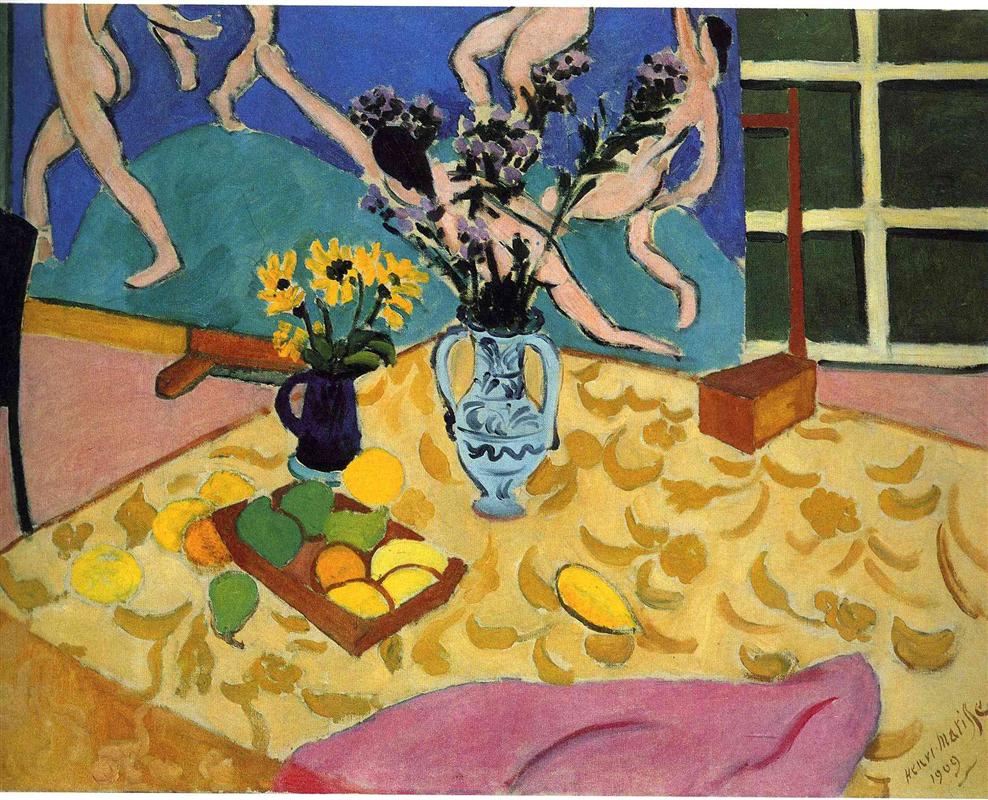
Henri Matisse’s “Still Life with ‘Dance’” (1909) is a thrilling conversation between two kinds of painting that he was refining at the same moment: the intimate tabletop still life and the monumental decorative panel. On a patterned yellow tablecloth, vases and fruit sit with unforced gravity. Behind them, a canvas-within-the-canvas shows the whirling nudes of “Dance,” the great theme Matisse was developing for an architectural commission. The juxtaposition is not a studio anecdote; it is a statement of method. The small things of a room—lemons, a wooden box, stems of flowers—are orchestrated with the same clarity and rhythmic conviction as the mythic bodies on the blue ground. Across the surface, Matisse binds near and far through color chords, counterposed geometries, and a decorative logic that turns the whole picture into one breathable fabric.
A 1909 Language of Order After Fauvism
By 1909 Matisse had tempered the blazing shocks of early Fauvism into a calm architecture of color. He discovered that a limited palette, placed with authority, could carry space, light, and feeling without descriptive modeling. “Still Life with ‘Dance’” shows that consolidation in action. The palette is disciplined—lemon yellows and ochres, ultramarine and lavender, sap greens, a few notes of terracotta, and the flesh-pinks of the dancers. Drawing is done with the brush; contours are declarative but supple. Most crucially, the painting admits no empty zones. Background, tabletop, and objects are coordinated as a single decorative order where every inch matters.
The Two Stages: Tabletop and Decorative Panel
Matisse cleaves the composition into two stages that interlock rather than compete. The front stage is the table, tilted forward to present its abundance. The rear stage is the large panel of “Dance,” propped on a stand so the ring of nudes sweeps across a blue sky and a green hill. Between them, a window grid cools the right edge with its olive panes, and a low plank ledge draws a pink horizon line that keeps the eye from sliding out of the room. The two stages narrate Matisse’s world: the studio as a site where lived objects and invented forms coexist, each clarifying the other.
Composition and the Architecture of the Table
The tabletop is a generous oval of patterned yellow, cropped at the lower edge to enhance immediacy. At center right sits a pale blue, decorated pitcher with tall purple flowers; at left a deep violet jug holds yellow blooms. A shallow wooden tray brims with lemons, oranges, and green fruit; a lone lemon lies to the right, and a folded pink cloth relaxes at the near edge. The wooden box near the window provides a quiet block of warm weight to counter the floral height. Objects are spaced like musical notes—no crowding, no vacuum. The eye moves from tray to jug to tall pitcher, then diagonally up to the dancers and back across the window, completing a circuit that feels inevitable.
Pattern as Ground and Atmosphere
The tablecloth is a tour de force of pattern used structurally. Golden arabesques roll across buttery yellow, echoing leaf and vine without literalizing them. The pattern does not sit as wallpaper under the objects; it rises around them, adjusting density to guide the eye. Where the fruit tray sits, the motifs thin so the warm wood and citrus tones carry; around the lone lemon, a subdued swirl functions like a halo; near the pink cloth, the pattern loosens into broad, restful shapes. Matisse uses ornament to distribute interest evenly while keeping the tabletop coherent as a plane.
The Still-Life Ensemble and Its Color Chords
Color relationships anchor the still life. The violet jug and yellow flowers form a complementary pair—cool vessel, warm bloom—while the pale blue pitcher vibrates gently against the yellow ground and green stems. The fruit offers a warm gradient from lemon to orange to the cooler greens of unripe skins. A single lemon appears outside the tray as a bright punctuation, proof that Matisse composes by intervals rather than by inventory. The pink cloth at the front edge softens the lower register and introduces the very tint that returns in the distant dancers’ flesh, linking table to panel.
The Inserted “Dance” and Its Rhythmic Echoes
The background panel is not a quotation for pride’s sake; it completes the room’s music. The pink nudes leap hand-in-hand against ultramarine, their bodies arcing across a green mound. Those curves rhyme with the arabesques on the tablecloth and the stems that rise in the central pitcher. Where the still life presents solids—the leaved bouquet, lemons, box—the “Dance” supplies pure motion. The two registers are thus complementary: a stable, tactile foreground and an airborne, emblematic distance, both kept to shallow depth so the surface remains continuous.
Counterpoint of Curves and Grids
Matisse stabilizes the swirl of dancers and cloth with geometric counterforces. The window’s rectilinear grid introduces a measured cadence of verticals and horizontals. The wooden box is a small, square chord, and the tabletop’s lip establishes a clean ellipse. Against these fixed structures, dancers, flowers, and pattern supply curved energy. The dialogue is audible everywhere: the vertical pitcher stands like a column while its tendrils and painted scrolls curl; the dark chair leg at far left answers the window mullions; the tray’s oblique edges slide against the table’s rounded perimeter.
Space as Shallow, Convincing Stage
Depth is constructed without illusionism. The table tilts forward more than perspective would allow, a deliberate choice that displays objects like a stage set. The panel of “Dance” sits just behind, its stand indicated by a few ochre and pink strokes. The window is not a view to distant landscape but a greenish plane, more wall than opening. Overlap and value are sufficient cues: the bouquet occludes the “Dance” panel; the box casts a modest shadow; a lemon half-overlaps a pattern curl. The room becomes a woven fabric of near and far, held on one surface.
Drawing With the Brush
Contours in this painting are confident and varied. The pitchers’ outlines swell and slim, catching the flare of the lip and the swell of the belly. Fruit is ringed with soft, decisive edges; the tray and box are squared by a few straight passes of the brush. The dancers are written with a darkish contour that holds flesh against the blue field. Everywhere the line feels musical—never mechanical, always responsive to the turn of form. Because the line is so sure, the color planes remain broad and legible, and the eye is never forced into fussy modeling.
Light As Color Relation
There is no single theatrical light source. Illumination arises from color relations: lemon against violet jug; pale blue against buttery yellow; flesh pink against ultramarine; ochre box against green window. A few placed highlights—on a pitcher’s shoulder, on the woody lip of the tray, on a lemon’s rind—suffice to kindle the sense of sheen. Matisse’s light is constructed, not described; it is the outcome of exact adjacency rather than the mimicry of optics.
The Flowers as Conductors of Vertical Energy
The bouquets are more than decoration; they are conductors that carry energy between table and panel. The yellow daisies in the dark jug echo the lemons’ chroma while their upright stems puncture the tabletop’s horizontal calm. The taller purple blossoms in the central pitcher arc upward into the blue of “Dance,” literally touching the panel and fusing the two stages. Their stems, drawn with flexing lines, create a visual metronome that keeps time between the dancers’ leaps and the still life’s repose.
The Wooden Box and the Discipline of Rest
At first glance the small ochre box seems a humble prop. Compositionally, it is vital. Its simple geometry offers a needed rest amid floral complexity and patterned swirl. Set just before the window grid, it locks that corner and prevents the blue panel’s action from spilling unchecked to the right edge. Its warm orange also links the table’s yellows to the distant pinks of the dancers, knitting the color field.
The Pink Cloth and the Human Trace
At the near edge, the folded pink cloth appears casual, even offhand. It is, in fact, the painting’s most human trace: the sign of a hand that has just placed it, the sign of domestic life continuing around the art on the easel. Chromatically it performs subtle work. Its pink reprises the dancers’ flesh and the warm tones in the fruit; as a soft mass it counters the hard box and grid. It is also a small curtain that pulls us into the picture, inviting the touch that the lemons and pitchers quietly refuse.
Pattern, Repetition, and the Decorative Principle
What Matisse called the “decorative” is not an overlay but a principle of coherence. Repetition—of yellows in fruit and cloth, of curves in pattern and bodies, of rectangles in window and box—creates a web that distributes interest evenly. Differences within repetition keep that web lively: lemons vary in hue; cloth motifs change scale; dancers shift pose; window panes hold slightly different greens. The decorative in this sense is a discipline: it ensures that no patch of canvas is neglected and that every decision supports the whole.
Dialogue Between Studio and Myth
“Still Life with ‘Dance’” can be read as a manifesto about the studio as a site where everyday things and mythic images inform one another. The dancers do not loom over the still life; they converse with it. The circular rhythm of bodies sharpens our perception of the tablecloth’s arabesques; the tactility of lemons and crockery grounds the abstraction of the panel. Matisse declares that the same laws—balance, interval, clarity—govern both scales. The studio is not a mere container for art; it is the instrument by which art is tuned.
Evidence of Process and the Living Surface
The painting wears its making openly. In the blue panel, earlier edges of the green hill remain visible as halos; the window mullions cut slightly into the surrounding paint; the table’s pattern shows the drag of a semi-dry brush. On the lemons, undercolor peeks through where Matisse adjusted placement. These traces do not read as indecision; they read as the record of arriving at right relations. The final calm is earned, not polished into anonymity.
Relation to Sister Works of 1909
The canvas sits in direct conversation with “Harmony in Red” and “Still Life with Blue Tablecloth.” In those works, wall and table merge into a continuous patterned plane. Here, the concept is extended: the patterned table occupies the foreground while a large decorative painting shapes the background climate. The room itself becomes a polyphonic instrument, its components tuned to the same key. The ring of dancers anticipates the monumental panels of 1910, while the tabletop ensemble distills the domestic clarity Matisse would pursue throughout his career.
Psychological Temperature and the Promise of Rest
Despite the lively dancers and the bright fruit, the mood is restful. The blue in the panel and the window cools the atmosphere; the yellows are buttery rather than shrill; the compositions of vases and box are poised. Matisse’s oft-cited desire for an art that offers balance and serenity—“like a good armchair”—is realized without blandness. The picture invites prolonged looking and rewards it with gentle discoveries of relation: a lemon answering a necklace of dancers, a curve in a cloth echoing a thigh, a window pane stabilizing a vase.
Why the Picture Still Feels Fresh
The painting remains contemporary because it trusts a few strong ideas and carries them through with conviction. Place objects on a tilted stage; set a large decorative image behind; tune color to a limited chord; let pattern unify; keep depth shallow; draw with the brush; show the record of making. These choices belong as much to today’s design grammar as to 1909 painting. The image reads instantly and deepens slowly, which is the hallmark of durable visual invention.
Conclusion
“Still Life with ‘Dance’” proves that Matisse’s decorative vision could hold both the modest and the monumental in a single frame. Lemons, a jug, flowers, cloth, and a small wooden box share the room with a circling company of nudes, and nothing crowds anything else. Color carries light; contour conducts rhythm; pattern distributes attention; geometry steadies motion. The painting embodies a generous order: the mythic is made neighbor to the everyday, and the ordinary becomes radiant through exact relation. It is a portrait of a studio mind at work and a demonstration that harmony is not the absence of difference but the right choreography of parts.