Image source: wikiart.org
Claude Monet’s Early Still Life and the Surprise of Restraint
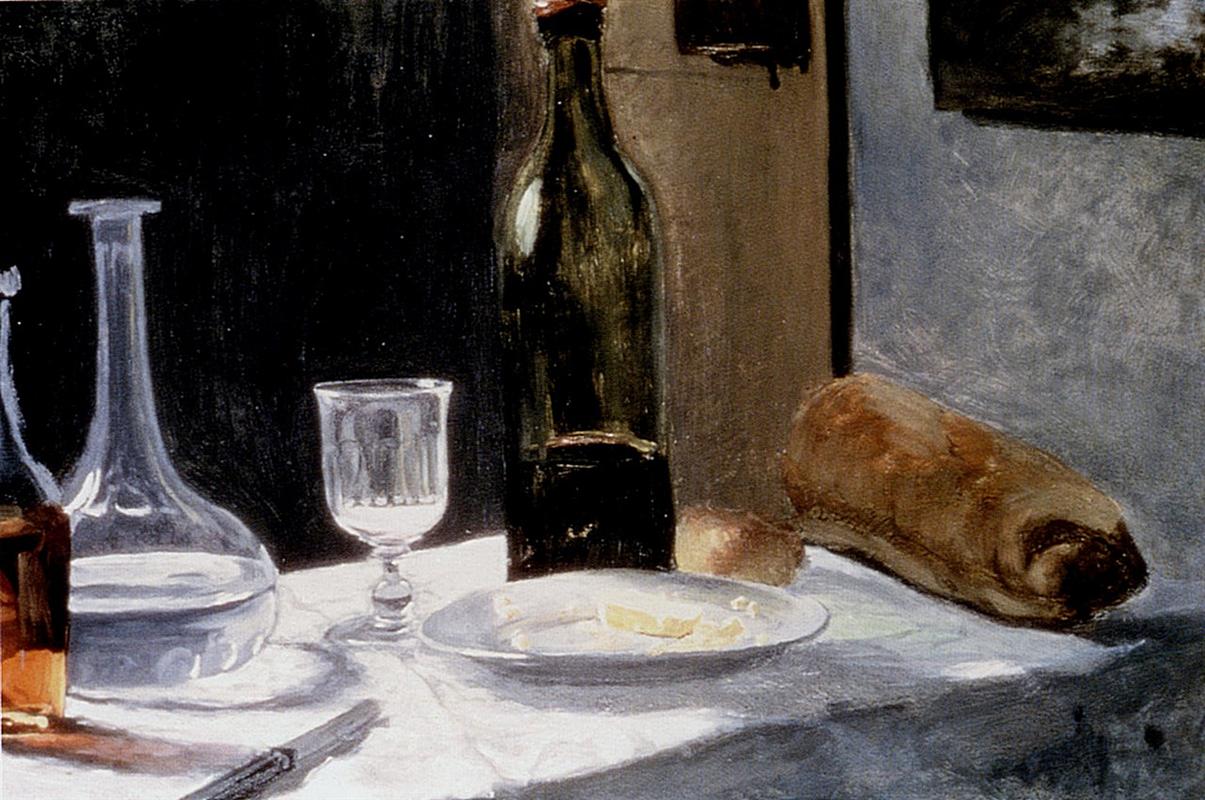
Claude Monet is most often associated with open air painting, broken color, and the shimmering effects of atmosphere that would later define Impressionism. Because of that, an early work like Still Life With Bottles can feel unexpectedly intimate. Instead of riverbanks, gardens, or bustling modern life, this painting gives us a small arrangement of ordinary things placed on a white tablecloth in a dim interior. A decanter, a glass, two bottles, a plate, an onion, and a loaf of bread become the entire drama. The result is quiet, concentrated, and deeply revealing.
Painted in 1863, this work belongs to a formative moment in Monet’s development. It shows an artist looking carefully at the physical world and learning how much can be expressed through simple objects, controlled lighting, and subtle relationships of surface and tone. Even though the painting does not yet display the bright, flickering palette of his mature work, it already shows his fascination with perception. He is not merely listing objects. He is studying how light settles on glass, how a white cloth turns blue and gray in shadow, and how ordinary things acquire dignity when observed with enough attention.
What makes this painting especially compelling is that it does not rely on abundance or decorative complexity. Many still lifes overwhelm the eye with fruit, flowers, silverware, elaborate fabrics, or symbolic detail. Monet chooses restraint instead. The composition is sparse. The colors are limited. The setting is unadorned. Yet this restraint gives the painting unusual power, because it directs the viewer toward the essentials of seeing. We become aware of transparency, reflection, weight, and silence. The painting teaches us to look slowly.
The Arrangement of Objects and the Logic of the Composition
At first glance, the arrangement appears casual, as if the objects were simply left on the table after a meal. But the composition is carefully balanced. Monet organizes the scene through a sequence of vertical and horizontal relationships. The bottles and glass rise upward from the tabletop, creating a series of upright forms that anchor the image. The table itself stretches across the foreground, its white cloth forming a broad plane of light that supports everything else. The loaf of bread on the right introduces a rounded horizontal mass that counters the vertical emphasis of the bottles.
The eye tends to move from left to right in a gentle rhythm. It begins with the pale decanter, travels to the smaller glass, then to the dark central bottle, then to the lighter brown zone in the background, and finally comes to rest on the bread at the far right. This movement is not abrupt. It feels natural, almost conversational. Each object is given enough space to be recognized individually, yet each contributes to a larger whole.
The central bottle plays a particularly important role. It acts almost like a visual pillar, dividing the composition while also unifying it. Its dark body contrasts sharply with the tablecloth and helps establish depth. Without it, the arrangement might feel too dispersed. With it, the painting gains structure and gravity. The bread on the right provides a secondary anchor, one that is softer and more organic. Together, the bottle and bread create a dialogue between rigid and rounded form, between glass and food, between vertical stillness and horizontal repose.
The plate near the center foreground is also crucial. It sits low and wide, preventing the composition from becoming too top heavy. It acts as a kind of visual pause, a calm shape that receives the surrounding light and holds the scene together. Even the onion near the back right has a compositional function. It adds a small but important note of warm color and helps connect the bottle to the bread.
This is a painting built on measured spacing, thoughtful contrast, and careful equilibrium. What looks simple is actually highly controlled.
Light as the Real Subject
The objects in this painting matter, but light matters even more. Monet uses the still life format as a means of studying illumination and reflection. The white tablecloth becomes the stage on which light performs. It is not simply white. It contains cool blues, silvery grays, pale violets, and warm cream tones. These shifts give the cloth life and make it one of the most expressive surfaces in the painting.
The glass objects are even more dependent on light. The decanter at the left is defined less by contour than by transparency and reflection. Monet shows its presence by painting the way it bends and catches the light around it. The same is true of the goblet near the center left. The glass is visible because of the subtle shifts of tone within it, the pale highlights on its rim and stem, and the darker shapes seen through its transparent body.
The central bottle absorbs and reflects light differently. Unlike the decanter, it is darker and more opaque, yet it still carries gleaming highlights that suggest smooth curved glass. Its reflective surface creates a strong contrast with the matte softness of the bread and the cloth. Through these differences, Monet explores the character of materials. Light does not behave the same way on every surface. It shines, diffuses, glows, or disappears according to texture and density.
The background also plays an important part in the painting’s lighting scheme. It is dark on the left and lighter on the right, which creates an asymmetrical atmosphere. This contrast helps the pale objects stand out while also giving the scene a sense of enclosure. The left side feels deeper, more shadowed, more mysterious. The right side, though still subdued, opens slightly into a paler wall. This variation prevents the background from becoming a flat backdrop. Instead, it contributes to the painting’s quiet drama.
In many ways, light is what transforms this simple arrangement into something memorable. Monet is showing that even the humblest objects can become visually rich when light reveals their differences. What could have been merely descriptive becomes poetic.
The White Tablecloth and the Art of Subtle Color
One of the most impressive aspects of Still Life With Bottles is Monet’s handling of the white tablecloth. White is rarely just white in painting, and this work demonstrates that principle beautifully. The cloth becomes a field of delicate color relationships. Its brightest passages glow with cool illumination, while its folds and receding areas dissolve into gray blue shadow. These variations keep the surface from feeling inert. Instead, the cloth seems to breathe with light.
This attention to tonal nuance shows Monet’s sensitivity to optical truth even at an early stage in his career. He understands that white surfaces pick up surrounding colors and that shadow has its own chromatic richness. The cloth reflects the coolness of the glass, the darkness of the bottle, and the warmer tones of the bread and onion. Because of this, it becomes the site where the whole painting comes together.
The same subtlety appears in the wall and background. Rather than using flat brown or black, Monet builds the space through modulated neutrals. The darker left side contains deep blacks softened by brushwork and tonal variation. The right wall carries gray and blue tones that echo the cloth. This creates harmony across the painting and keeps the contrast from becoming harsh.
The limited palette is a strength, not a limitation. By restricting himself, Monet forces the viewer to notice small differences. A pale highlight becomes more meaningful. A warm brown passage in the bread becomes more vivid. A hint of gold in the bottle neck becomes more noticeable. The painting gains refinement because it does not shout. It invites concentration.
This is one reason the work feels so mature despite its early date. Monet is already interested in painting as an art of relationships. Color is not used here for spectacle. It is used to organize perception, to connect objects, and to deepen atmosphere.
Glass, Bread, and Onion, Material Contrast in the Still Life
Still life painting often thrives on contrast between materials, and Monet takes full advantage of that tradition here. The most striking opposition is between glass and bread. The glass vessels are hard, cool, and reflective. The bread is dense, warm, and absorbent. One catches the room around it, the other holds its own quiet solidity. By placing them in the same composition, Monet invites us to compare the visual behavior of unlike things.
The decanter is especially finely observed. Its broad base and narrow neck give it elegance, but what really defines it is the way light travels through it. It holds liquid, and that liquid alters the shape of the reflected light. The result is both descriptive and painterly. We recognize the object at once, yet we also become aware of the abstract beauty of its highlights and contours.
The goblet, smaller and lighter, adds another variation on transparency. It is more delicate, less imposing than the bottle, and its presence introduces refinement into an otherwise plain setting. The bottle in the middle is heavier and more severe. Its darkness gives it authority. It feels like the visual center of gravity, not just because of where it stands, but because of how much tonal weight it carries.
Then there is the bread, one of the most human objects in the painting. It is humble, nourishing, and tactile. Monet paints it with a softness that contrasts with the crisp reflections of the glass. Its crust has a muted warmth, and its rounded form suggests weight and substance. The onion nearby extends this sense of domestic reality. It is a small object, almost easy to miss, but it strengthens the atmosphere of everyday life. These are not luxury items arranged for display. They are familiar things from a lived interior.
The contrast between materials does more than create visual interest. It also shapes meaning. Glass suggests fragility and refinement. Bread suggests necessity and sustenance. Together, they form a still life that feels grounded in real life rather than theatrical display.
Brushwork and the Young Monet’s Method of Observation
Although this is not yet the loose, scintillating brushwork of Monet’s later years, the painting already reveals his painterly intelligence. The brushwork is controlled but not dry. He does not polish every edge into academic smoothness. Instead, he allows strokes to remain visible, especially in the cloth, the background, and the bread. These strokes give the painting vitality and keep it from feeling overfinished.
The dark background, for example, is built from layered brushwork that creates depth without excessive detail. The wall on the right is similarly handled with textured strokes that suggest plaster rather than describe it minutely. The cloth is painted with enough softness to convey folds and reflected light, but not so much finish that it loses freshness. Monet seems to be balancing accuracy with immediacy.
This balance matters because it points toward his later artistic direction. Even in a still life, he is interested in the act of seeing rather than in idealized perfection. He wants the painting to feel observed. The highlights on the glass are placed with care, but they are not overworked. The bread is solid, but not labored. The objects retain their material identity while also remaining part of a unified pictorial surface.
The handling of edges is especially telling. Some contours are sharp, particularly where contrast is strongest, while others soften into surrounding tones. This variation helps create a natural sense of focus. Our eyes do not see every edge with equal clarity, and Monet uses that fact to make the painting feel more true to experience. It is a subtle but important achievement.
The brushwork also contributes to the mood of the painting. Because it is neither rigid nor flamboyant, it supports the tone of quiet attention. The artist is present, but not intrusive. The painting feels thoughtful, steady, and sincere.
Mood, Silence, and the Domestic Interior
There is a strong sense of silence in Still Life With Bottles. The scene feels paused, as though someone has just left the table or is about to return. The meal is suggested but incomplete. The bread remains uncut. The wine bottle stands open. The glass waits. The plate is not empty, but not full either. This incompleteness gives the work emotional resonance. It feels like a fragment of ordinary life caught in stillness.
Unlike many still lifes that aim for abundance, luxury, or symbolic richness, this painting is modest and inward. Its mood comes from understatement. The dim interior, the simple meal, and the sparse arrangement all contribute to a sense of privacy. We are not looking at a display prepared for public admiration. We are looking at a quiet table in an enclosed room.
This mood aligns well with the intimacy of early realist painting. The subject is not grand, but it is serious. Monet treats these objects with respect. He does not sentimentalize them, but neither does he trivialize them. By painting them with such care, he suggests that ordinary domestic life deserves attention.
The emotional effect is subtle but lasting. The painting does not tell a story directly, yet it implies human presence through absence. Someone poured the liquid into the decanter. Someone placed the bread on the table. Someone may return to finish the meal. The still life becomes a record of use, a quiet reminder of daily habit and physical need.
This sense of lived reality is part of what makes the painting appealing today. It feels honest. It does not depend on spectacle or sentiment. It finds beauty in the everyday and dignity in the overlooked.
Early Monet Between Realism and the Future of Impressionism
As an early work, Still Life With Bottles occupies an interesting place in Monet’s artistic development. It belongs to a period before his name became synonymous with Impressionism, yet it already contains elements that would matter deeply in his later career. The painting is more subdued than the landscapes for which he is famous, but its core concerns are recognizably his. Light, surface, color relationships, and visual sensation are already central.
At the same time, the work reflects the influence of mid nineteenth century realism and studio practice. The indoor setting, the careful arrangement, and the somber tonal range connect it to traditions of still life painting that predate Impressionism. Monet is clearly learning from earlier models, including the long European history of representing domestic objects with seriousness and skill. He studies form, material, and tone with disciplined attention.
What makes the painting especially interesting is that it does not feel like a mere exercise. It is too resolved, too atmospheric, and too perceptive for that. It may be early, but it is not immature. Monet is already showing a personal sensitivity to how objects exist in light. Even the dark bottle has a luminous presence. Even the white cloth is a place of chromatic complexity. These qualities anticipate the later Monet, who would spend decades pursuing the changing appearance of the visible world.
In that sense, this still life helps broaden our understanding of him. It reminds us that the painter of haystacks and water lilies did not emerge fully formed. He arrived there through sustained looking, technical discipline, and close engagement with humble subjects. Paintings like this one reveal the roots of his later freedom.
Why This Painting Still Matters
Still Life With Bottles matters because it shows how much can be achieved through simplicity. It proves that a major artist does not need a spectacular subject to produce a compelling work. A few bottles, a glass, a plate, a loaf of bread, and a white cloth are enough. In Monet’s hands, these things become a meditation on light, matter, and stillness.
The painting also matters because it complicates the popular image of Monet. Viewers who know only his bright outdoor scenes may be surprised by the sobriety and restraint of this work. Yet that surprise is valuable. It reveals the depth of his practice and the seriousness of his early training. It shows that the later brilliance of Impressionism was built on a foundation of close observation and formal control.
There is also something enduringly attractive about the painting’s humility. In a culture that often values spectacle, this work offers concentration instead. It asks the viewer to slow down, to notice minor tonal shifts, to appreciate the difference between opaque and transparent surfaces, and to recognize beauty in simple arrangements. Its power unfolds gradually. The longer one looks, the richer it becomes.
Finally, the painting remains compelling because it feels human. The objects are ordinary, but they carry traces of life. The bread suggests nourishment. The bottle suggests use and gathering. The empty or nearly empty plate hints at time passing. These are simple signs, but they create an emotional atmosphere without forcing interpretation. The painting is quiet, but not empty.
That balance between material reality and poetic stillness is what gives Still Life With Bottles its lasting appeal. It is a modest work, yet a memorable one. It does not proclaim greatness. It reveals it slowly, through patience, light, and attention.