Image source: wikiart.org
Introduction
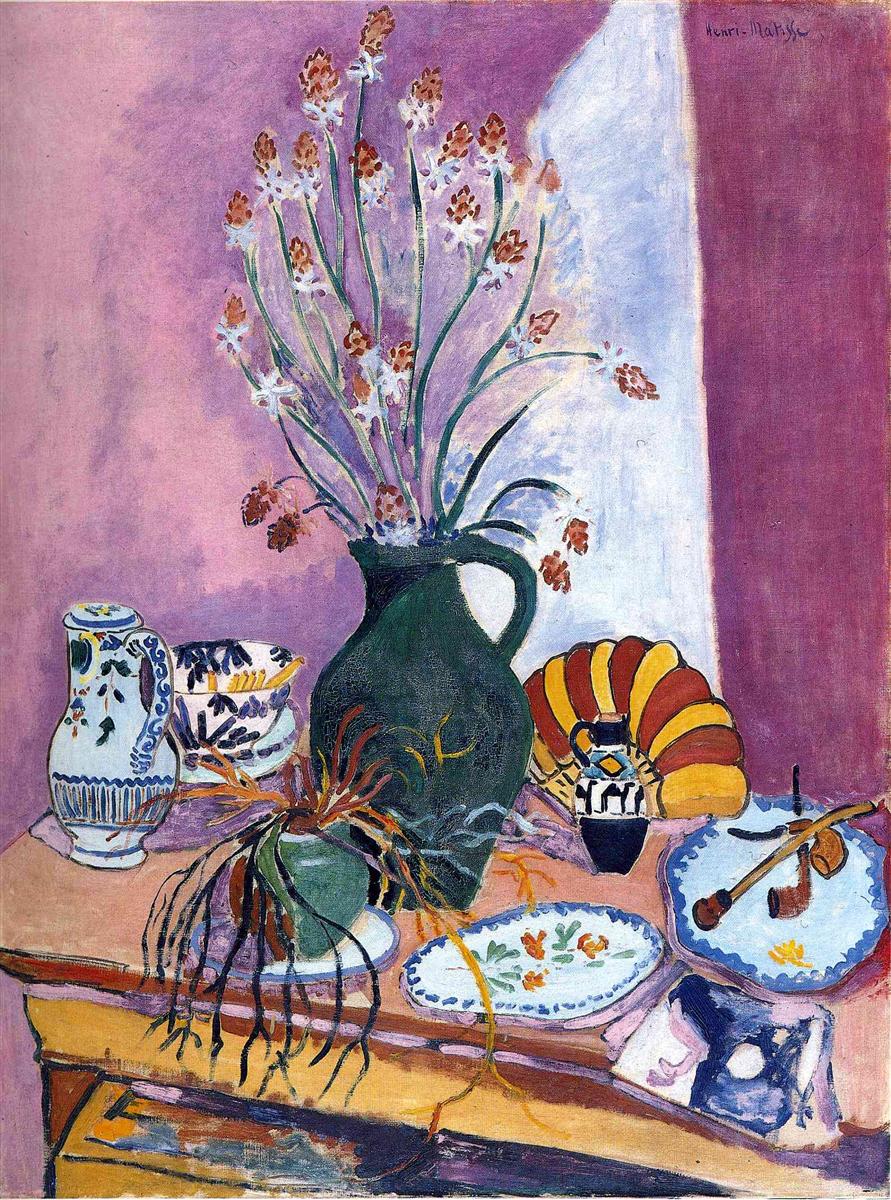
Henri Matisse’s Still Life with Asphodels (1907) transforms a tabletop arrangement into a stage where color, contour, and pattern perform with theatrical clarity. A tall green jug bearing spiky asphodel blooms anchors the center. Around it, ceramics, plates, a fan-like shell, a small violin and bow, and a potted plant with trailing roots are set on a diagonally pitched table. The background is divided into broad planes of mauve, lilac, and white, converting the room into pure fields of tone. This is not a quiet still life; it is a living composition where everyday objects become actors, and color does the work of light, volume, and mood.
Historical Context
The year 1907 marked a pivotal turn for Matisse. After the first blaze of Fauvism, he sought a new equilibrium that kept color bold while giving forms greater stability. Still Life with Asphodels belongs to this phase of consolidation. The palette remains audacious—violet walls, pink light, green-black silhouettes—but everything is orchestrated with a firmer architecture: objects are simplified, contours are purposeful, and the picture plane asserts itself as an organized field rather than an illusionistic window. The canvas anticipates later interiors where color subsumes space—works like The Red Studio—yet still retains the intimacy of a traditional still life.
The Central Motif: Asphodels
Asphodels rise from the green jug in wiry verticals that end in small, flame-like heads of white and russet. Matisse renders the stalks as swift green lines, letting their movement define the bouquet’s rhythm more than botanical exactness. Historically, asphodels had associations in classical literature with remembrance and the meadows of the underworld; Matisse does not turn the symbolism into narrative, but the flower’s spare, upright habit imparts a serious, almost heraldic presence. Their cool whites and rusty tips introduce a delicate counterpoint to the bolder plates and fan, and their arcing stems establish a tempo that runs through the entire composition.
Composition and Spatial Design
The tabletop tilts steeply toward the viewer, flattening space and making the objects read like shapes pinned to a decorative field. The tall jug stands just off center, its dark mass anchoring the lighter plates that flank it like satellites. The diagonal of the table edge thrusts from lower left to upper right, while the fan-scallop form at the right pushes back, creating a push-pull between advance and retreat. Nothing is strictly perspectival: plates are seen as ellipses from above, the violin lies across one plate as if on a stage, and the background wall is a set of color blocks whose meeting edges substitute for architectural lines. This deliberate compression of depth allows color and shape to dominate perception.
Color as Architecture
Matisse builds the room with color rather than linear perspective. The left wall is a velvety mauve that slides into a cooler violet toward the middle; the right wall is a more saturated plum, parted by a vertical shaft of white that reads as a window or light stripe. Across these planes, the deep green jug asserts itself like a column. A limited family of pastel pinks and purples connects foreground and background, while accents of yellow-orange in the fan and warm ocher in the tabletop provide heat. The plates’ blue rims and the blue-black drawing on the ceramics intensify nearby whites. Everywhere, color is not only description but structure: it tells us where things are and how they relate.
The Role of Contour
Black and dark green contours hold the composition together. They outline the jug, pick out the lobes of leaves, articulate the scalloped rims of plates, and nip the edges of petals. These lines are broad and elastic; they thicken at turns and thin along straights, revealing the pressure of the brush. The line’s emphasis makes the painting read almost like stained glass, with dark “lead” enclosing luminous fields. By letting contour do so much work, Matisse can keep modeling to a minimum. A plate may have nothing but a blue border and a few flower marks, yet it sits securely in the composition because contour gives it authority.
Pattern and the Decorative Imagination
Matisse treats decoration as a structural value rather than as mere embellishment. The plates display sprigs and scalloped rims; the small jug at left bears blue bands and leaf motifs; the fan-like shell at right offers scaled ridges of yellow and red. Even the trailing roots of the potted plant are drawn as rhythmic filaments, a vegetal calligraphy that echoes the asphodels’ linearity. These patterns are not copied from specific objects so much as distilled from them. They help bind the composition across the table’s diagonal and across the background planes, turning still life into tapestry.
Objects as Characters
Each object brings a distinct personality. The tall green jug is solemn and structural, a pillar of color. The white-and-blue carafe at left, with its undulating band and floral ornament, feels buoyant. The small amphora-like vessel before the fan introduces a note of exoticism with its black-and-cream geometry. The violin on the right plate is the most surprising actor—a sign of music in a world of ceramics and flowers. Reduced to essential shapes, it becomes a warm brown accent that tightens the right-hand corner and suggests an auditory echo to the visual rhythm. Rather than staging a domestic vignette, Matisse assigns each object a role in a larger harmony.
Light Without Illusionism
Traditional still life relies on a directional light that models objects through shadow and highlight. Here, light is generalized. The white vertical in the background intimates a source, but objects are not bound to it by consistent shading. Instead, brightness and shadow arrive as color decisions: the jug’s interior arcs are simply darker greens; petals are accented by white touches; ceramics shine because their fields are left light and encircled by crisp lines. This approach keeps the surface intact and the colors luminous. The room feels flooded with daylight even though it is built from flat tones.
Brushwork and Surface
The surface retains the energy of making. In the walls, Matisse lays down broad strokes that allow underlayers to breathe through, producing a soft, chalky vibration. The jug’s green is opaque, carrying weight like a painted stone. The asphodel stalks are flicked in with swift, slightly transparent strokes, letting the mauve ground show through in places and giving the flowers air. The fan and plates combine more solid brushwork with swift outlines, a hybrid handling that animates solid form without laborious detailing. This variety of touch keeps the eye roaming and prevents flat fields from feeling static.
The Diagonal Table and Skewed Perspective
The table’s diagonal orientation is more than a compositional convenience; it is a device that activates the entire scene. Objects on a steeply pitched plane threaten to slide toward the viewer, a tension that Matisse counters by wedging them against each other with contour and overlapping shapes. The skew releases the painting from academic correctness, aligning it with the modern conviction that the picture is a constructed surface. At the same time, the diagonal sets up a dynamic counter to the vertical sweep of the asphodels and the vertical stripe of white in the background, creating a lattice of forces across the canvas.
Warm and Cool Harmonies
The painting’s pleasure lies in the meeting of warm and cool. Mauve-lilac walls and cool greens establish a calm base; the ocher table edge and the fan’s yellow-red crescents inject warmth like sudden sun. The small orange centers of petals, the brown violin, and the warm shadow beneath the plates deepen this heat. These temperatures balance across the painting so that no area dominates: warmth gathers but never burns, coolness pervades but never chills. Matisse’s great gift is to let complementary oppositions—green against red, blue against orange—hum together without collapse into grayness.
The Violin and Visual Music
The presence of a violin in a still life may seem strange until one recalls how often Matisse likened painting to music. The instrument, reduced to a few essential forms, becomes a sign of rhythm within the arrangement. Its curved body echoes the scalloped rims of the plates; its neck points along the table’s diagonal; its warm brown answers the fan’s orange. Placing the violin on a plate is a playful breach of category, uniting sound and taste, culture and everyday use. It reminds viewers that the still life is not silent; it moves at the tempo of color and line.
The Background as Stage
The background’s three-part division—mauve at left, white stripe in the middle, plum at right—operates like stage flats. They are simple planes with edges softened by brushwork, enough to suggest architecture while keeping attention on the tabletop. The white band lifts and cools the center, preventing the heavy jug from overwhelming the room. The plum panel at right collects warm notes and bonds with the fan. This chromatic staging, rather than conventional perspective, makes the interior breathable.
Symbolic Echoes and Studio Reality
Still life often allows for subtle symbolic connotations. Asphodels have associations with remembrance; the violin hints at cultivated leisure; ceramics and patterned plates reflect a taste for crafted objects. Yet the painting does not sermonize. It is grounded in studio reality: favorite objects grouped on a table, moved and measured until their shapes lock. The potted plant with its tangled roots is a reminder of the living and the unruly within an otherwise composed world. If symbolism exists, it is woven through the feeling of time spent with these things and the pleasure of arranging them into balance.
Dialogue with Tradition
Matisse engages the long tradition of French still life—Chardin’s dignified tables, Cézanne’s apples and cloths—while forging a distinctly modern path. From Chardin he inherits the belief that humble objects can carry gravity; from Cézanne the idea that planes of color build solidity. But he departs decisively in his treatment of color as atmosphere and structure, his embrace of decorative pattern, and his casual skewing of perspective. Still Life with Asphodels thus stands both within and against tradition, honoring the genre while renewing it with fresh pictorial logic.
Materiality and the Viewer’s Distance
Seen up close, the painting rewards attention with its material facts: ridges of pigment along outlines, thin washes in the background where canvas grain freckles through, and thicker impasto in the green jug that catches light. From a step back, these marks dissolve into clarity; the plate rims snap into ellipse, flowers gather into sprays, and the entire table tilts as one plane. Matisse designs for both distances, giving the connoisseur tactile pleasure and the casual viewer immediate legibility.
Balance, Asymmetry, and Calm
The composition balances without ever becoming symmetrical. The tall jug rises slightly left of center; the fan and violin cluster to the right; a potted plant sits forward on the left edge with trailing roots that counter the fan’s radiating lobes. The asymmetries keep the eye moving, yet the total effect is calm. Matisse achieves this by repeating shapes—ovals of plates and buds, curves of jug and fan—so that variations feel like echoes rather than disruptions. The painting proves that serenity in modern art can be constructed from bold oppositions if they are tuned with care.
After Fauvism: Toward Orchestration
Compared with his 1905 canvases, this work is less about chromatic shock and more about orchestration. Color is still intense, but it is parceled into clear areas that interlock like pieces of a score. Contour provides the meter, pattern supplies melody, and temperature shifts deliver harmony. In this sense Still Life with Asphodels is a rehearsal for the grand decorative interiors to come, where Matisse would let color occupy entire rooms while sustaining equilibrium through line and layout.
Conclusion
Still Life with Asphodels distills Matisse’s 1907 ambitions into a tabletop drama: a tall green jug, a spray of austere blossoms, patterned plates, a fan, a violin, and a potted plant arranged on a tilted plane against fields of mauve and white. The image is at once intimate and declarative, built from bold areas of color bound by decisive contour. Instead of theatrical lighting, Matisse relies on chromatic relationships to create presence; instead of strict perspective, he uses the diagonal table and the repetition of shapes to generate space. The painting honors the still-life tradition while carrying it forward into a modern language where color is architecture, pattern is structure, and ordinary objects become instruments in a composed harmony.