Image source: wikiart.org
Introduction to Francisco de Zurbaran’s “Still Life”
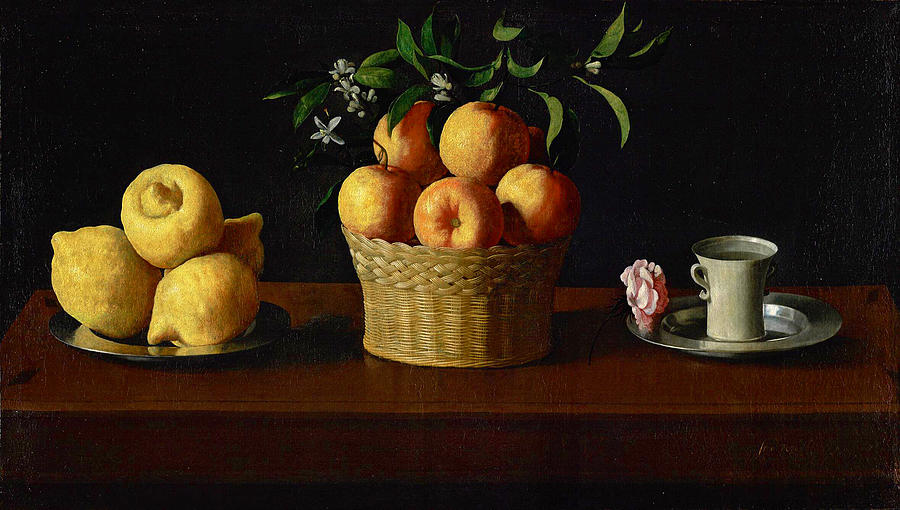
Francisco de Zurbaran’s “Still Life” from 1633, often known as “Still Life with Lemons, Oranges and a Rose,” is one of the quiet masterpieces of the Spanish Baroque. At first glance it seems disarmingly simple. Three groups of objects sit on a wooden table against a deep black background. On the left is a pile of thick skinned lemons on a metal plate. In the center a woven basket brims with oranges and leafy branches dotted with white blossoms. On the right a silver saucer supports a small cup beside a single pale pink rose.
Nothing happens in the conventional sense. There are no figures, no narrative and no landscape. Yet the painting feels charged with presence. The objects appear almost hyper real, lit by a calm, focused light that cuts through the darkness and gives them a sculptural solidity. The silence of the scene invites prolonged looking. As the eye travels from lemons to oranges to cup and flower, the painting slowly reveals itself as both a celebration of everyday abundance and a meditative image infused with spiritual meaning.
Composition and Overall Structure
Zurbaran structures the composition with a clarity that borders on austerity. The wooden tabletop runs horizontally across the canvas, slightly above the lower edge, creating a stage that seems to project into the viewer’s space. On this stage the three still life groups are carefully spaced, each occupying its own zone yet harmonizing with the others.
The left cluster of lemons is low and compact. The central basket rises higher, forming the compositional peak, while the cup and rose on the right descend again. This creates a gentle rhythmic curve across the painting, leading the eye from one object to the next. The strict frontal arrangement and alignment of plates and basket emphasize order and stability.
Despite its apparent simplicity, the composition is finely calibrated. The empty spaces between the three groups are as important as the objects themselves. These spaces give the viewer room to breathe and heighten the sense of stillness. They also allow each element to be contemplated individually, almost as if the painting offered three small still lifes within one larger frame.
Zurbaran avoids any hint of diagonal recession or complex spatial tricks. Everything is arranged parallel to the picture plane. This creates a feeling of intimacy and immediacy. The table could almost be an altar, and the objects offerings placed upon it.
Light, Shadow and the Drama of the Dark Background
The deep black background is one of the defining features of the painting. It is not a neutral void but an active element. By eliminating any surrounding context, Zurbaran isolates the objects and makes them stand out with almost theatrical intensity. The darkness also carries connotations of mystery, suggesting a space beyond ordinary perception.
A single, steady light source falls from the left, bathing the lemons and gradually diminishing as it moves toward the right. The lemons are therefore the brightest objects, their knobbly skins catching the strongest illumination. The basket and oranges occupy a middle zone where light and shadow intermingle. The cup and rose are lit more delicately, their highlights smaller and cooler.
This progression of light creates a subtle narrative across the surface. The eye is first arrested by the sharp brightness of the lemons, then moves through the warm glow of the basket to the more subdued, reflective light on the metal saucer and cup. The black background absorbs the shadows, reinforcing the three dimensional presence of the objects and imparting a quiet drama to the scene.
Zurbaran’s mastery of chiaroscuro turns even the tiniest shadow into something expressive. The dark crevices between the fruit, the shadow cast by the basket, and the soft gloom beneath the table edge all contribute to the painting’s contemplative mood.
The Lemons: Weight, Texture and Imperfect Beauty
On the left sit four large lemons, arranged almost like a small monument. Their thick, bumpy rind is rendered with loving attention. We see small scars, irregularities and discolorations that mark them as real fruit, not idealized symbols. The way the light grazes their surfaces reveals the porous texture of the skin. Highlights sparkle on the highest points while the hollows sink into golden shadow.
These lemons are placed on a simple metal plate, slightly tilted so we can see its edge and reflective surface. The plate mirrors a faint echo of the fruit’s color, anchoring the group on the table. The lemons lean against one another, suggesting weight and gravity. They are not arranged like decoration but piled as if just set down by human hands.
The imperfect forms, with their knots and bulges, contribute to the painting’s realism and to its understated poetry. Zurbaran seems to invite viewers to appreciate beauty in the ordinary and flawed. The lemons also introduce the sharpest color note in the painting, their yellow standing out against the dark background and the more muted tones of the basket and cup.
The Basket of Oranges and Blossoms
At the center of the painting sits a woven basket filled with oranges and sprigs of orange tree branches bearing leaves and white flowers. This middle group forms the heart of the composition. The basket itself is beautifully painted, each strand of straw described with tiny strokes that capture the subtle play of light across its interlaced pattern.
The oranges, round and full, press against each other and slightly against the rim of the basket. Their surfaces are smoother than the lemons but still marked by small irregularities. The light catches them in broad highlights, giving them an almost glowing presence. The oranges, being warmer in tone and centrally placed, create a feeling of abundance and quiet richness.
Perhaps the most lyrical detail in the entire work is the foliage and blossoms that rise above the fruit. The green leaves curve and twist, introducing graceful diagonals that gently break the strict horizontals of the table and basket. Among them, small white flowers open like stars. These blossoms, painted with exquisite delicacy, add a touch of freshness and life that contrasts with the heavy materiality of the table and metal plates.
The combination of fruit and flowers suggests a cycle of growth, from bloom to ripened harvest. It also gives the still life a faintly aromatic presence. The viewer can almost imagine the scent of citrus and blossoms filling the dark room.
The Silver Cup and the Rose
On the right side of the table is a silver saucer holding a small, elegant cup. Beside the saucer lies a single pinkish white rose, its stem trailing gently across the tabletop. This grouping is more refined and delicate than the robust citrus on the left and center.
The cup, with its slender stem and ring handles, is painted with great sensitivity to metal’s reflective qualities. Light glints on its rim and along the curve of its body, while darker tones pick out its interior and cast shadow. The saucer mirrors these highlights and also reflects a faint silhouette of the cup and the surrounding darkness. Zurbaran captures the cool sheen of silver without resorting to ostentation.
The rose introduces a different kind of beauty. Its petals, softly curled and tinged with pink, seem almost fragile compared to the sturdy fruit and solid cup. It lies on its side, as if it has just been placed there or has fallen from a bouquet. The flower’s placement near the cup creates a subtle dialogue between natural and crafted beauty, between the transient life of the blossom and the enduring solidity of metal.
Together, the cup and rose shift the tone of the painting from rustic abundance to refined contemplation. They suggest hospitality, ritual and perhaps a hint of luxury, yet they remain modest within the overall simplicity of the scene.
Color, Surface and Sensory Experience
The color scheme of “Still Life” is restrained but rich. Warm yellows and oranges dominate, balanced by the cooler grays of the metal and the gentle green of leaves. The dark background intensifies these tones, making them appear more saturated. Zurbaran avoids flashy contrasts, preferring harmonies that feel calm and balanced.
Texture plays a major role in the painting’s appeal. The rough skin of the lemons, the smoother peel of the oranges, the fine weave of the basket, the polished surfaces of the metal plates and cup, the soft petals of the rose and the matte grain of the wood all invite imaginary touch. Each material is described with a different handling of paint, from the stippled highlights on the fruit to the smooth, almost glassy strokes on the silver.
These tactile qualities engage the senses beyond sight. Viewers can almost feel the coolness of the cup, the weight of a lemon in the hand, the slight prick of a leaf’s edge. The painting becomes an exercise in sensory imagination, transforming a simple tabletop into a world of tangible experiences.
Symbolic and Spiritual Interpretations
Although the painting functions superbly as a realistic still life, many scholars have recognized a deeper layer of meaning. Seventeenth century Spanish viewers were immersed in a culture where everyday objects often carried religious symbolism, especially in art commissioned for monasteries or churches.
The trio of lemon group, basket of oranges and blossoms, and cup with rose may allude to aspects of Christian devotion. Citrus fruits and blossoms were associated with purity and the Virgin Mary. The rose, particularly white or pale pink, was also a Marian symbol and could represent charity or spiritual love. The silver cup might evoke the Eucharistic chalice, while the dark background and altar like table suggest a liturgical setting.
In this reading, the painting ceases to be merely a display of fruit and becomes a quiet meditation on the mysteries of faith. The untouched, pristine objects might symbolize spiritual virtues laid out for contemplation. The progression from robust lemons to fragrant blossoming oranges to the refined vessel and delicate rose could be seen as a journey from earthly sustenance to spiritual nourishment and divine love.
Even if one does not accept a specific iconographic program, the painting’s solemn stillness and reverent attention to humble things encourage a contemplative attitude. Zurbaran’s still life hints that the divine can be encountered in the simplest elements of daily life when they are seen with a meditative gaze.
Zurbaran’s Bodegones and Artistic Context
“Still Life” belongs to the Spanish tradition of bodegón painting, a genre that depicts pantry items, kitchen utensils and simple meals with intense realism. While Italian and Dutch still lifes often revel in elaborate arrangements and symbolic variety, Spanish bodegones tend to be austere and focused, aligning with the spiritual seriousness of the Counter Reformation.
Zurbaran, primarily known for his religious scenes and monastic figures, brought the same meditative sensibility to his still lifes. He painted only a few, but they are now regarded as some of the finest examples of the genre. In “Still Life” his approach is distinct from that of contemporaries like Velazquez. There is no casual scattering of objects, no suggestion of a human presence just outside the frame. Instead, everything is meticulously placed and illuminated, as if arranged for an act of contemplation.
The painting also shows the influence of Caravaggio’s tenebrism in its strong contrasts and dark background. Yet Zurbaran tempers this drama with a quieter, more inward mood. The objects are not thrust aggressively into our space but presented with dignified calm.
Viewed within the broader history of still life, the work marks a turning point where the genre moves from mere demonstration of skill to a vehicle for profound reflection on matter and spirit.
Emotional Atmosphere and Modern Reception
Despite the absence of human figures, “Still Life” has a distinct emotional tone. It is serene but not cold, simple yet far from empty. The measured spacing of objects, the soft light and the enveloping darkness combine to create an atmosphere of quiet concentration. The viewer feels almost as if they have entered a silent chapel where humble gifts are laid upon a wooden altar.
Modern audiences often respond to the painting’s minimalism, seeing in it an early anticipation of later aesthetic movements that prize simplicity and reduction. Its focus on a few carefully chosen objects resonates with contemporary sensibilities that value mindfulness and appreciation of everyday things.
At the same time, the painting remains rooted in the Baroque world, with its love of strong contrasts and deep spirituality. This fusion of old and modern appeals has helped make Zurbaran’s still life one of the most admired and frequently reproduced works of Spanish art. It speaks simultaneously to the senses, the intellect and the heart.
Conclusion
Francisco de Zurbaran’s “Still Life” of 1633 may at first seem like a modest arrangement of lemons, oranges, a cup and a rose, but under the painter’s hand these objects become vehicles of contemplation. Through a disciplined composition, dramatic use of light and shadow, meticulous description of textures and a restrained but resonant color palette, Zurbaran transforms a simple tabletop into a space of quiet revelation.
The painting invites viewers to linger, to move slowly from one group of objects to another, and to discover both sensual pleasure and spiritual suggestion in their forms. Whether read as a meditation on abundance and purity, as a veiled reference to Marian devotion and the Eucharist, or simply as a masterpiece of still life, it continues to captivate and reward close attention.
By honoring humble things with such reverence, Zurbaran reminds us that beauty and meaning can be found in the most ordinary corners of the world when they are seen in the right light.