Image source: wikiart.org
Historical Context And Why This Figure Study Matters
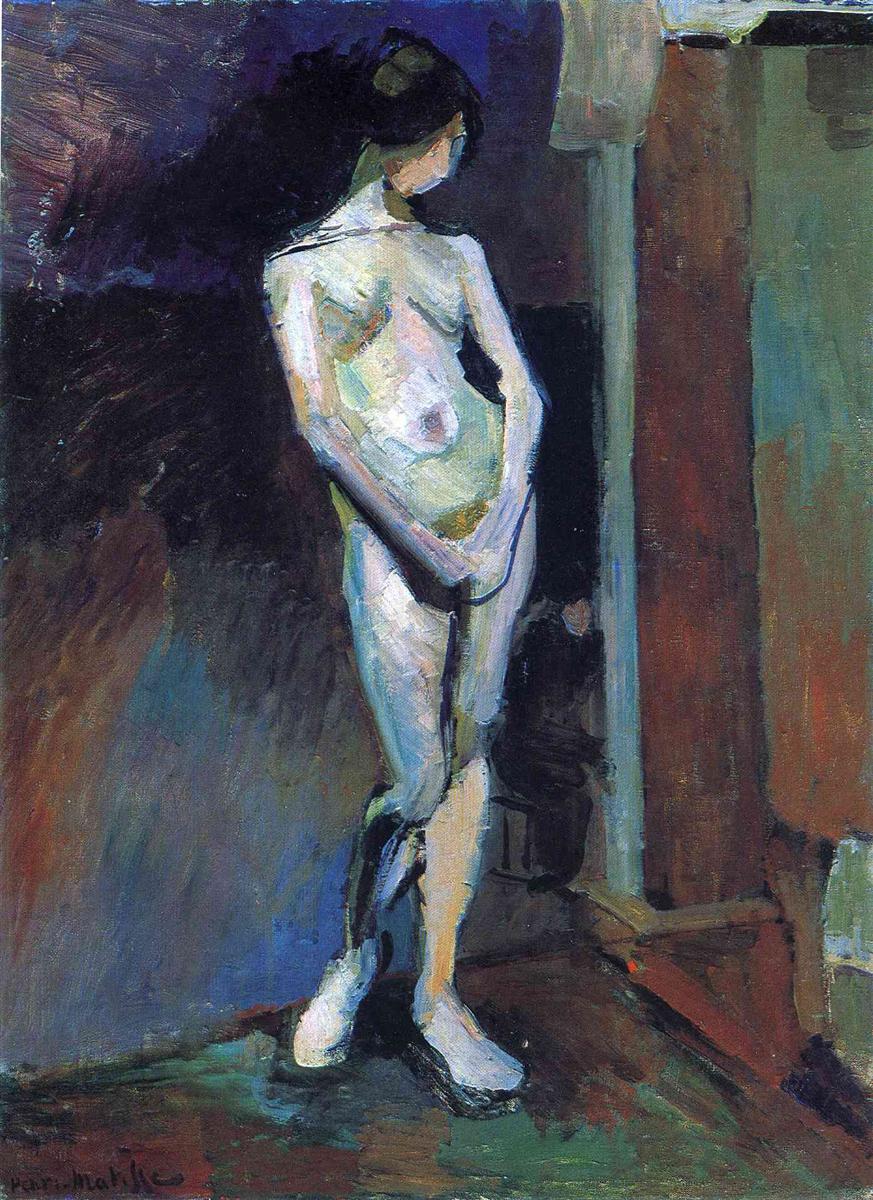
“Standing Model” was painted in 1901, the threshold year when Henri Matisse left behind academic finish and began to construct pictures from tuned color, simplified planes, and a frank, memorable touch. He had learned the rigors of life drawing in Paris and studied how Cézanne built form with adjacent patches rather than soft shading. He was equally attentive to the Nabis’ decorative flattening and to the expressive speed of Van Gogh’s brush. The studio nude was the ideal laboratory for this transition: stable, concentrated, and free of anecdote. In this canvas Matisse tests how far chromatic temperature, edge-by-adjacency, and a shallow, designed space can carry a fully convincing human presence. The painting stands as a compact rehearsal for the Fauvist audacity that would soon define him.
First Look: A Body Emerging From Studio Air
The composition presents a nude figure at three-quarter view, weight settled on one leg, head turned aside, hands loosely joined at the pelvis. The model is lit from above and from the right, which cools one side and warms the other. Behind her, a broad field of dark plum and blue yields to a band of ochre and olive as the wall turns. A pale vertical abutment at the extreme right—perhaps a door jamb or screen—acts as a pillar that pushes the figure into prominence. The floor slopes forward with green and umber notes that catch reflected light from the body. Features are abbreviated, but posture is exact; the body is constructed by patches of cool and warm that declare volume without theatrical shadow. The first sensation is not of finely modeled anatomy but of a person held in air by the simple, truthful meeting of colors.
Composition And The Poise Of The Pose
The design depends on a balance of diagonals and uprights. The figure’s long axis tips gently to the left, countered by the vertical pillar at right. The supporting leg forms a firm column; the free leg crosses it at the ankle, softening the stance and giving the body a graceful S-curve. The head’s turn away from the viewer shifts the center of gravity and allows light to fall across the torso like a sash. Cropping is close but breathable. There is enough ground at the feet to secure weight, and enough dark above the shoulders to keep the figure from pressing against the top edge. A staged chair, drapery, or prop is absent; the room is reduced to zones that carry the geometry of a stage without cluttering its meaning. The result is a poised asymmetry that reads at a glance and rewards sustained looking.
Color Architecture And The Prelude To Fauvism
The figure is built from a restrained yet vivid chord: milky whites and pale violets on the lit planes; cool blue-greens and bluish grays on the turning surfaces; small, decisive oranges and siennas in warm spots at shoulder, hip, and breast; and black used sparingly to sharpen a contour or draw a joint. Surrounding those notes, the studio is transcribed as temperature fields—plum and ultramarine to the left of the body, olive and russet to the right—so that the nude is held between complementary climates rather than outlined in charcoal. This architecture anticipates Matisse’s Fauvist method. Color is not an afterthought that fills drawn shapes; it is the very scaffolding of the figure, the thing that makes the body stand.
Modeling With Temperature Instead Of Academic Shadow
Traditional life painting often builds flesh with a tonal pyramid that runs from highlight to halftone to shadow. Matisse chooses a different grammar. He models with temperature shifts that substitute for deep chiaroscuro. Where a plane turns toward the light, the mixture warms and pales; where it retreats, it cools into blue or violet. At the shin and the outer thigh, a cool band describes a recession as surely as a dark cast shadow would, yet the painting remains airy and unified. This is particularly clear in the abdomen and ribcage: a cool gray-violet hollows the flank, a milky warm note swells the sternum, and a tiny cool touch under the breast locks the volume. The body reads convincingly because temperatures are tuned, not because a spotlight has been simulated.
Drawing Through Abutment Rather Than Outline
Edges throughout the painting arise where one color abuts another. The outer contour of the torso is written by the meeting of pale flesh and a plum-black wall; the inner edges—at the hip, the groin, the abdomen—are expressed as temperature changes rather than as inked lines. A few strong accents do appear, such as the dark seam under the arching foot or a trimmed stroke to fix the jaw, but they are quickly absorbed back into surrounding color. This method keeps the picture a single, vibrating surface. Instead of a figure pasted on a background, we encounter a body precipitated from the same atmosphere that fills the room.
Brushwork And The Time Of Looking
Matisse varies touch to match matter. The background is laid with broader, scumbled strokes that breathe and admit remnants of the ground color. The floor gathers longer, horizontal pulls mixed with small, directional notes that suggest the plane’s slope. Across the body, strokes are shorter and more deliberate; they follow the directional logic of the form—vertical along the shin, oblique around the hip, circular at the shoulder. Paint thickens at anatomical hinges such as the knee and ankle, catching real light to reinforce the optical turning of color. Nothing is fussed; the brush records decision and speed. We feel the painter stepping back to test balance, then returning to lay a single patch that makes the posture cohere.
Light, Studio Space, And The Drama Of Edges
The illumination is a steady studio light rather than a theatrical beam. There is a basin of coolness to the left and a zone of warm reflection at the right wall that echoes in the flesh. Edges sharpen or soften according to their role. At the left flank, contour is crisp so the body emerges strongly from the dark. At the right, where the figure fades into the olive field, the edge relaxes, allowing air to insinuate itself between body and wall. The most expressive edge may be at the neck and cheek, where a quick, warm stroke meets a cool dark, producing the sensation of flesh turning away even though the features are barely stated. The drama of the canvas lives in these edges, not in facial description.
Space Compressed Into A Decorative Field
Depth exists—there is floor before and wall behind—but recession is mild. The floor tilts like a thin carpet; the wall reads as stacked planes; the pillar at right operates as a flat, pale strip pressed to the surface. This compression is intentional. It lets the painting function first as a designed harmony of shapes and colors and only second as a window. Matisse will hold to this decorative discipline even in his most naturalistic works; the surface must remain sovereign so that balance can be built and preserved.
Anatomy, Proportion, And The Ethics Of Presence
Although details are abbreviated, proportion is carefully observed. The pelvis is sturdy, the ribcage buoyant, the shoulder girdle convincing in its width and slope. The hands, almost clasped, are simplified into a single pale mass that pulls the composition downward and steadies the twisting torso. Feet are firm and grounded; the left insists on its weight by being slightly larger and brighter than the right. The head turns away, refusing portrait likeness and preventing narrative from overtaking form. The result is an unsentimental dignity. The model is not eroticized or idealized; she is presented with the respect of accurate weight and structure, a person who stands because the world of the painting holds her.
The Studio As Abstract Construction
The room’s elements are treated as colored planes rather than as furniture or architecture. The pillar is a pale vertical wedge; the wall at right is a stack of olive and russet; the left field is a deep, breathing plum and blue. Together they act as counterweights that keep the figure in place. This conversion of place into abstract construction owes something to the Nabis and to Cézanne’s insistence that a painting must be remade, not copied. In “Standing Model” you can sense how later Matisse interiors will operate: simplified shapes, long planes of color, and a figure that anchors a decorative field.
Dialogues With Predecessors And Peers
From Cézanne comes the method of constructing volumes with adjacent patches that follow the motif’s logic, and the tilted plane that refuses rigid perspective. From Gauguin and the Nabis Matisse borrows the courage to simplify silhouettes and to let non-local color carry truth. From Van Gogh he translates the idea that brush direction, not just value, can energize form. Yet the temperament in this painting is already unmistakably Matisse’s. He seeks equilibrium and calm, even at high contrast. Where Van Gogh would ignite the dark with agitation, Matisse quiets it into a breathable field. Where Gauguin would allegorize the nude, Matisse declines narrative. Where Cézanne tightens structure toward tension, Matisse relaxes into poise.
Materiality, Pigments, And The Skin Of Paint
Turn-of-the-century pigments make the chord possible: cobalt and ultramarine for the cool planes, earth umbers and siennas for warm accents, viridian tinged into the floor, alizarin or madder for the plum field, and lead white to build the milky highlights that catch actual light. Matisse alternates lean scumbles with thicker, body-color strokes so that some areas absorb light while others return it. The weave of the canvas is allowed to show, especially in thinner passages, where physical light mingles with painted light and deepens the sensation of space without literal perspective.
Rhythm And The Viewer’s Path Through The Picture
The painting invites a looped viewing. Many eyes enter at the bright foot planted in green, climb the cool axis of the shin, cross the knee into the warm sash of thigh and hip, rise along the pale torso, pause at the warm cheek turning away, and then slide down the dark left flank back to the foot. Each circuit reveals confirmations: a violet echo at the abdomen that answers the plum wall, a warm seam at the shoulder that corresponds to the ochre pillar, a green reflection near the ankle that ties ground to body. The route is the rhythm of a studio session transformed into a durable choreography for the viewer.
Abbreviation And The Courage To Omit
The painting’s freshness owes much to what Matisse leaves out. There is no etched pupil in the eye, no fingernail, no counted rib, no explicit prop. The pose is stated with the fewest possible moves that will remain true. Omission concentrates meaning and protects the picture’s balance. It also invites the viewer to collaborate, to complete the figure in imagination, which keeps the image alive long after a more detailed description would have exhausted itself.
How To Look Slowly And Profitably
Stand back first to absorb the major relations: pale body against plum and olive, vertical pillar against canted figure, green floor against warm wall. Let that chord stabilize. Move closer to watch edges form by contact rather than by line, and to feel how small temperature flips carry the turn of a limb. Notice the variety of speeds in the paint—the long sweep across the background, the compact touches around the ankle, the weighty patch that sets the knee. Step back again until the figure breathes inside the room as one whole. This oscillation between near and far replicates the painter’s own tuning process and reveals the picture’s structural harmony.
Place Within Matisse’s 1901 Suite
Compared with the landscapes and still lifes of the same year, “Standing Model” is cooler in chroma but identical in grammar. Color creates structure; black acts as a living neighbor rather than a void; space is shallow and designed; omission clarifies. Seen beside “Faith, the Model,” it shares the reliance on temperature modeling and the calligraphic economy of edges, though it is quieter in heat and more concentrated in verticality. The figure studies of 1901 are the bridge to Matisse’s Fauvist figures: once the painter proves to himself that color alone can carry a body, he will push chroma higher and simplification further without losing legibility.
Why “Standing Model” Endures
The canvas endures because it distills a modern ethos with humility and authority. It shows that a nude can be truthful without fetish detail, dignified without theatrics, and structurally sound when built from balanced color relations. It replaces academic shadow with temperature, replaces outline with adjacency, and replaces descriptive furniture with abstract planes that carry the emotional weight of a room. In a single standing figure, Matisse discovers a grammar that will support his greatest interiors and portrait inventions. The model stands; the painting stands with her.