Image source: wikiart.org
First Look: A Figure Built From Bursts of Color
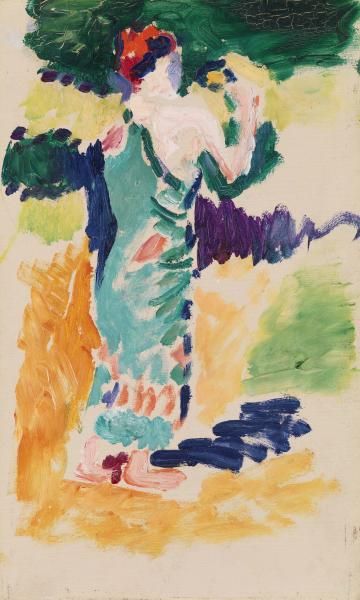
At first glance, “Standing Figure” presents a slender body rising like a flame through a field of light. The figure is turned three-quarters, stepping forward, one arm raised to the head as if adjusting hair or shielding the eyes. What arrests the eye is not anatomical modeling but a construction of separate, rich strokes: teal, viridian, ultramarine, coral, violet, and warm ocher. Against an uncluttered pale ground, these patches do the drawing. There is no continuous outline binding the silhouette; edges happen where one temperature collides with another. Even facial detail is abbreviated to a few quick planes that nevertheless locate the head and turn it in space. The result is not a descriptive likeness but a distilled sensation of a person outdoors, moving, sunlit, alive.
The 1906 Moment: From Fauvist Heat to Open Air
Painted in 1906, the work belongs to Matisse’s crucial years refining the breakthroughs that erupted in Collioure in 1905. The previous summer had taught him that saturated color could replace chiaroscuro as the engine of structure. By 1906 he often thinned the paint, left portions of the ground to breathe, and used shorter, more directional touches—still high in chroma but freer, more open. “Standing Figure” reads like a rehearsal for larger pastoral scenes from the same period: a solitary actor explored before the ensemble enters. The canvas is not a finished portrait in the conventional sense; it is an exploration of how little information is required for the eye to assemble a human body when color is allowed to carry form and light.
Subject and Pose: A Body Mid-Gesture
Though the features are spare, the pose is legible and expressive. Weight rests on one foot; the other foot advances; the raised arm suggests a casual adjustment or greeting. The body is not frozen but caught in the hinge between one step and the next. The garment—a turquoise sheath banded with pale mint and trailed by warm ocher—clings close, so the figure is felt as volume rather than drapery. The head is capped by a reddish accent that could be a scarf or flower; this small hot note becomes a visual metronome, picking up the warm marks at ankle and along the left margin.
Format and Composition: Vertical Energy in a Narrow Field
The panel’s tall, narrow proportions amplify the body’s ascent. Matisse pushes the figure nearly from bottom to top, leaving only breath at the extremities so the movement is not cramped. A dense green crown above the head functions like a canopy or a tree’s low branch, giving the raised hand a destination and tightening the composition. A vertical violet swath crosses the middle ground like a shadow cast by foliage, while ocher and pale green patches stake out the earth and air. This architecture is simple—figure, canopy, ground—yet perfectly tuned. The vertical march is countered by diagonal accents at the feet and a lateral band of purple, preventing the eye from shooting straight up and out of the frame.
Color Architecture: Warm–Cool Seams That Do the Drawing
The figure is largely cool—teal, turquoise, mint—trimmed with hot punctuation. Matisse relies on the reciprocity of complements to make edges and volumes. Where a mint band meets a note of coral, the hip turns; where the turquoise garment touches a navy shadow, the leg steps forward; where a cool shoulder grazes a warm ocher field, the arm detaches from the torso. Because the pigments are laid cleanly rather than blended into mud, each seam is both boundary and energy source. The eye reads these temperature clashes as light falling across planes. Shadows are blue or violet; highlights are pale versions of local hue; brown is almost entirely absent. The picture proves that you can model a body without descending the value scale into mud—temperature and placement are enough.
Brushwork and Facture: Direction as Description
The surface is a ledger of decisive, directional strokes. Long vertical passes run down the garment, echoing the body’s length; short cross-strokes notch the waist and knee; quick, fanning touches at the hem suggest fluttering fabric. In the ground, strokes are broader and more horizontal, spreading like dry light on sand. The canopy above the head is built from denser, overlapping greens whose horizontal drag pushes back against the body’s climb. This orchestrated variety makes the painting readable at a glance: direction maps form. Even the violet band behind the figure is applied in a zigzag that feels like the shadow’s undulation rather than a flat strip of color. Looking becomes the act of tracking the brushed paths the painter’s hand took across the surface.
Light Without Chiaroscuro: An Outdoor Climate in Color
Instead of a single directional beam, the painting suggests a broad outdoor light. The pale ground behaves like glare; cool shadows pool where the figure’s mass turns away; warm reflected light lifts the left edge of the dress and the feet. The raised arm, painted with quick pinks and pale creams, reads as sunlit skin in front of a darker canopy without any heavy contour. Across the midsection, small coral notes interrupt the cool field like sunlight filtered through leaves. This is an optic borrowed from Impressionism but condensed through Fauvist discipline: not a thousand broken touches, but a handful of bold ones placed where the perception pivots.
Space and Background: Stage Without Scenery
Matisse keeps the setting deliberately schematic. A block of ocher stands for ground; a wash of pale green for sun-hit grass; a dense strip of dark green for foliage; a violet shadow for cool depth. These few ingredients build a believable, shallow stage that lets color relations shine. The space never collapses into flatness because overlaps are clear: canopy sits behind hand; hand sits before violet shadow; violet shadow crosses behind the calves; feet rest on ocher. Distance is measured by value steps and temperature rather than linear perspective, so the whole retains decorative unity while remaining spatially convincing.
The Role of Reserve: Letting the Ground Be Light
Large passages of the pale support are left untouched. Rather than feeling unfinished, these reserves are active participants that serve as high-value light. They also keep the palette clean, because each stroke is surrounded by air instead of smeared into an underlayer. This use of reserve is a lesson that echoes through Matisse’s later interiors and, eventually, the paper cut-outs: whiteness is not merely absence; it is a luminous field that can be composed with as deliberately as any pigment.
Gesture and the Idea of the Arabesque
Matisse often spoke of the “arabesque,” a unifying, flowing line that organizes a picture’s rhythms. In “Standing Figure,” the arabesque is embodied in the body’s S-curve. From the heel, a cool stroke snakes up the calf, rides the hip, narrows at the waist, and spills into the lifted arm. Around this curve, the painter arranges counter-flows—the horizontal thrust of the violet band, the oblique ocher to the left, the dark canopy’s shelf—so the movement is felt rather than diagrammed. The figure’s lilt is less dance step than breath; it animates the entire field.
Relationship to Contemporary Works and to Tradition
The painting converses with Matisse’s pastoral scenes from 1905–1906, where nude or lightly draped bodies inhabit an Arcadian grove. Here, the solitary figure anticipates those ensembles, bringing the problem of body-in-landscape down to essentials. It also acknowledges Cézanne’s lesson of constructing form with color planes while refusing Cézanne’s denser, earthier palette. One might sense an echo of classical draped figures in the museum, but any archaeological specificity is dissolved by Fauvist clarity. The figure is modern because it is created by relationships that belong to the canvas rather than to a model posed under academic light.
Abstraction’s Threshold: How Much Is Enough
“Standing Figure” hovers near abstraction without crossing into pattern for its own sake. Remove the head and foot in your imagination, and the painting remains a compelling arrangement of turquoise, violet, green, and ocher. But the few anatomical cues that remain—heels, elbow, tilt of scalp—are perfectly placed to snap the colors into legibility. This is the painting’s daring: it trusts the viewer’s capacity to assemble a figure from minimal signs. It also shows Matisse testing a question that will preoccupy him for decades: how few marks can deliver maximum clarity and pleasure?
Material Presence and Scale
Close looking reveals ridges left by the brush as paint is dragged, especially in denser dark greens and blues. These ridges catch real light and subtly echo the tactile qualities of cloth and foliage. In the paler zones, paint is thin enough that the weave of the ground is visible. Scale matters: the relatively small format heightens the sense of speed and experiment. The work reads as the outcome of a concentrated session in front of a model or a memory, not a studio marathon, which gives it the vitality of a live sketch with the authority of an oil.
How to Look: A Path the Painting Invites
Begin at the reddish accent in the hair and feel how it sends you down the raised arm. Follow the cool seam at the edge of the biceps to the elbow; ride the turquoise band along the waist, where small coral intrusions warm the cool; drop to the hem, where alternating mint and navy launch a lateral hop toward the purple shadow; swing across that shadow into the ocher field and then back up into the canopy. Each passage previews the next with a rhyme of color or direction. After a few circuits, the figure’s motion becomes your motion; the painting leads, and you follow.
Psychology and Mood Without a Face
There is no detailed expression, yet the picture has a distinct emotional climate. The palette is cheerful without being sugary, the pose relaxed but alert. The raised hand suggests a moment’s pause—an intake of air, a glance toward light—rather than strain. The overall effect is buoyant calm, an outdoor ease that Matisse prized as an ethical stance for art: clarity and pleasure achieved without melodrama. The title’s plainness, “Standing Figure,” reinforces this direction away from anecdote. The painting is about the experience of seeing a person in light, not a story recounted in paint.
Lessons for Painters and Designers
The canvas is a primer in building form by adjacency. Edges do not need to be drawn; they can be inferred where temperatures meet. Shadows need not be black or brown; they can be cool relatives of the local color. A few passages of dense dark can anchor large airy fields. Reserve is a tool, not a gap to be covered. Directional brushwork can communicate volume as effectively as detailed modeling. And perhaps most importantly, a composition can be held together by one coherent rhythm—the arabesque—that organizes both figure and ground.
Legacy and Anticipations
The strategies rehearsed here will echo across Matisse’s oeuvre. The use of high-key complements to build structure blossoms in the interiors of the Nice period. The reliance on reserve flowers into the cut-outs, where color and contour are literally one material. The balance of decorative flatness and bodily presence culminates in works like “The Red Studio,” where space is an orchestration of hue. “Standing Figure” is a modest-sized but pivotal step on that path: a proof that the human body—painting’s oldest subject—could be reinvented by a modern color grammar.
Conclusion: A Body Held Together by Color’s Intelligence
“Standing Figure” is neither an academic study nor a mere sketch. It is a compact manifesto in which a handful of clean pigments, a few confident strokes, and carefully preserved light create a persuasive human presence. By trusting warm–cool seams to do the drawing, directional marks to explain volume, and reserve to supply illumination, Matisse turns a narrow panel into a stage where movement, air, and clarity unfold. More than a century later, the painting still instructs the eye and steadies the mind: a person in sunlight built not from shadow, but from color thinking aloud.